On This Page
Description
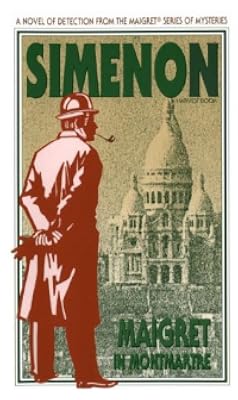
"He opened the door for her and watched her walk away down the huge corridor, then hesitate at the top of the stairs. Heads turned as she passed. You sensed she came from a different world, the world of the night, and there was something almost indecent about her in the harsh light of a winter's day." A young cabaret dancer in a black silk dress leads Inspector Maigret into a seamy world of nightclubs, drug addiction and exploitation on the streets of Montmartre.Tags
Recommendations



























Member Reviews
A drunk exotic dancer working in an American-style burlesque show tips off police that she’s overheard a plot to kill a duchess for her jewelry. The police give the woman (who goes by the stage name Arlette) such a hard time that an exhausted Arlette recants her story just so she can go home. Just a few hours later, she’s found strangled.
First published in English in 1951 and previously released in English under the titles of Maigret and the Strangled Stripper, Maigret at Montmatre and Inspector Maigret and the Strangled Stripper, Georges Simenon’s 36th Maigret novel will strike some readers 70 years later as dated with its harsh portrayal of gay men and women; however, I chalked it up to the era. and enjoyed the mystery very show more much. How grateful I am that Penguin Books and Audible Studios are gradually re-releasing every one of the Maigret novels! show less
First published in English in 1951 and previously released in English under the titles of Maigret and the Strangled Stripper, Maigret at Montmatre and Inspector Maigret and the Strangled Stripper, Georges Simenon’s 36th Maigret novel will strike some readers 70 years later as dated with its harsh portrayal of gay men and women; however, I chalked it up to the era. and enjoyed the mystery very show more much. How grateful I am that Penguin Books and Audible Studios are gradually re-releasing every one of the Maigret novels! show less
This is the third of the five Maigret books published in 1951 that I have read. Maigret is up to his neck in sleaze and seems to be quite enjoying it. The novel starts with Arlette a striptease dancer stumbling into a police station in Montmartre Paris at 5 am claiming that the countess is going to be murdered. She is drunk and fairly incoherent and really only gets the time of day because one of the police detectives is an admirer. Later that day Arlette has been murdered and Maigret is called in to examine the crime scene. He immediately takes charge and launches an enquiry to discover who she meant by the countess.
Picratt's is the name of the small nightclub where Arlette performed and that is where Maigret heads for, to interview show more the owner and the other artists. He finds a club that is at the end of the line, meaning that people looking for entertainment in that pert of Paris end up there, when there is no other place to go. The owner Fred manages it with the help of his wife Rose and Maigret soon rules them out of the investigation, but reading through the notes of Arlette's interview he is certain that there is a connection between the club and the murders. Maigret spends most of his time interviewing witnesses at his Headquarters or ensconced in Picratts where he can always get another drink and watch the show. Georges Simenon's story takes on the usual procedure of Maigret skilfully breaking down suspects in the interview room, handing them over to Sergeant Torrence when he wants them roughed up. However a feature of this novel is the workings of the small nightclub, sleazy it might be, but it is a business like any other. There is a telephone inside the club and so Maigret finds it convenable to sequester himself inside while his team and the local police trudge around the wet wintry streets of Paris.
There are some good backstory's to the main murder enquiry and it is all over after 150 pages when Maigret finally rouses himself from his chair in the night club. 3.5 stars. show less
Picratt's is the name of the small nightclub where Arlette performed and that is where Maigret heads for, to interview show more the owner and the other artists. He finds a club that is at the end of the line, meaning that people looking for entertainment in that pert of Paris end up there, when there is no other place to go. The owner Fred manages it with the help of his wife Rose and Maigret soon rules them out of the investigation, but reading through the notes of Arlette's interview he is certain that there is a connection between the club and the murders. Maigret spends most of his time interviewing witnesses at his Headquarters or ensconced in Picratts where he can always get another drink and watch the show. Georges Simenon's story takes on the usual procedure of Maigret skilfully breaking down suspects in the interview room, handing them over to Sergeant Torrence when he wants them roughed up. However a feature of this novel is the workings of the small nightclub, sleazy it might be, but it is a business like any other. There is a telephone inside the club and so Maigret finds it convenable to sequester himself inside while his team and the local police trudge around the wet wintry streets of Paris.
There are some good backstory's to the main murder enquiry and it is all over after 150 pages when Maigret finally rouses himself from his chair in the night club. 3.5 stars. show less
It’s 4:30 am and Arlette enters the police station to make a statement regarding two men she overheard in the afterhours club she works in. They are planning a robbery and a murder. It’s urgent she speaks with someone. She is stalled and winds up falling asleep waiting. When she wakes up she is hesitant to talk about it.
Arlette tells of the Contessa and her jewels and a man names Oscar. She is vague with her information, blaming it on her drinking. Inspector Maigret comes upon the discussion and becomes interested.
Later, when she is found strangled in her room and then a Contessa is found strangled in the same manner, Maigret finds himself investigating in the demimonde of striptease artists, morphine addicts and the afterhours show more world of Monmartre.
Maigret follows up on any and all clues with considerable attention to the smallest detail. He is methodical in his work.
Reading Simenon is like working a jigsaw puzzle…many pieces that will only fit together one way. show less
Arlette tells of the Contessa and her jewels and a man names Oscar. She is vague with her information, blaming it on her drinking. Inspector Maigret comes upon the discussion and becomes interested.
Later, when she is found strangled in her room and then a Contessa is found strangled in the same manner, Maigret finds himself investigating in the demimonde of striptease artists, morphine addicts and the afterhours show more world of Monmartre.
Maigret follows up on any and all clues with considerable attention to the smallest detail. He is methodical in his work.
Reading Simenon is like working a jigsaw puzzle…many pieces that will only fit together one way. show less
I found it difficult to rate this.
I finished it. It was well-written and translated.
But ... i found my self continuing, not because it was gripping, but because I just wanted to get to the end. I didn’t find any of the characters engaged my interest or sympathy. It was fairly grim, with way too much homophobia for today’s sensibilities. I know it dates from an earlier period, and another country, and presumably reflects how things were then, but it did not make for enjoyable reading.
The best I can give it is a reluctant 3.5 stars. Certainly not a book I will re-read.
I finished it. It was well-written and translated.
But ... i found my self continuing, not because it was gripping, but because I just wanted to get to the end. I didn’t find any of the characters engaged my interest or sympathy. It was fairly grim, with way too much homophobia for today’s sensibilities. I know it dates from an earlier period, and another country, and presumably reflects how things were then, but it did not make for enjoyable reading.
The best I can give it is a reluctant 3.5 stars. Certainly not a book I will re-read.
Another good one. I was a little bummed at his depiction of homosexuals in this book, but I do understand 1) it was 1950 and 2) he is generally pretty liberal and thoughtful in these books. Hopefully some of the language was simply because it was the characters way of thinking about his.
This story has been filmed for the BBC series with Michael Gambon and maybe the French series with Bruno Cremer also. It's a good story and has the usual curtness in its telling. The one thing is has that most others don't have is flagrant anti-gay rhetoric. If some people could get hold of it, it would be censored. I found some of those unpleasant parts painful to read. Simenon must have been much more anti-gay than most Frenchmen (I know he's Belgian, but still) of his time and even way before his time.
Good french mystery. Enjoyable, suspenseful read.
Members
- Recently Added By
Lists

Paris, City of Lights
103 works; 17 members

Reading LIst
648 works; 1 member
Author Information

1,321+ Works 62,806 Members
The prolific Belgian-born writer Georges Simenon produced hundreds of fictional works under his own name and 17 pseudonyms, in addition to more than 70 books about Inspector Maigret, long "the favorite sleuth of highbrow detective-story readers" (SR). More than 50 "Simenons" have been made into films. In addition to his mystery stories, he wrote show more what he called "hard" books, the serious psychological novels numbering well over 100. The autobiographical Pedigree, set in his native town of Liege, is perhaps his finest work. The publication of Simenon's intimate memoirs also attracted considerable attention. Simenon himself once said that he would never write a "great novel." Yet Gide called him "a great novelist, perhaps the greatest and truest novelist we have in French literature today," and Thornton Wilder (see Vol. 1) found that Simenon's narrative gift extends "to the tips of his fingers." The following are some of Simenon's novels, exclusive of the Maigret detective stories, that are in print. (Bowker Author Biography) Georges Simenon was born on February 13, 1903 in Liege, Belgium. He wrote more than 200 fiction works under 16 different pseudonyms. His first book, The Case of Peter the Lent led to 80 more of the like including the main character, Inspector Maigret. He published over 400 books that were translated into 50 different languages and sold by the millions. He also wrote psychological novels, including The Man Who Watched the Train Go By. He died on September 4, 1989 in Lausanne. (Bowker Author Biography) show less
Some Editions
Awards and Honors
Notable Lists
Series

Belongs to Publisher Series
Work Relationships
Common Knowledge
- Canonical title
- Maigret in Montmartre
- Original title
- Maigret au 'Picratts'
- Alternate titles
- Inspector Maigret and the Strangled Stripper
- Original publication date
- 1951
- People/Characters*
- Jules Maigret; Albert Lapointe; Albert Janvier; Joseph Torrence
- Important places*
- Parigi, Francia; Francia
- Related movies*
- Murder in Montmarte (1960 | IMDb); Moord op Montmartre (1964 | IMDb); Maigret au Picratt's (1985 | IMDb); Maigret et les plaisirs de la nuit (1992 | IMDb); Maigret in Montmartre (2017 | IMDb)
- First words
- For Officer Jussiaume, whose beat took him to the same places at almost exactly the same time every night, these comings and goings were such a part of his routine that he registered them unconsciously, a little as people liv... (show all)ing next to a station register the arrivals and departures of trains.
- Last words
- (Click to show. Warning: May contain spoilers.)As for Lognon, no one had remembered to relieve him of his watch, and he was still languishing on the steps in Place Constantin-Pecqueur.
- Original language*
- Francese
*Some information comes from Common Knowledge in other languages. Click "Edit" for more information.
Classifications
Statistics
- Members
- 510
- Popularity
- 58,644
- Reviews
- 21
- Rating
- (3.44)
- Languages
- 11 — Danish, Dutch, English, Finnish, French, German, Italian, Polish, Portuguese, Spanish, Swedish
- Media
- Paper, Audiobook, Ebook
- ISBNs
- 41
- ASINs
- 36