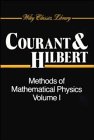
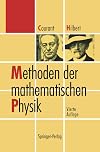
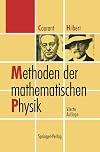
Methods of mathematical physics
by Richard Courant, David Hilbert
74 Members (4.70)
On This Page
Description
In diesem Buch spürt man noch immer die Inspiration zweier großer Mathematiker: Hilbert gilt als der letzte seiner Zunft, der in allen Gebieten der Mathematik zu Hause war. Seine grundlegend neuen Erkenntnisse prägten entscheidend die moderne Auffassung vom Wesen der Mathematik. Sein Schüler Courant ist auch heute noch anerkannt als ein ausgezeichneter Lehrer, der die Gabe hatte, schwierigste Materien verständlich darstellen zu können.Tags
Recommendations












Member Reviews
Members
- Recently Added By
Author Information

32+ Works 1,785 Members
Richard Courant was born in Lublintz, Germany, on January 8, 1888, later becoming an American citizen. He was a mathematician, researcher and teacher, specializing in variational calculus and its applications to physics, computer science, and related fields. He received his Ph.D. from the University of Gottingen, Germany, lectured at Cambridge show more University and headed the mathematics department at New York University. Courant's writings include Introduction to Calculus and Analysis (1965), written with John Fritz, Differential and Integral Calculus (1965), Methods of Mathematical Physics: Dirichlet's Principle, Conformal Mapping and Minimal Surfaces (1950), and Supersonic Flow and Shock Waves (1948). He edited a mathematics series and contributed to journals and periodicals. Courant received the Distinguished Service Award from the Mathematical Association of America in 1965. He earned the Navy Distinguished Public Service Award, the Knight-Commander's cross, and Germany's Star of the Order of Merit in 1958. Courant died on January 27, 1972. (Bowker Author Biography) show less

45+ Works 829 Members
Born in Konigsberg, Germany, David Hilbert was professor of mathematics at Gottingen from 1895 to1930. Hilbert was among the earliest adherents of Cantor's new transfinite set theory. Despite the controversy that arose over the subject, Hilbert maintained that "no one shall drive us from this paradise (of the infinite)" (Hilbert, "Uber das show more Unendliche," Mathematische Annalen [1926]). It has been said that Hilbert was the last of the great universalist mathematicians and that he was knowledgeable in every area of mathematics, making important contributions to all of them (the same has been said of Poincare). Hilbert's publications include impressive works on algebra and number theory (by applying methods of analysis he was able to solve the famous "Waring's Problem"). Hilbert also made many contributions to analysis, especially the theory of functions and integral equations, as well as mathematical physics, logic, and the foundations of mathematics. His work of 1899, Grundlagen der Geometrie, brought Hilbert's name to international prominence, because it was based on an entirely new understanding of the nature of axioms. Hilbert adopted a formalist view and stressed the significance of determining the consistency and independence of the axioms in question. In 1900 he again captured the imagination of an international audience with his famous "23 unsolved problems" of mathematics, many of which became major areas of intensive research in this century. Some of the problems remain unresolved to this day. At the end of his career, Hilbert became engrossed in the problem of providing a logically satisfactory foundation for all of mathematics. As a result, he developed a comprehensive program to establish the consistency of axiomatized systems in terms of a metamathematical proof theory. In 1925, Hilbert became ill with pernicious anemia---then an incurable disease. However, because Minot had just discovered a treatment, Hilbert lived for another 18 years. (Bowker Author Biography) show less
Series
Belongs to Publisher Series
Classifications
Statistics
- Members
- 74
- Popularity
- 427,566
- Rating
- (4.70)
- Languages
- English, German
- Media
- Paper, Ebook
- ISBNs
- 7
- ASINs
- 4