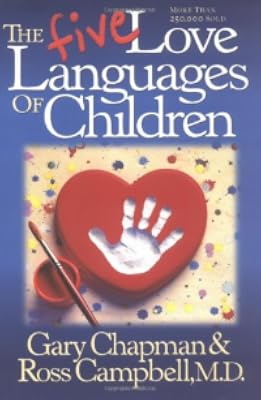
The Five Love Languages of Children
by Gary Chapman, D. Ross Campbell
On This Page
Description
Does your child speak a different language? Sometimes they wager for your attention, and other times they ignore you completely. Sometimes they are filled with gratitude and affection, and other times they seem totally indifferent. Attitude. Behavior. Development. Everything depends on the love relationship between you and your child. When children feel loved, they do their best. But how can you make sure your child feels loved?Since 1992, Dr. Gary Chapman's best-selling book The 5Love show more Languages has helped millions of couples develop stronger, more fulfilling relationships by teaching them to speak each others' love language. Each child, too, expresses and receives love through one of five different communication styles. And your love language may be totally different from that of your child. While you are doing all you can to show your child love, he may be hearing it as something completely opposite. Discover your child's primary language and learn what you can do to effectively convey unconditional feelings of respect, affection, and commitment that will resonate in your child's emotions and behavior.
. show less
Tags
Recommendations









Member Reviews
In The 5 Love Languages of Children, Dr. Gary Chapman and Dr. Ross Campbell apply Chapman's popular concept of the five love languages to the parent-child relationship. Each of the five love languages is explained and examples are given of how to use (and how not to use) a child's love language. Parents are encouraged to love their children unconditionally, which is sometimes not as easy as one would assume it to be, and to successfully express that love to a child.
I found The 5 Love Languages of Children to be insightful and challenging. The explanations of each language were informative, but the real life examples were what I found to be most helpful. There is a full chapter as well as a love language “game” at the end dedicated show more to help parents correctly identify how a child gives and receives love. At times, the book was a bit overwhelming to me as it felt like I have to do everything perfectly or I'm going to really mess my child up. I know that was not the authors' intention and maybe not everyone will get that feeling, but that's how it was for me.
The 5 Love Languages of Children is geared for children above age five. My child is only two which is a bit young for her love language to be obvious. The authors say five is usually the minimum age before a child's love language can be determined as it's prone to fluctuate in the early years. Therefore, a lot of the information was good, but not completely relevant to me. The main points I was able to take away from the book were: unconditional love is the desire of a child's heart, whether or not a child's love needs are fulfilled will affect them positively or negatively, and it's important to practice all five love languages at this point. I plan to keep The 5 Love Languages of Children and will probably revisit it in a few years.
Disclosure of Material Connection: I received this book free from the publisher. I was not required to write a positive review. The opinions I have expressed are my own. I am disclosing this in accordance with the Federal Trade Commission’s 16 CFR, Part 255: "Guides Concerning the Use of Endorsements and Testimonials in Advertising." show less
I found The 5 Love Languages of Children to be insightful and challenging. The explanations of each language were informative, but the real life examples were what I found to be most helpful. There is a full chapter as well as a love language “game” at the end dedicated show more to help parents correctly identify how a child gives and receives love. At times, the book was a bit overwhelming to me as it felt like I have to do everything perfectly or I'm going to really mess my child up. I know that was not the authors' intention and maybe not everyone will get that feeling, but that's how it was for me.
The 5 Love Languages of Children is geared for children above age five. My child is only two which is a bit young for her love language to be obvious. The authors say five is usually the minimum age before a child's love language can be determined as it's prone to fluctuate in the early years. Therefore, a lot of the information was good, but not completely relevant to me. The main points I was able to take away from the book were: unconditional love is the desire of a child's heart, whether or not a child's love needs are fulfilled will affect them positively or negatively, and it's important to practice all five love languages at this point. I plan to keep The 5 Love Languages of Children and will probably revisit it in a few years.
Disclosure of Material Connection: I received this book free from the publisher. I was not required to write a positive review. The opinions I have expressed are my own. I am disclosing this in accordance with the Federal Trade Commission’s 16 CFR, Part 255: "Guides Concerning the Use of Endorsements and Testimonials in Advertising." show less
While I found a lot of the stories about parents and their children very tragic, I enjoyed learning about how to love children in a way that will be most meaningful to them. I especially enjoyed the chapter about teaching children how to deal with their anger in an appropriate way.
If you follow the Nas Daily page on Facebook, you might have seen a video he recently posted on various love languages. Unfortunately, the source of his idea was this book which he only showed for barely a second on the screen and didn't even mention by name.
I very rarely read self-help books. I can't digest the platitudes being thrown around. One big exception to this rule has been the 'The Five Love Languages' series. Gary Chapman and Ross Campbell have worked a simple idea in such a brilliant way, I wonder why this book is not more popularly known. I have read The Five Love Languages of Children, and am now midway through the first book, 'The Five Love Languages: The Secret to Love that Lasts'. (Yeah, I know, I'm going the other way show more around: pehle bacchhe, phir patidev! show less
I very rarely read self-help books. I can't digest the platitudes being thrown around. One big exception to this rule has been the 'The Five Love Languages' series. Gary Chapman and Ross Campbell have worked a simple idea in such a brilliant way, I wonder why this book is not more popularly known. I have read The Five Love Languages of Children, and am now midway through the first book, 'The Five Love Languages: The Secret to Love that Lasts'. (Yeah, I know, I'm going the other way show more around: pehle bacchhe, phir patidev! show less
In the Evangelical tribe I grew up in, The Five Love Languages by Gary Chapman provided the idiom to talk about how each us receive and give love. Because of our unique personalities and family of origin, we each have modes of expressing love which is particularly meaningful to us. For some it words of affirmation. Others feel particularly loved when you spend quality time with them. Giving and receiving gifts is another ‘love language.’ Others feel loved through physical touch or acts of service. My love language is gift giving (so keep them coming ;P ). Chapman’s original book has helped countless people understand their own love needs and how to best express love to their mates (and other loved ones) whose ‘love language is show more often different from their own.
I don't typically read ‘spin-off’ books. The fact that there is a Love Language book for singles, men, children, teenagers etc, seems a little too much like “Chicken Soup for the Cat-Lover’s Soul.” It is more of a marketing ploy than something you expect to say something new. But then I am the father of three very different children and thought that The 5 Love Languages of Children would provide me with some insights on how to love my children well. I was pleasantly surprised by what I read inside. This is a great book.
While Gary Chapman and his co-author, Ross Campbell, M.D., say that it is impossible to identify a primary love language for kids under the age of five, and warns that love languages can change at various stages, I gained some appreciation for the uniqueness of my three year old needs and some understanding of my five year old. My two-year-old son is still a mystery.
Chapman and Campbell devote the first half of this book to describing the five love languages and how to recognize them in your children. In the last half of the book they describe how to discipline children, foster learning and help children manage their anger by responding to them in ways which ‘fill their love language’ when we give direction or correction. They also discuss some of the unique challenges of responding to a child’s love language for single-parent families and how modelling love languages in marriage helps your children.
This is a quick read with a lot of insight. Every involved parent loves their children (hopefully!); however not every child feels their parent’s love. This book helps parents understand their children and offers sage advice on how to nurture them in love. My oldest daughter seems to have a primary love language of Quality Time and loves it when you spend time with her. My almost four year old, I would guess has a preference for acts of service. She loves it when you do things for her in a way that her independent older sister never did. This helps me respond with greater patience when she has me help her with something she is quite capable of. And of course Chapman and Campbell also encourage parents to nurture your children to express each of the love languages to others.
But the most important chapters for me would be the chapters on discipline, learning and managing anger. My kids are unique with different personalities and I have learned that what works with one kid will not work with the others. Certainly there is a lot I still need to discover about my children but like the original Love Languages book, this gives me some words to talk about it.
I recommend this book to parents. It may be a spin-off but it delievers the goods. I give this book four stars. : ★★★★☆
Thank you to Moody Publishers for providing me a copy of this book in exchange for this fair and honest review. show less
I don't typically read ‘spin-off’ books. The fact that there is a Love Language book for singles, men, children, teenagers etc, seems a little too much like “Chicken Soup for the Cat-Lover’s Soul.” It is more of a marketing ploy than something you expect to say something new. But then I am the father of three very different children and thought that The 5 Love Languages of Children would provide me with some insights on how to love my children well. I was pleasantly surprised by what I read inside. This is a great book.
While Gary Chapman and his co-author, Ross Campbell, M.D., say that it is impossible to identify a primary love language for kids under the age of five, and warns that love languages can change at various stages, I gained some appreciation for the uniqueness of my three year old needs and some understanding of my five year old. My two-year-old son is still a mystery.
Chapman and Campbell devote the first half of this book to describing the five love languages and how to recognize them in your children. In the last half of the book they describe how to discipline children, foster learning and help children manage their anger by responding to them in ways which ‘fill their love language’ when we give direction or correction. They also discuss some of the unique challenges of responding to a child’s love language for single-parent families and how modelling love languages in marriage helps your children.
This is a quick read with a lot of insight. Every involved parent loves their children (hopefully!); however not every child feels their parent’s love. This book helps parents understand their children and offers sage advice on how to nurture them in love. My oldest daughter seems to have a primary love language of Quality Time and loves it when you spend time with her. My almost four year old, I would guess has a preference for acts of service. She loves it when you do things for her in a way that her independent older sister never did. This helps me respond with greater patience when she has me help her with something she is quite capable of. And of course Chapman and Campbell also encourage parents to nurture your children to express each of the love languages to others.
But the most important chapters for me would be the chapters on discipline, learning and managing anger. My kids are unique with different personalities and I have learned that what works with one kid will not work with the others. Certainly there is a lot I still need to discover about my children but like the original Love Languages book, this gives me some words to talk about it.
I recommend this book to parents. It may be a spin-off but it delievers the goods. I give this book four stars. : ★★★★☆
Thank you to Moody Publishers for providing me a copy of this book in exchange for this fair and honest review. show less
Both my wife and I read the Five Languages of Love book and that definitely benefited us. We both read this one too and agree that it has provided deep insights into loving our child more.
The tips that the authors provide regarding discovering your child's primary love language are elegantly simple. They just make complete sense. Also, the pointers on 'what do to if [x] is your child's primary love language', at the end of the chapters, are quite enlightening.
The chapter on disciplining was fascinating as well. It says 'ask "What my child needs when he misbehaves?" instead of "What should I do to correct his behavior?"' - neat, real neat. It goes on to say that disciplining should be done only when the child's love tank is full, else show more the child will develop a resentful mindset.
Fathers (myself included) - apparently there's a 11-yr study that says that children grow up much better when we are involved with them during their childhood days.
While reading the book I was trying to identify the primary love language of our (almost) 4yr old. But the authors say that below 5, children expect to be loved in all of the 5 ways and that's very true of our kid.
"Don't be a victim of the urgent. In the long run, much of what seems so pressing right now won't matter. What you do with your children will matter forever." - absolutely true (especially for the corporate employees). show less
The tips that the authors provide regarding discovering your child's primary love language are elegantly simple. They just make complete sense. Also, the pointers on 'what do to if [x] is your child's primary love language', at the end of the chapters, are quite enlightening.
The chapter on disciplining was fascinating as well. It says 'ask "What my child needs when he misbehaves?" instead of "What should I do to correct his behavior?"' - neat, real neat. It goes on to say that disciplining should be done only when the child's love tank is full, else show more the child will develop a resentful mindset.
Fathers (myself included) - apparently there's a 11-yr study that says that children grow up much better when we are involved with them during their childhood days.
While reading the book I was trying to identify the primary love language of our (almost) 4yr old. But the authors say that below 5, children expect to be loved in all of the 5 ways and that's very true of our kid.
"Don't be a victim of the urgent. In the long run, much of what seems so pressing right now won't matter. What you do with your children will matter forever." - absolutely true (especially for the corporate employees). show less
I read this book before reading the 5 Love languages for couples. I love how in depth the book goes to help us identify what our children's love language is. I agree that it is hard to determine the love language of a child under a certain age, however, I have been able to figure out that our 3 year old's love language is definitely touch. While I'm sure he has awhile before we can have an idea of his secondary, it is apparent that he is a toucher.
I didn't realize that we all receive love differently until I read this book. It helped me pinpoint which love languages my older children feel loved. It should have been a given since they both enjoy quality time, but I didn't realize that is how they feel loved.
I plan on reading this for a show more second time because it is that great! show less
I didn't realize that we all receive love differently until I read this book. It helped me pinpoint which love languages my older children feel loved. It should have been a given since they both enjoy quality time, but I didn't realize that is how they feel loved.
I plan on reading this for a show more second time because it is that great! show less
Aware that each one of my sons were 3 indiviual people, with their own unique makeup, I selected this book as a desire to understand their love language and how I was communicating my love to them. This book is an easy read and an excellent help to parents. As you learn the 5 love languages you can adapt to each child as necessary. Which is very important if you want to communicate your love in the language that they understand best. I learned that there are no cookie-cutter-molds for love; one 'love shoe' does NOT fit all sizes! A must read for any parent or caretaker of children. I gained a wealth of knowledge from this book.
Members
- Recently Added By
Lists

GAL Book Club
75 works; 3 members
Author Information

186 Works 14,043 Members

2 Works 3,261 Members
Common Knowledge
- Original title
- The five love languages of children
- Alternate titles*
- 兒童愛之語 : 打開親子愛的頻道; "酷"爸"酷"媽的五項修練 : 親子溝通的密碼 (簡) (簡)
*Some information comes from Common Knowledge in other languages. Click "Edit" for more information.
Classifications
- Genres
- Nonfiction, General Nonfiction, Religion & Spirituality
- DDC/MDS
- 649.1 — Applied science & technology Home economics & family management Child rearing; home care of people with illnesses and disabilities by family and friends Parenting
- LCC
- BF723 .C57 .C47 — Philosophy, Psychology and Religion Psychology Psychology Developmental psychology
- BISAC
Statistics
- Members
- 3,235
- Popularity
- 5,304
- Reviews
- 22
- Rating
- (3.80)
- Languages
- 11 — Chinese, Czech, Dutch, English, French, German, Hungarian, Romanian, Russian, Spanish, Portuguese (Portugal)
- Media
- Paper, Audiobook, Ebook
- ISBNs
- 37
- ASINs
- 10