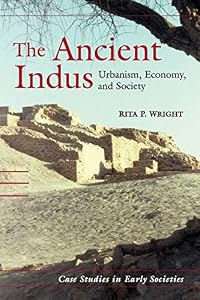
The ancient Indus : urbanism, economy, and society
by Rita P. Wright
17 Members (4.00)
On This Page
Description
This early civilisation was erased from human memory until 1924, when it was rediscovered. Our understanding of the Indus has been partially advanced by textual sources from Mesopotamia that contain references to Meluhha, a land identified by cuneiform specialists as the Indus, with which the ancient Mesopotamians traded and engaged in battles. In this volume, Rita P. Wright uses both Mesopotamian texts but principally the results of archaeological excavations and surveys to draw a rich show more account of the Indus civilisation's well-planned cities, its sophisticated alterations to the landscape, and the complexities of its agrarian and craft-producing economy. She focuses principally on the social networks established between city and rural communities; farmers, pastoralists, and craft producers; and Indus merchants and traders and the symbolic imagery that the civilisation shared with contemporary cultures in Iran, Mesopotamia, Central Asia, and the Persian Gulf region. Her study emphasises the interconnected nature of early societies. show lessTags
Member Reviews
Members
- Recently Added By
Lists

Books in the Bibliography of The Dawn of Everything by Graeber & Wengrow
478 works; 2 members
Author Information
3+ Works 31 Members
Rita P. Wright is associate professor of anthropology at New York University. A John D. and Catherine T. MacArthur Fellow, she has conducted archaeological field research in Afghanistan, Iran, and Pakistan. She is the editor of Gender and Archaeology and coeditor, with Cathy L. Costin, of Craft and Social Identity.
Series
Belongs to Publisher Series
Common Knowledge
- Canonical title
- The ancient Indus : urbanism, economy, and society
- Original publication date
- 2010
- Epigraph
- [None]
- Dedication
- [None]
- First words
- This book is about a civilisation that was erased from human memory until the early part of the twentieth century and the discoveries made by the explorers, travellers, and archaeologists whose accounts and research brought t... (show all)o light the civilisation's significance in world history.
- Last words
- (Click to show. Warning: May contain spoilers.)Here, I have drawn together aspects of the civilisation's political economy toward creating a perspective that places the Indus within the broadened framework of what is now known about the nature and character of early state societies.
Classifications
Statistics
- Members
- 17
- Popularity
- 1,444,390
- Rating
- (4.00)
- Languages
- English
- Media
- Paper
- ISBNs
- 2