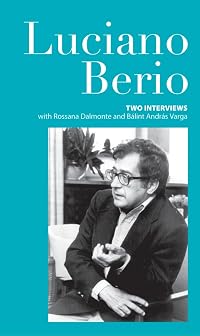
Luciano Berio: Two Interviews
by Luciano Berio
15 Members (4.00)
On This Page
Description
Dalmonte's questions cover many aspects of contemporary musical life. Berio talks freely about his early childhood through his contact with the Darmstadt serialists and his experiences while teaching and performing in America. There is also a detailed examination of his major instrumental works of the 1960s -- The Sequenzas, Chemins, and Sinfonia -- and a review of his involvement with electronic music in the 1970s. Varga asks him about his various vocal and theatrical works. Berio discusses show more the purpose of music. show lessTags
Member Reviews
Members
- Recently Added By
Author Information

115+ Works 217 Members
A musician and composer, Luciano Berio was born in Oneglia, near Genoa, Italy. Music was an intrinsic part of his childhood. His father was his first teacher, instructing him on the organ and piano. At the age of 15, Berio went to the Milan Conservatory, where he studied composition and conducting. After graduation, he worked for a short period as show more a voice coach and conductor in several Italian opera houses and composed several pieces, including Due Pezzi, for violin and piano (1951); Variazioni, for piano (1952); and Chamber Music, for voice, clarinet, cello, and harp, based on poems by James Joyce. While at the Berkshire Music Center at the Tanglewood Music Center in Lenox, Massachusetts, Berio studied composition with Luigi Dallapiccola. Dallapiccola introduced Berio to the artistic potentials of 12-tone music and serialism. Variations for Chamber Orchestra (1953); Nones, for orchestra (1954); and Allelujah 1, for orchestra (1956) are characterized as controlled serialism. In 1954 Berio returned to Milan, where he founded the Studio di Fonologia Musicale in order to experiment with electronic music. He incorporated electronic sounds into such compositions as Mutazioni (1955); Omaggio a Joyce (1958), based on Chapter 11 of Joyce's Ulysses; and Momento (1958). Berio no longer confined music to pitched sound; he embraced the world of sound and experimented with and used sounds of all kinds in his compositions. Visage (1960) was the last piece of music that Berio wrote during this period of experimentation with electronics at his Milan studio. In 1960 Berio returned to the United States. He taught music at Mills College at Oakland, California, and Harvard University before settling at the Julliard School of Music in New York. (Bowker Author Biography) show less
Classifications
Statistics
- Members
- 15
- Popularity
- 1,597,033
- Rating
- (4.00)
- Languages
- English, German
- Media
- Paper
- ISBNs
- 3