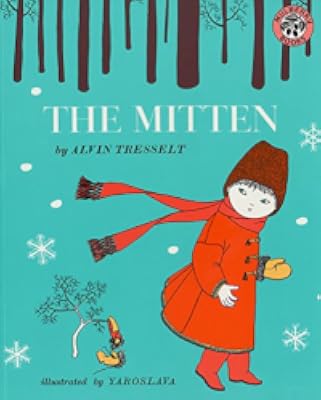
The Mitten: An Old Ukrainian Folktale
by Alvin Tresselt
On This Page
Description
A retelling of the traditional tale of how a boy's lost mitten becomes a refuge from the cold for an increasing number of animals.Tags
Recommendations





Member Recommendations

by conuly
Member Reviews
Now, let me say from the start that, having read Jan Brett's version first, I prefer it. And unless your home library is enormous, you probably don't need both books. However, as the comments here show, many people prefer this version, which predates Brett's version by quite a while. If you can get your hands on both, do so - keep one for yourself and donate the other to a local school!
This story is a great classic. A boy loses his mitten in the woods, a series of progressively larger animals climb in, culminating in a bear. When one teeny animal tries to be the last to just squeeeeeze in (in this version, a cricket), that proves too much for the old mitten and it bursts all over the place.
In contrast to Jan Brett's signature style of show more very intricate pictures, the artwork in this book is very simple... and like many books of that time period, it alternates between full-color spreads and one-color spreads. (In this case, that one color is turquoise, as you can see on the cover.) I like the detail more, but there's a real charm in the simpler pictures of this edition.
Jan Brett has the animals looking and acting like animals. They don't wear clothes, and they don't explicitly talk to each other... and the prey animals move over for the predators only because they're intimidated by the talons, claws, and teeth (this detail is skipped in the board book version of Brett's book). In this edition, the animals speak politely to each other and act generally like humans. Some people prefer the lack of outright intimidation in this book.
I'm going to donate this book to my niece's school. They probably do have a copy of Brett's edition, but this would be a good thing for them to compare and contrast - and really, it stands on its own as a lovely book. It's just SO similar to the other, more well-known version (or, I should say, Brett's version is so similar to this one!) that I don't see the point in keeping both editions. show less
This story is a great classic. A boy loses his mitten in the woods, a series of progressively larger animals climb in, culminating in a bear. When one teeny animal tries to be the last to just squeeeeeze in (in this version, a cricket), that proves too much for the old mitten and it bursts all over the place.
In contrast to Jan Brett's signature style of show more very intricate pictures, the artwork in this book is very simple... and like many books of that time period, it alternates between full-color spreads and one-color spreads. (In this case, that one color is turquoise, as you can see on the cover.) I like the detail more, but there's a real charm in the simpler pictures of this edition.
Jan Brett has the animals looking and acting like animals. They don't wear clothes, and they don't explicitly talk to each other... and the prey animals move over for the predators only because they're intimidated by the talons, claws, and teeth (this detail is skipped in the board book version of Brett's book). In this edition, the animals speak politely to each other and act generally like humans. Some people prefer the lack of outright intimidation in this book.
I'm going to donate this book to my niece's school. They probably do have a copy of Brett's edition, but this would be a good thing for them to compare and contrast - and really, it stands on its own as a lovely book. It's just SO similar to the other, more well-known version (or, I should say, Brett's version is so similar to this one!) that I don't see the point in keeping both editions. show less
Originally published in 1964, and recently re-released, Alvin Tresselt's retelling of this Ukrainian folktale is probably one of the most textual adaptations available. A simple progression tale about a series of woodland animals who take up temporary residence in a lost mitten, there isn't much to this story. In fact, the other versions I have seen, Jan Brett's 1989 retelling amongst them, all have fairly minimal text. Here, Tresselt adds a little bit to the story, with more description and more animal dialogue, making for a much more satisfying narrative.
Yaroslava's delicate illustrations, alternating from a white to a blue background, are charming. An online friend described them as having a true "fairy-tale quality," and I would show more agree with that assessment. All told, this is one of my favorite versions of this story, although I think it is interesting to read it in conjunction with others. show less
Yaroslava's delicate illustrations, alternating from a white to a blue background, are charming. An online friend described them as having a true "fairy-tale quality," and I would show more agree with that assessment. All told, this is one of my favorite versions of this story, although I think it is interesting to read it in conjunction with others. show less
Another book which I poured over when I was young. As always, it was the illustrations which sold the story to me. The story is a fine and rather common fable of hospitality being abused, but the pictures in this book are delicate and special.
Apparently, "The Mitten" is a popular Ukrainian folktale because a) it was the easiest for me to find multiple versions of, and b) it was featured in all three of the collections I borrowed in January 2016. Although I could not find an "original" version in print. So I researched online and found this page. From reading that page, Evgenii Rachev appears to be the first illustrator of the story, Rukavichka, which was published in 1951. The version I read, translated and retold by Alvin Tresselt, was first published in 1964.
This retelling's mittens were made of leather and lined with fur. The animals in order of occupancy: mouse, frog, owl, rabbit, fox, wolf, boar, bear -- and finally, a cricket was one too many. The mitten splits apart show more with such force it throws the animals all over the place.
4 stars
I found it interesting that the animals never questioned whether it was safe for them to allow the next animal, only that the mitten was crowded and couldn't possibly hold another creature. Is the lesson then to always give / share, even if doing so means you sacrifice your own comfort or safety?
(c) 1964 Retold by Alvin R. Tresselt. Adapted from the version by E. Rachov. Illustrated by Yaroslava. show less
This retelling's mittens were made of leather and lined with fur. The animals in order of occupancy: mouse, frog, owl, rabbit, fox, wolf, boar, bear -- and finally, a cricket was one too many. The mitten splits apart show more with such force it throws the animals all over the place.
4 stars
I found it interesting that the animals never questioned whether it was safe for them to allow the next animal, only that the mitten was crowded and couldn't possibly hold another creature. Is the lesson then to always give / share, even if doing so means you sacrifice your own comfort or safety?
(c) 1964 Retold by Alvin R. Tresselt. Adapted from the version by E. Rachov. Illustrated by Yaroslava. show less
This story is based on Ukrainian folk lore, and although I found it a bit odd and confusing, it is still an enjoyable read, and the illustrations are nice.
Unlike the one many of us are familiar with by Jan Brett, this story has a similar plot line. The big difference with the Ukrainian Tale is the pictures. The use of simple lines and colors allow the reader to focus on what is happening "right now." Though the plot line is similar, the ending is a bit different, and welcomed.
This was a strange folktale and one that I still do not fully understand. A child was gathering wood and dropped their mitten. A mouse found the mitten and curled up in it to escape the cold. Other animals happened by and climbed into the ever expanding mitten all the way up to a bear. The mitten strained at the seams but didn't burst until a small grasshopper tried to join in and then it immediately exploded. I thought at first the moral was to share and then maybe a cautionary tale about sharing but neither of these seemed to fit.
Members
- Recently Added By
Lists

Favorite Childhood Books
1,646 works; 514 members

A Child's Book Tour of Ukraine
29 works; 2 members
Honey For a Child's Heart
1,152 works; 25 members

Early Picture Books
467 works; 9 members
Author Information

44+ Works 7,745 Members
All Editions
Awards and Honors
Series
Belongs to Publisher Series
Common Knowledge
- Canonical title
- The Mitten: An Old Ukrainian Folktale
- Important places*
- Oekraïne
*Some information comes from Common Knowledge in other languages. Click "Edit" for more information.
Classifications
- Genres
- Children's Books, Picture Books
- DDC/MDS
- 398.21094771 — Society, government, & culture Customs, etiquette & folklore Folklore & Folktales Folk literature Fairy Tales Fairy tales by place Fairy tales of Europe Fairy Tales of Russia and the Baltic States
- LCC
- PZ8.1 .T7 .M — Language and Literature Fiction and juvenile belles lettres Fiction and juvenile belles lettres Juvenile belles lettres
- BISAC
Statistics
- Members
- 1,481
- Popularity
- 15,665
- Reviews
- 19
- Rating
- (4.08)
- Languages
- Danish, English, Swedish
- Media
- Paper, Audiobook
- ISBNs
- 23
- UPCs
- 2
- ASINs
- 10