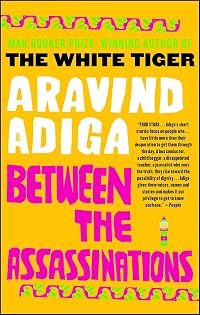
Between the Assassinations
by Aravind Adiga
On This Page
Description
In this short story collection set in the Indian city of Kittur sometime between the assassination of Indira Gandhi in 1984 and that of her son Rajiv in 1991, Adiga creates a cast of characters--from a twelve-year old boy to a Marxist-Maoist Party member--who are immersed in class struggles and their own personal denouements.Tags
Recommendations

















Member Reviews
I haven't read Adiga's Booker-winning debut novel The White Tiger (yet, I should add). However, I've recently read at least two Indian novels - Farahad Zama's The Marriage Bureau for Rich People and Vikas Swarup's Q&A - that try to present the issues facing modern India for a Western audience. There's a lot of talk about the conflict between the old caste society and new "modern" values, clashes between different religions, the supposed but not all-encompassing rise from third-world poverty to a major economic power, etc, but in both cases they end up as simple fluff. Let's all just get along, and if you're lucky you'll win a lot of money and move out of the shack and be happy, and hey, here's a dance number in saris.
Not so in Between show more The Assassinations, a collection of 14 loosely connected short stories set in (a fictionalised version of) the city of Kittur. The assassinations referred to are the ones of Indira and Rajiv Gandhi in 1984 and 1991, and even though the book is divided into seven days, they're not necessarily presented in order. Adiga doesn't offer solutions or easy ways out; at best, he offers a black sense of humour. We get to meet 14 people from all walks of life, from beggars to rich industrialists - and when I say 14, I mean millions; because in setting every story in the same city, having the characters cross each others' paths, the fleeting but always present references to the larger world outside, we're never allowed to forget that they all make up a part of a much larger puzzle. That's just one of the rather delicious dark ironies in this; everyone knowing their place is part of their failure in escaping it.
Obviusly, some stories stand out more than others. Some are darkly funny (the wealthy low-caste school boy who thinks he's supposed to become a terrorist; the journalist who tries to tell the truth about corruption), others desperately grim (the bicycle kuli who realises his body is giving up at 30, and that every day he wastes more calories than he can buy with the money he earns), and some just depressingly realistic. Adiga sticks to a very limited third-person narration, taking us into the head of each protagonist (not that many of them are in a position to do much protagonisin'), having each story tell one character's truth only to move on to a different one with no clear moral.
And then there's the frame story: Adiga prefaces every section of the book as well as every story with a short, supposedly objective description of part of the city: here's the shopping district; here's the various churches, temples and mosques; here's the park; here's the adult cinema. There are fact sheets about population and chronology. And then he undercuts the tourist brochure-like descriptions of buildings and architecture with the lives of the people there, everything that keeps them there, the invisible but real patterns that make sure things don't change too much. "The untouchables are 90% of this town," say politicians trying to curry favour with them, while a fact sheet elsewhere in the book points out that they're nowhere near that many. Every story here can be read on its own; yet together, they start questioning each other, mistrusting each other, undercutting and trying to gain advantage over each other. Some fail. Some succeed, only to still find themselves trapped in a book with cheerful Indian colours on the jacket. And it begins, and ends, with people getting killed. show less
Not so in Between show more The Assassinations, a collection of 14 loosely connected short stories set in (a fictionalised version of) the city of Kittur. The assassinations referred to are the ones of Indira and Rajiv Gandhi in 1984 and 1991, and even though the book is divided into seven days, they're not necessarily presented in order. Adiga doesn't offer solutions or easy ways out; at best, he offers a black sense of humour. We get to meet 14 people from all walks of life, from beggars to rich industrialists - and when I say 14, I mean millions; because in setting every story in the same city, having the characters cross each others' paths, the fleeting but always present references to the larger world outside, we're never allowed to forget that they all make up a part of a much larger puzzle. That's just one of the rather delicious dark ironies in this; everyone knowing their place is part of their failure in escaping it.
Obviusly, some stories stand out more than others. Some are darkly funny (the wealthy low-caste school boy who thinks he's supposed to become a terrorist; the journalist who tries to tell the truth about corruption), others desperately grim (the bicycle kuli who realises his body is giving up at 30, and that every day he wastes more calories than he can buy with the money he earns), and some just depressingly realistic. Adiga sticks to a very limited third-person narration, taking us into the head of each protagonist (not that many of them are in a position to do much protagonisin'), having each story tell one character's truth only to move on to a different one with no clear moral.
And then there's the frame story: Adiga prefaces every section of the book as well as every story with a short, supposedly objective description of part of the city: here's the shopping district; here's the various churches, temples and mosques; here's the park; here's the adult cinema. There are fact sheets about population and chronology. And then he undercuts the tourist brochure-like descriptions of buildings and architecture with the lives of the people there, everything that keeps them there, the invisible but real patterns that make sure things don't change too much. "The untouchables are 90% of this town," say politicians trying to curry favour with them, while a fact sheet elsewhere in the book points out that they're nowhere near that many. Every story here can be read on its own; yet together, they start questioning each other, mistrusting each other, undercutting and trying to gain advantage over each other. Some fail. Some succeed, only to still find themselves trapped in a book with cheerful Indian colours on the jacket. And it begins, and ends, with people getting killed. show less
After writing two of my favorite books, Aravind Adiga can do no wrong. "The White Tiger" was brilliant and "Last Man in Tower" was the most boiling, intense book I have ever read.
"Between the Assassinations" is a collection of short stories about Kittur, a fictitious Indian city that was once a Portuguese colony. The city is a multicultural and religious mix, beset by typical problems in India: namely religious violence, poverty, and caste prejudice.
The stories' protagonists are mostly men. They are porters, handymen, school boys, and bootleggers. We meet a few people, such as a schoolteacher who lives in the middle class and a rich housewife, but for the most part the characters are poor.
I read a review that said these stories were show more precursors to "The White Tiger." They certainly seem that way. Kittur seems like one of the intermediate cities that Balram, main character in "The White Tiger," goes to on his rise to power.
My qualms with some of these stories is that they can be a little pointless. Although they provide some valuable cultural information, they are not as tense, prescient, or powerful as Adiga's other works. The book is presented as a travel guide to Kittur. Each story is preceded by a vignette describing an attraction or place in the city. That presentation is very tacked-on because the vignettes have little to do with the stories.
Nevertheless, everything in this book is well-written. It certainly kept me reading and I look forward to reading more from Adiga. show less
"Between the Assassinations" is a collection of short stories about Kittur, a fictitious Indian city that was once a Portuguese colony. The city is a multicultural and religious mix, beset by typical problems in India: namely religious violence, poverty, and caste prejudice.
The stories' protagonists are mostly men. They are porters, handymen, school boys, and bootleggers. We meet a few people, such as a schoolteacher who lives in the middle class and a rich housewife, but for the most part the characters are poor.
I read a review that said these stories were show more precursors to "The White Tiger." They certainly seem that way. Kittur seems like one of the intermediate cities that Balram, main character in "The White Tiger," goes to on his rise to power.
My qualms with some of these stories is that they can be a little pointless. Although they provide some valuable cultural information, they are not as tense, prescient, or powerful as Adiga's other works. The book is presented as a travel guide to Kittur. Each story is preceded by a vignette describing an attraction or place in the city. That presentation is very tacked-on because the vignettes have little to do with the stories.
Nevertheless, everything in this book is well-written. It certainly kept me reading and I look forward to reading more from Adiga. show less
Adiga delivers another very real portrait of life in India, this time via a collection of short stories set in the town of Kittur between 1984 and 1991, the dates Indira Gandhi and then later Rajiv Gandhi were assassinated. The book covers a full spectrum of people and is brilliant as a collection of snapshots that one assembles to create a more complete picture, not unlike a book such as "Sketches from a Hunter's Album" by Turgenev (sorry if the context switch to 19th century pastoral Russia is a bit of a leap). As others have commented, it's not a "feel good" book and indeed Adiga pulls no punches.
On India:
"Sunil Shetty said, 'The other day I read in the Times of India that the chief of Johnnie Walker said there is more Red Label show more consumed in the average small Indian town than is produced in all of Scotland. When it comes to three things' - he counted them off - 'black marketing, counterfeiting, and corruption, we are the world champions.'"
"They viewed him as the product of a buccaneering adventure on the part of his father; they associated him (he was sure) with an entire range of corruptions. Mix one part premarital sex and one part caste violation in a black pot and what do you get? This cute little Satan: Shankara."
"Once India had been ruled by three foreigners: England, France, and Portugal. Now their place was taken by three native-born thugs: Betrayal, Bungling, and Backstabbing. 'The problem is here -' He tapped his ribs. 'There is a beast inside us.'"
"'The only mix-up, Mr. Bhatt,' said the assistant headmaster, 'was made on fifteen August 1947, when we thought this country could be run by a people's democracy instead of a military dictatorship.'"
"The most commonly heard term, 'son of a bald woman,' requires explanation. Upper-caste widows were once forbidden to remarry and forced to shave their heads to prevent them from attracting men. A child born of a bald woman was very likely to be an illegitimate one."
"He had lost contact with all his relatives; plus he did not actually want to get married. Bring children - into what future? That was the most baboonlike thing the other coolies did: procreate, as if to say they were satisfied with their fate, they were happy to replenish the world that had consigned them to this task."
"'Everything's been falling apart in this country since Mrs. Gandhi was shot,' the man in the blue sarong said, kicking his legs about. 'Buses are late. Trains are late. Everything's falling apart. We'll have to hand this country back to the British or the Russians or someone, I tell you. We're not meant to be masters of our own fate, I tell you."
"These animals have no concern in the world. Even in the house of a man who has killed himself, they are still fed and fattened. How effortlessly they rule over the men of this village, as if human civilization has confused masters and servants."
This one seems maybe the author himself, maybe not in age but spirit:
"He thought back twenty-five years, when he had come to this village with his notebook and his dreams of becoming an Indian Maupassant. As he walked down the twisting streets, crowded with street children playing their violent games, fatigued day laborers sleeping in the shade, and with thick, still, glistening pools of effluent, he was reminded of that strange mixture of the strikingly beautiful and the filthy that is the nature of every Indian village - and the simultaneous desire to admire and to castigate that had been inspired in him from the time of his first visits."
"Ultimately it was not Marx; it was Gandhi and Nehru who were to blame. Murali was convinced of that. A whole generation of young men, deluded by Gandhianism, wasting their lives running around organizing free eye clinics for the poor and distributing books for rural libraries, instead of seducing those young widows and unmarried girls. That old man in his loincloth had turned them mad. Like Gandhi you had to withhold all your lusts. Even to know what you wanted in life was a sin; desire was bigotry. And look where the country was, after forty years of idealism. A total mess! Maybe if they had all become bastards, the young men of his generation, the place would be like America by now!"
On Christianity:
"There was a time when he had thought about converting to Christianity; among Christians there were no castes. Every man was judged by what he had done with his own life. But after the way the Jesuit priest had treated him - caning him once on a Monday morning in the assembly grounds, in full view of the entire school - he had sworn never to become a Christian. There was no better institution to stop Hindus from converting to Christianity than the Catholic boys' school."
"What would the gods do to her, she wondered, as the bus rattled over the dirt road; what would she be in the next life? A cockroach, a silverfish that lived in old books, an earthworm, a maggot in a pile of cow shit, or something even filthier.
Then a strange thought came to her: maybe, if she sinned enough in this life, she would be sent back as a Christian in the next one...
The thought made her feel light-headed with joy; and she dozed off almost at once."
On beauty in small things; this is my favorite quote and given the life the children in this story lead, truly heartbreaking:
"The stopped outside the hotel to watch a group of crows bathing in a puddle of water. The sun was shining on the water, and the black coats of the crows turned glossy as scintillas of water flew from their shaking bodies; Raju declared it was the most beautiful thing he had ever seen." show less
On India:
"Sunil Shetty said, 'The other day I read in the Times of India that the chief of Johnnie Walker said there is more Red Label show more consumed in the average small Indian town than is produced in all of Scotland. When it comes to three things' - he counted them off - 'black marketing, counterfeiting, and corruption, we are the world champions.'"
"They viewed him as the product of a buccaneering adventure on the part of his father; they associated him (he was sure) with an entire range of corruptions. Mix one part premarital sex and one part caste violation in a black pot and what do you get? This cute little Satan: Shankara."
"Once India had been ruled by three foreigners: England, France, and Portugal. Now their place was taken by three native-born thugs: Betrayal, Bungling, and Backstabbing. 'The problem is here -' He tapped his ribs. 'There is a beast inside us.'"
"'The only mix-up, Mr. Bhatt,' said the assistant headmaster, 'was made on fifteen August 1947, when we thought this country could be run by a people's democracy instead of a military dictatorship.'"
"The most commonly heard term, 'son of a bald woman,' requires explanation. Upper-caste widows were once forbidden to remarry and forced to shave their heads to prevent them from attracting men. A child born of a bald woman was very likely to be an illegitimate one."
"He had lost contact with all his relatives; plus he did not actually want to get married. Bring children - into what future? That was the most baboonlike thing the other coolies did: procreate, as if to say they were satisfied with their fate, they were happy to replenish the world that had consigned them to this task."
"'Everything's been falling apart in this country since Mrs. Gandhi was shot,' the man in the blue sarong said, kicking his legs about. 'Buses are late. Trains are late. Everything's falling apart. We'll have to hand this country back to the British or the Russians or someone, I tell you. We're not meant to be masters of our own fate, I tell you."
"These animals have no concern in the world. Even in the house of a man who has killed himself, they are still fed and fattened. How effortlessly they rule over the men of this village, as if human civilization has confused masters and servants."
This one seems maybe the author himself, maybe not in age but spirit:
"He thought back twenty-five years, when he had come to this village with his notebook and his dreams of becoming an Indian Maupassant. As he walked down the twisting streets, crowded with street children playing their violent games, fatigued day laborers sleeping in the shade, and with thick, still, glistening pools of effluent, he was reminded of that strange mixture of the strikingly beautiful and the filthy that is the nature of every Indian village - and the simultaneous desire to admire and to castigate that had been inspired in him from the time of his first visits."
"Ultimately it was not Marx; it was Gandhi and Nehru who were to blame. Murali was convinced of that. A whole generation of young men, deluded by Gandhianism, wasting their lives running around organizing free eye clinics for the poor and distributing books for rural libraries, instead of seducing those young widows and unmarried girls. That old man in his loincloth had turned them mad. Like Gandhi you had to withhold all your lusts. Even to know what you wanted in life was a sin; desire was bigotry. And look where the country was, after forty years of idealism. A total mess! Maybe if they had all become bastards, the young men of his generation, the place would be like America by now!"
On Christianity:
"There was a time when he had thought about converting to Christianity; among Christians there were no castes. Every man was judged by what he had done with his own life. But after the way the Jesuit priest had treated him - caning him once on a Monday morning in the assembly grounds, in full view of the entire school - he had sworn never to become a Christian. There was no better institution to stop Hindus from converting to Christianity than the Catholic boys' school."
"What would the gods do to her, she wondered, as the bus rattled over the dirt road; what would she be in the next life? A cockroach, a silverfish that lived in old books, an earthworm, a maggot in a pile of cow shit, or something even filthier.
Then a strange thought came to her: maybe, if she sinned enough in this life, she would be sent back as a Christian in the next one...
The thought made her feel light-headed with joy; and she dozed off almost at once."
On beauty in small things; this is my favorite quote and given the life the children in this story lead, truly heartbreaking:
"The stopped outside the hotel to watch a group of crows bathing in a puddle of water. The sun was shining on the water, and the black coats of the crows turned glossy as scintillas of water flew from their shaking bodies; Raju declared it was the most beautiful thing he had ever seen." show less
"Let animals live like animals; let humans live like humans."
'Between the Assassinations' is a collection of 14 short stories set in the fictional coastal town of Kittur in India and take place over a period of seven days. The title refers to the period between the assassinations of Indira Gandhi and her son Rajiv in 1984 and 1991 respectively but I am fairly sure would still be relevant today, as one of the characters says, "nothing ever changes. Nothing will ever change."
Each story is preceded by a short tourist guide depiction of a section of the fictional town. The blandness of these short sections provide an interesting relief from the main stories which look at the urban underbelly of India and feature characters from a wide show more social and economic spectrum ranging from upper-caste bankers and an idealist capitalist sweatshop owner, Christian headmasters to lower-caste rickshaw pullers and Muslim tea boys. Each character and each echelon of Indian society are given a human face.
Social injustice and poverty is central to each story as Adiga maps his character's aspirations and anxieties. Each have deeply felt longings but ultimately must accept that life will not change.
I enjoyed Adiga's writing style and these vignettes of Indian urban life are interesting if not particularly surprising. Generally I felt that the individual chapters worked well as a collection but as individual stories they are a mixed bag. Some I really enjoyed whilst I felt others were not of the same standard. Overall I found this an interesting if unspectacular read. show less
'Between the Assassinations' is a collection of 14 short stories set in the fictional coastal town of Kittur in India and take place over a period of seven days. The title refers to the period between the assassinations of Indira Gandhi and her son Rajiv in 1984 and 1991 respectively but I am fairly sure would still be relevant today, as one of the characters says, "nothing ever changes. Nothing will ever change."
Each story is preceded by a short tourist guide depiction of a section of the fictional town. The blandness of these short sections provide an interesting relief from the main stories which look at the urban underbelly of India and feature characters from a wide show more social and economic spectrum ranging from upper-caste bankers and an idealist capitalist sweatshop owner, Christian headmasters to lower-caste rickshaw pullers and Muslim tea boys. Each character and each echelon of Indian society are given a human face.
Social injustice and poverty is central to each story as Adiga maps his character's aspirations and anxieties. Each have deeply felt longings but ultimately must accept that life will not change.
I enjoyed Adiga's writing style and these vignettes of Indian urban life are interesting if not particularly surprising. Generally I felt that the individual chapters worked well as a collection but as individual stories they are a mixed bag. Some I really enjoyed whilst I felt others were not of the same standard. Overall I found this an interesting if unspectacular read. show less
It did not seem that this was a collection of stories, not a single novel, when I bought this book. The book contains, in the form of short stories, glimpses of the lives, predominantly sad, of ordinary citizens living in an ordinary south indian coastal town, in the seven-year period between the assassinations of Indira Gandhi and her son Rajiv Gandhi. The best thing about this book is the way Adiga paints the town and the people and everything else; the reader can actually see, smell and feel the life in the town of Kittur. Apart from that, most of the stories do not have any fixed conclusions, the reader is left to make his own. The stories are disturbing in their showcase of poverty, exploitation and corruption. In all, it is a show more painful set of stories, made readable by the author's skill in bringing the town to life through written words. show less
'The White Tiger' was a great book; 'Between the Assassinations' is an even more profound work, and one that I would call a masterpiece. It is a collection of tales set in the fictitious Indian town of Kittur (there is a real Kittur, but the real town is not on the coast), with the occasional overlap of characters a la 'Winesburg, Ohio.' Every aspect of life in the town is examined with honest bravery by Aravind Adiga; the corruption and misery of a life of poverty comes through clearly, though you find yourself sympathising with even the worst of the rogues in this book.
I really enjoyed this collection of stories set in a fictional southern Indian town, Kittur. The stories are mostly bleak and morose. Adiga's characters face life with the fatalistic belief that nothing will ever change for them. They are stuck in a cycle that they know they will never escape. Some are angry, some are resigned, and some (very few) are hopeful in tone. But the main character, throughout all the stories, is India, in all her guts and glory. While I enjoyed some stories in this collection more than others, they all moved me in some way. The characters are vivid, true and wonderfully three-dimensional for the forty or so pages they are given.
And the language is so lush- Kittur, India really comes to life- the sights and show more sounds, the tastes and smells. Some of the sentences just struck a chord. For example, "She lay in the storage room, seeking comfort in the fumes of the DDT and the sight of the Baby Krishna's silver buttocks." Or, "The centerpiece of his body was a massive potbelly, a hard knot of flesh pregnant with a dozen cardiac arrests." It was so much fun to read a whole book full of sentences like these. Adiga creates characters you can cheer for, and writes in such a beautiful manner that you will want this one for your keeper shelves. Highly recommended!
Also, if you like this book, I'd highly recommend In Other Rooms, Other Wonders, by Daniyal Mueenuddin. It is set in Pakistan in the 1970s and is also excellent.
Truncated from full review at:
http://aartichapati.blogspot.com/2009/07/between-assassinations.html show less
And the language is so lush- Kittur, India really comes to life- the sights and show more sounds, the tastes and smells. Some of the sentences just struck a chord. For example, "She lay in the storage room, seeking comfort in the fumes of the DDT and the sight of the Baby Krishna's silver buttocks." Or, "The centerpiece of his body was a massive potbelly, a hard knot of flesh pregnant with a dozen cardiac arrests." It was so much fun to read a whole book full of sentences like these. Adiga creates characters you can cheer for, and writes in such a beautiful manner that you will want this one for your keeper shelves. Highly recommended!
Also, if you like this book, I'd highly recommend In Other Rooms, Other Wonders, by Daniyal Mueenuddin. It is set in Pakistan in the 1970s and is also excellent.
Truncated from full review at:
http://aartichapati.blogspot.com/2009/07/between-assassinations.html show less
Members
- Recently Added By
Author Information

5+ Works 12,915 Members
Awards and Honors
Common Knowledge
- Canonical title
- Between the Assassinations
- Original title
- Between the Assassinations
- Original publication date
- 2009
- Important places
- India
- Original language
- English
Classifications
Statistics
- Members
- 1,042
- Popularity
- 24,727
- Reviews
- 31
- Rating
- (3.34)
- Languages
- 10 — Dutch, English, French, German, Italian, Norwegian (Bokmål), Polish, Portuguese, Spanish, Swedish
- Media
- Paper, Audiobook, Ebook
- ISBNs
- 43
- UPCs
- 1
- ASINs
- 8