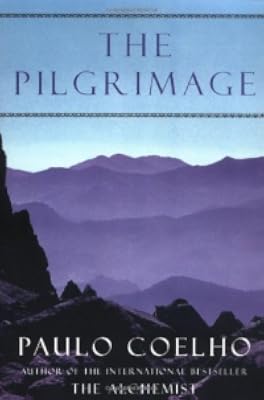
The Pilgrimage: A Contemporary Quest for Ancient Wisdom
by Paulo Coelho
On This Page
Description
The Pilgrimage paved the way to Paulo Coehlo's international bestselling novel The Alchemist. In many ways, these two volumes are companions-to truly comprehend one, you must read the other. Step inside this captivating account of Paulo Coehlo's pilgrimage along the road to Santiago. This fascinating parable explores the need to find one's own path. In the end, we discover that the extraordinary is always found in the ordinary and simple ways of everyday people. Part adventure story, part show more guide to self-discovery, this compelling tale delivers the perfect combination of enchantment and insight. show lessTags
Recommendations








Member Reviews
"Дневник мага", или "Паломничество", как еще называют эту книгу, - это описание путешествия Пауло Коэльо по легендарному Пути Сантьяго, пройденному миллионами пилигримов со времен средневековья. В своем поиске он встречает мистических проводников и демонических вестников, учится понимать природу истины, обретает Могущество и свой меч. Проводник-посвященный по имени Петрус учит его важнейшим show more упражнениям-ритуалам мистического ордена RAM, - упражнениям, которые могут изменить жизнь каждого из нас. Прелесть и чудо этой книги в том, что она обещает: ты сам в полной мере способен пройти своим Путем, достичь своей мечты, обрести свой меч. show less
1/2 a star doesn't begin to do justice to how much I hated this book. Pseudospiritual willy-waving self-indulgent hand-wringing with nothing whatsoever to recommend it. There are tons of books worth reading on the Santiago de Compostela pilgrimage, this is most definitely not one of them.
The story opens on the night of January 2, 1986, on a mountain off Brazil, where Paulo is to be ordained as master of the Order of RAM, about to receive his new sword—used in performing various “miraculous operations” and a seal in his initiation to the secret society of the Tradition. However, a single erroneous act undoes all of what he went through and his Master deems him unworthy—for now—to receive it. Instead, he was given a task to seek it by taking a pilgrimage on a medieval route known as the “strange road to Santiago”; to travel among common people.
Meeting and getting to know the enigmatic Petrus was like coming to terms with Carlo Castañeda’s Don Juan—a man learned in the ways of life that to be in his show more presence is both an enlightening and humbling experience. Petrus was obligated by the Tradition to guide someone who didn’t achieve his sword along the Road to Santiago in able to pay his dues to the order. He taught Paulo the RAM practices and exercises; practices that almost anyone can discover for themselves only if they are willing to seek them out. Following the exercises, Petrus says, will help people achieve absolutely anything they desire.
For all his knowledge, what makes Petrus endearing is he never imposed himself on Paulo. Throughout the journey he made no effort to appear wiser or holier than Paulo. Petrus is just another pilgrim on the Road. Aside from being an effective guide, he is all at once a coach and instructor. Truth to tell, he sometimes gives Paulo absurd orders that Paulo needs to comply. But it goes without saying that through this, Petrus manages to deliver powerful lessons across with lasting impact.
Throughout “The Pilgrimage” we see Paulo’s transformation from a man who’s taken pride of his learning and how he rose from the ranks of the Tradition, to how he embraced the common ways of ordinary folks—by living and experiencing agape or the love that consumes. The journey taught him things he already knew but have a hard time accepting. The path to change, so it goes, is never a walk in the park. The Road is always beset with trials and obstacles that constantly test our strength and inner character, by applying the lessons learned in real life—“Wisdom has only value only if it is helps us to overcome obstacles.” For Paulo the ultimate test is to vanquish the demon Legion, his personal enemy along the Road in the form of a black dog. With these encounters we learn that battling our enemy is also an act of love, for he was placed in our lives for a purpose: to develop and sharpen us. And this purpose has to be met. If ever we are defeated then that’s all to it—we lose! But in losing there is a lesson learned and an experience gained. Fleeing is never an option for we only let the enemy declare its own victory. In winning a battle—most importantly in this battle we participate in called life—we must never allow the enemy to choose how the battle will be waged.
Coelho’s prose has that lyrical beauty all its own, simplistic yet with profound intensity. What you’re about to discover is not that Earth shattering; half of it you might already know. Yet if you felt you have gone astray then cracking open this book is a refreshing way to start, to get you on track once again on the path you could have taken yet lack the courage to tread on. show less
Meeting and getting to know the enigmatic Petrus was like coming to terms with Carlo Castañeda’s Don Juan—a man learned in the ways of life that to be in his show more presence is both an enlightening and humbling experience. Petrus was obligated by the Tradition to guide someone who didn’t achieve his sword along the Road to Santiago in able to pay his dues to the order. He taught Paulo the RAM practices and exercises; practices that almost anyone can discover for themselves only if they are willing to seek them out. Following the exercises, Petrus says, will help people achieve absolutely anything they desire.
For all his knowledge, what makes Petrus endearing is he never imposed himself on Paulo. Throughout the journey he made no effort to appear wiser or holier than Paulo. Petrus is just another pilgrim on the Road. Aside from being an effective guide, he is all at once a coach and instructor. Truth to tell, he sometimes gives Paulo absurd orders that Paulo needs to comply. But it goes without saying that through this, Petrus manages to deliver powerful lessons across with lasting impact.
Throughout “The Pilgrimage” we see Paulo’s transformation from a man who’s taken pride of his learning and how he rose from the ranks of the Tradition, to how he embraced the common ways of ordinary folks—by living and experiencing agape or the love that consumes. The journey taught him things he already knew but have a hard time accepting. The path to change, so it goes, is never a walk in the park. The Road is always beset with trials and obstacles that constantly test our strength and inner character, by applying the lessons learned in real life—“Wisdom has only value only if it is helps us to overcome obstacles.” For Paulo the ultimate test is to vanquish the demon Legion, his personal enemy along the Road in the form of a black dog. With these encounters we learn that battling our enemy is also an act of love, for he was placed in our lives for a purpose: to develop and sharpen us. And this purpose has to be met. If ever we are defeated then that’s all to it—we lose! But in losing there is a lesson learned and an experience gained. Fleeing is never an option for we only let the enemy declare its own victory. In winning a battle—most importantly in this battle we participate in called life—we must never allow the enemy to choose how the battle will be waged.
Coelho’s prose has that lyrical beauty all its own, simplistic yet with profound intensity. What you’re about to discover is not that Earth shattering; half of it you might already know. Yet if you felt you have gone astray then cracking open this book is a refreshing way to start, to get you on track once again on the path you could have taken yet lack the courage to tread on. show less
I liked it. I expected to love it - I tend to enjoy the woo-woo. But I kept having a low level of annoyance throughout because of the way they ignored general rules of being In the world (the sequences with the dog really bothered me)....and how testosterone-driven they were. Some of the exercises were great, but when I failed to figure out the name of my messenger I couldn’t do them all. The end fixed a lot for me (he tied it all up and explained a bit) and I’m glad I read it but it was a bit of a slog.
Not a particularly religious or spiritual person myself but having enjoyed reading 'The Alchemist', I thought I'd give this a try.
There are some very insightful and rewarding lessons in the book: fight the good fight, listen to yourself, don't become distracted from the important things in life by the not-so, appreciate the blessedness of life itself and many others. For this, I think it is a very rewarding read and a great book, however what I found a little hard to stomach was how easily the narrator 'learnt' each lesson. Barely sentences (sometimes even mid-sentence) had passed from the instructional page outlining the particular lesson taught by Petrus, his guide, and the narrator had already seemingly mastered the lesson. A show more pilgrimage, in essence, is a long and somewhat testing journey so the speed at which this mastery was achieved didn't seem to fit with the theme of the book. Perhaps the story was fundamentally a sidecar to the lessons but it just seemed a little forced. I would've liked to have seen the pilgrim grow to develop the skills through practice as his journey progressed because then I think his physical and mental/spiritual journey would have felt more in harmony.
Regardless of this, 'The Pilgrimage' is a 'good-read' and enjoyable. It is also a savvy reminder of our fragile existence, beautiful planet and ability to be distracted from what we truly want and aspire to be which in my opinion, is never a bad thing. show less
There are some very insightful and rewarding lessons in the book: fight the good fight, listen to yourself, don't become distracted from the important things in life by the not-so, appreciate the blessedness of life itself and many others. For this, I think it is a very rewarding read and a great book, however what I found a little hard to stomach was how easily the narrator 'learnt' each lesson. Barely sentences (sometimes even mid-sentence) had passed from the instructional page outlining the particular lesson taught by Petrus, his guide, and the narrator had already seemingly mastered the lesson. A show more pilgrimage, in essence, is a long and somewhat testing journey so the speed at which this mastery was achieved didn't seem to fit with the theme of the book. Perhaps the story was fundamentally a sidecar to the lessons but it just seemed a little forced. I would've liked to have seen the pilgrim grow to develop the skills through practice as his journey progressed because then I think his physical and mental/spiritual journey would have felt more in harmony.
Regardless of this, 'The Pilgrimage' is a 'good-read' and enjoyable. It is also a savvy reminder of our fragile existence, beautiful planet and ability to be distracted from what we truly want and aspire to be which in my opinion, is never a bad thing. show less
I've read a lot of Paulo Coelho over the years, but I had never read "The Pilgrimage" in its entirety. Last week, after watching a special about the Portuguese road to Santiago, I decided to read this book and was both pleasantly surprised and slightly disappointed (if that's even possible).
I was surprised by how much this book made me want to travel the road and learn about myself and the history of those who have traveled it. (I'm going to look into the Portuguese road and all that it has to offer. I have been to Santiago de Compostela, but walking the road is really what I find most intriguing.) I was disappointed in the "supernatural" aspect of the book, all the things I consider impossible to the majority of the population. We show more cannot all have these magical powers that Coelho claims to have. We do not all have the sage knight Petrus to guide us on the road. This is perhaps why I find the story of "The Alchemist" so much more appealing to the population at large. The shepherd Santiago can be anyone, while the pilgrim Paulo Coelho is always Paulo Coelho.
This being said, I loved the way this experience clearly inspired Coelho's many books. The shepherd Santiago is obviously named after the Saint, of course, but he is also inspired by the shepherd who appears here to Coelho during his pilgrimage. The ruined castle is a scene that comes up again and again in Coelho's stories--not just in "The Alchemist" but also in "Veronika Decides to Die" and other books.
Reading Paulo Coelho is always rewarding in some way because by reading his books you learn about yourself. This, Coelho's first book, is no exception. Reading Paulo Coelho is more rewarding, of course, the more you read Paulo Coelho. I am glad I did not read "The Pilgrimage" before "The Alchemist" or before "Veronika" because I do not know that I would have kept reading and seeking. I had been in a Coelho slump recently, but this has motivated me to pull another of his novels off the shelf. show less
I was surprised by how much this book made me want to travel the road and learn about myself and the history of those who have traveled it. (I'm going to look into the Portuguese road and all that it has to offer. I have been to Santiago de Compostela, but walking the road is really what I find most intriguing.) I was disappointed in the "supernatural" aspect of the book, all the things I consider impossible to the majority of the population. We show more cannot all have these magical powers that Coelho claims to have. We do not all have the sage knight Petrus to guide us on the road. This is perhaps why I find the story of "The Alchemist" so much more appealing to the population at large. The shepherd Santiago can be anyone, while the pilgrim Paulo Coelho is always Paulo Coelho.
This being said, I loved the way this experience clearly inspired Coelho's many books. The shepherd Santiago is obviously named after the Saint, of course, but he is also inspired by the shepherd who appears here to Coelho during his pilgrimage. The ruined castle is a scene that comes up again and again in Coelho's stories--not just in "The Alchemist" but also in "Veronika Decides to Die" and other books.
Reading Paulo Coelho is always rewarding in some way because by reading his books you learn about yourself. This, Coelho's first book, is no exception. Reading Paulo Coelho is more rewarding, of course, the more you read Paulo Coelho. I am glad I did not read "The Pilgrimage" before "The Alchemist" or before "Veronika" because I do not know that I would have kept reading and seeking. I had been in a Coelho slump recently, but this has motivated me to pull another of his novels off the shelf. show less
first, this book isn't about El Camino de Santiago at all. it takes a HUGE back seat to Coelho's narcissism.
second, this was nothing more than a bunch of new age, humanist, mumbo-jumbo. when he started talking about invoking your personal devil to help you i put it down.
maybe i just don't "get it". but "The Alchemist" i did get, and enjoyed immensely. when Coelho sticks to universal human truths he shines. when he starts talking about the sacred "Order of RAM" he loses me.
second, this was nothing more than a bunch of new age, humanist, mumbo-jumbo. when he started talking about invoking your personal devil to help you i put it down.
maybe i just don't "get it". but "The Alchemist" i did get, and enjoyed immensely. when Coelho sticks to universal human truths he shines. when he starts talking about the sacred "Order of RAM" he loses me.
Members
- Recently Added By
Published Reviews
ThingScore 75
Chiunque abbia familiarità con questo scrittore, sarà perfettamente preparato all’alto contenuto sia spirituale che mistico che troverà nel libro, fattore di non facile comprensione ma proprio grazie a questo, capace di trasportare e affascinare il lettore.
Paulo Coelho ne “Il Cammino di Santiago” descrive una parabola sul bisogno di ognuno di trovare la propria strada nella vita e show more conferirle un significato autentico, risultato che è possibile raggiungere solo attraverso il superamento di alcune prove e la progressione lungo il nostro personale percorso di crescita interiore.
Nonostante le recensioni talvolta negative, a questo libro si deve almeno in parte il merito di aver contribuito a ridare popolarità al Cammino di Santiago. show less
Paulo Coelho ne “Il Cammino di Santiago” descrive una parabola sul bisogno di ognuno di trovare la propria strada nella vita e show more conferirle un significato autentico, risultato che è possibile raggiungere solo attraverso il superamento di alcune prove e la progressione lungo il nostro personale percorso di crescita interiore.
Nonostante le recensioni talvolta negative, a questo libro si deve almeno in parte il merito di aver contribuito a ridare popolarità al Cammino di Santiago. show less
added by EricThings
Author Information

216+ Works 100,807 Members
Paulo Coelho was born in Rio de Janeiro, Brazil on August 24, 1947. As a teenager, he wanted to become a writer, but his parents wanted him to pursue a more substantial and secure career. At the age of 17, his introversion and opposition to his parents led them to commit him to a mental institution. He escaped three times before being released at show more the age of 20. Once released, he abandoned his ideas of becoming a writer and enrolled in law school to please his parents. He stayed in law school for one year. In 1986, Coelho walked the 500-plus mile Road of Santiago de Compostela in northwestern Spain, a turning point in his life. On the path, he had a spiritual awakening, which he described in his book The Pilgrimage. Before becoming a full-time author, he worked as theatre director and actor, lyricist, and journalist. He wrote song lyrics for many famous performers in Brazilian music including Elis Regina, Rita Lee, and Raul Seixas. His first book, Hell Archives, was published in 1982. He has written over 25 books since then including The Alchemist, Brida, The Fifth Mountain, The Devil and Miss Prym, Eleven Minutes, The Zahir, The Witch of Portobello, Like a Flowing River, and Adultery. He received numerous awards including Las Pergolas Prize, The Budapest Prize, Nielsen Gold Book Award, and the Grand Prix Litteraire Elle. In 1996, he founded the Paulo Coelho Institute, which provides aid to children and elderly people with financial problems. In 2007, Coelho was named a Messenger of Peace to the United Nations. (Bowker Author Biography) show less
Some Editions
Series
Belongs to Publisher Series
Work Relationships
Common Knowledge
- Canonical title
- The Pilgrimage: A Contemporary Quest for Ancient Wisdom
- Original title
- O diário de um mago
- Alternate titles*
- De weg naar het zwaard
- Original publication date
- 1987; 1987, Sant Jordi Asociados, Barcelona
- Important places
- Santiago de Compostela, Galicia, Spain; Way of St. James (Peregrinatio Compostellana); Spain
- Original language
- Portuguese
*Some information comes from Common Knowledge in other languages. Click "Edit" for more information.
Classifications
Statistics
- Members
- 3,980
- Popularity
- 3,944
- Reviews
- 57
- Rating
- (3.41)
- Languages
- 34 — Arabic, Bulgarian, Catalan, Czech, Danish, Dutch, English, Estonian, Finnish, French, German, Galician, Greek, Hungarian, Indonesian, Italian, Japanese, Korean, Latvian, Lithuanian, Malayalam, Norwegian (Bokmål), Farsi/Persian, Polish, Romanian, Russian, Serbian, Slovak, Slovenian, Spanish, Swedish, Turkish, Ukrainian, Portuguese (Portugal)
- Media
- Paper, Audiobook, Ebook
- ISBNs
- 189
- UPCs
- 1
- ASINs
- 35