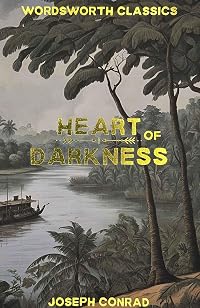
Heart of Darkness / Youth / The End of the Tether
by Joseph Conrad
On This Page
Description
'The horror! The horror!'. These are Kurtz's final words in Joseph Conrad's 'Heart of Darkness', the story of a man who travels into the jungle to seek his fortune and who instead finds an all-consuming moral and spiritual wilderness. Conrad's enduring tale served as a touchstone for many works of fiction inspired by its sombre theme. This collection also includes an additional five of Conrad's best stories.Tags
Recommendations











Member Reviews
The End of the Tether is one of the few Conrad works that I hadn't read yet. Originally published in 1902, this short novel was republished during Conrad's lifetime in a single-volume collection also including Youth and Heart of Darkness. It's one of Conrad's lesser known and lesser read works, and I'd concur that it doesn't match up to his best works. Still, it's Conrad, which for me has almost always meant, at the very least, enjoyable reading. Captain Whalley has been at sea for decades. He's seen, with regret, the closing of the age of the sailing ship and the onset of the steamship era. Places in the Eastern seas that Whalley was among the first Europeans to enter, and passages he was among the first Europeans to chart, have now show more become commonplace shipping lanes and established colonial ports. Yet he is still a man of vigor and strength. He is a widower who still sharply mourns his wife, who had shared his enthusiasm for exploration and for the sea. And he has one grown daughter living in Europe who has made an unfortunate marriage to a man of ill luck in business, and now of health too poor for working. So she is entirely dependent on her father financially. So he must keep working, though at his age commands are harder and harder to come by. He buys into a partnership in, and a command of, a that steamship that plies a boring and barely remunerative trade among the islands. But his partner, who is also the ship's chief engineer, is a vane and grasping man, and the first mate is a conniver, endlessly scheming for a way to get ahead. Whalley is enduring it all for the sake of his daughter until fate pulls one more fast one on him.
At 174 pages, this is a relatively quick read. For me it was a pleasure, as I love having Conrad's voice in my head. And indeed I do find as I read him that I feel like he's talking to me and telling me a story one-on-one. I've always enjoyed his insights into human nature, his sometimes slightly off-kilter way with words, and his descriptions of nature. Here's The End of the Tether's opening paragraph:
"For a long time after the course of the steamer Sofala had been altered for the land, the low swampy coast had retained its appearance of a mere smudge of darkness beyond a belt of glitter. The sun rays fell violently upon the palm see--semed to shatter themselves upon an adamantine surface into sparkling dust, into a dazzling vapor of light that blinded the eye and wearied the brain with its unsteady brightness."
And here's a short passage that struck me particularly. During a flashback describing Whalley's life and career, we come to the death of his wife at sea, their young daughter on board with them as well:
"But Captain Whalley could in a half-hour of solitude live again all his life, with its romance, its idyl, and its sorrow. He had to close her eyes himself. She went away from under the ensign like a sailor's wife, a sailor herself at heart. He had read the service over her, out of her own prayer-book, without a break in his voice. When he raised his eyes he could see old Swinburne facing him with his cap pressed to his breast, and his rugged, weather-beaten, impassive face streaming with drops of water like a lump of chipped red granite in a shower. It was all very well for that old sea-dog to cry. He had to read on to the end; but after the splash he did not remember much of what happened for the next few days. An elderly sailor of the crew, deft at needlework, put together a mourning frock for the child out of one of her black skirts.
He was not likely to forget; but you cannot dam up life like a sluggish stream. It will break out and flow over a man's troubles, it will close upon a sorrow like the sea upon a dead body, no matter how much love has gone to the bottom."
So I enjoyed The End of the Tether and would recommend it to anyone without a previously minted antipathy for Conrad and/or his writing style. He's not for everyone. This short novel won't get you too deeply into the Conrad weeds: it's relatively straightforwardly written and it includes some of Conrad's frequent themes, including the ability or inability, as the case may be from story to story, of an upright, moral person to endure in the face of scoundrels and the cruel turns that life itself can dish out. But a reader is wishing to discover why Conrad devotees consider him to be such a great writer should start elsewhere, as this is not one of Conrad's classics. show less
At 174 pages, this is a relatively quick read. For me it was a pleasure, as I love having Conrad's voice in my head. And indeed I do find as I read him that I feel like he's talking to me and telling me a story one-on-one. I've always enjoyed his insights into human nature, his sometimes slightly off-kilter way with words, and his descriptions of nature. Here's The End of the Tether's opening paragraph:
"For a long time after the course of the steamer Sofala had been altered for the land, the low swampy coast had retained its appearance of a mere smudge of darkness beyond a belt of glitter. The sun rays fell violently upon the palm see--semed to shatter themselves upon an adamantine surface into sparkling dust, into a dazzling vapor of light that blinded the eye and wearied the brain with its unsteady brightness."
And here's a short passage that struck me particularly. During a flashback describing Whalley's life and career, we come to the death of his wife at sea, their young daughter on board with them as well:
"But Captain Whalley could in a half-hour of solitude live again all his life, with its romance, its idyl, and its sorrow. He had to close her eyes himself. She went away from under the ensign like a sailor's wife, a sailor herself at heart. He had read the service over her, out of her own prayer-book, without a break in his voice. When he raised his eyes he could see old Swinburne facing him with his cap pressed to his breast, and his rugged, weather-beaten, impassive face streaming with drops of water like a lump of chipped red granite in a shower. It was all very well for that old sea-dog to cry. He had to read on to the end; but after the splash he did not remember much of what happened for the next few days. An elderly sailor of the crew, deft at needlework, put together a mourning frock for the child out of one of her black skirts.
He was not likely to forget; but you cannot dam up life like a sluggish stream. It will break out and flow over a man's troubles, it will close upon a sorrow like the sea upon a dead body, no matter how much love has gone to the bottom."
So I enjoyed The End of the Tether and would recommend it to anyone without a previously minted antipathy for Conrad and/or his writing style. He's not for everyone. This short novel won't get you too deeply into the Conrad weeds: it's relatively straightforwardly written and it includes some of Conrad's frequent themes, including the ability or inability, as the case may be from story to story, of an upright, moral person to endure in the face of scoundrels and the cruel turns that life itself can dish out. But a reader is wishing to discover why Conrad devotees consider him to be such a great writer should start elsewhere, as this is not one of Conrad's classics. show less
my recent reading of the poisonwood bible definitely enhanced my reading of this book (for context) because it talks about nearly the same situation - white colonization of the congo, and the ravaging of the land and people by the whites, as well as their lack of understanding of the native people. i had to keep in mind, while reading, that it was written in 1899 and it's not fair to judge a writer by today's standards for social justice. i recognize that it might be easier for me to say that as a white person, i can somehow justify the use of the n word in this book. but i also wonder at his purpose for his depiction of the native people, if he was drawing attention to the injustice or perpetuating it. it certainly seems that his show more intention is to show the destruction of the land and people. i'm just not sure if he does this from a place of true understanding of the congolese or not. he does say "The conquest of the earth, which mostly means the taking it away from those who have a different complexion or slightly flatter noses than ourselves, is not a pretty thing when you look into it too much." for me, though, the writing was a bit dense and hard to get through, with awkward sentence structure, but at the same time the language was fantastic. in retrospect i actually wish i'd read this book aloud. it's so short that it's possible to do this, and i think the language comes through better that way.
my favorite 2 quotes, one for content and one for language:
"'I don't like work - no man does - but I like what is in the work, - the chance to find yourself. Your own reality - for yourself, not for others - what no other man can ever know.'"
"'The sun was low; and leaning forward side by side, they seemed to be tugging painfully uphill their two ridiculous shadows of unequal length, that trailed behind them slowly over the tall grass without bending a single blade.'" show less
my favorite 2 quotes, one for content and one for language:
"'I don't like work - no man does - but I like what is in the work, - the chance to find yourself. Your own reality - for yourself, not for others - what no other man can ever know.'"
"'The sun was low; and leaning forward side by side, they seemed to be tugging painfully uphill their two ridiculous shadows of unequal length, that trailed behind them slowly over the tall grass without bending a single blade.'" show less
As always with classic literature, I must first warn you NOT to read the introduction before the main event. Why publishers put analysis that ruins the whole thing at the front of the book baffles me. Particularly in this case, as an author’s note and end notes are also included. Whyever isn’t the so-called introduction situated as an afterword? It would make far more sense so arranged.
Anyway, I skipped the introduction then read it after the three novellas/extended short stories. It succinctly analysed all three stories so well that there seems little left to say about their themes, motifs, or subtext. It also pointed out, though, that all three stories draw heavily from Conrad’s own life. This was fascinating to learn more show more details about. I was originally prompted to read this book by [b:King Leopold's Ghost: A Story of Greed, Terror and Heroism in Colonial Africa|347610|King Leopold's Ghost|Adam Hochschild|https://images.gr-assets.com/books/1348621563s/347610.jpg|937922], a devastating piece of non-fiction about the Belgian exploitation of the Congo. Conrad travelled up the Congo river and saw this regime in action, subsequently turning his experiences into ‘Heart of Darkness’.
Thus it did not surprise me to find ‘Heart of Darkness’ the stand out story of the book. All three were extraordinarily well written, however. The collection took me a lot longer to read than I expected as a result of this. I couldn’t keep up reading momentum when beautiful sentences and paragraphs kept forced me to read them several times. Conrad’s writing has a texture (for want of a better word) that I loved. ‘Heart of Darkness’ displays this quality to its utmost, given the atmosphere of menace that pervades it. ‘Youth’ and ‘The End of the Tether’ both have their appeal, but ‘Heart of Darkness’ is justly famous. ‘Youth’ is tense and exciting, whereas ‘The End of the Tether’ is gloomy and inexorable, thus they make for effective bookends. It seems unnecessary to praise ‘Heart of Darkness’, which I feel that I need to re-read several times to truly appreciate its terrible intensity.
This passage from it was among those that I found especially striking:
I think that 'Heart of Darkness' reminded me of nothing so much as studying the Aeneid a decade ago. It reads like a journey into a monstrous mythical underworld, with the firm assurance that even once you have left you are forever tainted by the experience. show less
Anyway, I skipped the introduction then read it after the three novellas/extended short stories. It succinctly analysed all three stories so well that there seems little left to say about their themes, motifs, or subtext. It also pointed out, though, that all three stories draw heavily from Conrad’s own life. This was fascinating to learn more show more details about. I was originally prompted to read this book by [b:King Leopold's Ghost: A Story of Greed, Terror and Heroism in Colonial Africa|347610|King Leopold's Ghost|Adam Hochschild|https://images.gr-assets.com/books/1348621563s/347610.jpg|937922], a devastating piece of non-fiction about the Belgian exploitation of the Congo. Conrad travelled up the Congo river and saw this regime in action, subsequently turning his experiences into ‘Heart of Darkness’.
Thus it did not surprise me to find ‘Heart of Darkness’ the stand out story of the book. All three were extraordinarily well written, however. The collection took me a lot longer to read than I expected as a result of this. I couldn’t keep up reading momentum when beautiful sentences and paragraphs kept forced me to read them several times. Conrad’s writing has a texture (for want of a better word) that I loved. ‘Heart of Darkness’ displays this quality to its utmost, given the atmosphere of menace that pervades it. ‘Youth’ and ‘The End of the Tether’ both have their appeal, but ‘Heart of Darkness’ is justly famous. ‘Youth’ is tense and exciting, whereas ‘The End of the Tether’ is gloomy and inexorable, thus they make for effective bookends. It seems unnecessary to praise ‘Heart of Darkness’, which I feel that I need to re-read several times to truly appreciate its terrible intensity.
This passage from it was among those that I found especially striking:
I could see the cage of his ribs all astir, the bones of his arms waving. It was as though an animated image of death carved out of old ivory had been shaking its hand with menaces at a motionless crowd of men made of dark and glittering bronze. I saw him open his mouth wide - it gave him a weirdly voracious aspect, as though he had wanted to swallow all the air, all the earth, all the men before him.
I think that 'Heart of Darkness' reminded me of nothing so much as studying the Aeneid a decade ago. It reads like a journey into a monstrous mythical underworld, with the firm assurance that even once you have left you are forever tainted by the experience. show less
Youth, a Narrative; and Two Other Stories is a collection of three novellas by Joseph Conrad published as a single volume in 1902, it is one of the half-dozen or so volumes of short-story/novellas published in his lifetime. The stories are Youth (1902), The Heart of Darkness (1899) and The End of the Tether (1902). Although Heart of Darkness is more well known today - it has aged well - the story Youth got title billing - Conrad worked on it between 1881 and 1998, about 17 years! It certainly was his favorite of the three based on his comments in the Authors Note, in part because it was the first appearance of "Marlow", an auto-biographical alter-ego character that would resurface in many later works. Youth is the most autobiographical, show more with Conrad saying (quote) "Youth" is a feat of memory. It is a record of experience; but that experience, in its facts, in its inwardness and in its outward colouring, begins and ends in myself. (end-quote)
Heart of Darkness is a more stylistic work, much to the chagrin of many readers expecting a gripping adventure story along the lines of Apocalypse Now, it is a slow, stuttering, dark, beast of a thing that even after 3 readings I still feel like I am reading it anew, an impenetrable thicket of overlapping symbolisms. Conrad says of its authenticity (quote) "Heart of Darkness" is experience, too; but it is experience pushed a little (and only very little) beyond the actual facts of the case. [Heart of Darkness] was like another art altogether. That sombre theme had to be given a sinister resonance, a tonality of its own, a continued vibration that, I hoped, would hang in the air and dwell on the ear after the last note had been struck.(end quote) I wonder what the "actual facts of the case" were - or is it best not to know.
The last story is the longest of the three, it is clearly Conrad's least favorite, saying (quote) As to its "reality," that is for the readers to determine. More skill would have made them more real and the whole composition more interesting. It is not very likely that I shall ever read "The End of the Tether" again. No more need be said. It accords best with my feelings to part from Captain Whalley in affectionate silence.(end quote) It is a damning sentiment, even by under-stated Victorian standards, however contrary to Conrad I found it to be absolutely delightful. He dispenses with the heavy symbolic artifice of the first two works and sticks with a more naturalistic or realist mode that conveys a sense of place and time, and in particular the character of Captain Whalley, is unforgettable. The villein, Mr. Massey, owner of a tramp steamer in the backwaters of the orient, is on par with evil captains like Queeg or Ahab - it was easy to imagine him being played by Humphrey Bogart. I love works rich in historical detail and this one really brings the era alive.
--Review by Stephen Balbach, via CoolReading (c) 2008 cc-by-nd show less
Heart of Darkness is a more stylistic work, much to the chagrin of many readers expecting a gripping adventure story along the lines of Apocalypse Now, it is a slow, stuttering, dark, beast of a thing that even after 3 readings I still feel like I am reading it anew, an impenetrable thicket of overlapping symbolisms. Conrad says of its authenticity (quote) "Heart of Darkness" is experience, too; but it is experience pushed a little (and only very little) beyond the actual facts of the case. [Heart of Darkness] was like another art altogether. That sombre theme had to be given a sinister resonance, a tonality of its own, a continued vibration that, I hoped, would hang in the air and dwell on the ear after the last note had been struck.(end quote) I wonder what the "actual facts of the case" were - or is it best not to know.
The last story is the longest of the three, it is clearly Conrad's least favorite, saying (quote) As to its "reality," that is for the readers to determine. More skill would have made them more real and the whole composition more interesting. It is not very likely that I shall ever read "The End of the Tether" again. No more need be said. It accords best with my feelings to part from Captain Whalley in affectionate silence.(end quote) It is a damning sentiment, even by under-stated Victorian standards, however contrary to Conrad I found it to be absolutely delightful. He dispenses with the heavy symbolic artifice of the first two works and sticks with a more naturalistic or realist mode that conveys a sense of place and time, and in particular the character of Captain Whalley, is unforgettable. The villein, Mr. Massey, owner of a tramp steamer in the backwaters of the orient, is on par with evil captains like Queeg or Ahab - it was easy to imagine him being played by Humphrey Bogart. I love works rich in historical detail and this one really brings the era alive.
--Review by Stephen Balbach, via CoolReading (c) 2008 cc-by-nd show less
This is very interesting collection of three short stories all related to the certain parts of human life.
Youth
Title says it all - young Marlowe (also a lead character in Heart of Darkness) gets his first command as a result of disastrous event when coal transported by his ship catches fire and explodes. Whole story though just emanates the energy of the youth that sees nothing as an obstacle and is eager to prove itself. Conrad manages to capture the way of life on high seas, relations among the crew and everyday life of the seaman to the smallest detail.
Heart of Darkness
Marlowe, now older and wiser (middle age) decides to join the European company for tour in Africa, running a steamer carrying ivory from impenetrable jungle to the show more European companies collection station. This is rather wordy story and it takes a while to go through it. People Marlowe meets are all strange people who might be very proper back in civilization but in the wilderness they seem to have lost their compass. Driven by greed they tend to look at all around them (natives and other company men) as an obstacle. So when he finally meets mysterious Mr. Kurtz who placed himself as a ruler of several native tribes, great man of whom company has greatest expectations, he sees how far can man fall when not in control of his wits. Like most people at the time Kurtz came to Africa as a missionary to spread "light" among the natives. But in the process he slowly lost his way starting to treat his surroundings and natives as his own fiefdom, waging brutal wars and killing men, women and children sometimes out of whim. Soon his madness takes its toll and Kurtz slowly spirals into illness of body (mind being lost for a while now) and finally gets saved by Marlowe only to die at the very end of journey down the river.
I understand there is lots of controversy around this story but as far as I can see it Conrad very successfully presented two things.
First is utter horror and acts of colonial companies extracting natural wealth using natives as a workforce and treating them in horrible ways. The way greed controls the people in power (when is it ever enough?) eats through the core of very people working for the company. Even if they are not inherently bad under the influence and temptations of wealth (so much ivory) they become brutes and very much total opposite of what they think of themselves (remember this is period where developed world (Europe and Americas) treated all the exotic locals of Africa and Asia as dark places to which they need to bring the light).
Second is the very fact that in each of us we have a savage sitting. By savage I mean part of us that is ready to do heinous things, kill , maim, destroy. Civilization is maybe there to help us keep it under control but when in wild it is very clear how weak man is. When confronted with might and beauty of nature unprepared souls get overwhelmed and start their slow spiral into madness. For Kurtz, very capable orator, man capable of rallying other men for his cause, contact with natives, their very nature and fear he can exploit for his means, places him in the place of absolute power. More than enough to consume anyone. It is very short step from genius to madman but also from civilized to utmost barbaric.
The End of the Tether
Third story is very sad story of an ultimate sacrifice. What is devoted father (old age) ready to do for his child, his daughter. After losing his wife and losing his savings old captain decides to spend rest of his days making money to help his daughter that is in very bad financial state. Father will forgo his pride and opinions [especially about his son in law] because he knows hard times strike a man down from time to time and nobody can be blamed for it. He gathers strength to do his best to help his daughter. Even if it means working for a complete maniac of ship-owner and having a back-stabbing first officer.
Very touchy and ultimately very sad story with a happy ending.
All three stories impressed me much. They might be too wordy for modern times and pages might seem just so full of words that you have a feeling you will drown in them. But as a stories they are very humane and very down to earth and this is great part of their charm.
Recommended to all who like a good story. show less
Youth
Title says it all - young Marlowe (also a lead character in Heart of Darkness) gets his first command as a result of disastrous event when coal transported by his ship catches fire and explodes. Whole story though just emanates the energy of the youth that sees nothing as an obstacle and is eager to prove itself. Conrad manages to capture the way of life on high seas, relations among the crew and everyday life of the seaman to the smallest detail.
Heart of Darkness
Marlowe, now older and wiser (middle age) decides to join the European company for tour in Africa, running a steamer carrying ivory from impenetrable jungle to the show more European companies collection station. This is rather wordy story and it takes a while to go through it. People Marlowe meets are all strange people who might be very proper back in civilization but in the wilderness they seem to have lost their compass. Driven by greed they tend to look at all around them (natives and other company men) as an obstacle. So when he finally meets mysterious Mr. Kurtz who placed himself as a ruler of several native tribes, great man of whom company has greatest expectations, he sees how far can man fall when not in control of his wits. Like most people at the time Kurtz came to Africa as a missionary to spread "light" among the natives. But in the process he slowly lost his way starting to treat his surroundings and natives as his own fiefdom, waging brutal wars and killing men, women and children sometimes out of whim. Soon his madness takes its toll and Kurtz slowly spirals into illness of body (mind being lost for a while now) and finally gets saved by Marlowe only to die at the very end of journey down the river.
I understand there is lots of controversy around this story but as far as I can see it Conrad very successfully presented two things.
First is utter horror and acts of colonial companies extracting natural wealth using natives as a workforce and treating them in horrible ways. The way greed controls the people in power (when is it ever enough?) eats through the core of very people working for the company. Even if they are not inherently bad under the influence and temptations of wealth (so much ivory) they become brutes and very much total opposite of what they think of themselves (remember this is period where developed world (Europe and Americas) treated all the exotic locals of Africa and Asia as dark places to which they need to bring the light).
Second is the very fact that in each of us we have a savage sitting. By savage I mean part of us that is ready to do heinous things, kill , maim, destroy. Civilization is maybe there to help us keep it under control but when in wild it is very clear how weak man is. When confronted with might and beauty of nature unprepared souls get overwhelmed and start their slow spiral into madness. For Kurtz, very capable orator, man capable of rallying other men for his cause, contact with natives, their very nature and fear he can exploit for his means, places him in the place of absolute power. More than enough to consume anyone. It is very short step from genius to madman but also from civilized to utmost barbaric.
The End of the Tether
Third story is very sad story of an ultimate sacrifice. What is devoted father (old age) ready to do for his child, his daughter. After losing his wife and losing his savings old captain decides to spend rest of his days making money to help his daughter that is in very bad financial state. Father will forgo his pride and opinions [especially about his son in law] because he knows hard times strike a man down from time to time and nobody can be blamed for it. He gathers strength to do his best to help his daughter. Even if it means working for a complete maniac of ship-owner and having a back-stabbing first officer.
Very touchy and ultimately very sad story with a happy ending.
All three stories impressed me much. They might be too wordy for modern times and pages might seem just so full of words that you have a feeling you will drown in them. But as a stories they are very humane and very down to earth and this is great part of their charm.
Recommended to all who like a good story. show less
I bought this book for Heart of Darkness, and as this famous piece is so short (less than 70 pages), the publishers pads it with two other short stories - Youth, and The End of the Tether. Heart of Darkness is a compelling piece of writing. It is famous for portraying the atrocities of the colonial regime in the Congo (the darkness refers equally to the Belgians as to the dark continent)) but the surprise for me was the quality of the writing.
The story is told aloud by a story-teller, as in Lord Jim, which is a clunky way of structuring the writing, but Conrad makes it work. While an expose, it is not a polemic. The awful bits are told, almost as aside. No effort is made to comment. The reader is being told a different story - the Congo show more seems to be the background. But of course, the Belgian regime is really the core of the book, and the apparent structure just a device. It works so well.
The other stories are good to read, but not up to the standard of Heart of Darkness. Tether is over written, too embellished - the story drowns in words in a way that is a total contrast to Heart of Darkness.
Great stuff. Read May 2014. show less
The story is told aloud by a story-teller, as in Lord Jim, which is a clunky way of structuring the writing, but Conrad makes it work. While an expose, it is not a polemic. The awful bits are told, almost as aside. No effort is made to comment. The reader is being told a different story - the Congo show more seems to be the background. But of course, the Belgian regime is really the core of the book, and the apparent structure just a device. It works so well.
The other stories are good to read, but not up to the standard of Heart of Darkness. Tether is over written, too embellished - the story drowns in words in a way that is a total contrast to Heart of Darkness.
Great stuff. Read May 2014. show less
Well, I hate to do it, but I'm taking the rating down to 4 out of 5 stars. I'm not sure why, but this time around, Joseph Conrad did not manage to induce the same level of fascination as he did the first couple of times I read this book. Maybe because the last time I read it was for a class, where we got to discuss it so much.
It's the story of Marlow, the classic man of the sea, and his trip down the river Congo to find Kurtz, the company man said to have native. But instead of being drawn into the story, this time I felt like Conrad was deliberately keeping the reader at arms' length. Marlow is telling the story, and an unnamed male listener is telling the reader what Marlow says. Then Marlow tells the listener who tells us what Marlow show more says somebody else says. Still with me?
Maybe the point of all those layers was to make the reader question the story a little more, to ask one's self how much you really know about someone else if all you know is what they say.
Anyway, it was good to read it again, but not as great as I remembered. I'm not sure why, but it must be a change inside me, because I *LOVED* this book back in college. show less
It's the story of Marlow, the classic man of the sea, and his trip down the river Congo to find Kurtz, the company man said to have native. But instead of being drawn into the story, this time I felt like Conrad was deliberately keeping the reader at arms' length. Marlow is telling the story, and an unnamed male listener is telling the reader what Marlow says. Then Marlow tells the listener who tells us what Marlow show more says somebody else says. Still with me?
Maybe the point of all those layers was to make the reader question the story a little more, to ask one's self how much you really know about someone else if all you know is what they say.
Anyway, it was good to read it again, but not as great as I remembered. I'm not sure why, but it must be a change inside me, because I *LOVED* this book back in college. show less
Members
- Recently Added By
Lists

Obama Reads
181 works; 3 members
Author Information

723+ Works 91,040 Members
Joseph Conrad is recognized as one of the 20th century's greatest English language novelists. He was born Jozef Konrad Nalecz Korzeniowski on December 3, 1857, in the Polish Ukraine. His father, a writer and translator, was from Polish nobility, but political activity against Russian oppression led to his exile. Conrad was orphaned at a young age show more and subsequently raised by his uncle. At 17 he went to sea, an experience that shaped the bleak view of human nature which he expressed in his fiction. In such works as Lord Jim (1900), Youth (1902), and Nostromo (1904), Conrad depicts individuals thrust by circumstances beyond their control into moral and emotional dilemmas. His novel Heart of Darkness (1902), perhaps his best known and most influential work, narrates a literal journey to the center of the African jungle. This novel inspired the acclaimed motion picture Apocalypse Now. After the publication of his first novel, Almayer's Folly (1895), Conrad gave up the sea. He produced thirteen novels, two volumes of memoirs, and twenty-eight short stories. He died on August 3, 1924, in England. (Bowker Author Biography) show less
Some Editions
Series
Belongs to Publisher Series
Work Relationships
Common Knowledge
- Canonical title
- Heart of Darkness / Youth / The End of the Tether
- Original title
- Youth, a Narrative and Two Other Stories; Youth: A Narrative; and Two Other Stories
- Original publication date
- 1898: Youth; 1899: Heart of Darkness; 1902: The End of the Tether; 1902: This collection
- People/Characters
- Charles Marlow; Kurtz; Captain Eliott; Captain Whalley; John Beard [from Joseph Conrad’s sea tales]; Mr. Massy (show all 8); Mr. Van Wyk; Mr. Sterne
- Important places
- Congo River, Africa
- Related movies
- Heart of Darkness (1993 | IMDb); Apocalypse Now (1979 | IMDb)
- Disambiguation notice
- This work contains "Youth", "Heart of Darkness", and "The End of the Tether". Please do not combine with works containing a different selection of stories.
Classifications
Statistics
- Members
- 1,417
- Popularity
- 16,672
- Reviews
- 12
- Rating
- (3.94)
- Languages
- 7 — Dutch, English, German, Italian, Polish, Russian, Spanish
- Media
- Paper, Audiobook, Ebook
- ISBNs
- 38
- ASINs
- 26