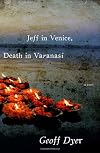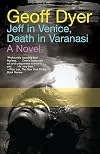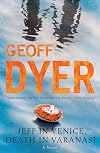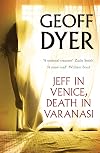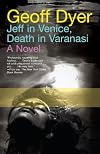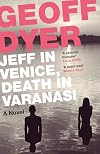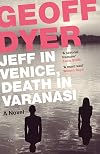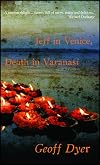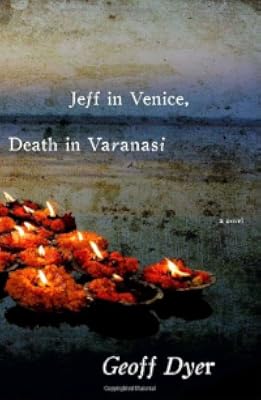
Jeff in Venice, Death in Varanasi
by Geoff Dyer
On This Page
Description
Every two years the international art world descends on Venice for the opening of the Biennale. Among them is Jeff Atman, a jaded and dissolute journalist, whose dedication to the cause of Bellini-fuelled party-going is only intermittently disturbed by the obligation to file a story. When he meets the spellbinding Laura, he is rejuvenated, ecstatic. Their romance blossoms quickly, but is it destined to disappear just as rapidly? Every day thousands of pilgrims head to the banks of the Ganges show more at Varanasi, the holiest Hindu city in India. Among their number is a narrator who may or may not be the Atman previously seen in Venice. Intending to visit only for a few days, he ends up staying for months, and suddenly finds a hitherto unexamined idea of himself, the self. In a romance he can only observe, he sees a reflection of the kind of pleasures that, willingly or not, he has renounced. In the process, two ancient and watery cities become versions of each other. Could two stories, in two different cities, actually be one and the same story? An irrepressible and wildly original novel of erotic fulfillment and spiritual yearning, Jeff in Venice, Death in Varanasi is dead-on in its evocation of place, longing, and the possibility of neurotic enlightenment. show lessTags
Recommendations





















Member Recommendations
alalba Readers who have enjoyed 'Death in Varanasi' might also like Holy Cow
Member Reviews
Jeff is a London-based freelance reporter sent, in the first novella, to cover the art extravaganza Biennale in Venice. He's 45 and full of self-loathing--for all his snarky and very funny commentary on everyone else, there's no one he holds in lower esteem than himself. He falls in love in Venice, but the whole episode is really a wild ("raucous"--Ondaatje's perfect word on the jacket) ride into the depths of ego, sensation and gluttony during an impossible heat wave in this mysterious, louche, crumbling, maze-like city of the imagination. Party after party (enviously comparing quality of invitations), two-fisted drinking, snorting, shallow people hobnobbing shallowly, and one art exhibit after another displaying more naked ambition show more than anything else. This is the no-holds-barred setup for the extraordinary novella that follows.
Jeff (never named this time) goes on assignment to write a travel piece about Varanasi. Hilariously commuting--via rickshaw, tuk-tuk, taxi--from his remote hotel into town, he conceives a videogame called "Varanasi Death Trip" involving simply staying alive on the crazy streets--a Westerner's take on this mess of a place, but also the "trip" he's on. He writes his piece somewhere in here, though doesn't bother to mention it till much later (one of the wonderful ways Dyer characterizes Jeff's state of mind and the transformation that's taking place). He blows off his departure date and moves to a hotel in town. ("Oh, WHY?!" I thought, so thoroughly has he conveyed the Westerner's view of the horrors of the place--the toxic "sacred" river Ganges, the human excrement in the streets, the disease and stench and general filth, the incessant begging and genuine danger, the ashes of burning bodies in the water and air, the sight of dogs eating a body. But Jeff's not feeling it in quite the same way....) He ends up staying indefinitely, hanging out at the hotel as tourists come and go, befriending some, becoming a fixture like a potted plant. He stops checking his email, thereby blowing off jobs, inevitably incurs chronic intestinal distress and gets skinnier and skinnier, lets his beard and hair (so self-consciously dyed before his trip to Venice) grow unkempt, and generally goes native. He, too, will shit in the street in an emergency, "bathe" daily in the disgusting Ganges he once pissed in for spite, and discover the essence of meditation in a deafening cacophony of temple bells. He will shave head, beard and eyebrows except for a pigtail in back that the locals wear in mourning. Mourning the death of Jeff, without regret.
Wonderfully, this novella is written in first-person, while the Venice piece is in third. He has lost himself to becoming fully himself--the "I" in the moment. Jeff never lived in the moment, was always wanting. Before his beer glass emptied, he was worrying about getting it filled again; high on coke, he was monitoring the high, looking to restoke it as it tapered off. While with the woman of his dreams in Venice, he was already worrying about when he'd see her again. Simultaneously a shiftless and directionless man and one of great extremes, he's the perfect candidate for the plunge into Being (into godhood) in Varanasi.
Just to note some other things I loved... His Westerner's assessment of the great practices of yoga and meditation to come out of India is that it makes perfect sense: the only way to escape the impossible racket and stink and general assault of the place was to retreat inside. When a pair of musicians are staying at the hotel, he envies their love for their art--when not jamming together, they're in their rooms playing (he hates to write, dreads sitting down to the blank screen...), and music becomes one of the great forces of altered consciousness--brilliantly written--in the novella. This ultimately leading to the om of the bells.
And I'd hate to forget his stoned encounter with a familiar goat who suddenly starts chatting with him.... show less
Jeff (never named this time) goes on assignment to write a travel piece about Varanasi. Hilariously commuting--via rickshaw, tuk-tuk, taxi--from his remote hotel into town, he conceives a videogame called "Varanasi Death Trip" involving simply staying alive on the crazy streets--a Westerner's take on this mess of a place, but also the "trip" he's on. He writes his piece somewhere in here, though doesn't bother to mention it till much later (one of the wonderful ways Dyer characterizes Jeff's state of mind and the transformation that's taking place). He blows off his departure date and moves to a hotel in town. ("Oh, WHY?!" I thought, so thoroughly has he conveyed the Westerner's view of the horrors of the place--the toxic "sacred" river Ganges, the human excrement in the streets, the disease and stench and general filth, the incessant begging and genuine danger, the ashes of burning bodies in the water and air, the sight of dogs eating a body. But Jeff's not feeling it in quite the same way....) He ends up staying indefinitely, hanging out at the hotel as tourists come and go, befriending some, becoming a fixture like a potted plant. He stops checking his email, thereby blowing off jobs, inevitably incurs chronic intestinal distress and gets skinnier and skinnier, lets his beard and hair (so self-consciously dyed before his trip to Venice) grow unkempt, and generally goes native. He, too, will shit in the street in an emergency, "bathe" daily in the disgusting Ganges he once pissed in for spite, and discover the essence of meditation in a deafening cacophony of temple bells. He will shave head, beard and eyebrows except for a pigtail in back that the locals wear in mourning. Mourning the death of Jeff, without regret.
Wonderfully, this novella is written in first-person, while the Venice piece is in third. He has lost himself to becoming fully himself--the "I" in the moment. Jeff never lived in the moment, was always wanting. Before his beer glass emptied, he was worrying about getting it filled again; high on coke, he was monitoring the high, looking to restoke it as it tapered off. While with the woman of his dreams in Venice, he was already worrying about when he'd see her again. Simultaneously a shiftless and directionless man and one of great extremes, he's the perfect candidate for the plunge into Being (into godhood) in Varanasi.
Just to note some other things I loved... His Westerner's assessment of the great practices of yoga and meditation to come out of India is that it makes perfect sense: the only way to escape the impossible racket and stink and general assault of the place was to retreat inside. When a pair of musicians are staying at the hotel, he envies their love for their art--when not jamming together, they're in their rooms playing (he hates to write, dreads sitting down to the blank screen...), and music becomes one of the great forces of altered consciousness--brilliantly written--in the novella. This ultimately leading to the om of the bells.
And I'd hate to forget his stoned encounter with a familiar goat who suddenly starts chatting with him.... show less
Fantastic book, high energy from the beginning (when Geoff gets his hair dyed to remove the grey before he goes to parties at the Venice Biennale) to the end (where the first person narrator, presumably also Geoff, gets the hair on his head shaved in Hindu mourning fashion in Varanasi).
Really two linked novellas. The first takes Geoff, a clever, self-aware, hackish journalist, on a junket to cover the Venice Biennale. He leaves more focused on the parties and drinks than the art and ends up absorbing both -- along with an almost dreamlike fantasy of a romance.
The second novella is written in the first person with a journalist who seems an awful lot like Geoff taking what is originally a four-day assignment to Varanasi but ends up show more staying much longer, moving closer to the center of the city, and once again while being wholly ironic and self aware slipping increasingly into the culture. In this case, at the opposite ascetic end of the spectrum from the Venice portion of the story.
Either half of the book would have been good on it's own. And together -- labeled with the not entirely superfluous subtitle "A Novel" -- they are outstanding. show less
Really two linked novellas. The first takes Geoff, a clever, self-aware, hackish journalist, on a junket to cover the Venice Biennale. He leaves more focused on the parties and drinks than the art and ends up absorbing both -- along with an almost dreamlike fantasy of a romance.
The second novella is written in the first person with a journalist who seems an awful lot like Geoff taking what is originally a four-day assignment to Varanasi but ends up show more staying much longer, moving closer to the center of the city, and once again while being wholly ironic and self aware slipping increasingly into the culture. In this case, at the opposite ascetic end of the spectrum from the Venice portion of the story.
Either half of the book would have been good on it's own. And together -- labeled with the not entirely superfluous subtitle "A Novel" -- they are outstanding. show less
As a novel, I was not enthralled with this book, the story, the character development were disappointing. As a travelogue, I loved it. Hearing about Jeff's Venice Bienniale high life was entertaining, but the Varanasi portion was fascinating as he related the highs and horrors of his time in India. Despite the illnesses, haranguing, death, pollution and poverty, I want to go visit Varanasi and stay at the Ganges View. Dyer is a talented writer and has one of the funniest descriptions on record of queuing for an ATM in a foreign country. I also recommend his nonfiction book, Out of Sheer Rage: wrestling with D.H. Lawrence.
This one is giving me mixed emotions... Which I think is a good thing.
The story follows Jeff, a freelance art writer from London. Jeff travels to Venice to cover a festival, where he meets a woman. They have a whirl-wind romance fueled by booze and drugs. The second part of the story is kind of a mystery. The narrator ends up in Varanasi and ends up staying, presumably forever (but we don't ever really know). In Varanasi he undergoes changes, life altering "spiritual" changes. But again, the fruition to which these changes lead the narrator is unknown.
I really liked the story, and although I felt the writing was a bit embellished I liked the writing also. My biggest complaint has nothing to do with the story whatsoever, rather it's show more the use of one very offensive word - the c word. I'm by no means a prude, quite frankly I could make a sailor blush, but there are a few words that even I won't mutter and the c word is one of them. I don't know why this bothered me so bad, but I actually had to put the book down for a while to let myself cool off. As I was reading the more I kept thinking about that word and the more upset I got. I know it's crazy, but it just bothered me.... Once I cooled off a bit I was able to read it without seething, I guess I was having a moment.
I liked the wit that was apparent throughout the book. I think without the added wit the story would have been somewhat lacking. But the humor made me want to keep reading (after I got over the c word thing). Something that was a little odd, but was part of the mystery of the second part, was that the first part of the book is written in third person whereas the second part is written in first person. But again, there is so much mystery as to who the narrator is (presumably Jeff from the first part, but I'll let you make your own decision). Then the mystery as to if he ever returns home...
I can't say I loved this book, but I think that it was good. I have never read anything that reminds me of this so I can't make any comparison. I liked it, but at times it kind of teetered on a thin line between brilliant and completely absurd. show less
The story follows Jeff, a freelance art writer from London. Jeff travels to Venice to cover a festival, where he meets a woman. They have a whirl-wind romance fueled by booze and drugs. The second part of the story is kind of a mystery. The narrator ends up in Varanasi and ends up staying, presumably forever (but we don't ever really know). In Varanasi he undergoes changes, life altering "spiritual" changes. But again, the fruition to which these changes lead the narrator is unknown.
I really liked the story, and although I felt the writing was a bit embellished I liked the writing also. My biggest complaint has nothing to do with the story whatsoever, rather it's show more the use of one very offensive word - the c word. I'm by no means a prude, quite frankly I could make a sailor blush, but there are a few words that even I won't mutter and the c word is one of them. I don't know why this bothered me so bad, but I actually had to put the book down for a while to let myself cool off. As I was reading the more I kept thinking about that word and the more upset I got. I know it's crazy, but it just bothered me.... Once I cooled off a bit I was able to read it without seething, I guess I was having a moment.
I liked the wit that was apparent throughout the book. I think without the added wit the story would have been somewhat lacking. But the humor made me want to keep reading (after I got over the c word thing). Something that was a little odd, but was part of the mystery of the second part, was that the first part of the book is written in third person whereas the second part is written in first person. But again, there is so much mystery as to who the narrator is (presumably Jeff from the first part, but I'll let you make your own decision). Then the mystery as to if he ever returns home...
I can't say I loved this book, but I think that it was good. I have never read anything that reminds me of this so I can't make any comparison. I liked it, but at times it kind of teetered on a thin line between brilliant and completely absurd. show less
A breezy, superficial book, a combination of the English mortification and fretting in "Bridget Jones's Diary" and ordinary travel journalism.
What is the value, for fiction, of detailed, immediate, lightly fictionalized, fairly accurate reporting of unusual places? This book is divided in two: I have never been to Varanasi, so that half struck me as having been transferred as quickly as possible from experience to fiction, as if the details of the place would go stale if they spent too long in the author's head. The result is a kind of raw, sparkling immediacy, but the price is high: the scenes don't seen thought about, mulled over, transformed into imagination and back into prose. They seem jotted down and typed.
The first part of the show more book, about the Venice biennale, is very familiar to me (I am an art historian). As a result I can understand all the references, and I can judge Dyer's level of engagement with, and understanding of, the art world, and I'm not interested -- and the result of that is I can read only for the idea of realistic detail; I can't be persuaded by Dyer's attempts to conjure the place or the people. As a result all the carefully gathered scenes, artworks, and characters seem to be revealed as gestures at realism, as the author's hopes of creating something that will be entrancing or persuasive. It's like looking behind the scenes at the opera, or like Barthes's "S/Z."
What's left is the author's manipulation of his model reader's sense of anticipation, of drama, love and sex, society and career, aging and vanity... because nothing in the setting was of interest, I lost confidence in whatever interest I might have in the author's other concerns; and because I saw how he assembled elements of the biennale to make his mis-en-scene, I lost the ability to suspend disbelief in anything else in the narrative.
A moral might be: if, as a novelist, you depend on veracity in travel-style writing, you need to also depend on readers' lack of knowledge of those settings. Or, to put it in a positive way, it is probably best to let the details of life sit in mind for some time, changing slowly into something that can only exist in fiction.
This is another book I read for the 2016 AWP meeting. show less
What is the value, for fiction, of detailed, immediate, lightly fictionalized, fairly accurate reporting of unusual places? This book is divided in two: I have never been to Varanasi, so that half struck me as having been transferred as quickly as possible from experience to fiction, as if the details of the place would go stale if they spent too long in the author's head. The result is a kind of raw, sparkling immediacy, but the price is high: the scenes don't seen thought about, mulled over, transformed into imagination and back into prose. They seem jotted down and typed.
The first part of the show more book, about the Venice biennale, is very familiar to me (I am an art historian). As a result I can understand all the references, and I can judge Dyer's level of engagement with, and understanding of, the art world, and I'm not interested -- and the result of that is I can read only for the idea of realistic detail; I can't be persuaded by Dyer's attempts to conjure the place or the people. As a result all the carefully gathered scenes, artworks, and characters seem to be revealed as gestures at realism, as the author's hopes of creating something that will be entrancing or persuasive. It's like looking behind the scenes at the opera, or like Barthes's "S/Z."
What's left is the author's manipulation of his model reader's sense of anticipation, of drama, love and sex, society and career, aging and vanity... because nothing in the setting was of interest, I lost confidence in whatever interest I might have in the author's other concerns; and because I saw how he assembled elements of the biennale to make his mis-en-scene, I lost the ability to suspend disbelief in anything else in the narrative.
A moral might be: if, as a novelist, you depend on veracity in travel-style writing, you need to also depend on readers' lack of knowledge of those settings. Or, to put it in a positive way, it is probably best to let the details of life sit in mind for some time, changing slowly into something that can only exist in fiction.
This is another book I read for the 2016 AWP meeting. show less
Fantastic book, high energy from the beginning (when Geoff gets his hair dyed to remove the grey before he goes to parties at the Venice Biennale) to the end (where the first person narrator, presumably also Geoff, gets the hair on his head shaved in Hindu mourning fashion in Varanasi).
Really two linked novellas. The first takes Geoff, a clever, self-aware, hackish journalist, on a junket to cover the Venice Biennale. He leaves more focused on the parties and drinks than the art and ends up absorbing both -- along with an almost dreamlike fantasy of a romance.
The second novella is written in the first person with a journalist who seems an awful lot like Geoff taking what is originally a four-day assignment to Varanasi but ends up show more staying much longer, moving closer to the center of the city, and once again while being wholly ironic and self aware slipping increasingly into the culture. In this case, at the opposite ascetic end of the spectrum from the Venice portion of the story.
Either half of the book would have been good on it's own. And together -- labeled with the not entirely superfluous subtitle "A Novel" -- they are outstanding. show less
Really two linked novellas. The first takes Geoff, a clever, self-aware, hackish journalist, on a junket to cover the Venice Biennale. He leaves more focused on the parties and drinks than the art and ends up absorbing both -- along with an almost dreamlike fantasy of a romance.
The second novella is written in the first person with a journalist who seems an awful lot like Geoff taking what is originally a four-day assignment to Varanasi but ends up show more staying much longer, moving closer to the center of the city, and once again while being wholly ironic and self aware slipping increasingly into the culture. In this case, at the opposite ascetic end of the spectrum from the Venice portion of the story.
Either half of the book would have been good on it's own. And together -- labeled with the not entirely superfluous subtitle "A Novel" -- they are outstanding. show less
To be perfectly honest, I'm still not sure what to make of Jeff in Venice, Death in Varanasi, but I know that I liked it. It seems to be a novel that illuminates how opposites not only are able to coexist but absolutely must exist to define the other. This book feels like a journey, for more reasons than the exotic locations, and what's more, it's a journey where it's perfectly fine to lose one's way a bit, to not always completely follow where it goes, or to suddenly be perfectly in tune with the narrator's thoughts.
I've been on the lookout for Jeff in Venice, Death in Varanasi even before its release in hardcover, but I couldn't tell you why. Perhaps it wasn't anything more than the allure of Venice (which is really all it takes for show more me to be interested), but I was delighted when I found a copy at a stoop sale, thus saving me the hardcover price and the paperback wait time. I cannot quite remember what I expected, but it wasn't this... and yet that's not at all a bad thing. Dyer's book continually surprised me with its insight and descriptive detail that vividly inserts the reader into the scene, whether that's the Biennale or the ghats along the Ganges. After reading up on Geoff Dyer, one can tell that the fellow writes books that defy genres and this book is no different. It might be presented as a novel, but really it feels more like two novellas or stories, the first taking place in Venice and the second in Varanasi. It could just as easily be described as a travel book, for each story is as interested in the city as the narrator (indeed, the narrator's interest in the city often deflects us from discovering more about the narrator).
The first part, "Jeff in Venice" features our narrator, Jeff Atman, a C-level freelance journalist attending the Biennale in Venice with the additional objective of interviewing a woman whose fame exists by association -- she was once the lover of an artist, had his child, and raised the girl, who is now rising to her own stardom as a singer. Atman is to interview her, obtain the rights to a never-before-seen sketch from the famous artist who was her lover, and also photograph the woman as she is now. Of course, Atman is also just happy to be at the Biennale, which apparently causes a segment of the London population to be transported to Venice for a few days: "You came to Venice, you saw a ton of art, you went to parties, you drank up a storm, you talked bollocks for hours on end and went back to London with a cumulative hangover, liver damage, a notebook almost devoid of notes and the first tingle of a cold sore." The stated objective might be to see a large amount of art, but clearly everyone seems bent on consuming as many bellinis and as much free risotto as they possibly can. (There's a fantastic examination of human nature in a particular scene that involves the promise of free risotto and the anger when it does not manifest.) Jeff is a pretty impressive cynic when it comes to this scene, but then, he's also incredibly funny as a guide that's tired of it all and yet cannot bear the idea of being left out. It's this humor that makes everything even more delightful than it already would be as simply an examination of a yearly Venetian event. Early on, Jeff meets Laura, a beautiful woman with whom Jeff has instant chemistry (unsurprisingly, Laura is an American with a dolphin tattoo though surprisingly only seems to have a tame supply of white cotton panties). Dyer paints some wonderfully erotic scenes and as their whirlwind romance begins, the reader (along with Jeff) is left to wonder where it all might lead in the twisting canals of such an eternal city.
Of course, from the very title of the book, one has to think of Thomas Mann's Death in Venice and will notice multiple nods along the way. Is Jeff is Aschenbach and is Laura Tadzio? Well, if only by virtue of the rampant sex and the age of consent for both parties, no... but in Varanasi, we have another beautiful woman that Jeff looks at with a more diluted sense of attraction and this relationship will never come to fruition. The real thing to notice here is that Jeff is always longing for something. Just because one desire is fulfilled, it doesn't mean another does not take its place. When we head off to Varanasi, we find the other half of Mann's title, though perhaps not the same Aschenbach fate. (Side note: there's no assurance that the narrator of the second half of the novel is the same Jeff Atman, as there are no specific ties. Yes, the narrator is a journalist from London who is now traveling in Varanasi, a location which had come up in discussions between Laura and Jeff during their time in Venice, but there's no absolute affirmation. Of course, the reader inevitably assumes they must be the same man and, indeed, assumes that his experience in Varanasi takes place after that of the one in Venice.)
There is a palpable difference between the stories; gone are the swarms of art world bellini-swillers. Instead, in the "Death in Varanasi" section, we have a man traveling alone and veering off on a very different kind of bender; this one is full of the concept of emptying one's self and focusing on the present, one's surroundings, and the life that occurs in Varanasi. Of course, where we had sex in Venice, there's death aplenty in Varanasi. It all seems to originate from the funerals and burning pyres on the ghats of the Ganges... and then it simply spirals out to touch everything with the knowledge that life is very fragile indeed. From terrifying taxi rides to horrifying squalor to quite disgusting illnesses... well, we're a long way from the Biennale. Atman has companions from time to time, other travelers who drift in and out, but Atman himself rather loses his desire to travel away from Varanasi and so stays in his hotel and simply exists. It's not really as though he's waiting for something, but rather, he's slowly exploring the location, taking his time and doing whatever he pleases. There's a distinct sense of melancholy, but then, this could also be interpreted as a kind of solitary peace that simply feels sadder in comparison with the parties in Venice. Jeff still seems to be seeking something, if not "enlightenment" exactly, then some kind of understanding... yet this quieter and more personal longing is starkly different from the erotic and professional longing experienced in Venice. That might be called more frivolous, but then, it could also be simply one side of a coin that represents the longing for life.
Both of these cities seem to rise up from the water, but they do very different things to the pilgrims who travel to them... or do they? Once thinks of Venice as being about life and love (even if it's swirling out of control with drugs and alcohol), whereas the holy city of Varanasi at first sight appears to be more about death and sickness (though this, in turn, makes the city a city of life, too). Venice personifies consuming passions whereas Varanasi is emptying one's self of everything (be this in a spiritual sense or a physical sense that involves copious amounts of vomiting and such). It's not that Varanasi is a bad place, necessarily, but for the casual tourist, it will seem rather dirty and squalid. As a holy city, the tourist attraction oddly lies with the ghats on the Ganges and several times, the narrator watches bodies being burned. A great deal of time is spent musing on this sacred river that seems so polluted and yet is such a source of life, but the whole time in Varanasi is not spent musing on death by any means. Jeff is, essentially, mesmerized by the life in Varanasi, from the dancing that occurs beside burning funeral pyres to the complexities of the Indian music as spontaneous jam sessions develop on the terrace of his hotel. Some very humorous scenes arise, often involving monkeys -- it almost seems like cheating in travelogues to visit a place with monkeys, as they provide reliable humor. It's as though the only way the narrator really comes to appreciate and enjoy life in Varanasi is by staying to see beyond the constant requests for money (for boat rides, for tours, for temples, for beggars) and the filthy conditions. Many fascinating experiences arise from this time in Varanasi, but when one compares the two sections, one has to wonder if a certain amount of the spiritual discussion in Varanasi is not so different from all the bollocks one talked in Venice. In Varanasi, Jeff watches two of his friends embark upon a romance and he remains the one outside. There are echoes of each story in the other, though each left me with very different emotions.
Naturally, the reader will have to notice the comparison between Geoff the author and Jeff the narrator. Even if they're not the same person, there is great significance in a character that shares the author's name and several descriptive traits. The New York Times review described it as such: "Jeff, in other words, feels a lot like Geoff: an all-purpose writer for the high-end British papers and a determined idler whose love of freeloading can never quite conceal his hunger for something deeper and more transcendent." It's easy to think of Jeff as an alternate version of Geoff... indeed, Atman is apparently Hindu for the true and universal self. Read into that what you will, but I count it as another one of Dyer's playful touches. Above all, the thing I enjoyed was Atman's tone, which was incredibly intelligent and self-aware, unafraid to be honest and yet still allowing for the chance that things could be just what they seemed and yet still be more (at one point Atman says "it’s possible to be a hundred percent sincere and a hundred percent ironic at the same time").
So ultimately, I quite enjoyed the novel and really, if I haven't processed all of it, I'm not too concerned. It's a novel that stays with you and to which your thoughts will occasionally drift back. I'll certainly be seeking out more of Geoff Dyer's work, though I shall take great pleasure in adding this book to my list of authors who have fallen in love with Venice and on whom I can rely when I need to dip into their adventures and remember the taste of that great city. show less
I've been on the lookout for Jeff in Venice, Death in Varanasi even before its release in hardcover, but I couldn't tell you why. Perhaps it wasn't anything more than the allure of Venice (which is really all it takes for show more me to be interested), but I was delighted when I found a copy at a stoop sale, thus saving me the hardcover price and the paperback wait time. I cannot quite remember what I expected, but it wasn't this... and yet that's not at all a bad thing. Dyer's book continually surprised me with its insight and descriptive detail that vividly inserts the reader into the scene, whether that's the Biennale or the ghats along the Ganges. After reading up on Geoff Dyer, one can tell that the fellow writes books that defy genres and this book is no different. It might be presented as a novel, but really it feels more like two novellas or stories, the first taking place in Venice and the second in Varanasi. It could just as easily be described as a travel book, for each story is as interested in the city as the narrator (indeed, the narrator's interest in the city often deflects us from discovering more about the narrator).
The first part, "Jeff in Venice" features our narrator, Jeff Atman, a C-level freelance journalist attending the Biennale in Venice with the additional objective of interviewing a woman whose fame exists by association -- she was once the lover of an artist, had his child, and raised the girl, who is now rising to her own stardom as a singer. Atman is to interview her, obtain the rights to a never-before-seen sketch from the famous artist who was her lover, and also photograph the woman as she is now. Of course, Atman is also just happy to be at the Biennale, which apparently causes a segment of the London population to be transported to Venice for a few days: "You came to Venice, you saw a ton of art, you went to parties, you drank up a storm, you talked bollocks for hours on end and went back to London with a cumulative hangover, liver damage, a notebook almost devoid of notes and the first tingle of a cold sore." The stated objective might be to see a large amount of art, but clearly everyone seems bent on consuming as many bellinis and as much free risotto as they possibly can. (There's a fantastic examination of human nature in a particular scene that involves the promise of free risotto and the anger when it does not manifest.) Jeff is a pretty impressive cynic when it comes to this scene, but then, he's also incredibly funny as a guide that's tired of it all and yet cannot bear the idea of being left out. It's this humor that makes everything even more delightful than it already would be as simply an examination of a yearly Venetian event. Early on, Jeff meets Laura, a beautiful woman with whom Jeff has instant chemistry (unsurprisingly, Laura is an American with a dolphin tattoo though surprisingly only seems to have a tame supply of white cotton panties). Dyer paints some wonderfully erotic scenes and as their whirlwind romance begins, the reader (along with Jeff) is left to wonder where it all might lead in the twisting canals of such an eternal city.
Of course, from the very title of the book, one has to think of Thomas Mann's Death in Venice and will notice multiple nods along the way. Is Jeff is Aschenbach and is Laura Tadzio? Well, if only by virtue of the rampant sex and the age of consent for both parties, no... but in Varanasi, we have another beautiful woman that Jeff looks at with a more diluted sense of attraction and this relationship will never come to fruition. The real thing to notice here is that Jeff is always longing for something. Just because one desire is fulfilled, it doesn't mean another does not take its place. When we head off to Varanasi, we find the other half of Mann's title, though perhaps not the same Aschenbach fate. (Side note: there's no assurance that the narrator of the second half of the novel is the same Jeff Atman, as there are no specific ties. Yes, the narrator is a journalist from London who is now traveling in Varanasi, a location which had come up in discussions between Laura and Jeff during their time in Venice, but there's no absolute affirmation. Of course, the reader inevitably assumes they must be the same man and, indeed, assumes that his experience in Varanasi takes place after that of the one in Venice.)
There is a palpable difference between the stories; gone are the swarms of art world bellini-swillers. Instead, in the "Death in Varanasi" section, we have a man traveling alone and veering off on a very different kind of bender; this one is full of the concept of emptying one's self and focusing on the present, one's surroundings, and the life that occurs in Varanasi. Of course, where we had sex in Venice, there's death aplenty in Varanasi. It all seems to originate from the funerals and burning pyres on the ghats of the Ganges... and then it simply spirals out to touch everything with the knowledge that life is very fragile indeed. From terrifying taxi rides to horrifying squalor to quite disgusting illnesses... well, we're a long way from the Biennale. Atman has companions from time to time, other travelers who drift in and out, but Atman himself rather loses his desire to travel away from Varanasi and so stays in his hotel and simply exists. It's not really as though he's waiting for something, but rather, he's slowly exploring the location, taking his time and doing whatever he pleases. There's a distinct sense of melancholy, but then, this could also be interpreted as a kind of solitary peace that simply feels sadder in comparison with the parties in Venice. Jeff still seems to be seeking something, if not "enlightenment" exactly, then some kind of understanding... yet this quieter and more personal longing is starkly different from the erotic and professional longing experienced in Venice. That might be called more frivolous, but then, it could also be simply one side of a coin that represents the longing for life.
Both of these cities seem to rise up from the water, but they do very different things to the pilgrims who travel to them... or do they? Once thinks of Venice as being about life and love (even if it's swirling out of control with drugs and alcohol), whereas the holy city of Varanasi at first sight appears to be more about death and sickness (though this, in turn, makes the city a city of life, too). Venice personifies consuming passions whereas Varanasi is emptying one's self of everything (be this in a spiritual sense or a physical sense that involves copious amounts of vomiting and such). It's not that Varanasi is a bad place, necessarily, but for the casual tourist, it will seem rather dirty and squalid. As a holy city, the tourist attraction oddly lies with the ghats on the Ganges and several times, the narrator watches bodies being burned. A great deal of time is spent musing on this sacred river that seems so polluted and yet is such a source of life, but the whole time in Varanasi is not spent musing on death by any means. Jeff is, essentially, mesmerized by the life in Varanasi, from the dancing that occurs beside burning funeral pyres to the complexities of the Indian music as spontaneous jam sessions develop on the terrace of his hotel. Some very humorous scenes arise, often involving monkeys -- it almost seems like cheating in travelogues to visit a place with monkeys, as they provide reliable humor. It's as though the only way the narrator really comes to appreciate and enjoy life in Varanasi is by staying to see beyond the constant requests for money (for boat rides, for tours, for temples, for beggars) and the filthy conditions. Many fascinating experiences arise from this time in Varanasi, but when one compares the two sections, one has to wonder if a certain amount of the spiritual discussion in Varanasi is not so different from all the bollocks one talked in Venice. In Varanasi, Jeff watches two of his friends embark upon a romance and he remains the one outside. There are echoes of each story in the other, though each left me with very different emotions.
Naturally, the reader will have to notice the comparison between Geoff the author and Jeff the narrator. Even if they're not the same person, there is great significance in a character that shares the author's name and several descriptive traits. The New York Times review described it as such: "Jeff, in other words, feels a lot like Geoff: an all-purpose writer for the high-end British papers and a determined idler whose love of freeloading can never quite conceal his hunger for something deeper and more transcendent." It's easy to think of Jeff as an alternate version of Geoff... indeed, Atman is apparently Hindu for the true and universal self. Read into that what you will, but I count it as another one of Dyer's playful touches. Above all, the thing I enjoyed was Atman's tone, which was incredibly intelligent and self-aware, unafraid to be honest and yet still allowing for the chance that things could be just what they seemed and yet still be more (at one point Atman says "it’s possible to be a hundred percent sincere and a hundred percent ironic at the same time").
So ultimately, I quite enjoyed the novel and really, if I haven't processed all of it, I'm not too concerned. It's a novel that stays with you and to which your thoughts will occasionally drift back. I'll certainly be seeking out more of Geoff Dyer's work, though I shall take great pleasure in adding this book to my list of authors who have fallen in love with Venice and on whom I can rely when I need to dip into their adventures and remember the taste of that great city. show less
Members
- Recently Added By
Published Reviews
ThingScore 100
The moral emptiness of “Jeff in Venice” seems all the more devastating when put into relief by its companion, “Death in Varanasi.” The first story is a flowing tide of sex and carnality; the second is dominated by a holy river of life and death, the Ganges. The first gluts itself on fleshly pleasures; the second empties itself of those temptations (there is no sex, and little drinking, show more though there is a bit of drug-taking). The tale is narrated by a nameless middle-aged journalist, who may or may not be Jeff Atman (or Geoff Dyer, for that matter), and who has come to Varanasi, one of the holiest sites of Hindu pilgrimage, to write a piece for a London newspaper. There are links with the book’s Venice story, and with Thomas Mann’s Venice story. show less
added by Kbsmom
Author Information

32+ Works 6,069 Members
Geoff Dyer was born in Cheltenham in 1958. He currently lives in London.
Awards and Honors
Awards
Distinctions
Common Knowledge
- Canonical title
- Jeff in Venice, Death in Varanasi
- Original title
- Jeff in Venice, Death in Varanasi
- Original publication date
- 2009
- Important places
- Varanasi, India; Venice, Veneto, Italy; Benares, India
Classifications
Statistics
- Members
- 767
- Popularity
- 36,627
- Reviews
- 25
- Rating
- (3.52)
- Languages
- 9 — Dutch, English, French, German, Italian, Polish, Portuguese, Spanish, Turkish
- Media
- Paper, Audiobook, Ebook
- ISBNs
- 30
- ASINs
- 6