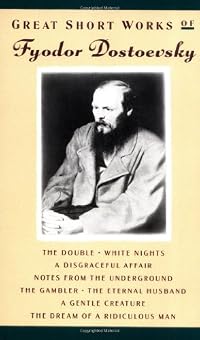
Great Short Works of Dostoyevsky
by Fyodor Dostoyevsky 
On This Page
Description
Presents a collection of short stories by the Russian author, including "White Nights," "Notes from the Underground," and "A Gentle Creature."Tags
Recommendations






Member Reviews
Thematically enthralling, but as another reviewer pointed out these translations run to the clunky (a fault which the Tolstoy volume in this series does not share). Oddly, I found this particularly true of the translation of "The Double," which seems to have been done specifically for this volume.. Oddly, too, the ones by the oft-reviled Constance Garnett are probably the smoothest. Shouldn't the newer translations be better than the older ones?
Said translational clunkiness consists, as it often does for me with translations from Russian, in a very unnatural, un-idiomatic sound to things -- translations that read like dubbed movies sound. I am probably wrong, but I suspect Dostoevsky does not sound like this in the original.
Said translational clunkiness consists, as it often does for me with translations from Russian, in a very unnatural, un-idiomatic sound to things -- translations that read like dubbed movies sound. I am probably wrong, but I suspect Dostoevsky does not sound like this in the original.
I read each of the stories sporadically over the course of 3 or 4 years before finally finishing this collection.
The two that stood out to me as clear favorites were The Double and A Disgraceful Affair (a.k.a. An Unpleasant Predicament.) The latter of which brought to mind Michael Scott levels of social awkwardness. Brilliantly told stories that peer into the inner-turmoils of one's consciousness the way few do as well as FD.
The two that stood out to me as clear favorites were The Double and A Disgraceful Affair (a.k.a. An Unpleasant Predicament.) The latter of which brought to mind Michael Scott levels of social awkwardness. Brilliantly told stories that peer into the inner-turmoils of one's consciousness the way few do as well as FD.
The great short works of Fyodor Dostoevsky
Ian Kowalski
As this is a collection of several writings of Dostoevsky, it is useful for seeing some consistencies that his writings have. For example, the majority of the main characters have either a strong obsession with some idea or concept or the main characters demonstrate a notable character flaw, but are less obsessed with a single idea. However, the character do not seem to show both of these traits in the writing, so if they are obsessed with an idea they will not have other problems based off of a character flaw, and vice versa.
In the stories The Double, The Dream of a Ridiculous Man, Notes from the Underground, and The Gambler, the main character’s issues (or the source of their show more narrative) is from an idea or concept integral to their character. In The Double, the main character is convinced that a person looks exactly like him (the person at least looks very similar to him), and that this person is doing the best to cause his downfall. It is an interesting example of how ones beliefs affect what one sees, even to the point of madness. The Dream of a Ridiculous Man deals with a character who becomes convinced that he traveled to a Garden of Eden, and eventually caused its downfall because he could not understand, and therefore interfered with, their way of life. The Gambler and Notes from the Underground respectively deal with a man who is convinced that gambling will be his salvation, while the other deals with a man convinced that humanity will reject having a perfect world based off of logic. Notes from the Underground is particularly interesting because it uses the argument of two plus two is equal to four not as George Orwell later would (“freedom is the freedom to say…”) but as an argument for conformity to a scientific ideal, that would result in a ‘perfect world’. The argument of two plus two equals five is used to in this case represent humans freedom to choose their own path, to take the illogical route. This argument while interesting on its own (and indeed, humanity in the end would choose two plus two equals five just as the Dostoevsky suggests), is more interesting if one has read 1984, as it shows how two arguments can use the same concept (two plus two equals four) to come to opposite results (in Dostoevsky’s argument two plus two is the argument for complete control, while in Orwell’s it is for freedom). Despite the opposite results (freedom or enslavement), two plus two in both arguments stands for rationality, so in 1984 this means the right to think logically, while Dostoevsky uses logic as an example of complete control. Two plus two equals five stands for illogic, be it the freedom to do evil for personal gain, or commitment to the ingsoc party.
In the stories A Disgraceful Affair, The Eternal Husband, White Nights, and A Gentle Creature, they all feature characters’ with a major flaw. In A Disgraceful Affair, the source of the trouble is the characters inability to understand that he gave offence to someone, and acts as a demonstration how a person in power can, because they have power, feel that any act performed by them is not disgraceful, simply because it was performed by them. The Eternal Husband does not have the main character as severely flawed but rather the secondary character, who is the archetypical ‘eternal husband’. The concept of the eternal husband is an interesting one, although I do not think that it would be the same type of person as represented in the book. In the book, the eternal husband is a man who when married completely changes his personality to essentially what his wife wants, but whenever he is not married reverts to how he normally is. I personally suspect that the personality would change whenever he was in a place of responsibility, but that is not the case within the book. White Nights has the character’s main flaw to be introversion, so that he cannot understand people around him, and cannot deal with losing a friend. A Gentle Creatures main character is similarly flawed in his inability to understand characters, and this results in the death of his wife. This story shows how a person, when he grows excessively intent on his own goals, loses the ability to understand other people out of context of his goal, so the main character loses the ability to see his wife’s depression while he tries to reform her. After her death, there is a chapter entitled the scales fell from my eyes, which serves to demonstrate how once the persons goal is complete, either because the object of the goal is gone or they completed it, is now able to see how the actions they performed actually affected others.
Those are some of the concepts contained within Dostoevsky’s stories, such as an argument for the illogical nature of the human race, or corruption caused by power. These stories also show how Dostoevsky frequently builds characters in a similar manner, typically give them on highly noticeable trait, with short stories typically only having one character who acts as the test subject, while the longer stories will have multiple ideals. show less
Ian Kowalski
As this is a collection of several writings of Dostoevsky, it is useful for seeing some consistencies that his writings have. For example, the majority of the main characters have either a strong obsession with some idea or concept or the main characters demonstrate a notable character flaw, but are less obsessed with a single idea. However, the character do not seem to show both of these traits in the writing, so if they are obsessed with an idea they will not have other problems based off of a character flaw, and vice versa.
In the stories The Double, The Dream of a Ridiculous Man, Notes from the Underground, and The Gambler, the main character’s issues (or the source of their show more narrative) is from an idea or concept integral to their character. In The Double, the main character is convinced that a person looks exactly like him (the person at least looks very similar to him), and that this person is doing the best to cause his downfall. It is an interesting example of how ones beliefs affect what one sees, even to the point of madness. The Dream of a Ridiculous Man deals with a character who becomes convinced that he traveled to a Garden of Eden, and eventually caused its downfall because he could not understand, and therefore interfered with, their way of life. The Gambler and Notes from the Underground respectively deal with a man who is convinced that gambling will be his salvation, while the other deals with a man convinced that humanity will reject having a perfect world based off of logic. Notes from the Underground is particularly interesting because it uses the argument of two plus two is equal to four not as George Orwell later would (“freedom is the freedom to say…”) but as an argument for conformity to a scientific ideal, that would result in a ‘perfect world’. The argument of two plus two equals five is used to in this case represent humans freedom to choose their own path, to take the illogical route. This argument while interesting on its own (and indeed, humanity in the end would choose two plus two equals five just as the Dostoevsky suggests), is more interesting if one has read 1984, as it shows how two arguments can use the same concept (two plus two equals four) to come to opposite results (in Dostoevsky’s argument two plus two is the argument for complete control, while in Orwell’s it is for freedom). Despite the opposite results (freedom or enslavement), two plus two in both arguments stands for rationality, so in 1984 this means the right to think logically, while Dostoevsky uses logic as an example of complete control. Two plus two equals five stands for illogic, be it the freedom to do evil for personal gain, or commitment to the ingsoc party.
In the stories A Disgraceful Affair, The Eternal Husband, White Nights, and A Gentle Creature, they all feature characters’ with a major flaw. In A Disgraceful Affair, the source of the trouble is the characters inability to understand that he gave offence to someone, and acts as a demonstration how a person in power can, because they have power, feel that any act performed by them is not disgraceful, simply because it was performed by them. The Eternal Husband does not have the main character as severely flawed but rather the secondary character, who is the archetypical ‘eternal husband’. The concept of the eternal husband is an interesting one, although I do not think that it would be the same type of person as represented in the book. In the book, the eternal husband is a man who when married completely changes his personality to essentially what his wife wants, but whenever he is not married reverts to how he normally is. I personally suspect that the personality would change whenever he was in a place of responsibility, but that is not the case within the book. White Nights has the character’s main flaw to be introversion, so that he cannot understand people around him, and cannot deal with losing a friend. A Gentle Creatures main character is similarly flawed in his inability to understand characters, and this results in the death of his wife. This story shows how a person, when he grows excessively intent on his own goals, loses the ability to understand other people out of context of his goal, so the main character loses the ability to see his wife’s depression while he tries to reform her. After her death, there is a chapter entitled the scales fell from my eyes, which serves to demonstrate how once the persons goal is complete, either because the object of the goal is gone or they completed it, is now able to see how the actions they performed actually affected others.
Those are some of the concepts contained within Dostoevsky’s stories, such as an argument for the illogical nature of the human race, or corruption caused by power. These stories also show how Dostoevsky frequently builds characters in a similar manner, typically give them on highly noticeable trait, with short stories typically only having one character who acts as the test subject, while the longer stories will have multiple ideals. show less
I read this in tandem with certain of Freud's essays, which was rather interesting, as Freud generated some of his ideas through Dostoevsky, which makes Freud readily applicable to Dostoevsky (full circle when reading). I haven't read any of his longer works yet; I'm wondering how much these shorter works are just brief forays into specific themes before he mixed them all together in novel form. There's some definite repetition of themes. This would be fine, except this was read for a class, so we had to read *all* of them very quickly, and constantly rehashed these themes again. And again. And again. STill, very interesting, and I'm glad I got to read it. The things he does with narrators and women tend to be very subtle, while his show more social critiques take center stage. 8/10 show less
Slightly too much philosophy here and there for my taste in short fictions. Some very interesting themes for the time written, especially the Double- very Gogol/ Kafka. The Gambler reminded me of Proust. For the most part very depressing. All of the main characters are losers.
The shorter works by Dostoevsky that include Notes from Underground, The Gambler, The Double, and others. These works demonstrate the breadth of the author's genius.
GoodReads: Eight short masterworks, including "The Double", "White Nights," "A Disgraceful Affair", "Notes from the Underground," "The Gambler," "The Eternal Husband", "A Gentle Creature," and "The Dream of a Ridiculous Man".
GoogleBooks: The shorter works of one of the world's greatest writers, including the classics The Gambler and Notes From the Underground. The short works of Dostoevsky exist in the very large shadow of his astonishing longer novels, but they too are among the best works in the history of literature. The Gambler chronicles Dostoevsky's own addiction, which he eventually overcame. Many have argued that Notes From the Underground contains several keys to understanding the themes of the longer novels, like Crime and show more Punishment and The Idiot. Those stories are joined here by other classics, including White Nights and The Eternal Husband.
In the introduction to this volume, Ronald Hingley writes: "It is admittedly impossible to evaluate or understand Dostoevsky's major work properly without taking into account his less voluminous writings, (and) it is also true that many of his shorter works are masterpieces in their own right--as it is hoped the reader may remind himself or discover for the first time..."
Source: Publisher for HarperCollins 2004 edition (ISBN 9780060726461,) show less
GoogleBooks: The shorter works of one of the world's greatest writers, including the classics The Gambler and Notes From the Underground. The short works of Dostoevsky exist in the very large shadow of his astonishing longer novels, but they too are among the best works in the history of literature. The Gambler chronicles Dostoevsky's own addiction, which he eventually overcame. Many have argued that Notes From the Underground contains several keys to understanding the themes of the longer novels, like Crime and show more Punishment and The Idiot. Those stories are joined here by other classics, including White Nights and The Eternal Husband.
In the introduction to this volume, Ronald Hingley writes: "It is admittedly impossible to evaluate or understand Dostoevsky's major work properly without taking into account his less voluminous writings, (and) it is also true that many of his shorter works are masterpieces in their own right--as it is hoped the reader may remind himself or discover for the first time..."
Source: Publisher for HarperCollins 2004 edition (ISBN 9780060726461,) show less
Members
- Recently Added By
Lists

Best Sellers / Popular 1968
237 works; 5 members
Author Information

1,423+ Works 179,497 Members
One of the most powerful and significant authors in all modern fiction, Fyodor Dostoevsky was the son of a harsh and domineering army surgeon who was murdered by his own serfs (slaves), an event that was extremely important in shaping Dostoevsky's view of social and economic issues. He studied to be an engineer and began work as a draftsman. show more However, his first novel, Poor Folk (1846), was so well received that he abandoned engineering for writing. In 1849, Dostoevsky was arrested for being a part of a revolutionary group that owned an illegal printing press. He was sentenced to be executed, but the sentence was changed at the last minute, and he was sent to a prison camp in Siberia instead. By the time he was released in 1854, he had become a devout believer in both Christianity and Russia - although not in its ruler, the Czar. During the 1860's, Dostoevsky's personal life was in constant turmoil as the result of financial problems, a gambling addiction, and the deaths of his wife and brother. His second marriage in 1887 provided him with a stable home life and personal contentment, and during the years that followed he produced his great novels: Crime and Punishment (1886), the story of Rodya Raskolnikov, who kills two old women in the belief that he is beyond the bounds of good and evil; The Idiots (1868), the story of an epileptic who tragically affects the lives of those around him; The Possessed (1872), the story of the effect of revolutionary thought on the members of one Russian community; A Raw Youth (1875), which focuses on the disintegration and decay of family relationships and life; and The Brothers Karamazov (1880), which centers on the murder of Fyodor Karamazov and the effect the murder has on each of his four sons. These works have placed Dostoevsky in the front rank of the world's great novelists. Dostoevsky was an innovator, bringing new depth and meaning to the psychological novel and combining realism and philosophical speculation in his complex studies of the human condition. (Bowker Author Biography) show less
Fyodor Dostoyevsky has a Legacy Library. Legacy libraries are the personal libraries of famous readers, entered by LibraryThing members from the Legacy Libraries group.
Series
Belongs to Publisher Series
Work Relationships
Common Knowledge
- Original publication date
- 1968 (collection) (collection)
Classifications
- Genres
- Fiction and Literature, General Fiction
- DDC/MDS
- 891.733 — Literature & rhetoric Asian Literature East Indo-European and Celtic literatures Russian and East Slavic languages Russian fiction 1800–1917
- LCC
- PZ3 .D742 — Language and Literature Fiction and juvenile belles lettres Fiction and juvenile belles lettres Fiction in English
- BISAC
Statistics
- Members
- 833
- Popularity
- 32,806
- Reviews
- 10
- Rating
- (4.39)
- Languages
- English
- Media
- Paper
- ISBNs
- 3
- ASINs
- 4