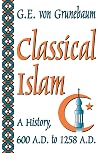
Classical Islam : a History 600-1258
by Gustave E. von Grunebaum
On This Page
Description
In a book written with the poignancy and beauty appropriate to its subject matter, the author opens by reminding us that the essence of a society is in a sense identical with its history. Classical Islam also serves as a reminder that in the case of Islam, despite its triumphs on the fields of battle, telling its history is the only way open to us to render that essence accessible and show it from all sides. The work offers a grand narrative of a faith that offers an interpretation of the show more world, a way of life, and a style of thinking, that goes far beyond institutional or political supports. The relevance of this historical perspective is beyond dispute. The period from 610 A.D. when Muhammad received his call until the conquest of Baghdad by the Mongols in 1258 is known as the classical period of Islam. This was the period of the great expansion of Islam both as a political structure and as a religious and intellectual community. It established the base for the development of the high Islamic civilization of North Africa, the Near East, Persia, and India, as well as further expansion of the Islamic religious and intellectual community throughout the world. This book presents an authoritative history of the period written by one of the world's leading experts on the subject.Classical Islam examines the relationships, both cultural and political, between the Islamic world and the Mediterranean countries and India and elaborates on the economic, social, and intellectual factors and forces that shaped the Muslim world and molded its interactions with infidels. The work is written in a clear and direct narrative form, emphasizing simultaneously the major intellectual trends and the political events and tendencies of the formative period in Islamic history that still resonates today. show lessTags
Recommendations
















Member Reviews
CLASSICAL ISLAM:
A HISTORY 600A D-1258A.D
G E.von Grunebaum
The period from 610 A.D. when Muhammad
received his "call" until the conquest
of Bagdad by the Mongols in 1258 is
known as the "classical" period of Islam
This was the period of the great expansion
of Islam both as a political structure and
as a religious and intellectual community.
It established the base for the development
of the high Islamic civilizations of
North Africa, the Near East, Persia, and
India, as well as further expansion of the
Islamic religious and intellectual community
throughout the world. This book
presents an authoritative history of the
period written by one of the world's leading
experts on the subject.
In Classical Islam Professor von
Grunebaum examines the show more relationships
both cultural and political, between the
Islamic world and the Mediterranean
countries and India and elaborates on the
economic, social, and intellectual factors and
forces that shaped the Muslim world and
molded its interactions with "infidels." The
book is written in simple and direct narrative
form, emphasizing simultaneously the
major intellectual trends and the political
events and tendencies of the period.
Succinct and well-written, Classical
Islam is important reading for all scholars
of Islam, comparative religion, and
medieval history and all those interested in
the Middle East. show less
A HISTORY 600A D-1258A.D
G E.von Grunebaum
The period from 610 A.D. when Muhammad
received his "call" until the conquest
of Bagdad by the Mongols in 1258 is
known as the "classical" period of Islam
This was the period of the great expansion
of Islam both as a political structure and
as a religious and intellectual community.
It established the base for the development
of the high Islamic civilizations of
North Africa, the Near East, Persia, and
India, as well as further expansion of the
Islamic religious and intellectual community
throughout the world. This book
presents an authoritative history of the
period written by one of the world's leading
experts on the subject.
In Classical Islam Professor von
Grunebaum examines the show more relationships
both cultural and political, between the
Islamic world and the Mediterranean
countries and India and elaborates on the
economic, social, and intellectual factors and
forces that shaped the Muslim world and
molded its interactions with "infidels." The
book is written in simple and direct narrative
form, emphasizing simultaneously the
major intellectual trends and the political
events and tendencies of the period.
Succinct and well-written, Classical
Islam is important reading for all scholars
of Islam, comparative religion, and
medieval history and all those interested in
the Middle East. show less
Jun 28, 2018Spanish
Ratings
Members
- Recently Added By
Author Information
16+ Works 327 Members
G. E. von Grunebaum was professor of history and director of the Near Eastern Center at the University of California, Los Angeles.
Common Knowledge
- Canonical title
- Classical Islam : a History 600-1258
Classifications
Statistics
- Members
- 83
- Popularity
- 384,775
- Reviews
- 1
- Rating
- (5.00)
- Languages
- English
- Media
- Paper, Ebook
- ISBNs
- 5
- ASINs
- 2