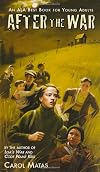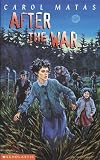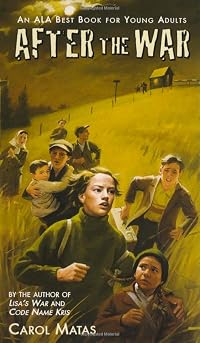
After the War
by Carol Matas
On This Page
Description
After being released from Buchenwald at the end of World War II, fifteen-year-old Ruth risks her life to lead a group of children across Europe to Palestine.Tags
Recommendations






Member Reviews
This is a brilliant novel. A great follow - up to Anne Frank type novels set during WW2, this occurs immediately after the war has ended. It tells of what happened to the jewish children who survived - the hardship and prejudice and battles they still faced, both inside their own heads and outside in the real world ( i.e from border guards) as they try to make their way to the homeland Palestine. This is Ruth's story - the only one of 80 family members to survive Auschwitz, death squads, forced marches and other methods of extermination. This is a harrowing story based on true accounts - how children were able to survive because they were hidden , they were small, they were resourceful, etc. Ruth must face her own demons as he pretends show more she is 18 to lead a group of younger children across 5 countries and onto a ship to the Middle east. There are a few serious tissue moments in this book - you have been warned! [Chapter 9 p.67-68 up to "I nod" then p.73 "the next afternoon" - p.77 Ruth must take down the younger children's stories.] show less
The problem recounting the saga of history is the question of where to end the story. History, of course, doesn't end... or at least it hasn't ended yet. Even if you bring the tale to the present day, all you need to do is wait until tomorrow, then go to the newspaper and find out what happens next. Of course, to be practical, you need to pick a stopping point--a place where events have reached a climax and one of the issues of history, at least, have been resolved. So it is with that bit of history we call World War II. To hear the tale of the war, you'll hear of the rise of Hitler and the Nazis, the expansion of German power, the oppression then slaughter of the Jews and others, the opposition of first France and Britain, then the show more Soviets and Americans. You'll hear of the battles, the strategies, the victories, the losses, the surrender and the liberation. And then they all lived happily ever after.... not. After the War is a tale set, naturally, after World War II. It's the story of a Jewish girl, Ruth, who has been liberated from Buchenwald. She returns to her home in Poland only to find that it's no longer her home. Her family is gone, her former residence is occupied by her uncle's maid, who answers the door wearing Ruth's mother's dress. She finds shelter with some fellow refugees, but finds that the shelter is tenuous at best. There are too many goyim who are only too ready to continue Hitler's agenda of lies and murder. Some of the Jews hold onto the hope of emigrating to Palestine, of founding a Jewish homeland where they can live, thrive and protect themselves. But the British have cut off all immigration there. How could anyone possibly manage to make the journey and get in? Ah, therein lies the tale. It's a well written one, with a depth of character and interesting plot. I found myself a bit torn reading it, sympathizing with the Ruth and her comrades, but also knowing the rest of the story, that an Israeli homeland would not guarantee perfect peace or justice.
--J. show less
--J. show less
After leaving a displaced persons camp, 15-year-old Ruth returns to Poland to search for any surviving members of her family. Believing herself to be the only survivor in her family, Ruth agrees to join the Brichah to help lead a group of Jewish children to Palestine. Palestine is still under the British Mandate, and the British were not allowing Jewish refugees to immigrate legally. Ruth and her travel companions must risk their lives to reach their dream of Eretz Israel.
While all the characters and events are fictional, the author modeled them on real characters and events. I’ve read a fair amount about the Holocaust, but I was less familiar with the continued post-war violence against Jews who returned to Poland and against Jews show more who attempted to enter Palestine illegally since the British severely limited the number of legal immigrants. I learned something from this inspirational story of a teenager’s transition from captivity and fear to freedom and joy. show less
While all the characters and events are fictional, the author modeled them on real characters and events. I’ve read a fair amount about the Holocaust, but I was less familiar with the continued post-war violence against Jews who returned to Poland and against Jews show more who attempted to enter Palestine illegally since the British severely limited the number of legal immigrants. I learned something from this inspirational story of a teenager’s transition from captivity and fear to freedom and joy. show less
I read this as a buddy read with Hilary, and we each read an Open Library edition. Thanks to Hilary for finding a book that had 2 editions of the same book, identical copies I think, available for borrowing immediately. We read this over 4 days and read at the same time which was really a fun way to do a buddy read. It was a really quick read. It could be read easily in one day and even in one sitting.
It’s such a short novel and most novels with so few pages are written for children. I had this on my children’s and on my young adult shelf, but so many of the events were so brutal. Too brutal for children in my opinion. There is also a bit of romance that would probably not interest most children, so I took it off my children’s show more shelf.
For young adult/adult it was too short. I wished it had been longer and included more details about characters & events. I wanted more fleshed-out characters. I was okay with not all the characters being three dimensional enough because this really is Ruth’s story. What was there I really enjoyed reading but there just wasn’t enough there to completely satisfy me. Also, maybe because it was so short and so much had to fit into so few words, I noticed many “representative types” for some of the characters. Every type of belief system and goal checked. That was slightly annoying but only slightly because it did seem real enough to me.
Ruth is a great character. She’s barely 15 but posing as older in order to appear less vulnerable. I’m in awe of her and many of the children and adult characters in the book. I also particularly like Zvi.
Some of the happenings would seem over the top but I’ve read a lot of Holocaust and post Holocaust books, including many non-fiction books, and everything that happens in the book were the kinds of things that really happened during the war and in the period after the war ended. Most of it seemed realistic so in other words highly disturbing. I appreciated the psychological sophistication shown about what these people went through and are going through and their coping styles and that the happenings are mostly presented quite realistically, in the past, in the present, and in the future too.
But there are things that rang false. These people seemed to know the numbers of how many Jews died in the Holocaust and in Poland. My understanding is that European civilians didn’t know these stats in the mid-late 40s. There were a few other things that seemed unrealistic or off. The way the escaping group behaved at one point. Also, at one point Ruth says she can’t swim and then when needed she swims which didn’t seem possible but then in an old memory she was swimming.
One part I thought was off wasn’t. I did look up when paper plates were invented because I thought maybe that way another “too far in the future thing” to have in this story but I was wrong. They’ve been around since the late 1800s.
I didn’t like that even by the end of the book she never seemed to reveal her real age to Zvi but in this short book even the relationships had to be rushed.
For all these criticisms, I didn’t seem to enjoy the reading experience any less. I liked it a lot. 3-1/2 stars. Hilary and I are going to read another book by this author and I’m looking forward to it. That said unless I like the next book (Lisa’s War) better than this one, I might not read more books by this author. She writes many books that seem similar to this one. There are just so many great books out there. This almost was 4 stars for me but it wasn’t, and I want all my books to be 5 or 4 stars.
Reading this book, the group of young people trying to get to Palestine, and of Cyprus’s role, and of a Sabra, made me want to watch the movie Exodus again and to read that book. show less
It’s such a short novel and most novels with so few pages are written for children. I had this on my children’s and on my young adult shelf, but so many of the events were so brutal. Too brutal for children in my opinion. There is also a bit of romance that would probably not interest most children, so I took it off my children’s show more shelf.
For young adult/adult it was too short. I wished it had been longer and included more details about characters & events. I wanted more fleshed-out characters. I was okay with not all the characters being three dimensional enough because this really is Ruth’s story. What was there I really enjoyed reading but there just wasn’t enough there to completely satisfy me. Also, maybe because it was so short and so much had to fit into so few words, I noticed many “representative types” for some of the characters. Every type of belief system and goal checked. That was slightly annoying but only slightly because it did seem real enough to me.
Ruth is a great character. She’s barely 15 but posing as older in order to appear less vulnerable. I’m in awe of her and many of the children and adult characters in the book. I also particularly like Zvi.
Some of the happenings would seem over the top but I’ve read a lot of Holocaust and post Holocaust books, including many non-fiction books, and everything that happens in the book were the kinds of things that really happened during the war and in the period after the war ended. Most of it seemed realistic so in other words highly disturbing. I appreciated the psychological sophistication shown about what these people went through and are going through and their coping styles and that the happenings are mostly presented quite realistically, in the past, in the present, and in the future too.
But there are things that rang false. These people seemed to know the numbers of how many Jews died in the Holocaust and in Poland. My understanding is that European civilians didn’t know these stats in the mid-late 40s. There were a few other things that seemed unrealistic or off. The way the escaping group behaved at one point. Also, at one point Ruth says she can’t swim and then when needed she swims which didn’t seem possible but then in an old memory she was swimming.
One part I thought was off wasn’t. I did look up when paper plates were invented because I thought maybe that way another “too far in the future thing” to have in this story but I was wrong. They’ve been around since the late 1800s.
I didn’t like that even by the end of the book she never seemed to reveal her real age to Zvi but in this short book even the relationships had to be rushed.
For all these criticisms, I didn’t seem to enjoy the reading experience any less. I liked it a lot. 3-1/2 stars. Hilary and I are going to read another book by this author and I’m looking forward to it. That said unless I like the next book (Lisa’s War) better than this one, I might not read more books by this author. She writes many books that seem similar to this one. There are just so many great books out there. This almost was 4 stars for me but it wasn’t, and I want all my books to be 5 or 4 stars.
Reading this book, the group of young people trying to get to Palestine, and of Cyprus’s role, and of a Sabra, made me want to watch the movie Exodus again and to read that book. show less
After WWII ends, and 15 year old Ruth is liberated from Buchenwald, she tries to return home. Finding noone, she believes her whole family has been killed and she is the only survivor. Lying about her age, she joins a group smuggling Jewish survivors to Palestine.
This is a good book that takes place after WWII and lets you know about what happen to all of the Jewish children that survived the Holocaust and what they had to go through while trying to get to reach their homeland, Palestine. The main character is a little girl by the name of Ruth. She is the last one left of her family. You live through Ruth and go on an amazing journey while they (Ruth and some other kids) try to get the Palestine.
This book was very intriguing. I am very interested in WWII and what happened after it, so this book was perfect for me. Event thought this book was fiction it was based on true events, so I could imagine what it was like after the war for children. This was an incredibly astounding book.
From a show more teacher’s point of view, “After the War” is a great book to use with older students. This book is a great book to use for a lead in to future lessons about WWII, the Holocaust, and can use this book for research projects and major classroom discussions. I didn’t think the book was well written, but I found it very entertaining. show less
This book was very intriguing. I am very interested in WWII and what happened after it, so this book was perfect for me. Event thought this book was fiction it was based on true events, so I could imagine what it was like after the war for children. This was an incredibly astounding book.
From a show more teacher’s point of view, “After the War” is a great book to use with older students. This book is a great book to use for a lead in to future lessons about WWII, the Holocaust, and can use this book for research projects and major classroom discussions. I didn’t think the book was well written, but I found it very entertaining. show less
15 yo, released from Buchenwald, leads group of children to Palestine
Members
- Recently Added By
Lists

Sonlight Books
1,487 works; 25 members

2022 Christmas Gifts
60 works; 13 members
Author Information

67+ Works 5,542 Members
Writer Carol Matas was born in Canada in 1949. Matas was an actress and currently teaches writing. Matas is best known for her historical adventures. These often feature young people caught up in the world's problems. "Daniel's Story," about a young Jewish boy in Nazi Germany, was short-listed for the 1993 Governor General's Award and the 1994 show more Ruth Schwartz Award and won the Silver Birch Award. Lisa won the Geoffrey Bilson Award and was a New York Times Book Review Notable of 1989. (Bowker Author Biography) show less
Awards and Honors
Awards
Distinctions
Common Knowledge
- Canonical title
- After the War
- Original publication date
- 1996
- Important places
- Palestine; Auschwitz concentration camp, Oświęcim, Lesser Poland, Poland; Ostroviec, Świętokrzyskie, Poland; Kielce, Świętokrzyskie, Poland; Czech border; Italy (show all 7); Cyprus
- Important events
- Holocaust
- Epigraph
- THE IMMIGRANT EXPERIENCE
like warriors of fate they delivered themselves from
hell leaving fires behind they sought water
braving mountains in winter and hostile neighbours
they were illegal everywhere
... (show all)
carrying their small inside coats taken from the dead
they knew even deserts would learn to grow trees
trusting no one they could see the path ahead
no longer the scorched of the earth
--Per Brask - Dedication
- To Donna Babcock and Tim Babcock with
heartfelt thanks, and to their children, Jennifer,
Jordan, Jeremy, and Hilary
Amanda Silvian - First words
- I thought you were all dead.
- Last words
- (Click to show. Warning: May contain spoilers.)"Welcome home," Simon says.
Classifications
Statistics
- Members
- 508
- Popularity
- 59,171
- Reviews
- 8
- Rating
- (3.78)
- Languages
- Dutch, English, Spanish
- Media
- Paper
- ISBNs
- 9
- ASINs
- 1