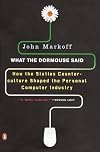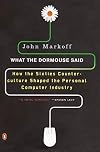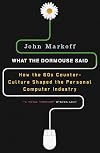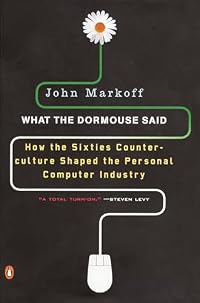
What the Dormouse Said: How the Sixties Counterculture Shaped the Personal Computer Industry
by John Markoff
On This Page
Description
Most histories of the personal computer industry focus on technology or business. John Markoff's landmark book is about the culture and consciousness behind the first PCs--the culture being counter- and the consciousness expanded, sometimes chemically. It's a brilliant evocation of Stanford, California, in the 1960s and '70s, where a group of visionaries set out to turn computers into a means for freeing minds and information. In these pages one encounters Ken Kesey and the phone hacker show more Cap'n Crunch, est and LSD, The Whole Earth Catalog and the Homebrew Computer Lab. What the Dormouse Said is a poignant, funny, and inspiring book by one of the smartest technology writers around. show lessTags
Recommendations













Member Reviews
Markoff has recovered a remarkable hidden history of the origins of the personal computer in the fertile soil of Palo Alto in the 1960s. Linking together the immense vision of Douglas Engelbert that a computer could be under control of a single mind, renegade psychedelic psychiatrists and bohemian artists, and anti-war activists attempting to liberate technology in the shadow of the military industrial complex.
The structure is of many small narratives linked together, a few names appearing again and again. Douglas Engelbert, Stewart Brand, and Fred Moore are the protagonists, with lesser engineers and activists coming in to solve a problem and then disappearing to a commune or Xerox PARC. The scattered oral histories make the overall show more narrative somewhat hard to follow, but the stories are simply incredible. This is the time the entire lab tried LSD. This is the time the lab joined a yoga cult. This is the time when anti-war activists laid siege to the building.
Two bits that I especially enjoyed were “The Mother of All Demos” Englebert’s 90 minute presentation of a networked interactive personal computer system. It’s worth being reminded that there was a point when all this was experimental and very hard, and cost real money. The journey of Fred Moore, committed pacifist, member of the People’s Computer Company, and founding member of the legendary Palo Alto Homebrew Computer Club, is a fascinating look at the social origins of computers as we use them, rather than as specialized military-scientific tools.
The argument of the book, that human-computer augmentation, psychedelic exploration, and radical politics, all flourished together, is more associational than causal. Certainly, a lot of people thinking in new ways were in the same place at the same time, but is LSD the reason the PC was born on the West Coast instead of around Route 128? Hard to say, but I do know that I had almost as much fun reading these stories as the participants had in 60s. show less
The structure is of many small narratives linked together, a few names appearing again and again. Douglas Engelbert, Stewart Brand, and Fred Moore are the protagonists, with lesser engineers and activists coming in to solve a problem and then disappearing to a commune or Xerox PARC. The scattered oral histories make the overall show more narrative somewhat hard to follow, but the stories are simply incredible. This is the time the entire lab tried LSD. This is the time the lab joined a yoga cult. This is the time when anti-war activists laid siege to the building.
Two bits that I especially enjoyed were “The Mother of All Demos” Englebert’s 90 minute presentation of a networked interactive personal computer system. It’s worth being reminded that there was a point when all this was experimental and very hard, and cost real money. The journey of Fred Moore, committed pacifist, member of the People’s Computer Company, and founding member of the legendary Palo Alto Homebrew Computer Club, is a fascinating look at the social origins of computers as we use them, rather than as specialized military-scientific tools.
The argument of the book, that human-computer augmentation, psychedelic exploration, and radical politics, all flourished together, is more associational than causal. Certainly, a lot of people thinking in new ways were in the same place at the same time, but is LSD the reason the PC was born on the West Coast instead of around Route 128? Hard to say, but I do know that I had almost as much fun reading these stories as the participants had in 60s. show less
This book was a fascinating history of personal computing in America, most specifically in Northern California, most especially in the Stanford region. I swear, I had no idea that Stanford played such a strategic role in the development of the personal computer.
The book attempts to tie together nerdie engineers with counterculture LSD druggies with free love types with antiwar activists with students with hackers and the mix is considerably hard to pull off, even for a writer as accomplished as Markoff. In fact, I would say that he fails at it. Still, he tries, yes, he does. He tries a chronological approach to things and soon we have computer science engineers dropping acid in what will become Silicon Valley, leading to who knows what show more kinds of creativity. But Markoff really concentrates this book on two or three people: Doug Engelbart and his Augmented Human Intelligence Research Center at SRI (Stanford Research Institute) and John McCarthy's SAIL (Stanford Artificial Intelligence Laboratory). Another important figure is Stewart Brand, author of the Whole Earth Catalog. Finally, there was programmer extraordinaire, Alan Kay.
Engelbart had a vision and he pulled in people to create his vision. He envisioned a computer -- this was the 1960s -- that would augment how people thought and what they did. McCarthy also envisioned a computerized world, albeit a slightly different one. Brand envisioned a computer for every person, while Kay envisioned small computers -- laptops of today -- that were so easy to use, that small children could be taught to use them. And these men all pulled it off!
Engelbart plays such a large role in the book, that it's nearly all about him, and I think that does the book a bit of a disservice. Nonetheless, it's he who creates the mouse to use with a display and keyboard in the late '60s. He was funded largely by ARPA and was critical in the development of the ARPAnet, the precursor to the Internet.
At some point, the book shifts to Xerox PARC (Palo Alto Reserch Center), the infamous Xerox research facility that had the most brilliant geniuses of the twentieth century under one roof and who literally did invent the personal computer as we know it to be. This was before Steve Wozniak and his famous claim that he invented the personal computer. Under Bob Taylor At PARC, Kay and the others who had shifted over there invented a graphical user interface, an operating system, a text editor (word processor), programming language, software, Ethernet for networking, a mouse, display, keyboard, audio, and a laser printer, which would be the only thing Xerox would go on to make money with. Xerox was so stupid, they never realized what they had in hand and they could have owned the world, but they didn't. Stupid, stupid, stupid.
Markoff weaves various stories of people like Fred Moore throughout the book, attempting to capture the counterculture spirit, but it seemed a little lost on me. Most of the techies weren't overly political. Most avoided Vietnam by working in a research facility that did weapons research (SRI). Most dropped acid at some point, but very few seemed to make that a lifestyle choice. I thought it was an interesting book, as the topic is personally interesting to me, but it wasn't the most cohesively written book and I would have expected a little more from a writer of Markoff's stature. Still, four solid stars and recommended. show less
The book attempts to tie together nerdie engineers with counterculture LSD druggies with free love types with antiwar activists with students with hackers and the mix is considerably hard to pull off, even for a writer as accomplished as Markoff. In fact, I would say that he fails at it. Still, he tries, yes, he does. He tries a chronological approach to things and soon we have computer science engineers dropping acid in what will become Silicon Valley, leading to who knows what show more kinds of creativity. But Markoff really concentrates this book on two or three people: Doug Engelbart and his Augmented Human Intelligence Research Center at SRI (Stanford Research Institute) and John McCarthy's SAIL (Stanford Artificial Intelligence Laboratory). Another important figure is Stewart Brand, author of the Whole Earth Catalog. Finally, there was programmer extraordinaire, Alan Kay.
Engelbart had a vision and he pulled in people to create his vision. He envisioned a computer -- this was the 1960s -- that would augment how people thought and what they did. McCarthy also envisioned a computerized world, albeit a slightly different one. Brand envisioned a computer for every person, while Kay envisioned small computers -- laptops of today -- that were so easy to use, that small children could be taught to use them. And these men all pulled it off!
Engelbart plays such a large role in the book, that it's nearly all about him, and I think that does the book a bit of a disservice. Nonetheless, it's he who creates the mouse to use with a display and keyboard in the late '60s. He was funded largely by ARPA and was critical in the development of the ARPAnet, the precursor to the Internet.
At some point, the book shifts to Xerox PARC (Palo Alto Reserch Center), the infamous Xerox research facility that had the most brilliant geniuses of the twentieth century under one roof and who literally did invent the personal computer as we know it to be. This was before Steve Wozniak and his famous claim that he invented the personal computer. Under Bob Taylor At PARC, Kay and the others who had shifted over there invented a graphical user interface, an operating system, a text editor (word processor), programming language, software, Ethernet for networking, a mouse, display, keyboard, audio, and a laser printer, which would be the only thing Xerox would go on to make money with. Xerox was so stupid, they never realized what they had in hand and they could have owned the world, but they didn't. Stupid, stupid, stupid.
Markoff weaves various stories of people like Fred Moore throughout the book, attempting to capture the counterculture spirit, but it seemed a little lost on me. Most of the techies weren't overly political. Most avoided Vietnam by working in a research facility that did weapons research (SRI). Most dropped acid at some point, but very few seemed to make that a lifestyle choice. I thought it was an interesting book, as the topic is personally interesting to me, but it wasn't the most cohesively written book and I would have expected a little more from a writer of Markoff's stature. Still, four solid stars and recommended. show less
I came to this book with no preconceptions, and came away feeling I had a much better understanding of the early days of personal computing. While others had difficulty finding a narrative thread, I thought Markoff (perhaps despite himself) told the interesting story of two ways of thinking about the impact of personal computing.
In Markoff's tale, Doug Engelbart and the group based at Xerox PARC was trying to figure out how to augment human intelligence, while the Stanford Artificial Intelligence Lab (SAIL) was trying to develop an electronic brain--essentially to replace human intelligence.
Yes, the story is convoluted, with a lot of characters. I did find myself wanting to create a timeline and chart the various dramatis personae; show more and someday I may still do that. Yes, I think the influence of LSD is probably overstated, though it certainly makes sense in creating a context for all this research. I do think this is a readable and fascinating account of this period. "What the Dormouse Said" is one of my favorite books of the last several years. show less
In Markoff's tale, Doug Engelbart and the group based at Xerox PARC was trying to figure out how to augment human intelligence, while the Stanford Artificial Intelligence Lab (SAIL) was trying to develop an electronic brain--essentially to replace human intelligence.
Yes, the story is convoluted, with a lot of characters. I did find myself wanting to create a timeline and chart the various dramatis personae; show more and someday I may still do that. Yes, I think the influence of LSD is probably overstated, though it certainly makes sense in creating a context for all this research. I do think this is a readable and fascinating account of this period. "What the Dormouse Said" is one of my favorite books of the last several years. show less
A most fascinating book, which describes how crooks by the names of Steve and William turned the "machines of loving grace" - created by geniuses like Douglas Engelbart and Alan Kay and promoted by dreamers like Fred Moore and Stewart Brand - into tools to spread hate and fake news, exploit the human labour, and make the rich richer.
I am finding this is making a great introduction to reading Walter Isaacson's biography of Steve Jobs. I never knew before of the radical activism of the genesis of personal computing: Computer power for the people! I also never knew that Bill Gates has been getting nicked by software piract since personal computers where solely in the domain of hobbyists. This books sheds light on the such important visionaries and innovators previously unknown to me as interface dreamer Doug Engelbart, ardent Lorax Fred Moore, San Francisco counterculture and the birth of home computing, and the ever fascinating Whole Earth Catalog and its creator Stewart Brand.
This book starts slow before you figure out that the entire book is about drug experimentation by the people who conceived every facet of the modern computer - the mouse, the GUI, and the Internet - at least on the left coast.
This is a fun book. I have read it a few times, and have now incorporated it into my California History course, as it complements material on the Bay Area's cultural history, and it especially offers a solid knowledge base concerning the establishment and development of the industries of Silicon Valley. Indeed, one of the more groundbreaking insights that I gained when reading this work is the undeniable and significant involvement of government-financed projects in developing the foundational concepts and technological breakthroughs that we enjoy today in the world of personal computers and electronic social networking.
Members
- Recently Added By
Lists

Science
28 works; 1 member
Author Information

4+ Works 1,324 Members
John Markoff has been a technology and science reporter at the New York Times since 1988. He was part of the team of Times reporters that won the 2013 Pulitzer Prize for Explanatory Reporting and is the author of What the Dormouse Said: How the Sixties Counterculture Shaped the Personal Computer. He lives in San Francisco, California.
Classifications
- Genres
- Technology, Nonfiction, History, General Nonfiction
- DDC/MDS
- 004.16 — Computer science, information & general works Computer science, knowledge & systems Computer science General works on specific types of computers Personal Computers
- LCC
- QA76.17 .M37 — Science Mathematics Mathematics Instruments and machines Calculating machines Electronic computers. Computer science
- BISAC
Statistics
- Members
- 529
- Popularity
- 56,076
- Reviews
- 11
- Rating
- (3.78)
- Languages
- English
- Media
- Paper, Ebook
- ISBNs
- 5
- ASINs
- 3