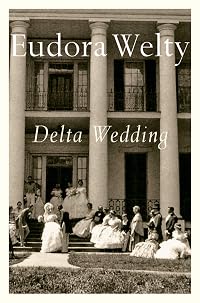
Delta Wedding
by Eudora Welty
On This Page
Description
A vivid and charming portrait of a large southern family, the Fairchilds, who live on a plantation in the Mississippi delta. The story, set in 1923, is exquisitely woven from the ordinary events of family life, centered around the visit of a young relative, Laura McRaven, and the family's preparations for her cousin Dabney's wedding.Tags
Recommendations



















Member Reviews
Delta Wedding is the story of the Fairchild family at the time of daughter Dabney’s wedding. The Fairchilds are a wealthy early 20th-century Mississippi Delta family; Dabney is marrying their overseer, Troy. That Dabney is 17 and Troy in his 30s, and that she is marrying beneath her station, don’t seem to bother anyone – at least not enough to do something about it. In another author’s hands this might be the central conflict of this novel, but Eudora Welty has something else in mind. This is primarily a portrait of a family at a certain place and time, how each person relates to one another, and how class informs their world view.
While Welty’s prose gripped me from the first page, as her characters tumbled off the page I show more found I had to concentrate more than usual just to keep up. Characters are given little introduction and it took quite a while for me to piece together the family relationships, and distinguish the servants from family members. Dabney is one of the least complex characters; her uncle George, on the other hand, is an enigma. He is different from the rest and held on a pedestal, for reasons that are never entirely clear. The plot – events in the days leading up to Dabney’s wedding – is secondary to the everyday interactions between people, and the composite picture this creates.
Although I can’t quite say I enjoyed Delta Wedding, it left me with a respect and appreciation for Eudora Welty and a desire to read more of her work. show less
While Welty’s prose gripped me from the first page, as her characters tumbled off the page I show more found I had to concentrate more than usual just to keep up. Characters are given little introduction and it took quite a while for me to piece together the family relationships, and distinguish the servants from family members. Dabney is one of the least complex characters; her uncle George, on the other hand, is an enigma. He is different from the rest and held on a pedestal, for reasons that are never entirely clear. The plot – events in the days leading up to Dabney’s wedding – is secondary to the everyday interactions between people, and the composite picture this creates.
Although I can’t quite say I enjoyed Delta Wedding, it left me with a respect and appreciation for Eudora Welty and a desire to read more of her work. show less
Rating: 3.75* of five
The Publisher Says: A vivid and charming portrait of a large southern family, the Fairchilds, who live on a plantation in the Mississippi delta. The story, set in 1923, is exquisitely woven from the ordinary events of family life, centered around the visit of a young relative, Laura McRaven, and the family’s preparations for her cousin Dabney’s wedding.
My Review: The Doubleday UK meme, a book a day for July 2014, is the goad I'm using to get through my snit-based unwritten reviews. Today's prompt, the ninth, is to discuss your favorite character in a novel to hate.
Dabney. Hands down, Dabney. What a self-centered nightmare of a spoiled brat! She's marryin' 'neath her, that no-count Troy is just scramblin' for a show more place in the Fairchilds! But Dabney, she knows:
And still, there's something deeply Southern in Dabney's greed, something that life in the lush heat of the land down by the water just puts in you, makes you part of it:
Dabney's complete inability to see the other person as real makes her a monster, that familiar monster, The Southern Belle. She hasn't got room for anyone but herself in the movie of her life:
Things, the stuff that surrounds people like the Fairchilds from cradle to grave (and they'd take it on as grave goods if only people still did that), *those* evoke tears and memories. Not the people, not the little damn-near stranger in the Fairchild midst, little motherless Laura whose presence is unwished for but accepted because she is Family.
And in the end, that's where we end up in this novel, in the Family. Like every family, the Fairchilds have codes and shortcuts in their communication that seem designed to exclude others. That includes the reader of the novel, in fact. But it's not that the Fairchilds don't want you to understand them, or that Miss Eudora failed to give you the keys to a roman à clef. It's this very experience that's the point of the novel. Either you like that experience, or you don't, but this is the point:
Now that said, what makes this book fall short of four stars for me, an ardent Eudoraist? Novels aren't like short stories in that the introduction of a character or inclusion of a detail must be part of the essential nature of the book. There are about a squillion voices in this chorus, and that's just way too many. WAY too many. So there isn't a long-term investment in the current carrying us to...to...wherever it is we're going and we don't quite get to. Miss Eudora could've pruned the voices to Dabney, Uncle George, and Laura, and been able to tell the same big, noisy story. But this is a novel, and writing novels was not Miss Eudora's métier. That was the short story, a form of which she was a mistress.
In the end, as much as I loved to hate Dabney and her cut-rate Scarlett-ness, I was only slightly less appalled by the sheer feckless ridiculousness of George, Dabney's uncle and the Fairchild Golden Boy, and the cult surrounding him. His morganatic marriage to Robbie is summed up by Aunt Ellen, one of his groupies:
That gets to the heart of my dislike and discomfort with George. He's so spoiled, so cossetted and babied, that only a severe adrenaline jolt (at someone else's expense) will do to fetch him up among the living.
It's not hard for me to appreciate this novel for what it is, but it's not at all the beau ideal of a novelist's art. I like it, I understand why others don't, but goodness me give me the lush, rich, deeply felt beauty of Welty's prose any old way it comes.
This work is licensed under a Creative Commons Attribution-NonCommercial-ShareAlike 3.0 Unported License. show less
The Publisher Says: A vivid and charming portrait of a large southern family, the Fairchilds, who live on a plantation in the Mississippi delta. The story, set in 1923, is exquisitely woven from the ordinary events of family life, centered around the visit of a young relative, Laura McRaven, and the family’s preparations for her cousin Dabney’s wedding.
My Review: The Doubleday UK meme, a book a day for July 2014, is the goad I'm using to get through my snit-based unwritten reviews. Today's prompt, the ninth, is to discuss your favorite character in a novel to hate.
Dabney. Hands down, Dabney. What a self-centered nightmare of a spoiled brat! She's marryin' 'neath her, that no-count Troy is just scramblin' for a show more place in the Fairchilds! But Dabney, she knows:
"I will never give up anything!" Dabney thought, bending forward and laying her head against the soft neck. "Never! Never! For I am happy, and to give up nothing will prove it. I will never give up anything, never give up Troy - or to Troy!" She thought smilingly of Troy, coming slowly, this was the last day, slowly plodding and figuring....
And still, there's something deeply Southern in Dabney's greed, something that life in the lush heat of the land down by the water just puts in you, makes you part of it:
The eagerness with which she was now going to Marmion, entering her real life there with Troy, told her enough - all the cotton in the world was not worth one moment of life! It made her know that nothing could ever defy her enough to make her leave it. How sweet life was, and how well she could hold it, pluck it, eat it, lay her cheek to it - oh, no one else knew. The juice of life and the hot, delighting taste and the fragrance and warmth to the cheek, the mouth....
Dabney's complete inability to see the other person as real makes her a monster, that familiar monster, The Southern Belle. She hasn't got room for anyone but herself in the movie of her life:
Life was not ever inviolate. Dabney, poor sister and bride, shed tears this morning (though belatedly) because she had broken the Fairchild night light the aunts had given her; it seemed so unavoidable to Dabney, that was why she cried, as if she had felt it was part of her being married that this cherished little bit of other peoples' lives should be shattered now.
Things, the stuff that surrounds people like the Fairchilds from cradle to grave (and they'd take it on as grave goods if only people still did that), *those* evoke tears and memories. Not the people, not the little damn-near stranger in the Fairchild midst, little motherless Laura whose presence is unwished for but accepted because she is Family.
And in the end, that's where we end up in this novel, in the Family. Like every family, the Fairchilds have codes and shortcuts in their communication that seem designed to exclude others. That includes the reader of the novel, in fact. But it's not that the Fairchilds don't want you to understand them, or that Miss Eudora failed to give you the keys to a roman à clef. It's this very experience that's the point of the novel. Either you like that experience, or you don't, but this is the point:
Indeed the Fairchilds took you in circles, whirling delightedly about, she thought, stirring up confusions, hopefully working themselves up. But they did not really want anything they got - and nothing, really, nothing really so very much, happened!
Now that said, what makes this book fall short of four stars for me, an ardent Eudoraist? Novels aren't like short stories in that the introduction of a character or inclusion of a detail must be part of the essential nature of the book. There are about a squillion voices in this chorus, and that's just way too many. WAY too many. So there isn't a long-term investment in the current carrying us to...to...wherever it is we're going and we don't quite get to. Miss Eudora could've pruned the voices to Dabney, Uncle George, and Laura, and been able to tell the same big, noisy story. But this is a novel, and writing novels was not Miss Eudora's métier. That was the short story, a form of which she was a mistress.
In the end, as much as I loved to hate Dabney and her cut-rate Scarlett-ness, I was only slightly less appalled by the sheer feckless ridiculousness of George, Dabney's uncle and the Fairchild Golden Boy, and the cult surrounding him. His morganatic marriage to Robbie is summed up by Aunt Ellen, one of his groupies:
t seemed to Ellen at moments that George regarded them, and regarded things - just things, in the outside world - with a passion which held him so still that it resembled indifference. Perhaps it was indifference - as though they, having given him this astonishing feeling, might for a time float away and he not care. It was not love or passion itself that stirred him, necessarily, she felt - for instance, Dabney's marriage seemed not to have affected him greatly, or Robbie's anguish. But little Ranny, a flower, a horse running, a color, a terrible story listened to in the store in Fairchilds, or a common song, and yes, shock, physical danger, as Robbie had discovered, roused something in him that was immense contemplation, motionless pity, indifference...Then, he would come forward all smiles as if in greeting - come out of his intensity and give some child a spank or a present. Ellen had always felt this about George and now there was something of surprising kinship in the feeling.
That gets to the heart of my dislike and discomfort with George. He's so spoiled, so cossetted and babied, that only a severe adrenaline jolt (at someone else's expense) will do to fetch him up among the living.
It's not hard for me to appreciate this novel for what it is, but it's not at all the beau ideal of a novelist's art. I like it, I understand why others don't, but goodness me give me the lush, rich, deeply felt beauty of Welty's prose any old way it comes.
This work is licensed under a Creative Commons Attribution-NonCommercial-ShareAlike 3.0 Unported License. show less
In the middle of cotton picking time, 17 year old Dabney Fairchild has announced that she will marry her family's overseer, Troy Flavin, a man decidedly not from the Delta, and at this moment exactly twice Dabney's age. ("...but that was just a funny accident, thirty-four being twice seventeen, it wouldn't be so later on. When she was as much as twenty-five, he wouldn't be fifty!") We learn of the upcoming wedding first from Dabney's 9-year-old cousin, Laura McRaven, who is traveling from Jackson alone on the train to attend. At first we see everything through Laura's eyes, colored slightly by her memory of being among the Fairchilds before, and by the fact that her mother has recently died. There is a large family (8 children, multiple show more aunts and uncles, and the black servants) spread over a sprawling plantation, the neighboring town, and some as far away as Memphis, all converging on short notice to see Dabney married. Despite the fact that "everyone" said the Fairchilds would die if there were to be a match between Dabney and Troy when they began keeping company, only her father seems to have raised any real protest, and even he ultimately relents to give her "any kind of wedding" she wanted.
This is the 1920's, and while the plantation is almost self-contained, and somewhat outside of time, still hints of the world beyond its fields and cotton houses creep in. Dabney's older sister, Shelley, longs to get her hands on a copy of The Beautiful and Damned, which is going around the Delta, and she is packing for a trip to Europe with her Aunt Tempe. Flowers, dresses, cake and shepherdesses' crooks for the wedding come in from Memphis and are viewed with awe and some skepticism. A cousin, also from Memphis, brings chicken pox with her, and must be quarantined.
The novel is short on plot, long on place and character, brimming with subtext. There are flighty maiden aunts, scatty and somewhat scary old black retainers, drunken uncles, dissatisfied wives, precocious children who pop in and out with observations and pronouncements that often seem out of place. The action sometimes has the feel of a stage play, and in fact treating it that way was helpful to me at times when I couldn't seem to "engage" with what was going on. I just tried to watch it as carefully as possible until the scene changed. There are levels and levels of meaning in the commonplace goings-on, and trying to read this book casually or superficially is likely to leave the reader unimpressed. There just isn't enough pure story to carry you on, unless you plunge into the depths and realize how much exploration of relationships and themes is happening below the surface. Men/women, blacks/whites, youth/age, love and disillusionment, class differences, motherhood, moral ambiguities...so much is going on. Just as one example, the whole subject of pregnancy and childbirth permeates scene after scene. Dabney's mother is pregnant (for the tenth time). Pinchy, one of the servants, is clearly near to giving birth, quite possibly to Troy's child. A cousin couldn't come to the wedding, because she has just recently had a baby. There is even a suggestion that Dabney may be pregnant. (One scene in particular put that idea in my head, and after all, why else would she be getting married in such a hurry at such an inopportune time?)
I'm not much of a close reader, but this novel is beautifully composed in a way that made that process rewarding. And naturally, once will not be enough for me. I think I've only begun to "know" this book. show less
This is the 1920's, and while the plantation is almost self-contained, and somewhat outside of time, still hints of the world beyond its fields and cotton houses creep in. Dabney's older sister, Shelley, longs to get her hands on a copy of The Beautiful and Damned, which is going around the Delta, and she is packing for a trip to Europe with her Aunt Tempe. Flowers, dresses, cake and shepherdesses' crooks for the wedding come in from Memphis and are viewed with awe and some skepticism. A cousin, also from Memphis, brings chicken pox with her, and must be quarantined.
The novel is short on plot, long on place and character, brimming with subtext. There are flighty maiden aunts, scatty and somewhat scary old black retainers, drunken uncles, dissatisfied wives, precocious children who pop in and out with observations and pronouncements that often seem out of place. The action sometimes has the feel of a stage play, and in fact treating it that way was helpful to me at times when I couldn't seem to "engage" with what was going on. I just tried to watch it as carefully as possible until the scene changed. There are levels and levels of meaning in the commonplace goings-on, and trying to read this book casually or superficially is likely to leave the reader unimpressed. There just isn't enough pure story to carry you on, unless you plunge into the depths and realize how much exploration of relationships and themes is happening below the surface. Men/women, blacks/whites, youth/age, love and disillusionment, class differences, motherhood, moral ambiguities...so much is going on. Just as one example, the whole subject of pregnancy and childbirth permeates scene after scene. Dabney's mother is pregnant (for the tenth time). Pinchy, one of the servants, is clearly near to giving birth, quite possibly to Troy's child. A cousin couldn't come to the wedding, because she has just recently had a baby. There is even a suggestion that Dabney may be pregnant. (One scene in particular put that idea in my head, and after all, why else would she be getting married in such a hurry at such an inopportune time?)
I'm not much of a close reader, but this novel is beautifully composed in a way that made that process rewarding. And naturally, once will not be enough for me. I think I've only begun to "know" this book. show less
Reading Delta Wedding is like attending a family wedding and meeting all your distant relatives for the first time. You have a sense of belonging and, at the same time, a sense of being an outsider. Everyone seems to know everyone so much better than you do and you're rushing to catch up on everyone's story and sort out who is who. This is a relatively short book, but perhaps because she is primarily a short-story writer, Eudora Welty has packed this book so densely with character and detail, you will feel as though you have read a family saga of many hundred pages. The delta is recreated in such detail that you can feel the humid, misty breezes and hear the crickets chirping. The young girls through whose perspective you watch the show more proceedings are enchanting.
Struggling to keep track of the characters forced me to go back and re-read parts of the book at times, which was, in fact, helpful in discovering important overlooked details. This is a book you can re-read many times always discovering something or someone new. show less
Struggling to keep track of the characters forced me to go back and re-read parts of the book at times, which was, in fact, helpful in discovering important overlooked details. This is a book you can re-read many times always discovering something or someone new. show less
Eudora Welty writes books that seem to be about nothing in particular. There are seldom any staggering occurrences. It is all about life. Of course, there is a major event coming in this novel, Dabney Fairchild is marrying, and all the family are gathering for the event; aunts, uncles, cousins, great-aunts, in-laws, all assembling to see Dabney off from the family home to a home of her own.
Along the way, we meet an array of fantastic characters, each an embodiment of their Southern heritage. This is a way of life that is virtually gone, I suppose, but it is a way of life that opens so many memories for me that it makes me want to cry. I was never, of course, one of THESE Southern belles, with the portico porches or land wealth and show more stores, but I can easily recall days when everyone from five generations would be gathered together in this same kind of family mash that sometimes brought with it ease and sometimes strain.
Welty knows people. Every word they utter in her stories rings with truth and veracity. You feel you have met them, you are there on the porch, you are sipping the iced tea, swinging the children, kissing the uncles. You are safe, as they are safe, because you have family, you belong, someone cares.
It has taken me a long time to get around to reading this wonderful story. I can add it to my list of Eudora Welty wonders that I have loved. show less
Along the way, we meet an array of fantastic characters, each an embodiment of their Southern heritage. This is a way of life that is virtually gone, I suppose, but it is a way of life that opens so many memories for me that it makes me want to cry. I was never, of course, one of THESE Southern belles, with the portico porches or land wealth and show more stores, but I can easily recall days when everyone from five generations would be gathered together in this same kind of family mash that sometimes brought with it ease and sometimes strain.
Welty knows people. Every word they utter in her stories rings with truth and veracity. You feel you have met them, you are there on the porch, you are sipping the iced tea, swinging the children, kissing the uncles. You are safe, as they are safe, because you have family, you belong, someone cares.
It has taken me a long time to get around to reading this wonderful story. I can add it to my list of Eudora Welty wonders that I have loved. show less
Had a dreamy quality that I enjoyed. The atmosphere was kind of beautiful and the descriptions were great and the scenes felt real. I liked it.
Weird/bad points: there was pretty much no conflict involved in the book even though quite a bit was set up, which was bizarre. For example, there are constant references to Troy's seeming unsuitability as a husband but nothing comes of it - and there's not really much explanation of WHY people talk about him as unsuitable.Near the end, Shelley witnesses him apparently shooting a black worker who's threatening him with a knife. The scene lasts maybe a page and she says it shows some sort of extreme unsuitability, but the event is never referenced again and Shelley makes no further comments about show more Troy, in thought or otherwise. The event itself is incredibly confusing and I have no idea what went on. Weird. There are a couple other similar scenes, which presumably have deeper implications or ones which aren't the obvious but aren't referenced again and don't seem to have an impact - George talking about "sleeping with" the vagrant girl Ellen finds in the woods - Ellen seems shocked but again nothing else happens, it doesn't affect their relationship and the girl is referenced once again in an ambiguous context. There are several times the author seems to be describing some sort of romantic tension between George and other people but maybe I'm reading too much into it. Every character is prone to going into deep reflection at every opportunity, which is pretty ridiculous but adds to the dream like quality of the book and really wasn't bad. There are a lot of named characters that it's impossible to keep track of and don't really have a point.
Bigger things: I note an event re: violence above - violence is treated as tainting someone in this one case. Yet Battle beating children happens often and is treated incredibly casually. He also threatens extreme violence casually and the one reference to this plays it off as a "oh haha our Battle!!" thing.
None of the Fairchilds are ever shown engaging in any work. Yet at the end of the book several describe how "draining" and "tiring" the wedding has been. The disconnect between words and experience is noticeable. The only reason I can see Troy being unsuitable, in fact, is in his job as an overseer - in doing their work, the work of the plantation owner running their lands, he's somehow "unclean". His presence impinges on the "paradise" of the Fairchilds' life - they have no experience of the reality of where their (obviously absolutely massive) income comes from. The thing is, this theme is hardly developed and shows mostly in omission, making me curious how the author felt about this.
The black workers have very little presence, even though they should be a constant presence around the house as domestic servants. The scenes that feature them show them as personality-less - they just obey orders happily - with 2 exceptions. Right at the end of the book, one says they don't like roses. This upsets Ellen, although we're not given much more than that. One character is visited at her house to ask about something lost and the Fairchilds who visited treat her vaguely dramatic searching as malicious - the one example of personality is shunned and considered bad.
In fact, I could think of only two other instances of things being treated as malicious or wrong in the book - the first is the mentally disabled preteen Maureen (who is referred to in rude terms) and the other is George's wife Robbie, who is again considered "unsuitable" but especially for leaving him when she feels hurt. Their real crime seems to be that they disturbed in some way the Fairchilds' untroubled existence.
I don't know if my view of the Fairchilds as horrible people who live an incredibly happy life merely by ignoring or shunning things that disturb it is an unreasonable one, but to me it was the only one that made sense and still let me enjoy the book. show less
Weird/bad points: there was pretty much no conflict involved in the book even though quite a bit was set up, which was bizarre. For example, there are constant references to Troy's seeming unsuitability as a husband but nothing comes of it - and there's not really much explanation of WHY people talk about him as unsuitable.
Bigger things: I note an event re: violence above - violence is treated as tainting someone in this one case. Yet Battle beating children happens often and is treated incredibly casually. He also threatens extreme violence casually and the one reference to this plays it off as a "oh haha our Battle!!" thing.
None of the Fairchilds are ever shown engaging in any work. Yet at the end of the book several describe how "draining" and "tiring" the wedding has been. The disconnect between words and experience is noticeable. The only reason I can see Troy being unsuitable, in fact, is in his job as an overseer - in doing their work, the work of the plantation owner running their lands, he's somehow "unclean". His presence impinges on the "paradise" of the Fairchilds' life - they have no experience of the reality of where their (obviously absolutely massive) income comes from. The thing is, this theme is hardly developed and shows mostly in omission, making me curious how the author felt about this.
The black workers have very little presence, even though they should be a constant presence around the house as domestic servants. The scenes that feature them show them as personality-less - they just obey orders happily - with 2 exceptions. Right at the end of the book, one says they don't like roses. This upsets Ellen, although we're not given much more than that. One character is visited at her house to ask about something lost and the Fairchilds who visited treat her vaguely dramatic searching as malicious - the one example of personality is shunned and considered bad.
In fact, I could think of only two other instances of things being treated as malicious or wrong in the book - the first is the mentally disabled preteen Maureen (who is referred to in rude terms) and the other is George's wife Robbie, who is again considered "unsuitable" but especially for leaving him when she feels hurt. Their real crime seems to be that they disturbed in some way the Fairchilds' untroubled existence.
I don't know if my view of the Fairchilds as horrible people who live an incredibly happy life merely by ignoring or shunning things that disturb it is an unreasonable one, but to me it was the only one that made sense and still let me enjoy the book. show less
Delta Wedding was my first book read during May. I chose it to tick off 1945 of my ACOB – and I wasn’t sure if I would enjoy it. I know lots of people really like Eudora Welty’s writing, but my only previous experience of her writing was not very successful. In 2012 I began reading her later novel Losing Battles, (1970) a book of something like 400 pages, I read about half of it before giving up in frustration. I had really wanted to like it but just couldn’t get to grips with it. I felt I needed to give Eudora Welty another try and this much earlier Welty novel was a charity shop find last year. Good news, I enjoyed Delta Wedding very much indeed, so much in fact that I might revisit Losing Battles one of these days.
Right from show more the start I was drawn into the story by the exceptional writing and evocative sense of place. It is a novel which deserves slow, considered reading, and while there isn’t a huge amount of plot – the story of a large, Mississippi family, in the weeks around the wedding of their daughter to the plantation overseer, is quite wonderful.
“People are mostly layers of violence and tenderness wrapped like bulbs, and it is difficult to say what makes them onions or hyacinths.”
In September 1923 nine-year-old Laura McRaven travels on the Yellow Dog train from Jackson Mississippi to the family plantation of Shellmound on the Mississippi delta. Laura’s mother has died, and at Shellmound she is enveloped by the enormous Fairchild family – her mother’s family. The cast of characters is huge, and it took me a while to get to grips with who was who. I found some names confusing, a child with the same name as his father and several older aunts called by their husbands’ names; ie Aunt Jim Allen – and Aunt Robbie married to Uncle George – it doesn’t take much to confuse me.
As Laura arrives the family are beginning to gather for the wedding of Dabney the prettiest of the Fairchild children. She is still only seventeen and about to marry an older man, Troy Flavin, a man from the mountains, the family overseer and there is the feeling that deep down the Fairchilds don’t fully approve. Though everyone treats Dabney with all the deference due to a beautiful young bride to be, giving her advice, and gently teasing.
“‘Don’t ever let this husband of yours, whoever he is, know you can cook, Dabney Fairchild, or you’ll spend the rest of your life in the kitchen. That’s the first thing I want to tell you.’”
The day to day events in the lives of this large, proud Southern family are portrayed with humour and affection. Children race around the house and grounds, drawing, poor motherless Laura into their games and their world, while the adults concern themselves with wedding preparations and family gossip. Aunt Ellen is the mother of the bride, mother to eight and expecting again, married to Uncle Battle she is a warm loving presence. Uncle George, the firm family favourite is due to arrive soon from Memphis with his wife Robbie – though when he finally turns up, he is alone, Robbie having apparently left him. This is just about as shocking a thing as any of the Fairchilds have ever heard, that she should leave George! George of course can do no wrong, though we see him as a little less than perfect.
As with all families, stories are told and retold, some quickly taking on an almost legendary status. Like the recent story; told to Laura and then repeated later by the adults – of George walking the railway trestle with young Maureen, as his wife watched nearby. Maureen’s foot got caught in the rail just as the train was coming, George stayed to free the child’s foot as the train raced toward them. Tragedy was averted, but the story of such a close call is hard to resist.
Dabney, the child bride is in love – after her marriage she will move into another family house on the plantation, Marmion. She has her head in the clouds, appearing at table just whenever she feels like it – Laura notices. She is girlish and romantic but despite her youth she knows what she wants and the life she wants is just within reach. The old maiden aunts gift her a small, treasured night light, the object seems to be symbolic for Laura and the aunts and perhaps even for Dabney too.
“Life was not ever inviolate. Dabney, poor sister and bride, shed tears this morning (though belatedly) because she had broken the Fairchild night light the aunts had given her; it seemed so unavoidable to Dabney, that was why she cried, as if she had felt it was part of her being married that this cherished little bit of other peoples’ lives should be shattered now.”
Capturing a time and place perfectly Delta Wedding is the story of long, slow Southern days, a complicated loving family, and ultimately a celebration of a way of life. So very pleased I gave Eudora Welty another chance. show less
Right from show more the start I was drawn into the story by the exceptional writing and evocative sense of place. It is a novel which deserves slow, considered reading, and while there isn’t a huge amount of plot – the story of a large, Mississippi family, in the weeks around the wedding of their daughter to the plantation overseer, is quite wonderful.
“People are mostly layers of violence and tenderness wrapped like bulbs, and it is difficult to say what makes them onions or hyacinths.”
In September 1923 nine-year-old Laura McRaven travels on the Yellow Dog train from Jackson Mississippi to the family plantation of Shellmound on the Mississippi delta. Laura’s mother has died, and at Shellmound she is enveloped by the enormous Fairchild family – her mother’s family. The cast of characters is huge, and it took me a while to get to grips with who was who. I found some names confusing, a child with the same name as his father and several older aunts called by their husbands’ names; ie Aunt Jim Allen – and Aunt Robbie married to Uncle George – it doesn’t take much to confuse me.
As Laura arrives the family are beginning to gather for the wedding of Dabney the prettiest of the Fairchild children. She is still only seventeen and about to marry an older man, Troy Flavin, a man from the mountains, the family overseer and there is the feeling that deep down the Fairchilds don’t fully approve. Though everyone treats Dabney with all the deference due to a beautiful young bride to be, giving her advice, and gently teasing.
“‘Don’t ever let this husband of yours, whoever he is, know you can cook, Dabney Fairchild, or you’ll spend the rest of your life in the kitchen. That’s the first thing I want to tell you.’”
The day to day events in the lives of this large, proud Southern family are portrayed with humour and affection. Children race around the house and grounds, drawing, poor motherless Laura into their games and their world, while the adults concern themselves with wedding preparations and family gossip. Aunt Ellen is the mother of the bride, mother to eight and expecting again, married to Uncle Battle she is a warm loving presence. Uncle George, the firm family favourite is due to arrive soon from Memphis with his wife Robbie – though when he finally turns up, he is alone, Robbie having apparently left him. This is just about as shocking a thing as any of the Fairchilds have ever heard, that she should leave George! George of course can do no wrong, though we see him as a little less than perfect.
As with all families, stories are told and retold, some quickly taking on an almost legendary status. Like the recent story; told to Laura and then repeated later by the adults – of George walking the railway trestle with young Maureen, as his wife watched nearby. Maureen’s foot got caught in the rail just as the train was coming, George stayed to free the child’s foot as the train raced toward them. Tragedy was averted, but the story of such a close call is hard to resist.
Dabney, the child bride is in love – after her marriage she will move into another family house on the plantation, Marmion. She has her head in the clouds, appearing at table just whenever she feels like it – Laura notices. She is girlish and romantic but despite her youth she knows what she wants and the life she wants is just within reach. The old maiden aunts gift her a small, treasured night light, the object seems to be symbolic for Laura and the aunts and perhaps even for Dabney too.
“Life was not ever inviolate. Dabney, poor sister and bride, shed tears this morning (though belatedly) because she had broken the Fairchild night light the aunts had given her; it seemed so unavoidable to Dabney, that was why she cried, as if she had felt it was part of her being married that this cherished little bit of other peoples’ lives should be shattered now.”
Capturing a time and place perfectly Delta Wedding is the story of long, slow Southern days, a complicated loving family, and ultimately a celebration of a way of life. So very pleased I gave Eudora Welty another chance. show less
Members
- Recently Added By
Lists

1940s
221 works; 25 members

Best Family Stories
241 works; 22 members
Southern Fiction
212 works; 52 members

Harold Bloom - The Western Canon: D. The Chaotic Age
833 works; 24 members
Talk Discussions
Past Discussions
Delta Wedding Group Read - Discussion Thread in 75 Books Challenge for 2022 (November 2022)
Author Information

99+ Works 15,324 Members
Eudora Welty was born in Jackson, Mississippi on April 13, 1909. She was educated at the Mississippi State College for Women in Columbus, Mississippi, and at the University of Wisconsin. She moved to New York in 1930 to study advertising at the Columbia University business school. After her father's death, she moved back to Jackson in 1931. She show more held various jobs on local newspapers and at a radio station before becoming a publicity agent for the Works Progress Administration (WPA), part of Franklin Roosevelt's New Deal program. Travelling through the state of Mississippi opened her eyes to the misery of the great depression and resulted in a series of photographs, which were exhibited in a one-women show in New York in 1936 and were eventually published as One Time, One Place: Mississippi in the Depression in 1971. She stopped working for the WPA in 1936. Her first stories, Magic and Death of a Travelling Salesman, were published in small magazines in 1936. Some of her better-known short stories are Why I Live at the P.O., Petrified Man, and A Worn Path. Her short story collections include A Curtain of Green, The Golden Apples, The Wide Net and Other Stories, and The Bride of Innisfallen and Other Stories. Her first novel, The Robber Bridegroom, was published in 1942. Her other novels include Delta Wedding, The Ponder Heart, Losing Battles, and The Optimist's Daughter, which won the Pulitzer Prize in 1972. She received the gold medal for fiction from the National Institute of Arts and Letters in 1972. Her nonfiction works include A Snapshot Album, The Eye of the Storm: Selected Essays and Reviews, and One Writer's Beginnings. She died from complications following pneumonia on July 23, 2001 at the age of 92. (Bowker Author Biography) show less
Some Editions
Awards and Honors
Distinctions
Notable Lists
Series
Belongs to Publisher Series
Work Relationships
Common Knowledge
- Canonical title
- Delta Wedding
- Original publication date
- 1946
- People/Characters
- Laura McRaven
- Important places
- Yazoo City, Mississippi, USA; Fairchilds, Mississippi, USA; Jackson, Mississippi, USA; Yazoo County, Mississippi, USA; Mississippi, USA
- Dedication
- To JOHN ROBINSON
- First words
- The nickname of the train was the Yellow Dog.
- Last words
- (Click to show. Warning: May contain spoilers.)She turned again to them, both arms held out to the radiant night.
Classifications
Statistics
- Members
- 1,128
- Popularity
- 22,453
- Reviews
- 22
- Rating
- (3.61)
- Languages
- 7 — Dutch, English, German, Italian, Portuguese, Spanish, Swedish
- Media
- Paper, Audiobook, Ebook
- ISBNs
- 27
- ASINs
- 15