The Crane Wife
by Odds Bodkin
On This Page
Description
A retelling of the traditional Japanese tale about a poor sail maker who gains a beautiful but mysterious wife skilled at weaving magical sails.Tags
Recommendations


















Member Reviews
This is yet another book in my collection with incredible illustrations of Gennady Spirin. I am locating and purchasing as many books illustrated by Spirin as I can find. His works of art never cease to amaze me! This story of the Crane Wife is no exception. His illustrations seem magically sheer and beautifully rendered.
A story of love, but also greed and selfishness, this is the tale of Osamu, who lives high in the Japanese mountains. He makes sails and sells them as his only way of making a living. One cold, cold night a crane was thrown tempest-tossed by the howling wind. Finding the crane outside his door, Osamu couldn't help but help the lovely crane. Three days of providing care, he nursed the lovely bird back to life so that it show more could once again fly in the lovely mountains.
Years later, another storm brought a lovely lady to Osamu's door. They fell in love and married. Yukiko saw the poverty of Osamu and offered to help by building a sall that he could take and sell in the village. Weaving a magical sail, her only request was that he not watch her as she wove a thing of incredible beauty. Magically, Yukiko wove the wind into her sails. Because of the uniqueness of the sail, it sold and was paid for in gold. There was enough gold to last a year.
When spring returned, so did the gentle, stunningly beautiful cranes. When the money was gone, Osamu pleaded with his wife to make yet one more sail. She told him that making these works of art caused her severe lack of energy. Exhausted, she gave a new sail to her husband, and again he was paid with enough gold to last another year.
Rather than working for both of them, he relied on his wife. And, again, when the gold was gone, he needed yet another sail. When a huge sailing ship arrived in the harbor, upon hearing of the incredible sails, he demanded one to be made and in return enough gold for a last time was promised.
Entreating her husband that making the sails literally takes life from her, nevertheless selfishly demanded another sail...a final one! Another selfish act occurred when the husband broke the rule of never coming into the room as the sails were made. He entered the room, and he say an actual crane weaving the magic. Weaving its white feathers into the sail, the wife/crane lifted herself and sailed out with the wind with the company of the other cranes.
Sadly, Osamu, was once again lonely. He lost his love through his selfish demands. The rest of his life he spun his simple sails and waited, hoping he would once again hear the gentle knock on the door. show less
A story of love, but also greed and selfishness, this is the tale of Osamu, who lives high in the Japanese mountains. He makes sails and sells them as his only way of making a living. One cold, cold night a crane was thrown tempest-tossed by the howling wind. Finding the crane outside his door, Osamu couldn't help but help the lovely crane. Three days of providing care, he nursed the lovely bird back to life so that it show more could once again fly in the lovely mountains.
Years later, another storm brought a lovely lady to Osamu's door. They fell in love and married. Yukiko saw the poverty of Osamu and offered to help by building a sall that he could take and sell in the village. Weaving a magical sail, her only request was that he not watch her as she wove a thing of incredible beauty. Magically, Yukiko wove the wind into her sails. Because of the uniqueness of the sail, it sold and was paid for in gold. There was enough gold to last a year.
When spring returned, so did the gentle, stunningly beautiful cranes. When the money was gone, Osamu pleaded with his wife to make yet one more sail. She told him that making these works of art caused her severe lack of energy. Exhausted, she gave a new sail to her husband, and again he was paid with enough gold to last another year.
Rather than working for both of them, he relied on his wife. And, again, when the gold was gone, he needed yet another sail. When a huge sailing ship arrived in the harbor, upon hearing of the incredible sails, he demanded one to be made and in return enough gold for a last time was promised.
Entreating her husband that making the sails literally takes life from her, nevertheless selfishly demanded another sail...a final one! Another selfish act occurred when the husband broke the rule of never coming into the room as the sails were made. He entered the room, and he say an actual crane weaving the magic. Weaving its white feathers into the sail, the wife/crane lifted herself and sailed out with the wind with the company of the other cranes.
Sadly, Osamu, was once again lonely. He lost his love through his selfish demands. The rest of his life he spun his simple sails and waited, hoping he would once again hear the gentle knock on the door. show less
A poor sail-maker, who lives by himself in a house high above the sea, Osamu finds himself nursing a wounded crane back to health, when it crashes into his home one stormy night. As if this visitor weren't surprising enough, a beautiful young woman appears on his doorstep, during the next storm! Although she will answer none of his questions, telling Osamu only that her name is Yukiko, the two soon fall in love, and marry. When money becomes scarce, Yukiko weaves a magic sail, with the sound of the wind in it, making Osamu promise not to watch her in the process. But soon even the money from this wonderful sail runs out, and Yukiko must weave another, and then another. And then one day, Osamu forgets his promise...
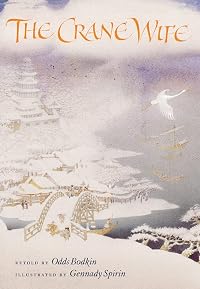
Of course, readers show more will guess Yukiko's secret from the beginning, but Odds Bodkins' retelling of this classic Japanese folktale will keep them engaged all the same, happy at the union of Osamu and Yukiko, and saddened by their inevitable parting. The watercolor and gouache illustrations by Gennady Spirin - whose other folklore projects include The Tale of The Firebird and The Fool and the Fish - are breathtakingly lovely, accentuating the sense of loneliness evoked by the story. This beautiful picture-book is one that all folk and fairy-tale lovers will want to peruse, both for the narrative and the artwork. Highly recommended! show less
Of course, readers show more will guess Yukiko's secret from the beginning, but Odds Bodkins' retelling of this classic Japanese folktale will keep them engaged all the same, happy at the union of Osamu and Yukiko, and saddened by their inevitable parting. The watercolor and gouache illustrations by Gennady Spirin - whose other folklore projects include The Tale of The Firebird and The Fool and the Fish - are breathtakingly lovely, accentuating the sense of loneliness evoked by the story. This beautiful picture-book is one that all folk and fairy-tale lovers will want to peruse, both for the narrative and the artwork. Highly recommended! show less
“The Crane Wife” retold by Odds Bodkin was an excellent Japanese tale that I enjoyed very much. The story was about a poor Japanese sail maker named Osamu. Osamu was also very lonely and longed for a wife to keep him company. However, because he lived such a solitary life he knew his chances of finding one was very slim. One night, during an autumn storm Osamu heard a loud noise and went outside to find that a crane had struck his door and become injured. Osamu took the bird into his home and noticed how light and delicate the creature was. Osamu nursed the bird back to health and soon it flew away. Some time passed and another storm came. During the storm Osamu heard a faint knocking at his door, so he opened it and found a very show more sick woman. He welcomed the woman into his home, stunned by her beauty, and nursed her back to health just as he did the crane. Over the course of time Osamu and the woman, whose name was Yukiko, fell in love and they became married. However, Osamu was still very poor and found it difficult to feed both him and his wife. Yukiko noticed Osamu’s struggles and offered to make a magic sail for him to sell in his village. However, she instructed her husband that he must not look at her as she worked. Osamu agreed to this and after many days Yukiko produced a magical sail that was woven from wind. This tasked Yukiko very much but was happy when Osamu was able to sell the magic sale for half a year’s gold. Half a year passed and Yukiko and Osamu’s gold ran out. Osamu asked Yukiko if she could make another magic sail for more money, but she was very afraid to because of how tired making the last one made her feel. However, because Yukiko loved her husband she obliged and made another magic sail, instructing again that Osamu not look at her as she worked. He agreed and thinking of, “only gold” Osamu sold the magic sail and took all the credit from Yukiko for making it. Becoming very cocky, Osamu visited the village some time later and was approached by a wealthy trader who offered a lifetime of gold for one of Osamu’s magic sails. Osamu agreed to the trader’s deal but when he told Yukiko about it she refused to make another one. This time, Osamu demanded as her husband that she make another sail, and Yukiko (out of fear) agreed, as long as Osamu did not look at her as she worked. However, Yukiko took longer than usual making the sail and a very impatient Osamu walked in on Yukiko while she was working. When Osamu did this he found a white crane weaving its white feathers into the sail, which was his wife. Yukiko became very afraid and flew away from Osamu leaving him poor and lonely. The story ends by saying, “Never again did Osamu see her. He wove simple sails for the rest of his years, there at his window, gazing at the marsh and the white cranes. And each autumn, in the season of storms, he waited for a knock on his door.” I thought that this storyline was so powerful and that main reason why I liked, “The Crane Wife” so much. I also really liked the story for its illustrations. The pictures were beautifully drawn with many gorgeous colors and Japanese details. The illustrations accompanied the story perfectly, and supported the words with beautiful and imaginative visuals. Lastly, I liked the story for its meaning. I believe the main idea of, “The Crane Wife” is to warn people to not take advantage of their loved ones or become blinded by greed. Osamu started off as a very humble and simple person who was kind and virtuous, as exemplified through his gentle care of the crane and Yukiko. However, because of the temptation money brings he became a greedy and insatiable man willing to do anything for money, including pushing his wife to her limits and breaking her one rule for him. Because of his greed Osamu’s wife turns back into a crane leaves him to be poor and lonely again. This main idea is to warn readers against greed and the destruction it can bring to people’s lives. If Osamu remained satisfied with the simplicity of his life and the love of his wife his life would have been much happier. show less
This is a beautifully illustrated retelling of the Japanese folktale, The Crane Wife. I was first attracted to this book because the watercolor and gouache illustrations appear to be influenced by Japanese scrolls produced during the Edo period. The characterized figures, choice of colors, and abstracted linear perspective are surely reminescent of Japansese works. The retelling of this story may have been written with the intent to leave room for the illustrations and the reader's imagination to create the entire setting. It would be difficult to grasp the meaningful context of this folktale without the words and pictures working together as exquisitely as they do in this version. Osamu, a lonely sail maker discovers that love and show more trust will always outweigh comfort, security, and financial success. show less
I could not find the version that I read however I believe this one is similar if not the same. I really enjoyed this book. You could tell the Japanese culture was present throughout with the wife being submissive to the husband. This was apparent a few times throughout the story, "If you would be so kind to allow it..." and "It was so painful for the young woman to see Yohei in this state that her eyes filled with tears as she watched him, until finally, unable to bear it another day, she bowed to his will." The Japanese aspect was also shown through Japanese onomatopoeic phrases such as, basabas and hotohoto used for the sounds things were making. I like also how the story kept the reader guessing about what was behind the paper door show more as she wove and why her husband could not look upon her. I also liked how the tale all connected back to the crane in the beginning and the mysterious woman suddenly showing up. The message in this story is about how money can change a person from their kind hearted ways to being greedy. Also it shows how with greed Yohei lost everything, "I fell in love with your gentle simple heart...I pray that your life will be long and that you will always be happy" as the crane, and his wife, left him for good. show less
The Crane Wife is a classic tale that speaks of a Japanese man marrying a crane. The culture and history of Japan are very evident in this book. It teaches a lesson about greed and selfishness. The illustrations in the book are amazing. The color scheme turns dark during the sad/poor times. The text towards the end becomes more frantic and lengthy when the man becomes greedy and reckless.
In what ways can we become more selfless?
In what ways can we become more selfless?
I liked this book for a few reasons. The first reason I liked the story was because of the descriptive language. When describing the village it is said, “In a faraway mountain village, where the snow falls deep and white.” A second example, “she now seemed thinner and more pathetic than before.” The descriptive language in the story allow the reader to better understand the events of the story. After each time of the wife weaves it is described that the wife gets sicker and sicker, and the reader is better able to visualize this with the descriptive language. Another way that the descriptive language is enhanced is through the illustrations. The illustrations along with the descriptive language allow the reader to visualize more show more of the story. After each time the wife weaves the drawing of her is whiter than before. This allows her to look sicklier than before. Having the illustrations this way allows them to enhance the story. Another reason that I liked the illustrations were because I thought that they fit the style of the story well. The illustrations were pretty simple and done in mute colors, and this fit the style of the story. It was often said that Yohei, the main character, was a simple man, so having simple drawings fit with this idea. Another reason that I liked the story was because it pushed readers to think about a tough issue. At first, Yohei was contempt with living a simple life. He was happy to spend time with his wife, and did not need much. But as his wife continued to spin more beautiful cloth and he received more money, than this began to consume his life. It got to the point that, “whether asleep or awake, all he could do was think about money.” He then gets so greedy that he disobeys his wife’s wishes, which causes her to leave. The issue that the reader is then forced to think about is if money is more important than relationships. A last reason that I liked the story was because the main character was so believable. His transformation from a simple mindset to a complicated mindset after getting greedy is something that most people can relate to. People can probably remember a time when the thought of money did not control their lives, so they will be able to relate to the simple mindset Yohei started with. And other people will be able to relate to the idea the money is more important than relationships, which is the complicated mindset that Yohei. In both examples Yohei is relatable, and this allows the story to be more interesting to read. I believe the overall message of the story is that relationships are more important than money. Yohei put the value of money over his wife, and in the end he lost her. He then regrets his choice, but at that point she is already gone. This is teaching readers to value the relationships before it is too late. show less
Members
- Recently Added By
Lists

A Child's Book Tour of Japan
58 works; 4 members

The Story of the World: History for the Classical Child: Activity Book Two
415 works; 2 members
Author Information
28 Works 494 Members
All Editions
Awards and Honors
Awards
Common Knowledge
- Dedication
- For my beloved wife, Miguelina -may she never fly away -O. B.
For Ilya and Emily -G. S.
Classifications
Statistics
- Members
- 277
- Popularity
- 116,065
- Reviews
- 22
- Rating
- (4.13)
- Languages
- English, French
- Media
- Paper
- ISBNs
- 9