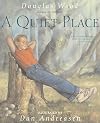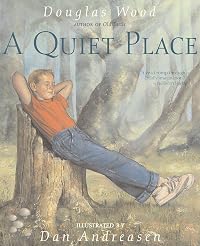
A Quiet Place
by Douglas Wood
On This Page
Description
Text and illustrations describe some of the special places that one can go to be quiet and alone and to imagine, such as a woods, a seashore, a library, or inside oneself.Tags
Recommendations









Member Reviews
This beautiful and reflective picture book, with stunning illustrations by Dan Andreasen, was first published close to a quarter of a century ago. In many ways, it feels like an even older book. For one thing, the illustrations show scenes depicting the past: 1940s cars, sailing ships, buried treasure, a pony express rider, cavemen, a Mayan temple, explorers, and the pristine natural world.
The author Douglas Wood’s message concerns the need for kids (and sometimes adults, too) to get away from noise and (over)stimulation. Unsurprisingly, given the book’s publication in 2002, no screens, gadgets, cell phones, and digital media are mentioned or shown in the book.
One could argue that a work like this may be more important now than show more ever before, as it gently provides counsel on how to find a quiet place to calm oneself, replenish energy, and exercise one’s imagination. Crawling under bushes while pretending to be a pirate who recovers buried treasure; looking in the woods, as one imagines being inside a green mansion or becoming a timber wolf; walking on a beach while envisioning oneself as an explorer—all these places and more (a desert, pond, cavern, hilltop, snow drift, museum, or library) are possible quiet places where the imagination can take flight. Or
This is a gentle, poetic book, one I’ve never test driven with a group of students. I’m not sure how it would go over with kids. My sense, though, is that children (especially those in rural areas) could still relate to it. I have the feeling that kids would have a lot of “quiet places” to add and would be eager to share information about their own. show less
The author Douglas Wood’s message concerns the need for kids (and sometimes adults, too) to get away from noise and (over)stimulation. Unsurprisingly, given the book’s publication in 2002, no screens, gadgets, cell phones, and digital media are mentioned or shown in the book.
One could argue that a work like this may be more important now than show more ever before, as it gently provides counsel on how to find a quiet place to calm oneself, replenish energy, and exercise one’s imagination. Crawling under bushes while pretending to be a pirate who recovers buried treasure; looking in the woods, as one imagines being inside a green mansion or becoming a timber wolf; walking on a beach while envisioning oneself as an explorer—all these places and more (a desert, pond, cavern, hilltop, snow drift, museum, or library) are possible quiet places where the imagination can take flight. Or
You could come home
and clean your room
and read your own books
and think your own thoughts
and feel your own feelings
and discover the very best quiet place of all—the one that’s always there,
no matter where you go or where you stay—
the one inside of you.
This is a gentle, poetic book, one I’ve never test driven with a group of students. I’m not sure how it would go over with kids. My sense, though, is that children (especially those in rural areas) could still relate to it. I have the feeling that kids would have a lot of “quiet places” to add and would be eager to share information about their own. show less
This is a book about a boy trying to find the best quiet place. Trying the woods, the library, or your room but finding out that the best quiet place is inside of him. It is quite a good book and is just about finding places to be yourself where there are no rules
This picture book is about finding a nice quiet place and all the different places that could be. This would be a great book to use to illustrate the use of a take a break chair in the classroom because it is a quiet place for them to collect themselves. It is also a good book to discuss the importance of having a time and place to be alone and quiet to relax. It could help students to be less stressed. Teachers could have them reflect and journal about their favorite "quiet place" in their lives. If they don't have one they could write about their perfect "quiet place." The illustrations used soft cool colors, and are beautiful paintings.
beautifully illustrated story of a boy who uses his imagination to take him to quiet places. Very nice story to use for creative writing lessons.
This book was very similar to Douglas Wood's "Nothing to Do". This book talks about finding a quiet place and imagining things. I feel like this would be great to use with children who find it hard to find peace and quite in their inner selves. I really liked the idea of the book and how the author provides suggestions of where to find quiet places in their lives where they can relax and appreciate silence.
The illustrations are the best part of this book. They are large and fun to look at. Using your imagination and different places you can go to use your imagination are two major elements of the book. It would be helpful in introducing creative thinking.
4 1/2 yrs - the first pages hit home with us, my daughter has always been really sensitive to sound. She's gotten better about it the last year or so. Beautifully illustrated and I enjoyed the message even if it's a bit over the head of a small child.
Members
- Recently Added By
Lists

Youth: Emotions & Feelings
126 works; 1 member
Author Information

40+ Works 9,685 Members
Awards and Honors
Awards
Notable Lists
Classifications
Statistics
- Members
- 519
- Popularity
- 57,536
- Reviews
- 9
- Rating
- (4.03)
- Languages
- English
- Media
- Paper, Ebook
- ISBNs
- 5
- ASINs
- 2