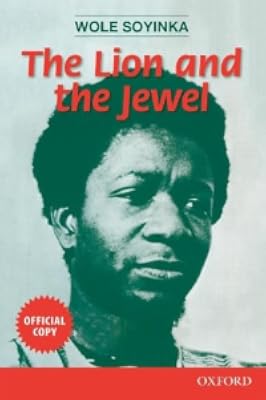
The Lion and the Jewel
by Wole Soyinka
On This Page
Description
This is one of the best-known plays by Africa's major dramatist, Wole Soyinka. It is set in the Yoruba village of Ilunjinle. The main characters are Sidi (the Jewel), 'a true village belle' and Baroka (the Lion), the crafty and powerful Bale of the village, Lakunle, the young teacher, influenced by western ways, and Sadiku, the eldest of Baroka's wives. How the Lion hunts the Jewel is the theme of this ribald comedy.Tags
Recommendations












Member Recommendations
libron Similar themes
Member Reviews
This is cute, although I found the obscurity, the assumption built into the very grammar of the sentences, that we would recognize all the references a bit annoying (but it's probably good for me to be annoyed in that way--like reading a Victorian novel would have been for Soyinka at Leeds). The only character more ridiculous than the shallow and venal traditional Yoruba is the modernizing fool Lakunle; the language is stilted in this pseudo-Elizabethan way that lends a spurious, but entirely charmingly so, dignity; everyone can summon up an all-singing, all-dancing chorus to tell a story at the drop of a calabash; and it's the only stories I've heard of where the ruttish old patriarch wins in the end without leaving a sour taste in show more your mouth. Because Baroka and his first wife/procurer Sadiku represent the ignorant, horny past, Lakunle the even more ignorant (Iignorant of the horrors it'll bring) future; and Sidi the site where they clash. Which is a retrograde plot, perhaps, but then Sidi takes it into her head to mess the whole thing around, making her more of a Pandora (with the expected unfortunate consequences for her), and when the Crocodile wins you cheer not only because it's done so playfully but also because at least it goes down as a loss in colonialism's column. show less
A thought-provoking play by the first African author to win the Nobel Prize in Literature. The play deals with the conflict between traditional ways and modernization; for example, should a man pay a bride price in order to marry? The young schoolmaster, a believer in Western culture, wants to marry 'the jewel' Sidi but doesn't want to pay her bride price claiming it is old-fashioned (though the reader/viewer is also left with the impression that he can't afford it!). The headman of the village, 'the lion', is in his 60s and has several wives and concubines already but can pay. The village is still traditional in its daily life but one senses that it is on the verge of change. As a Westerner myself, I started out with the preconceived show more notion that modernization would be a beneficial change but by the end of the play, I was not so sure. The 'Lion', representing the traditional values and culture, was not as weak and aged as he appeared to be -- I assume that is Soyinka's way of saying that the tradional culture isn't as ready to fade away either. Whether that is good or bad is unclear to me but interesting to think about... show less
Ratings
Members
- Recently Added By
Author Information

139+ Works 5,100 Members
Wole Soyinka was born in Abeokuta, Ogun State of Nigeria on July 13, 1934. He attended Government College and University College in Ibadan before receiving a degree in English from the University of Leeds in England in 1958. He has held research and teaching appointments at several universities including the University of Ibadan, the University of show more Ife, Cornell University, Emory University, the University of Nevada, Las Vegas, and Loyola Marymount. He is a distinguished playwright, poet, novelist, essayist, social critic, political activist, and literary scholar. His plays include The Swamp Dwellers, The Lion and the Jewel, A Dance of the Forests, The Bacchae of Euripides, A Play for Giants, Death and the King's Horsemen, From Zia with Love, The Beatification of Area Boy, and King Baabu. His collections of poetry include Idanre and Other Poems, A Shuttle in the Crypt, and Mandela's Earth and Other Poems. His novels include The Interpreters, which won the 1968 Jock Campbell Literary Award, and Season of Anomy. His autobiographical works include Ake: The Years of Childhood, Isara: A Voyage Around Essay, The Open Sore of a Continent: A Personal Memoir of the Nigerian Crisis, and You Must Set Forth at Dawn. His literary essays collections include Myth, Literature and the African World and Art, Dialogue and Outrage. During the civil war in Nigeria, he appealed for cease-fire in an article. Accused of treason, he was held in solitary confinement for 22 months. Two of his works, The Man Died: Prison Notes of Wole Soyinka and Poems from Prison, were secretly written on toilet paper and smuggled out of prison. He won the Nobel Prize for Literature in 1986. (Bowker Author Biography) show less
Series
Belongs to Publisher Series
Common Knowledge
- Canonical title
- The Lion and the Jewel
Classifications
- DDC/MDS
- 780 — Arts & recreation Music Music
- LCC
- PR6069 .O9 .L5 — Language and Literature English English Literature 1961-2000
- BISAC
Statistics
- Members
- 181
- Popularity
- 180,893
- Reviews
- 2
- Rating
- (3.61)
- Languages
- English
- Media
- Paper
- ISBNs
- 4
- UPCs
- 1
- ASINs
- 3