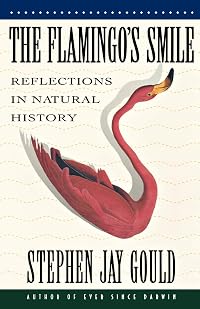
The Flamingo's Smile: Reflections in Natural History
by Stephen Jay Gould
Reflections in Natural History (4)
On This Page
Description
Evolutionary theory in the theme that binds together these essays on such seemingly disparate topics as the feeding habits of flamingos, flowers and snails that change from male to female and sometimes back again, and the extinction from baseball of the .400 hitter.Tags
Recommendations










Member Reviews
This is volume 4 of the collected essays by the late Stephen Jay Gould. As before, it is the usual mixture of some rather esoteric ones that go a bit over my head and subjects I find more interesting. I had to skip the article on baseball however, being from the UK and unable to drum up any interest. The discussion of mass extinctions was interesting, given that these essays were written during the period when the theory that the dinosaurs (and many marine invertebrates) had been wiped out by an asteroid strike was beginning to gather sufficient evidence to be accepted. Some of the articles have no doubt been superseded by more recent scientific developments which is problematic when a reader such as myself doesn't know which have been show more affected. So all in all, I rate this at 3 stars. show less
This is another collection of essays loosely based around evolutionary biology (with some inevitable baseball references).
This is what the author is best at. He like language and uses it in his own verbose and slightly pompous manner but once again we can see that he doesn't seem to have a nasty bone in his body.
Having now seen him talk on you tube I can picture him reading the book to me, slightly out of breath, fiddling with his glasses dramatically and pausing for effect quite often. This only helps the enjoyment all the more.
Some of the material covered is getting old now (1987) so bear that in mind, but I particularly enjoyed some of the "period" references e.g. the dino-killing impact theory.
If you haven't read Gould then this show more might be a decent place to start - if you have read him then this is a cracking example of him in the medium he does best. show less
This is what the author is best at. He like language and uses it in his own verbose and slightly pompous manner but once again we can see that he doesn't seem to have a nasty bone in his body.
Having now seen him talk on you tube I can picture him reading the book to me, slightly out of breath, fiddling with his glasses dramatically and pausing for effect quite often. This only helps the enjoyment all the more.
Some of the material covered is getting old now (1987) so bear that in mind, but I particularly enjoyed some of the "period" references e.g. the dino-killing impact theory.
If you haven't read Gould then this show more might be a decent place to start - if you have read him then this is a cracking example of him in the medium he does best. show less
Gould's fourth essays volume, which includes some real crackers. The title essay is a great read, for example. As usual, though, some have aged better than others.
Evolutionary Biology?: Is there any other type of modern biology? Evolution is so deeply interwined in today's biology that it almost seems a tautology to classify this book under Evolutionary Biology. Gould's reflections are masterpieces of rationality and logic heavily supported with facts and exposed with an uneven grace and uniqueness. This, as a lot of other Gould's books, is a collection of essays that don't need to be read in order since they are not chapters, their organization obeys the main subject of each essay, not a unique plot developed along the book. This is an easy and incredibly interesting journey inside reason and natural science, please don't hesitate if you want to be taken by the hand of one of the greatest show more zoologists of the twentieth century. show less
Love Gould, as usual. I can never remember which essays are in which - this is neither one of his first ones, where he's somewhat more accepting of standard stories, nor one of his later ones where his cancer becomes a frequent player, so I have no idea which of his stories are in here. But I enjoyed them! Not the first time I've read this one, either. He always makes me think, even on multiple re-reading.
Another collection of Gould's essays on evolution, natural history, palentology, baseball, etc. I've enjoyed his essays since I first started reading them many years back and this one is just as good. It is an older collection so it was interesting to read about the new at the time theory of mas extinction by asteroid and also an essay on nuclear winter.
Interesting essays, as always, about how science works, evolution and natural history. Reading these essays is a pleasure, tinged with regret that Stephen Jay Gould is no longer writing them.
Members
- Recently Added By
Lists

Best Science Books for Non-Scientists
113 works; 57 members

al.vick-parents books
301 works; 1 member
Author Information

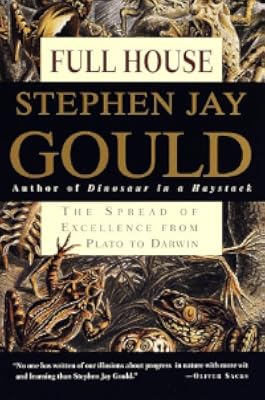
115+ Works 30,462 Members
Born in New York City in 1941, Stephen Jay Gould received his B.A. from Antioch College in New York in 1963 and a Ph.D. in paleontology from Columbia University in 1967. Gould spent most of his career as a professor at Harvard University and curator of invertebrate paleontology at Harvard's Museum of Comparative Zoology. His research was mainly in show more the evolution and speciation of land snails. Gould was a leading proponent of the theory of punctuated equilibrium. This theory holds that few evolutionary changes occur among organisms over long periods of time, and then a brief period of rapid changes occurs before another long, stable period of equilibrium sets in. Gould also made significant contributions to the field of evolutionary developmental biology, most notably in his work, Ontogeny and Phylogeny. An outspoken advocate of the scientific outlook, Gould had been a vigorous defender of evolution against its creation-science opponents in popular magazines focusing on science. He wrote a column for Natural History and has produced a remarkable series of books that display the excitement of science for the layperson. Among his many awards and honors, Gould won the National Book Award and the National Book Critics Circle Award. His titles include; Ever Since Darwin, The Panda's Thumb, Hen's Teeth and Horse's Toes, Time's Arrow, Time's Cycle, Wonderful Life: The Burgess Shale and the Nature of History, The Structure of Evolutionary Theory and Full House: The Spread of Excellence from Plato to Darwin. Stephen Jay Gould died on May 20, 2002, following his second bout with cancer. (Bowker Author Biography) show less
Series

Common Knowledge
- Canonical title*
- Das Lächeln des Flamingos. Betrachtungen zur Naturgeschichte
- Original title
- The Flamingo's Smile: Reflections in Natural History
- Original publication date
- 1985
- Dedication*
- Deb, für alles
- First words*
- Ein mittelalterliches Glasfenster der Kathedrale von Canterbury stellt eine biblische Szene dar, in der den schlafenden Weisen ein Engel erscheint und sie auffordert, sofort nach Hause zu gehen und nicht zu Herodes zurückzuk... (show all)ehren.
- Quotations
- An eminent colleague, a fine theoretician who has paid his dues in the field, once said to me, only partly facetiously, that fieldwork is one hell of a way to get information. All that time, effort and money, often for compar... (show all)atively little when measured against the hours invested. True enough, especially when I count the hours spent drinking Cuban coffee, the one pleasure of my least favorite place, Miami airport. But all the frustration and dull, repetitive effort vanish to insignificance before the unalloyed joy of finding something new – and this pleasure can be savored nearly every day if one loves little things as well. To say, "We have discovered it; we understand it; we have made some sense and order of nature's confusion." Can any reward be greater? (from: Opus 100)
- Original language
- English
*Some information comes from Common Knowledge in other languages. Click "Edit" for more information.
Classifications
Statistics
- Members
- 1,365
- Popularity
- 17,467
- Reviews
- 13
- Rating
- (3.94)
- Languages
- 7 — English, French, German, Italian, Portuguese, Spanish, Swedish
- Media
- Paper, Audiobook, Ebook
- ISBNs
- 24
- ASINs
- 13