On This Page
Description
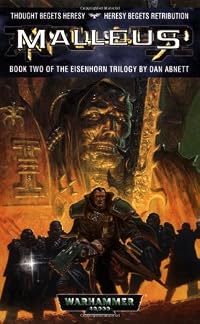
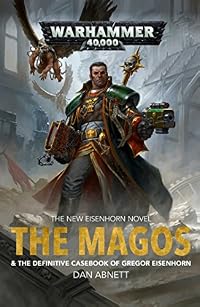
A century after his recovery of the alien Necroteuch, Gregor Eisenhorn is one of the Imperial Inquisition's most celebrated agents. But when a face from his past returns to haunt him, and he is implicated in a great tragedy that devastates the world of Thracian Primaris, Eisenhorn's universe crumbles around him. The daemon Cherubael is back, and seeks to bring the inquisitor to ruin - either by his death, or by turning him to the service of the Dark Gods..
Tags
Recommendations




Member Reviews
Well this was a surprising book in so many ways.
First, the narrative. We are told the entire story from the point of view of Eisenhorn, seasoned Inquisitor of Ordo Xenos and his retinue. He is a man who saw a lot in his service and it starts to show. Inquisitors are pretty independent people and they tend to work on solutions for problems, on their own, using whatever means are at their disposal. Sometimes this means taking risks and potentially even working outside the organization, which might cause ire from the more ...... politically correct colleagues :) Not to mention other rival Inquisition factions who look at world a little bit differently.
Eisenhorn is pretty erudite, true man of the world. His comments on the world around him show more are truly great and help flesh out the everyday W40K world, usually told either from battlefield perspective or from perspective of beings like Primarchs or Space Marines that do not walk among the ordinary folk. Of course, his being W40K, first person narration might not prove to be so much sincere. Again, this is world of the weird blend of future in form of magnificent machines, starships and weaponry intermingled with the reality bending psyker influences, world where faith in the Emperor or Chaos can actually bend the rules of physical world. What some might see as righteous path for everyone else on the sidelines might look like babbling of the lunatic and carnage. And everyone involved might be exquisitely eloquent.
In other words, there is definitely something going on with Eisenhorn, and reaction of some of his entourage seem to indicate this. It remains to be seen in future books, what exactly is the situation.
Second, characters. Story is told from the Eisenhorn's perspective in form of memoir, or standard report. But it is clear from this how much Eisenhorn cares about people he surrounds himself with. From the people who are just keeping his safe houses on various planets to people fighting alongside him, and those closest to him, those he takes as students, as Inquisition interrogators on the path to become Inquisitors themselves. Tragedy that befalls Ravenor in this book is something that truly shakes up Eisenhorn. But to his credit, he moves on, painfully aware that in his world death, even worse things than death, are always just a second away.
Third, nature of the Inquisition. This is not pure action book. Eisenhorn studiously approaches every problem and that takes time. As I said, entire narration is in form of memoir/report and time flies as team moves from one point to another. Nothing happens immediately, Eisenhorn and his team need to move great distances, check the leads, work with some very unsavory characters, work undercover and walk through many a trap, testing their own resolve and trust. As I said, Inquisitors walk this very fine line between fighting against and (potentially unknowingly) falling to the Chaos and doing its nefarious bidding. And they are also not that much into explaining themselves constantly to others - this tests their team members, their faith in their commander. Scenes on Cadia where Eisenhorn is investigated show this in much detail. We also get glimpse into Inquisition itself. These people carry a lot of power, sufficient sometimes to wipe out entire worlds. Control over them is paramount. So, greatest peril for the Inquisitor is to be put on the watch list of other Inquisitorial factions - this means that it is required to thread lightly and avoid any controversial actions (I mean, yeah right, controversial has a completely different meaning here :)) that might be used to deem one a heretic and thus free target for everyone with a potential grudge. This, at times completely crazy grip factions have on each other is the only way they can be controlled. Hope is that heads of local conclaves are of the expected quality and are able to prevent any potential conflict. And here is third thing - while required to have faith in Imperium and Emperor, Inquisitors are not all zealots. Majority are wise and experienced, with views that we might not call secular (but again such is the nature of the world they are surrounded with) and truly dedicated to the people of the Imperium, for which they are fighting their wars. They are not without empathy and Eisenhorn clearly shows it. Also, friendship plays a significant role to the Inquisitor - due to solitary nature of their work, having trusted allies might be difference between life and very gruesome death.
And then we get to action. Every action scene is magnificent. Main piece here is sudden attack of unknown forces on the day of the Imperial triumph. This is something to behold, the sheer confusion, and destruction. Most potent pyskers finding their escape in the chaos, sawing destruction (that scene with Space Marines and child was true horror) and then being mercilessly hunted through the hive city by Imperial forces. I can only say, truly epic.
I have to admit I liked a book much more than expected, and I am currently on a lookout for other volumes in the series.
If you like stories of lone wolves, secret organizations, investigations of mysterious deadly cults and events amongst the stars give this one a try. You will enjoy it every step of the way.
Highly recommended. show less
First, the narrative. We are told the entire story from the point of view of Eisenhorn, seasoned Inquisitor of Ordo Xenos and his retinue. He is a man who saw a lot in his service and it starts to show. Inquisitors are pretty independent people and they tend to work on solutions for problems, on their own, using whatever means are at their disposal. Sometimes this means taking risks and potentially even working outside the organization, which might cause ire from the more ...... politically correct colleagues :) Not to mention other rival Inquisition factions who look at world a little bit differently.
Eisenhorn is pretty erudite, true man of the world. His comments on the world around him show more are truly great and help flesh out the everyday W40K world, usually told either from battlefield perspective or from perspective of beings like Primarchs or Space Marines that do not walk among the ordinary folk. Of course, his being W40K, first person narration might not prove to be so much sincere. Again, this is world of the weird blend of future in form of magnificent machines, starships and weaponry intermingled with the reality bending psyker influences, world where faith in the Emperor or Chaos can actually bend the rules of physical world. What some might see as righteous path for everyone else on the sidelines might look like babbling of the lunatic and carnage. And everyone involved might be exquisitely eloquent.
In other words, there is definitely something going on with Eisenhorn, and reaction of some of his entourage seem to indicate this. It remains to be seen in future books, what exactly is the situation.
Second, characters. Story is told from the Eisenhorn's perspective in form of memoir, or standard report. But it is clear from this how much Eisenhorn cares about people he surrounds himself with. From the people who are just keeping his safe houses on various planets to people fighting alongside him, and those closest to him, those he takes as students, as Inquisition interrogators on the path to become Inquisitors themselves. Tragedy that befalls Ravenor in this book is something that truly shakes up Eisenhorn. But to his credit, he moves on, painfully aware that in his world death, even worse things than death, are always just a second away.
Third, nature of the Inquisition. This is not pure action book. Eisenhorn studiously approaches every problem and that takes time. As I said, entire narration is in form of memoir/report and time flies as team moves from one point to another. Nothing happens immediately, Eisenhorn and his team need to move great distances, check the leads, work with some very unsavory characters, work undercover and walk through many a trap, testing their own resolve and trust. As I said, Inquisitors walk this very fine line between fighting against and (potentially unknowingly) falling to the Chaos and doing its nefarious bidding. And they are also not that much into explaining themselves constantly to others - this tests their team members, their faith in their commander. Scenes on Cadia where Eisenhorn is investigated show this in much detail. We also get glimpse into Inquisition itself. These people carry a lot of power, sufficient sometimes to wipe out entire worlds. Control over them is paramount. So, greatest peril for the Inquisitor is to be put on the watch list of other Inquisitorial factions - this means that it is required to thread lightly and avoid any controversial actions (I mean, yeah right, controversial has a completely different meaning here :)) that might be used to deem one a heretic and thus free target for everyone with a potential grudge. This, at times completely crazy grip factions have on each other is the only way they can be controlled. Hope is that heads of local conclaves are of the expected quality and are able to prevent any potential conflict. And here is third thing - while required to have faith in Imperium and Emperor, Inquisitors are not all zealots. Majority are wise and experienced, with views that we might not call secular (but again such is the nature of the world they are surrounded with) and truly dedicated to the people of the Imperium, for which they are fighting their wars. They are not without empathy and Eisenhorn clearly shows it. Also, friendship plays a significant role to the Inquisitor - due to solitary nature of their work, having trusted allies might be difference between life and very gruesome death.
And then we get to action. Every action scene is magnificent. Main piece here is sudden attack of unknown forces on the day of the Imperial triumph. This is something to behold, the sheer confusion, and destruction. Most potent pyskers finding their escape in the chaos, sawing destruction (that scene with Space Marines and child was true horror) and then being mercilessly hunted through the hive city by Imperial forces. I can only say, truly epic.
I have to admit I liked a book much more than expected, and I am currently on a lookout for other volumes in the series.
If you like stories of lone wolves, secret organizations, investigations of mysterious deadly cults and events amongst the stars give this one a try. You will enjoy it every step of the way.
Highly recommended. show less
The action and intrigue from Xenos continues into Malleus. Just before that however, my edition comes with the short story "Missing in Action" which discloses the investigation of several murders that appear to be the work of a Chaos cult in the city of Urbitane.
Taking place several months after the events of Xenos, this little mystery is fun to follow since it appears obvious from early on who the killers are, but their motivations were a tragic surprise. It also shows a side of an inquisitor, let alone Gregor, that is rarely seen. The killers were former Imperial Guardsmen with bad cases of PTSD who see the forces of Chaos around every corner. Gregor was willing to show mercy, unheard of from an inquisitor. But this is Warhammer show more 40k, where hope is the first step on the road to disappointment.
The novel proper takes place about a century after Xenos, with Gregor doing what he does best. In addition to the investigations and fights from Xenos, Eisenhorn must also protect himself from the inquisition. The daemonhost Cherubael has been mentioning Gregor by name, creating suspicions that Gregor has been consorting with Chaos. This, along with Gregor surviving a attack on an Imperial parade and other (un?)fortunate coincidences causes the inquisition to formally charge Gregor with treason. The "cop chasing criminals while also on the run from the law" isn't the most original idea, but it's done well enough here to be entertaining.
Throughout the second half of the book, when Gregor works out who is behind the daemonhosts, Gregor's beliefs show more signs of shifting in a darker direction. Pontius Glaw, the disembodied heretic from Xenos, makes a return. When Gregor comes to him for information, he takes pleasure in seeing Gregor reach the point of no return. His confrontation with the fallen inquisitor Quixos feels like a foreshadowing of where Gregor's path is taking him. The epilogue further shows Gregor slipping away from his puritanical stance into becoming what he fights so hard against.
I'm enjoying this trilogy, and want to see the end, despite seeing the tragedy that's coming. It's not high literature, but the action is fun and the psychological changes in Eisenhorn are engaging. show less
Taking place several months after the events of Xenos, this little mystery is fun to follow since it appears obvious from early on who the killers are, but their motivations were a tragic surprise. It also shows a side of an inquisitor, let alone Gregor, that is rarely seen.
The novel proper takes place about a century after Xenos, with Gregor doing what he does best. In addition to the investigations and fights from Xenos, Eisenhorn must also protect himself from the inquisition. The daemonhost Cherubael has been mentioning Gregor by name, creating suspicions that Gregor has been consorting with Chaos. This, along with Gregor surviving a attack on an Imperial parade and other (un?)fortunate coincidences causes the inquisition to formally charge Gregor with treason. The "cop chasing criminals while also on the run from the law" isn't the most original idea, but it's done well enough here to be entertaining.
Throughout the second half of the book, when Gregor works out who is behind the daemonhosts, Gregor's beliefs show more signs of shifting in a darker direction.
I'm enjoying this trilogy, and want to see the end, despite seeing the tragedy that's coming. It's not high literature, but the action is fun and the psychological changes in Eisenhorn are engaging. show less
"Follows Inquisitor Gregor Eisenhorn, a year after the events of Xenos, as he is framed for heresy and devastating acts of chaos following a disaster at the Triumph of Thracian Primaris. Pursued by his own order and the daemonhost Cherubael, Eisenhorn must investigate a vast conspiracy to clear his name, highlighting his descent into Radicalism and the severe consequences of using dark tools against evil." Setting and plot are awesome, as are the characters, but I hated seeing Eisenhorn succumb.
This book is, more or less, exactly as it presents itself to be: a pulpy sci-fi fantasy about a guy with an impossibly cool outfit and a big gun. However, that does not mean that it's no good. Dan Abnett is perhaps most well known for his 'Gaunts Ghost' series of Warhammer 40000 novels, following a company of unusual Imperial soldiers with an even more unusual leader. With the Eisenhorn Trilogy, he takes a rather different route. Released nearly in tangent with the Games Workshop 'Inquisitor' game, the books follow the investigations of an Inquisitor Eisenhorn and his coterie as they uncover numerous plots of heresy and corruption within the Imperium. They are not fantastically written, but measure up to an author like Clive Cussler in show more both pacing and engrossment. Abnett makes his character's smart, but just enough that the reader can keep up with them, mixing both mystery and action in a read you just can't put down. Often, the protagonists will speak in a sort of improvised cipher, which can be fun to try and figure out. I'll be honest, after reading all three books in quick succession, I began to inadvertently drop words of this code into my own language, which may or may not have been a good thing.
If you are already a fan of the Warhammer 40k Universe, these books give a great peek at the civilian workings of the Imperium of Man and showcase many different strange and frightening worlds. If you are not learned with the background material, they may be a little hard to follow at times. Luckily, it is more or less character driven, and every time one of them meets a fate worse than death, you'll be sorry to see them go. show less
If you are already a fan of the Warhammer 40k Universe, these books give a great peek at the civilian workings of the Imperium of Man and showcase many different strange and frightening worlds. If you are not learned with the background material, they may be a little hard to follow at times. Luckily, it is more or less character driven, and every time one of them meets a fate worse than death, you'll be sorry to see them go. show less
Maybe it's just been a long time since Xenos, but this book seemed a bit flat for me. Abnett's writing is great, but the Inquisitor-hijinks plot just didn't grab me.
For what it is, really well done, and surprisingly nuanced. 3.5 stars.
Expect lots of war and gore. Weird characters.
Members
- Recently Added By
Author Information

1,180+ Works 25,293 Members
Series


Belongs to Publisher Series
The Black Library (30)
Work Relationships
Is contained in
Common Knowledge
- Canonical title
- Malleus
- Original publication date
- 2001-12
- People/Characters
- Gregor Eisenhorn; Alizebeth Bequin; Cherubael; Arianhrod Esw Sweydyr; Beldame Sadia; Pye (show all 24); Arnault Tantalid; Uber Aemos; Medea Betancore; Gideon Ravenor; Esarhaddon; Lyko; Harlon Nayl; Godwyn Fischig; Neve; Titus Endor; Quixos; Prophaniti; Commodus Voke; Raum Grumman; Massimo Ricci; Tobias Maxilla; Pontius Glaw; Arnault Tantalid
- Important places
- Lethe 11; Thracian Primaris; Gudrun; Eechan; Cadia; Cinchare (show all 8); Thessalon; Farness Beta
- Epigraph*
- Po sto let dlouhé, kruté válce, byl Ophiďanský subsektor konečně dobyt pro Boha Císaře. Na Thracian Primaris se koná velký triumf na oslavu vítězství, ale radost vystřídá tragédie tak obrovská svým rozsahe... (show all)m, že zdrtí i v bitvách zakalené Impérium. Inkvizitor Gregor Eisenhorn se pustí do vyšetřování původců toho zvěrstva, přestože je jeho vlastní reputace silně pošramocená zprávami o jeho neortodoxních metodách.
Jak se nitky případu rozplétají, Eisenhorn objeví spojení se sto let starým případem a začne směřovat ke střetu s démonickým Cherubaelem a jeho neznámým pánem…
Druhé pokračování trilogie o inkvizitoru Eisenhornovi z temné budoucnosti Warhammeru 40 000. - Original language
- English; translation: Czech
*Some information comes from Common Knowledge in other languages. Click "Edit" for more information.
Classifications
Statistics
- Members
- 272
- Popularity
- 118,084
- Reviews
- 8
- Rating
- (3.82)
- Languages
- 8 — Czech, English, French, German, Hungarian, Polish, Russian, Spanish
- Media
- Paper, Audiobook, Ebook
- ISBNs
- 17
- ASINs
- 5