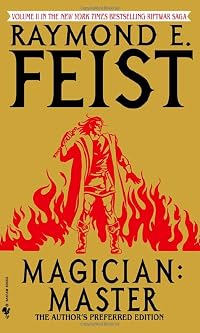
Magician: Master
by Raymond E. Feist
The Riftwar Cycle, Alternative Reading Order (01.2 (Riftwar Saga 01.2)), The Riftwar Cycle: Publication (Series Name) (Collections and Selections — The Riftwar Saga, 1, Part 2), The Riftwar Cycle: Chronological (1.2), The Riftwar Saga (Partial Editions — 1.2)
On This Page
Description
Fantasy. Fiction. Thriller. HTML:He held the fate of two worlds in his hands...Once he was an orphan called Pug, apprenticed to a sorcerer of the enchanted land of Midkemia.. Then he was captured and enslaved by the Tsurani, a strange, warlike race of invaders from another world.
There, in the exotic Empire of Kelewan, he earned a new name—Milamber. He learned to tame the unnimagined powers that lay withing him. And he took his place in an ancient struggle against an evil Enemy older than show more time itself. show less
Tags
Recommendations



Member Reviews
I did not read Feist when these were being published, though I would likely have been the ideal audience in the late 80s. Some folks say these have aged poorly and are just indicative of certain era of fantasy writing. I'm not so sure that's the case, I think they may never have been that great.
First things first, Magician: Apprentice is the first *half* of a book, split due to length. I'm going to combine the reviews for this and Magician: Master and put the review on both. But, going into the book not knowing that can lead to a very disjointed experience at the abrupt ending.
Magician is telling the story of Pug, an orphaned farm boy in a relatively idealic fantasy castle/village who through the beneficence of those around him show more experiences a pretty pleasant life. Up to eventually being taken in as the titular magician's apprentice despite a relative lack of talent. While Pug is clearly intended to be the focus of this bildungsroman, he's missing from vast swaths of both this and the subsequent book. Possibly for the best. His young friend, Tomas, on the path to becoming a warrior is our other main character, followed by an ensemble cast of the usual suspects in this type of fantasy (ranger stand ins, a princess or two, children of nobility having to take on various levels of responsibility) who truth be told get a lot more page time than our supposed main characters. Our main source of conflict is...an invading army from another world with a superior command of magic. Which has some distressingly stereotypical depictions of probably southeast asian cultures form the time.
So why the relatively low rating from someone who is otherwise a huge fan of fantasy? Besides some technical problems (real frequent shifts in pov and tense, seemingly at random and without purpose) and a whole lot of telling rather than showing, its just not great? Its too sterotypical of high fantasy, too simple, even within its own time, not just through the lens of the fantasy we get these days. A lot of characters are clearly thinly veiled caricatures of Tolkein characters, as are some of the plot points. We even have a very duex ex machina, two dimensional, wizard who feels like a bad Gandalf impersonator, an elf queen (and really elvish society) that seems to be a direct lift as well. There are some really unnecessary early teen love triangles involving a princess that feels pulled from any number of YA fantasy of the era. There are massive time skips throughout the book...as in years...that not only rob of us seeing the events that could cause the characters to change and grow, but seem to not result in any actual dynamic character growth or change. A lot of things happen that we're told about after the fact, and the characters (besides growing much more powerful) don't change in any fundamental way. Tomas is the only character who seems even mildly changed by the titanic events he passes through, and even in that case the changes are somewhat cosmetic and certainly not as deep as they should be.
Some of the issues can be explained by the fact that this is essentially a (less than great) novelization of Feist's D&D games from the time. Midkemia was their homebrewed campaign setting. I didn't realize that until after reading, but as soon as I learned that a lot of things from the cardboard characters to the lack of dynamism, to the massive power jumps after ever time skip, all started to make a lot more sense.
What can we find that feels more positive about these two books? I can see some very early shades of the sort of political intrigue we'd later seen so much more masterfully done by George RR Martin. I think that the world building if handled with more depth and focused more on showing rather than telling, *could* have been really interesting. And there may be a lot more of that in the subsequent books in the series that focus on less godlike, overpowered characters. Especially if it was based on a D&D campaign, there should be plenty of ambitious world building that *could* be done. I'll likely only read the next two (since I got the first four from a box at my aunt's house), and hopefully there will be more of that. While I realize that this is intended for adult fantasy readers, or maybe YA at the earliest, I think that if targeted at even younger readers this isn't necessarily a bad introduction to fantasy. Honestly, I can't see reading this past my pre-teen years and being into it, but I think for that late elementary age reader really into fantasy these would be perfect. The violence and sexuality are very tame, as is the language, and I think a lot of the structural issues wouldn't be as much of a problem. I do think if marketed in that way it would benefit from the two books being broken into maybe four smaller books, but hey, let a kid feel accomplished for reading such a big book.
So yeah, give them to a kid as an intro to better stuff, they can have fun later discovering similarities to other works. show less
First things first, Magician: Apprentice is the first *half* of a book, split due to length. I'm going to combine the reviews for this and Magician: Master and put the review on both. But, going into the book not knowing that can lead to a very disjointed experience at the abrupt ending.
Magician is telling the story of Pug, an orphaned farm boy in a relatively idealic fantasy castle/village who through the beneficence of those around him show more experiences a pretty pleasant life. Up to eventually being taken in as the titular magician's apprentice despite a relative lack of talent. While Pug is clearly intended to be the focus of this bildungsroman, he's missing from vast swaths of both this and the subsequent book. Possibly for the best. His young friend, Tomas, on the path to becoming a warrior is our other main character, followed by an ensemble cast of the usual suspects in this type of fantasy (ranger stand ins, a princess or two, children of nobility having to take on various levels of responsibility) who truth be told get a lot more page time than our supposed main characters. Our main source of conflict is...an invading army from another world with a superior command of magic. Which has some distressingly stereotypical depictions of probably southeast asian cultures form the time.
So why the relatively low rating from someone who is otherwise a huge fan of fantasy? Besides some technical problems (real frequent shifts in pov and tense, seemingly at random and without purpose) and a whole lot of telling rather than showing, its just not great? Its too sterotypical of high fantasy, too simple, even within its own time, not just through the lens of the fantasy we get these days. A lot of characters are clearly thinly veiled caricatures of Tolkein characters, as are some of the plot points. We even have a very duex ex machina, two dimensional, wizard who feels like a bad Gandalf impersonator, an elf queen (and really elvish society) that seems to be a direct lift as well. There are some really unnecessary early teen love triangles involving a princess that feels pulled from any number of YA fantasy of the era. There are massive time skips throughout the book...as in years...that not only rob of us seeing the events that could cause the characters to change and grow, but seem to not result in any actual dynamic character growth or change. A lot of things happen that we're told about after the fact, and the characters (besides growing much more powerful) don't change in any fundamental way. Tomas is the only character who seems even mildly changed by the titanic events he passes through, and even in that case the changes are somewhat cosmetic and certainly not as deep as they should be.
Some of the issues can be explained by the fact that this is essentially a (less than great) novelization of Feist's D&D games from the time. Midkemia was their homebrewed campaign setting. I didn't realize that until after reading, but as soon as I learned that a lot of things from the cardboard characters to the lack of dynamism, to the massive power jumps after ever time skip, all started to make a lot more sense.
What can we find that feels more positive about these two books? I can see some very early shades of the sort of political intrigue we'd later seen so much more masterfully done by George RR Martin. I think that the world building if handled with more depth and focused more on showing rather than telling, *could* have been really interesting. And there may be a lot more of that in the subsequent books in the series that focus on less godlike, overpowered characters. Especially if it was based on a D&D campaign, there should be plenty of ambitious world building that *could* be done. I'll likely only read the next two (since I got the first four from a box at my aunt's house), and hopefully there will be more of that. While I realize that this is intended for adult fantasy readers, or maybe YA at the earliest, I think that if targeted at even younger readers this isn't necessarily a bad introduction to fantasy. Honestly, I can't see reading this past my pre-teen years and being into it, but I think for that late elementary age reader really into fantasy these would be perfect. The violence and sexuality are very tame, as is the language, and I think a lot of the structural issues wouldn't be as much of a problem. I do think if marketed in that way it would benefit from the two books being broken into maybe four smaller books, but hey, let a kid feel accomplished for reading such a big book.
So yeah, give them to a kid as an intro to better stuff, they can have fun later discovering similarities to other works. show less
I read Magician: Apprentice, which was the first half of the story continued in this one, a while back and found it really disappointing. But I already had this volume, so I figured I might was well get around to finishing it. I think maybe this one was a bit better, in that it had some mildly interesting worldbuilding stuff once we got away from the Discount Tolkien World we started off in for a bit. But it still didn't do much for me. The pacing is deeply weird, there's a lot of telling when there should be showing, the plot's not super interesting even if there are a couple of cool ideal buried in in somewhere, and the characters are pretty flat. Well, except for the female characters. Those don't even rise to the level of flatness. show more They're basically zero-dimensional.
Yeah, I think we're going to have to chalk this up as yet another series whose popularity will have to remain mystifying to me. show less
Yeah, I think we're going to have to chalk this up as yet another series whose popularity will have to remain mystifying to me. show less
Holy cow, you guys. I can't believe what Feist has done with this series. I absolutely LOVED the first book and I was worried I wouldn't feel the same magic from the second book. However, I was wrong. Feist does an amazing job creating two completely different worlds feel so real and complex. There is one scene that stands out to me the most is when Pug (who goes by another name) travels up a tall tower and has visions of the past. I don't want to go into too much detail to avoid spoiling it, but Feist really painted a cosmic picture in my head and it is something I won't forget.
In the first book, Pug and Tomas are just boys who are charming and a fun group to follow. However, in this book they are no longer boys. We see these show more characters grow into powerful men. Honestly, I was very sad when this happened. They are both SO different from the first book. But that should be expected because of the emotional and physical turmoil they have to face. I mean, Pug becomes a slave for five years in a foreign land. If anything makes you lose your innocence it is probably that! Another part of this book that I really love is the political differences of Midkemia and Kelewan. Both see one another as barbaric. Add in the complex political structure of the Tsurani and you've got one hell of a stand off. It is fun to see each side's point of view. Basically, this book is great.
In summation, if you like epic fantasy with great characters, fun battles, and two very different worlds to explore then this is the series for you. It has been a LONG time since I've found a series that I can just DIVE in to and really get invested in the story. I will take a break from this series so I don't get burnt out, but I definitely have plans to finish this series. show less
In the first book, Pug and Tomas are just boys who are charming and a fun group to follow. However, in this book they are no longer boys. We see these show more characters grow into powerful men. Honestly, I was very sad when this happened. They are both SO different from the first book. But that should be expected because of the emotional and physical turmoil they have to face. I mean, Pug becomes a slave for five years in a foreign land. If anything makes you lose your innocence it is probably that! Another part of this book that I really love is the political differences of Midkemia and Kelewan. Both see one another as barbaric. Add in the complex political structure of the Tsurani and you've got one hell of a stand off. It is fun to see each side's point of view. Basically, this book is great.
In summation, if you like epic fantasy with great characters, fun battles, and two very different worlds to explore then this is the series for you. It has been a LONG time since I've found a series that I can just DIVE in to and really get invested in the story. I will take a break from this series so I don't get burnt out, but I definitely have plans to finish this series. show less
Very good sequel the power ramp was satisfying I don’t know how there can be problems in the following books when Pug is so strong. The writing is really incredible as always and I felt really engaged the entire time, except for some parts where were pulled away from the action to follow another character. Overall pretty good, there’s a couple dull moments but that’s to be expected. Ending is super satisfying and as someone who doesn’t want to get too involved in the 31 book saga I felt like this was a good stopping point.
The second half of Magician became increasingly dark as I approached the climactic end to the Kelewan-Midkemian Riftwar. I observed definite growth to full maturity between Pug and Tomas, and perhaps that growth from boyhood through young adult into adulthood is what I lament - the rite of passage of most normal young boys, though Pug and Tomas could never be mistaken for normal. While everything seemed wondrous and adventurous in the first half of the novel (also known as Magician: Apprentice), I felt the oppression of circumstances, the collision of events and the machinations of a magician previously thought trustworthy. Not all was dark and gloomy, yet I didn't walk away from this book thinking it ended on a resoundingly happy note. show more
A couple of scenes stood out as a bit over-the-top and stretched the envelope of believability:Milamber's reaction to the Imperial Games and Tomas' ability to overcome a dead dreaded god-like being with his boyish mental fortitude. And I can't deny I felt gut-punched by the eleventh-hour betrayal by Macros.
For a debut work, I applaud Raymond Feist for a magnificent tale and the beginning to a well-loved fantasy epic. I'm continuing the Riftwar Saga by reading Silverthorn this month. show less
A couple of scenes stood out as a bit over-the-top and stretched the envelope of believability:
For a debut work, I applaud Raymond Feist for a magnificent tale and the beginning to a well-loved fantasy epic. I'm continuing the Riftwar Saga by reading Silverthorn this month. show less
It's ok, but I've probably had enough.
I am a big fantasy fan, but hadn't read Magician. I thought both volumes were good enough, but they aren't quite for me.
This suffers most from being over-Gandalfed. Macros the Black is a supercharged Gandalf clone and he dominates the later half of the novel. He is possesses nearly godlike knowledge and power and guides/pushes protagonist Pug and the collected governments into doing just the right things to save the day. He makes a brief appearance in volume 1, but in volume 2 he mostly steals the agency of every other character.
I also thought the action was poorly written. There are lots of things happening, battles, mighty works of magic, and long journey's. This should be exciting, but it show more isn't.
Feist also has a prudish teenagers view of romance. There are maybe three romantic relationships in this giant book. All of them are pretty flat. They aren't chaste, one produces a child, but they are all completely bland. show less
I am a big fantasy fan, but hadn't read Magician. I thought both volumes were good enough, but they aren't quite for me.
This suffers most from being over-Gandalfed. Macros the Black is a supercharged Gandalf clone and he dominates the later half of the novel. He is possesses nearly godlike knowledge and power and guides/pushes protagonist Pug and the collected governments into doing just the right things to save the day. He makes a brief appearance in volume 1, but in volume 2 he mostly steals the agency of every other character.
I also thought the action was poorly written. There are lots of things happening, battles, mighty works of magic, and long journey's. This should be exciting, but it show more isn't.
Feist also has a prudish teenagers view of romance. There are maybe three romantic relationships in this giant book. All of them are pretty flat. They aren't chaste, one produces a child, but they are all completely bland. show less
At first, I thought this would be a 4/5, but as the book wore on, a lot of the same problems emerged as in book 1. The ideas are solid, but the execution is poor. It’s like Feist had the idea for a grander story, but cut it short (and made it lighter) due to a combination of trying to appeal to a broader audience, and a lack of technical skill. Its books like this that make one appreciate the realism of books like Game of Thrones, which don’t pull their punches when its not sensible to do so. In this book, folks die and twists happen, but it barely matters. In the end, everyone pairs up, moves on, and fondly remembers those lost. I may keep reading the series, but my expectations have dropped a lot.
Members
- Recently Added By
Lists

NPRs your picks: top 100 Sci-Fi/Fantasy books
297 works; 80 members

Favourite High Fantasy Books
113 works; 23 members
Author Information

156+ Works 96,972 Members
Fantasy writer Raymond E. Feist was born in Southern California. He received a B.A. in Communication Arts with honors from the University of California at San Diego in 1977. His first novel, Magician, published in 1982 is the first book of The Riftwar Saga. His other series include The Serpentwar Saga, The Empire Trilogy, The Riftwar Legacy, show more Krondor's Sons, Legends of the Riftwar, Conclave of Shadows, Darkwar Saga, Chaoswar Saga, Demonwar Saga, and The Firemane Saga. Feist's work appears regularly on the bestseller lists of The New York Times and The Times of London. He has also worked with Sierra Studios and PyroTechnix to produce a role-playing game. (Bowker Author Biography) show less
Series

The Riftwar Cycle, Alternative Reading Order
33 works (01.2 (Riftwar Saga 01.2))

The Riftwar Cycle: Publication (Series Name)
31 works (Collections and Selections — The Riftwar Saga, 1, Part 2)

The Riftwar Cycle: Chronological
32 works (1.2)

The Riftwar Saga
3 works (Partial Editions — 1.2)
Belongs to Publisher Series
blanvalet (24617)
Work Relationships
Is contained in
Common Knowledge
- Canonical title
- Magician: Master
- Original title
- Magician: Master
- Alternate titles
- Milamber und die Valheru
- Original publication date
- 1982-11
- People/Characters
- Pug (as Milamber); Laurie; Hokanu; Katala; Kamatsu; Fumita (show all 30); Tomas / Ashen-Shugar; Aglaranna; Calin; Tathar; Dolgan; Macros the Black; Kulgan; Shimone; Hochopepa; Arutha conDoin; Martin Longbow; Amos Trask; Erland conDoin; Guy of Bas-Tyra; Jocko Radburn; Jimmy the Hand; Trevor Hull; Aaron Cook; Roland; William; Caldric; Borric conDoin; Lyam conDoin; Ichindar (Emperor)
- Important places
- Kelewan; Midkemia; Rillanon
- Epigraph
- We were, fair queen, Two lads that thought there was no more behind But such a day to-morrow as to-day, And to be boy eternal. – Shakespeare, The Winter's Tale, Act I, Scene 2
- Dedication
- This book is dedicated to the memory of my father, Felix E. Feist, in all ways, a magician.
- First words
- The dying slave lay screaming.
- Last words
- (Click to show. Warning: May contain spoilers.)With a deep cry of despair, Amos said, "Ah, Arutha, you take all the fun out of life!"
- Original language
- English
Classifications
Statistics
- Members
- 4,556
- Popularity
- 3,221
- Reviews
- 43
- Rating
- (3.99)
- Languages
- 15 — Czech, Dutch, English, French, German, Greek, Hungarian, Norwegian (Bokmål), Norwegian, Polish, Portuguese, Serbian, Spanish, Swedish, Turkish
- Media
- Paper, Audiobook, Ebook
- ISBNs
- 34
- ASINs
- 17