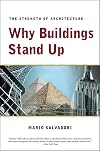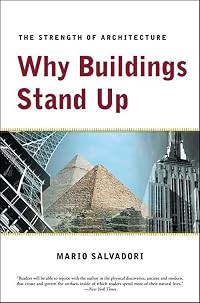
Why Buildings Stand Up: The Strength of Architecture
by Mario Salvadori
On This Page
Description
An introduction to building methods from ancient times to the present day. In the afterword (to the 1990 pbk. ed.), the author discusses recent advances in science and technology that have had important effects on the planning and construction of buildings: improved materials (steel, concrete, plastics), progress in antiseismic designs, and changes in both architectural and structural design made possible by the computer.Tags
Recommendations














Member Reviews
This is my second read, the first more than a decade ago. The theoretical chapters near the beginning (loads, materials, beams) are better than the chapters that get caught up in 'explaining architecture.' It's a good explainer book for structure, I'm not sure it's a good critique/history book, but both subjects get equal time.
In brief, as the author explains, this book offers the history of some of the great monuments of architecture and an explanation of why they stand up. He describes in detail the challenge of weight distribution, the role different materials play, and equilibrium provided by beams and columns, He then looks at specific types of buildings and how their construction has evolved, from houses to skyscrapers. The next chapters deal with specific structures, including the Eiffel Tower, some famous cathedrals and the domes that characterize them, and some famous bridges. He also deals with “form-resistant” structures. He ends with a discussion of natural disasters and how buildings can (or don’t) withstand them.
The book goes into quite a show more bit of technical detail, and although it makes for difficult reading, it definitely provides answers to questions you have about, for example, how pyramids and cathedrals could have been constructed without modern equipment, and how bridges could have been erected in water. show less
The book goes into quite a show more bit of technical detail, and although it makes for difficult reading, it definitely provides answers to questions you have about, for example, how pyramids and cathedrals could have been constructed without modern equipment, and how bridges could have been erected in water. show less
This had a lot of great information for someone like me; an interested layperson with no professional design training. The style is a classic sort of stuffy academic prose, and in places goes on at length about how much of a genius someone was (the paragraph-plus extolling the mind of Gustave Eiffel being a good example), but its certainly informative and engaging if I put that aside.
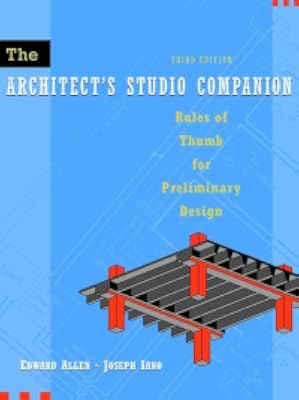
I did feel like a lot of what was here was similar to Edward Allen's (no relation!) book, How Buildings Work: The Strength of Architecture, which I read recently. Allen was rather broader in range of topics, and Salvadori more in depth in examining structural design theory and specific historical and modern buildings. It was worth a read, for sure.
I did feel like a lot of what was here was similar to Edward Allen's (no relation!) book, How Buildings Work: The Strength of Architecture, which I read recently. Allen was rather broader in range of topics, and Salvadori more in depth in examining structural design theory and specific historical and modern buildings. It was worth a read, for sure.
This is a good basic overview of structural principles and how they work. The writing style grated on me a bit, but I got used to it after a while. I’d recommend for anyone who has a basic interest in learning about structures and how they work. His cheerleading of specific technologies as the be all end all ages the book unfortunately as his predictions have not borne out.
Salvadori's book, together with its companion volume, Why Buildings Fall Down (an even more gripping read, of course), tells a series of fascinating stories to give us a readable, even entertaining, introduction to the principles of structural engineering.
The writing (or translation) is a little awkward, but the book is essential for understanding the engineering of buildings. Covers the Pyramids, residential dwellings, skyscrapers, beams and columns, bridges and cathedrals.
Why Buildings Stand Up: The Strength of Architecture Interesting.
Members
- Recently Added By
Lists

Best Architecture Books
87 works; 14 members
Author Information

22 Works 1,918 Members
Mario Salvadori (1907-1997) was James Renwick Professor Emeritus of Civil Engineering and Professor Emeritus of Architecture at Columbia University, an honorary member of the American Institute of Architects, and author of eighteen books, including (with Matthys Levy) Why Buildings Fall Down
Some Editions
Common Knowledge
- Canonical title*
- Perché gli edifici stanno in piedi
- Original publication date
- 1980
- Dedication
- To Carol, my wife
- First words
- (Preface): This book was written for those who love beautiful buildings and wonder how they stand up.
Compared to other human activities, architecture is a young art that had its beginnings only 10,000 years ago when men and women, having discovered agriculture and husbandry, were able to give up roaming the surface of the ea... (show all)rth in search of food. - Last words
- (Click to show. Warning: May contain spoilers.)Nowhere is this more true than in architecture and structure, a marriage in which science and beauty combine to fulfill some of the most basic physical and spiritual needs of humanity.
(Click to show. Warning: May contain spoilers.)(Afterword): Meanwhile, if the book in hand has drawn the reader closer to architecture and its technologies, my modest labors have been amply compensated.
*Some information comes from Common Knowledge in other languages. Click "Edit" for more information.
Classifications
- Genres
- Art & Design, Nonfiction, General Nonfiction, Science & Nature, Technology
- DDC/MDS
- 624.17 — Applied science & technology Engineering Bridges & Tunnels Structural Engineering Structural Analysis And Design
- LCC
- TH845 .S33 — Technology Building construction Building construction Architectural engineering. Structural
- BISAC
Statistics
- Members
- 785
- Popularity
- 35,571
- Reviews
- 8
- Rating
- (3.54)
- Languages
- 5 — English, French, Italian, Polish, Portuguese
- Media
- Paper
- ISBNs
- 10
- ASINs
- 4