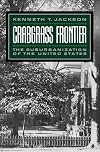
Crabgrass Frontier: The Suburbanization of the United States
by Kenneth T. Jackson
On This Page
Description
"This first full-scale history of the development of the American suburb examines how 'the good life' in America came to be equated with the a home of one's own surrounded by a grassy yard and located far from the urban workplace. Integrating social history with economic and architectural analysis, and taking into account such factors as the availability of cheap land, inexpensive building methods, and rapid transportation, Kenneth Jackson chronicles the phenomenal growth of the American show more suburb from the middle of the 19th century to the present day. He treats communities in every section of the U.S. and compares American residential patterns with those of Japan and Europe. In conclusion, Jackson offers a controversial prediction: that the future of residential deconcentration will be very different from its past in both the U.S. and Europe."--Provided by publisher show lessTags
Recommendations



























Member Reviews
I hadn’t much thought about the connections between inner-city gentrification and the rise of the suburbs, but they do have a few things in common:
- they both have the effect of protecting the interests of the “in” group against the marginalized in American (and for that matter Canadian) society
- they hijack public resources for private ends
We know that gentrification pushes individuals in marginal jobs far from their place of work, or often into intolerable living conditions close to their work. It happened in 19th century New York as well as 21st century London and Paris.
Suburbanization — mostly a N. American phenomenon — causes government to build vast networks of highways to support the wealthy few in far-flung and show more increasingly gated communities.
It’s not good for society and it sure as shooting isn’t good for the environment.
In “Crabgrass Frontier,” author Kenneth Jackson demonstrates how the rise of suburbs reinforced the racial divide in America.
- suburbs were allowed to opt out of public housing for propertyless African Americans
- zoning bylaws have been used to redraw the urban map and isolate marginalized groups
- Federal financing of home mortgages biased financing toward white veterans and their communities after the war, and even in Roosevelt programs in the wake of the Depression
It almost seems as though nothing happens in America that isn’t tied to race. show less
- they both have the effect of protecting the interests of the “in” group against the marginalized in American (and for that matter Canadian) society
- they hijack public resources for private ends
We know that gentrification pushes individuals in marginal jobs far from their place of work, or often into intolerable living conditions close to their work. It happened in 19th century New York as well as 21st century London and Paris.
Suburbanization — mostly a N. American phenomenon — causes government to build vast networks of highways to support the wealthy few in far-flung and show more increasingly gated communities.
It’s not good for society and it sure as shooting isn’t good for the environment.
In “Crabgrass Frontier,” author Kenneth Jackson demonstrates how the rise of suburbs reinforced the racial divide in America.
- suburbs were allowed to opt out of public housing for propertyless African Americans
- zoning bylaws have been used to redraw the urban map and isolate marginalized groups
- Federal financing of home mortgages biased financing toward white veterans and their communities after the war, and even in Roosevelt programs in the wake of the Depression
It almost seems as though nothing happens in America that isn’t tied to race. show less
An engaging book, but riddled with contradictions and, the author's impressive battery of statistics notwithstanding, rather glib. The superb chapter on redlining details the way racism festers in big government bureaucracies, and Jackson's solution is even bigger government, with even more bureaucracies.
Why does the US look so strange compared to other places with big cities, with failing urban cores surrounded by prosperous (ticklike, even) suburbs? Jackson gives the history of US suburbanization, which started with cheap transportation via streetcars and railroads and exploded with the rise of the automobile. He argues that there were two key preconditions—the suburban ideal of living in detached housing with an automobile (desires he argues are shared widely beyond the US, but the US’s wealth enabled more people to fulfill that ideal) and population growth, making geographic expansion seem desirable. And then there were two fundamental causes: racial prejudice (which led whites to flee cities when they could, and led to show more government policies that made it easier for whites to flee and harder for minorities, most especially African-Americans, to go anywhere—the government turned prejudice into policy, so that homes in “redlined” areas couldn’t get mortgages and therefore couldn’t help African-Americans build wealth) and cheap housing (also the result of government decisions to subsidize suburbanization, homeownership, and automobile transit, as well as new construction technology, abundant land, and relative wealth). Wealthy developers were allowed to shape government policy, unlike in Europe, so, for example, municipal services were extended to suburbs, often paid for by the cities they were draining.
Very interesting and depressing reading; published in 1984, Jackson makes some predictions about the future of suburbanization that, a quarter-century later, have mostly not been borne out, though they haven’t been disproved either. show less
Very interesting and depressing reading; published in 1984, Jackson makes some predictions about the future of suburbanization that, a quarter-century later, have mostly not been borne out, though they haven’t been disproved either. show less
Boring and highly informative, just as I expected.
The suburbs, a manifestation of middle-class values, trick their inhabitants into thinking they are the norm.
According to this book, the availability of land, the rise of middle-class mores about the nuclear family, the American ideals of freedom, and a fear/disdain for minorities and immigrants all collided to cause the flight from cities and the creation of periphery suburbs. While the rebellious 60s and riots that broke out in urban America contributed towards the growth of the suburbs, this book shows how these dynamics that drastically escalated by 1980 had been taking place for a century beforehand.
I also found helpful Jackson's exploration of the shifting importance of the show more nuclear family in the 19th century, in addition to the escalating domain of 'private life' over public.
Highly recommended for anyone who grew up in the suburbs, or who are interested in the spatial/geographic development of the United States. show less
The suburbs, a manifestation of middle-class values, trick their inhabitants into thinking they are the norm.
According to this book, the availability of land, the rise of middle-class mores about the nuclear family, the American ideals of freedom, and a fear/disdain for minorities and immigrants all collided to cause the flight from cities and the creation of periphery suburbs. While the rebellious 60s and riots that broke out in urban America contributed towards the growth of the suburbs, this book shows how these dynamics that drastically escalated by 1980 had been taking place for a century beforehand.
I also found helpful Jackson's exploration of the shifting importance of the show more nuclear family in the 19th century, in addition to the escalating domain of 'private life' over public.
Highly recommended for anyone who grew up in the suburbs, or who are interested in the spatial/geographic development of the United States. show less
I read this for a seminar I had on Urban and Suburban Sociology.
It is an interesting read (however, that is a subject that I truly love, so take this review with a grain of salt)
The writing is a little dry, can't really expect much from it, but it was very informational and makes me want to move out of the suburbs and despise it more =)
It is an interesting read (however, that is a subject that I truly love, so take this review with a grain of salt)
The writing is a little dry, can't really expect much from it, but it was very informational and makes me want to move out of the suburbs and despise it more =)
Jackson provides a comprehensive analysis of the the move to the suburbs in America. He argues that this is not a new phenomena, but goes back to the nineteenth century. He cites the causes as the abundance of land, distrust of cities, racial tensions and unregulated use of private property. New construction techniques and improvements in transportation were also very important. In particular, the growth of the use of cars allowed greater movement to the suburbs. In addition, federal policy, with public housing and red lining, contributed to suburbanization.
Jackson fluctuates between seeing suburbs as symbiotic and parasitic, with parasitism dominating recent decades. He sees suburbs as a drain on cities, offering very little in return. show more He appears completely hostile to the car, which is his primary villain in 20th century suburbanization, as it combines mobility and status. Yet he sees hope for the future as land and construction prices go up. Although most of his analysis has become the standard, his predictions have not held up as well. Twenty years later, suburbanization continues with little change in sight. show less
Jackson fluctuates between seeing suburbs as symbiotic and parasitic, with parasitism dominating recent decades. He sees suburbs as a drain on cities, offering very little in return. show more He appears completely hostile to the car, which is his primary villain in 20th century suburbanization, as it combines mobility and status. Yet he sees hope for the future as land and construction prices go up. Although most of his analysis has become the standard, his predictions have not held up as well. Twenty years later, suburbanization continues with little change in sight. show less
Pretty much a classic of American Studies, in which Jackson explores the political, economic, and social aspects of American suburbanization, from the beginnings of suburbs up through the 70s or maybe early 80s. He covers a lot of important issues, such as race relations and white flight, the decay of the downtown (once a shopper's paradise that people from the suburbs made special trips to visit), the role of the government in control over mass transport, and etc. With all the recent urban "revitalization" going on in some of our major cities, it might be time for a new edition? Still solid reading for those interested in urban studies.
Members
- Recently Added By
Lists

r/AskHistorians' Recommended Books
1,068 works; 19 members

Works Cited in The History of White People by Nell Irvin Painter
321 works; 2 members
Author Information

21+ Works 1,774 Members
Awards and Honors
Awards
Common Knowledge
- Original publication date
- 1985
- Important places
- USA
- Epigraph
- Even while you read this whole square miles of identical boxes are spreading like gangrene . . . developments conceived in error, nurtured by greed, corroding everything they touch.
- John Keats, The Crack in the Pictu... (show all)re Window - Dedication
- For Barbara
and
To the bright and enduring memory of our son, Kenneth Gordon Jackson II (1968-1984)
O my son Absalom,
my son, my son Absalom!
would God I had died for thee
- 2 Samuel 18 - First words
- Throughout history, the treatment and arrangement of shelter have revealed more about a particular people than have any other products of the creative arts. [Introduction]
- Last words
- (Click to show. Warning: May contain spoilers.)For better or for worse, the American suburb is a remarkable and probably lasting achievement. The words of an anonymous English jingle of the 1870s are apposite:
The richest crop for any field
Is a crop of bricks for it to yield.
The richest crop that it can grow,
Is a crop of houses in a row. - Canonical DDC/MDS
- 307.740973
- Canonical LCC
- HT384.U5
Classifications
- Genres
- Nonfiction, History, Sociology, General Nonfiction, Art & Design
- DDC/MDS
- 307.740973 — Society, government, & culture Social sciences, sociology & anthropology Communities Specific kinds of communities Suburban communities
- LCC
- HT384 .U5 — Social sciences Communities. Classes. Races Communities. Classes. Races Urban groups. The city. Urban sociology Urbanization. City and country
- BISAC
Statistics
- Members
- 836
- Popularity
- 32,914
- Reviews
- 10
- Rating
- (3.88)
- Languages
- English
- Media
- Paper, Audiobook, Ebook
- ISBNs
- 6
- ASINs
- 7