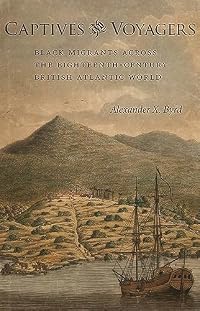
Captives and Voyagers: Black Migrants Across the Eighteenth-Century British Atlantic World
by Alexander X. Byrd
Antislavery, Abolition, and the Atlantic World (2008)
On This Page
Description
Jamestown and Plymouth serve as iconic images of British migration to the New World. A century later, however, when British migration was at its peak, the vast majority of men, women, and children crisscrossing the Atlantic on English ships were of African, not English, descent. Captives and Voyagers, a compelling study from Alexander X. Byrd, traces the departures, voyages, and landings of enslaved and free blacks who left their homelands in the eighteenth century for British colonies and show more examines how displacement and resettlement shaped migrant society and, in turn, Britain's Atlantic empire. Captives and Voyagers breaks away from the conventional image of transatlantic migration and illustrates how black men and women, enslaved and free, came to populate the edges of an Anglo-Atlantic world. Whether as settlers in Sierra Leone or as slaves in Jamaica, these migrants brought a deep and affecting experience of being in motion to their new homelands, and as they became firmly ensconced in the particulars of their new local circumstances they both shaped and were themselves molded by the demands of the British Atlantic world, of which they were an essential part. Byrd focuses on the two largest and most significant streams of black dislocation: the forced immigration of Africans from the Biafran interior of present-day southeastern Nigeria to Jamaica as part of the British slave trade and the emigration of free blacks from Great Britain and British North America to Sierra Leone in West Africa. By paying particular attention to the social and cultural effects of transatlantic migration on the groups themselves and focusing as well on their place in the British Empire, Byrd illuminates the meaning and experience of slavery and liberty for people whose journeys were similarly beset by extreme violence and catastrophe. By following the movement of this representative population, Captives and Voyagers provides a vitally important view of the British colonial world -- its intersection with the African diaspora.Captives and Voyagers traces the departures, voyages, and landings of enslaved and free blacks who left their homelands in the eighteenth century for British colonies and examines how displacement and resettlement shaped migrant society and, in turn, Britain's Atlantic empire. Alexander X. Byrd focuses on the two largest and most significant streams of black dislocation: the forced migration of Africans from the Biafran interior of present-day southeastern Nigeria to Jamaica as part of the British slave trade and the journeys of free blacks from Great Britain and British North America to Sierra Leone in West Africa. By paying particular attention to the social and cultural effects of transatlantic migration on the groups themselves and focusing as well on their place in the British Empire, Byrd illuminates the meaning and experience of slavery and liberty for people whose movements were similarly beset by extreme violence and catastrophe. show lessTags
Recommendations




Members
- Recently Added By
Author Information
1 Work 24 Members
Alexander X. Byrd is an assistant professor of history at Rice University.
Awards and Honors
Awards
Series

Common Knowledge
- Canonical title
- Captives and Voyagers: Black Migrants Across the Eighteenth-Century British Atlantic World
Classifications
Statistics
- Members
- 24
- Popularity
- 1,103,912
- Languages
- English
- Media
- Paper, Ebook
- ISBNs
- 3