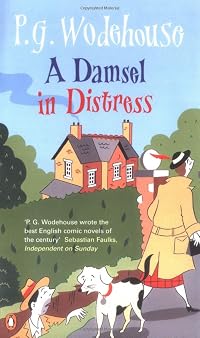
A Damsel in Distress
by P. G. Wodehouse
On This Page
Description
When you're in the mood for classic British humor writing, nothing can compare to the master of literary laughter, P.G. Wodehouse. The novel A Damsel in Distress is an uproarious combination of romantic intrigue, mistaken identities, and general hilarity. A must-read for Wodehouse fans, or for anyone who loves a good laugh and a well-told tale..
Tags
Recommendations

















Member Reviews
George is a music writer for several successful plays and Maud hops into his cab in Piccadilly to avoid seeing her brother who thinks she is back home in the country, rather than in London. George falls in love with Maud, but Maud is in love with an American she met in Wales last summer. All the while, her family wants her to marry Reggie who is love with his uncle’s secretary. This confusing set of circumstances all gets sorted out by the end in this comedy by Wodehouse. No one is better at poking fun at the upper classes while untangling a mass of miscommunication and chaos than Wodehouse is and I literally laughed out loud several times while reading this book.
This book was a Blandings book in the same way that [b:Cause Celeb|4529|Cause Celeb|Helen Fielding|http://photo.goodreads.com/books/1165445786s/4529.jpg|8162] featured Bridget Jones: the characters were often less hyperbolic, but readers can tell that the author started from a similar point with both books. In Helen Fielding's case, it was a British Singleton who couldn't keep a man. Cause Celeb ended up being much more serious than Bridget, but there were similar influences.
In that same light, this book resembled Wodehouse's world surrounding Blandings Castle. The book was slightly less absurd in many ways, but some of the characters were from the same source material. Lady Caroline, like Lady Constance, is a manifestation of show more Wodehouse's perpetual fear of domineering aunts. You have the slightly vacant Earl, the dotty cousin, and the young girl who has unwisely fallen for an improper man.
Unlike most of the Blandings books, A Damsel in Distress features a likeable hero instead of a judgmental nitwit I spend most of the book wanting to slap upside the head (for some of the Blandings books, I root for Galahad and completely ignore the main plot except where it provides me with delicious absurdity). George, an American composer, isn't one of Blandings Castle's sad saps who mopes when he thinks his gal just looked twice at another bloke. Instead, he's fairly forthright, genuine, and in possession of both humility and common sense. Without him, I still would have liked this book, but I probably wouldn't have enjoyed it to the extent that I did.
I also liked the Earl, who has slightly more substance than the Earl of Emsworth. He had a background and an active interest in his garden instead of sort of fluttering and fretting over it. Don't get me wrong: I love Clarence. It was just nice to see a gent who couldn't be tricked or tossed about by sucking up to him about his prized pig.
This book was a good deal of fun. I was amused and it actually caught me off guard a couple of times. Definitely recommend! show less
In that same light, this book resembled Wodehouse's world surrounding Blandings Castle. The book was slightly less absurd in many ways, but some of the characters were from the same source material. Lady Caroline, like Lady Constance, is a manifestation of show more Wodehouse's perpetual fear of domineering aunts. You have the slightly vacant Earl, the dotty cousin, and the young girl who has unwisely fallen for an improper man.
Unlike most of the Blandings books, A Damsel in Distress features a likeable hero instead of a judgmental nitwit I spend most of the book wanting to slap upside the head (for some of the Blandings books, I root for Galahad and completely ignore the main plot except where it provides me with delicious absurdity). George, an American composer, isn't one of Blandings Castle's sad saps who mopes when he thinks his gal just looked twice at another bloke. Instead, he's fairly forthright, genuine, and in possession of both humility and common sense. Without him, I still would have liked this book, but I probably wouldn't have enjoyed it to the extent that I did.
I also liked the Earl, who has slightly more substance than the Earl of Emsworth. He had a background and an active interest in his garden instead of sort of fluttering and fretting over it. Don't get me wrong: I love Clarence. It was just nice to see a gent who couldn't be tricked or tossed about by sucking up to him about his prized pig.
This book was a good deal of fun. I was amused and it actually caught me off guard a couple of times. Definitely recommend! show less
“A Damsel in Distress” (1919) contains all the elements so common in P.G. Wodehouse novels: a doddering lord of the manor, a domineering aunt, thwarted young lovers, domestic help quick to manipulate the lives of their employers and two of the author's favorite passions, golf and musical comedy. Yet somehow Wodehouse mixes all these familiar ingredients into a highly original and always entertaining novel. one of his best.
Maud remains passionate about an American man she met in Wales the year before, but Caroline, her aunt, demands she marry her son, Reggie, who is actually in love with Miss Faraday, the secretary who is helping Maud's father, Lord Marshmorton, with the family history. Lord Marshmorton, however, cares only about his show more roses.
Meanwhile George Bevan, a successful composer of Broadway musicals (one of which is playing in London) instantly falls in love with Maud when he comes to her aid on a London street. He tracks her back to her family estate, where she is being held a virtual prisoner. Her family mistakes George for the American from Wales, while Maud views him as a nice guy who might act as messenger between her and the man she loves. The confusion results in many chapters of sparkling comedy and finally a conclusion that is as romantic as anything Wodehouse ever wrote.
And yes, as usual, Wodehouse writes sentences that make you want to read them again and again, then go back later and read them again. Here's just one example: "Between ourselves, laddie, and meaning no disrespect to the dear soul, when the mater is moved and begins to talk, she uses up most of the language." Fortunately she left enough for Wodehouse to work his magic. show less
Maud remains passionate about an American man she met in Wales the year before, but Caroline, her aunt, demands she marry her son, Reggie, who is actually in love with Miss Faraday, the secretary who is helping Maud's father, Lord Marshmorton, with the family history. Lord Marshmorton, however, cares only about his show more roses.
Meanwhile George Bevan, a successful composer of Broadway musicals (one of which is playing in London) instantly falls in love with Maud when he comes to her aid on a London street. He tracks her back to her family estate, where she is being held a virtual prisoner. Her family mistakes George for the American from Wales, while Maud views him as a nice guy who might act as messenger between her and the man she loves. The confusion results in many chapters of sparkling comedy and finally a conclusion that is as romantic as anything Wodehouse ever wrote.
And yes, as usual, Wodehouse writes sentences that make you want to read them again and again, then go back later and read them again. Here's just one example: "Between ourselves, laddie, and meaning no disrespect to the dear soul, when the mater is moved and begins to talk, she uses up most of the language." Fortunately she left enough for Wodehouse to work his magic. show less
After Titus Andronicus, this made for a nice change of pace!
Maud thinks herself in love with an American she met in Wales last summer and finds herself limited to the grounds of the ancestral castle. After a bit of admirable sneaking, she finds herself in London and sees her brother Percy. IN order to avoid him, she dives into a taxi and begs George Bevan to save her. As it turns out, George is a man in need of some diversion in life to give it some interest. He turns knight errant, saves the damsel in distress and falls in love. Just like that.
From there, the action moves to Belpher castle and its environs. George contrives to get a message to Maud, via a page boy with an eye to the main chance.
Along the way, Reggie Bing's love life show more is also resolved, with a lot less fuss and bother than Maud's. Her story resolves itself in a nicely different way, with the girl deciding what she wants and going for it. All very empowering.
There are the usual array of characters in here, a bumbling Earl, the rather annoying aunt, the very annoying heir to the throne, a chorus girl and so on. All present and correct in a Wodehouse comedy.
I note that the description of Belpher village bears a lot in common with my home town, where PG Wodehouse lived for a number of years. So I'm claiming to be a resident >;-) show less
Maud thinks herself in love with an American she met in Wales last summer and finds herself limited to the grounds of the ancestral castle. After a bit of admirable sneaking, she finds herself in London and sees her brother Percy. IN order to avoid him, she dives into a taxi and begs George Bevan to save her. As it turns out, George is a man in need of some diversion in life to give it some interest. He turns knight errant, saves the damsel in distress and falls in love. Just like that.
From there, the action moves to Belpher castle and its environs. George contrives to get a message to Maud, via a page boy with an eye to the main chance.
Along the way, Reggie Bing's love life show more is also resolved, with a lot less fuss and bother than Maud's. Her story resolves itself in a nicely different way, with the girl deciding what she wants and going for it. All very empowering.
There are the usual array of characters in here, a bumbling Earl, the rather annoying aunt, the very annoying heir to the throne, a chorus girl and so on. All present and correct in a Wodehouse comedy.
I note that the description of Belpher village bears a lot in common with my home town, where PG Wodehouse lived for a number of years. So I'm claiming to be a resident >;-) show less
Unusually for Wodehouse, this is essentially a love story. George Bevan is a likeable young man who has made his fortune by writing popular music. He is beginning to feel a bit jaded when, to his astonishment, a beautiful girl leaps into his cab and asks him to hide her.
George rises to the occasion with aplomb, and ends up captivated by the girl, who soon disappears. But he manages to discover who she is, and rents a cottage in the neighbourhood of her home...
Cue typical Wodehouse misunderstandings and confusion as George arrives, and is mistaken for someone else.
In Wodehouse’s hands this story is a wonderful comedy of errors, with his usual subtle and not-so-subtle references to literary figures from works as diverse as the Bible show more and dubious limericks.
There are one or two unexpected developments in this book, but with Wodehouse it’s not the plot that matters so much as the mixture of people and the surreal situations which, in his hands, seem all-too-real. However the ending was most satisfactory, even if there was a bit of political incorrectness along the way.
Very enjoyable to read on my Kindle - highly recommended to all who enjoy this writer. show less
George rises to the occasion with aplomb, and ends up captivated by the girl, who soon disappears. But he manages to discover who she is, and rents a cottage in the neighbourhood of her home...
Cue typical Wodehouse misunderstandings and confusion as George arrives, and is mistaken for someone else.
In Wodehouse’s hands this story is a wonderful comedy of errors, with his usual subtle and not-so-subtle references to literary figures from works as diverse as the Bible show more and dubious limericks.
There are one or two unexpected developments in this book, but with Wodehouse it’s not the plot that matters so much as the mixture of people and the surreal situations which, in his hands, seem all-too-real. However the ending was most satisfactory, even if there was a bit of political incorrectness along the way.
Very enjoyable to read on my Kindle - highly recommended to all who enjoy this writer. show less
The first time I read P.G. Wodehouse I almost fell off my couch with laughter. If you were a fan of "Frasier" and enjoyed the good years of that sitcom, this might be your cup of tea. I can't help but wonder if the writers were fans of Wodehouse. DAMSEL IN DISTRESS, long before any t.v. show did, showed just how a simple misunderstanding could quickly become messy and quite entertaining...
Wodehouse never gets old for me. I love the style of his writing (witty), the mis-adventures his charactures endure (zany and madcap), and how everyone ends up happy in the end (uh, happily). A Damsel in Distress is another delightful comedy of errors, with mistaken identities, crazy relatives, love-sick young people, and one butter-lovin’ fat man. Mix it all together and you have a delicious romp through the British countryside. I do prefer the Jeeves and Wooster stories to Wodehouse’s standalones, but nonetheless—this was a fun read and is classic Wodehouse.
Read my full review here: http://letseatgrandpa.com/2011/01/03/book-review-1-a-damsel-in-distress-by-pg-wo...
Read my full review here: http://letseatgrandpa.com/2011/01/03/book-review-1-a-damsel-in-distress-by-pg-wo...
Members
- Recently Added By
Lists

Read the book and saw the movie
1,170 works; 195 members

Top Five Books of 2014
1,064 works; 398 members

Books Read in 2016
4,666 works; 199 members

Books Read in 2018
4,360 works; 110 members

Writers In Public Domain 2026
90 works; 1 member
Author Information

657+ Works 111,114 Members
P. G. Wodehouse was born in Guildford, United Kingdom on October 15, 1881. After completing school, he spent two years as a banker at the Hong Kong and Shanghai Bank in London and then took a job as a sports reporter and columnist for the Globe newspaper. His first novel, The Pothunters, was published in 1902. He wrote over 100 novels and short show more story collections during his lifetime including A Perfect Uncle, Love Among the Chickens, The Swoop, P. Smith in the City, Meet Mr. Milliner, Doctor Sally, Quick Service, The Old Reliable, Uneasy Money, A Damsel in Distress, Jill the Reckless, The Adventures of Sally, A Pelican at Blandings, The Girl in Blue, and Aunts Aren't Gentlemen. His most famous characters, Bertie Wooster and his manservant, Jeeves, appeared in books such as Much Obliged, Jeeves. He also wrote lyrics for musical comedies and worked as screenwriter in Hollywood in the 1930s. In 1939, he bought a villa in Le Touquet on the coast of France. He remained there when World War II started in 1939. The following year, the Germans appropriated the villa, confiscated property, and arrested him. He was detained in various German camps for almost one year before being released in 1941. He went to Berlin and spoke of his experience in five radio talks to be broadcast to America and England. The talks themselves were completely innocuous, but he was charged with treason in England. He was cleared, but settled permanently in the United States. He became a citizen in 1955. He was made a Knight Commander of the Order of the British Empire in 1975. He died from a heart attack after a long illness on February 14, 1975 at the age of 93. (Bowker Author Biography) show less
Some Editions
Series
Belongs to Publisher Series
Work Relationships
Has the adaptation
Common Knowledge
- Canonical title*
- Señorita en desgracia
- Original title
- A Damsel in Distress
- Original publication date
- 1919-10-04
- People/Characters
- Earl of Marshmoreton; Lady Patricia Marsh ("Maud"); Lord Belpher ("Percy"); Lady Caroline Byng; Reginald Byng ("Reggie"); Geoffrey Raymond (show all 11); George Bevan; Billie Dore; Alice Faraday; Keggs; Albert
- Important places
- Hampshire, England, UK; Belpher Castle
- Related movies
- A Damsel in Distress (1937 | IMDb)
- First words
- In as much as the scene of this story is that historic pile, Belpher Castle, in the county of Hampshire, it would be an agreeable task to open it with a leisurely description of the place, followed by some notes on the histor... (show all)y of the Earls of Marshmoreton, who have owned it since the fifteenth century.
- Quotations
- Unfortunately, in these days of rush and hurry, a novelist works at a disadvantage. He must leap into the middle of his tale with as little delay as he would employ in boarding a moving tramcar. He must get off the mark with ... (show all)the smooth swiftness of a jack-rabbit surprised while lunching. Otherwise, people throw him aside and go out to picture palaces.
- Last words
- (Click to show. Warning: May contain spoilers.)'Well,' said George to the steamer-trunk, 'and what are you butting in for? Who wants you, I should like to know!'
- Original language
- Inglés; English
*Some information comes from Common Knowledge in other languages. Click "Edit" for more information.
Classifications
Statistics
- Members
- 1,358
- Popularity
- 17,693
- Reviews
- 22
- Rating
- (4.01)
- Languages
- 5 — English, Finnish, Italian, Spanish, Swedish
- Media
- Paper, Audiobook, Ebook
- ISBNs
- 124
- ASINs
- 44