
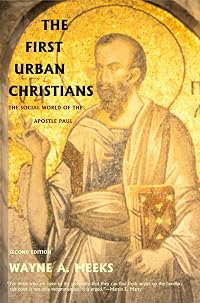
The First Urban Christians: The Social World of the Apostle Paul
by Wayne A. Meeks
On This Page
Description
In this classic work, Wayne A. Meeks analyzes the earliest extant documents of Christianity-the letters of Paul-to describe the tensions and the texture of life of the first urban Christians. In a new introduction, he describes the evolution of the field of New Testament scholarship over the past twenty years, including new developments in fields such as archaeology and social history.Praise for the earlier edition:"Many readers are likely to join me in feeling that they have never been so show more close to their mixed and mixed-up spiritual ancestors as Meeks helps them to be. For those who are open to the possibility that they can find fresh angles on the familiar, this book is not only recommended; it is urged."-Martin E. Marty, Christian Century"A much-needed authoritative study."-J. L. Houlden, Times Literary Supplement"Those with any historical bent will be intrigued by the way a story usually overlaid with thick layers of theological speculation is unraveled. . . . And those who simply have an interest in how groups form in any era . . . will be fascinated by this case study of one particular community that has ramifications for understanding all other communities."-Robert McAfee Brown, New York Times Book Review "Should fascinate any reader with an interest in the history of human thought."--Phoebe-Lou Adams, Atlantic Monthly show lessTags
Recommendations










Member Recommendations


Member Reviews
This is a model of good scholarship. Meeks seeks to look at the social dimension of Paul's communities by careful reading of the text and judicious use of a variety of sociological models and theories. He neither tries to claim too much, nor tries to reduce everything to sociology, as can occasionally happen. He draws also on the work of earlier authors who have attempted the same tasks, correcting them where he deems necessary.
The scholarship is imense, as witnessed by the extensive endnotes (45 pages) and bibliography (40 pages) and there are several indices
The scholarship is imense, as witnessed by the extensive endnotes (45 pages) and bibliography (40 pages) and there are several indices
Oh my! A full third of the book is notes and bibliographies - yes multiples.
INDEX; BIBLIOGRAPHY
Si l’on veut s’inspirer de la sociologie pour étudier le Nouveau Testament, il existe plusieurs manières de le faire. Même s’il prétend à l’éclectisme, W.A. Meeks, dans son enquête sur le christianisme urbain primitif, s’attache plus spécialement à la sociologie du langage, et donc à la fonction sociale du langage théologique : le fruit de son travail constitue une étude tout à fait originale et passionnante. Après avoir écarté un éventuel reproche de réductionnisme et montré en quoi une interprétation sociologique peut enrichir la connaissance du christianisme primitif, l’A. se propose de décrire ’l’environnement des groupes chrétiens d’une part, et, d’autre part, le monde tel que ces show more chrétiens le perçoivent et auquel ils donnent forme et sens au travers de leur langage spécifique et d’autres actions signifiantes’ (p. 8).
En ce qui concerne les communautés pauliniennes, l’environnement en question est celui du monde urbain puisque ’la mission du cercle paulinien fut conçue du début à la fin comme un mouvement urbain’ (p. 10) : c’est ce qui ressort par exemple du fait que ’les communautés pauliniennes se trouvent situées sur les deux principales routes qui vont de l’Est à l’Ouest’ (p. 17). Dans cette description du monde urbain, l’A. s’arrête surtout sur la mobilité sociale, les voyages, la place des associations……
Fr. Hervé PONSOT o.p., http://biblicom.net, 1984 show less
En ce qui concerne les communautés pauliniennes, l’environnement en question est celui du monde urbain puisque ’la mission du cercle paulinien fut conçue du début à la fin comme un mouvement urbain’ (p. 10) : c’est ce qui ressort par exemple du fait que ’les communautés pauliniennes se trouvent situées sur les deux principales routes qui vont de l’Est à l’Ouest’ (p. 17). Dans cette description du monde urbain, l’A. s’arrête surtout sur la mobilité sociale, les voyages, la place des associations……
Fr. Hervé PONSOT o.p., http://biblicom.net, 1984 show less
Jun 13, 2015French
Members
- Recently Added By
Author Information

15+ Works 4,494 Members
Wayne A. Meeks is the Woolsey Professor Emeritus of Religious Studies at Yale University. He has served as president of the Society of Biblical Literature and the Studiorum Novi Testamenti Scoietas and is a fellow of the British Academy and of the American Academy of Arts and Sciences.
Awards and Honors
Common Knowledge
- Last words
- (Click to show. Warning: May contain spoilers.)Those odd little groups in a dozzen or so cities in the Roman East were engaged, though they would not have quite put it this way, in constructiong a new world. In time, more time than they thought was left, their ideas, their images of God, their ways of organizing life, their rituals, would become part of a massive transformation, in ways they could not have foreseen, of the culture of the Mediterraneran basin, and of Europe
Classifications
- Genres
- Religion & Spirituality, Nonfiction, History, General Nonfiction
- DDC/MDS
- 270.1 — Religion History of Christianity History, geographic treatment, biography of Christianity Apostolic; Nativity to Constantine
- LCC
- BR166 .M44 — Philosophy, Psychology and Religion Christianity Christianity History By period Early and medieval
- BISAC
Statistics
- Members
- 1,033
- Popularity
- 24,955
- Reviews
- 4
- Rating
- (4.00)
- Languages
- English, German, Portuguese, Spanish
- Media
- Paper, Ebook
- ISBNs
- 8
- ASINs
- 7