ER Vets: Life in an Animal Emergency Room
by Donna M. Jackson
On This Page
Description
Witness the excitement and drama of life in an animal emergency room as the ER vets work to heal the creatures we consider part of our families.Tags
Recommendations
































Member Recommendations
Member Reviews
This book, merit-wise, is very good. The stories of pets and their owners, their trials and tribulations, are interesting enough. Likewise with the daily operations of a vet''s ER room. Unfortunately, I think the audience is far too niche. You have to be young. You have to be an animal lover. You have to maybe one day aspire to be a veterinarian. If you can't tick all those boxes, you may quickly lose interest.
That's not to say it doesn't belong in the children's section of a library. It certainly does. I think there are far too few books like this that really give the day-to-day details of an interesting job. Nothing is held back and there is complete honesty. Some days are bad, and some are real bad, but many are good, and the rewards show more of the profession keep you coming back every day. It's the sort of reality-of-the-job portrayals that children need more contact with. show less
That's not to say it doesn't belong in the children's section of a library. It certainly does. I think there are far too few books like this that really give the day-to-day details of an interesting job. Nothing is held back and there is complete honesty. Some days are bad, and some are real bad, but many are good, and the rewards show more of the profession keep you coming back every day. It's the sort of reality-of-the-job portrayals that children need more contact with. show less
"ER Vets" offers readers an up-close peek at the often dramatic inner workings of a fast-paced animal emergency room. Focusing on a leading veterinary hospital at Colorado State University, author Donna M. Jackson introduces us to a host of veterinarians, vet techs, and students all working together to deliver emergency medical care to animals brought in with life-threatening illnesses and injuries.
The book gives us a vivid sense of the intense collaborative spirit of the place as team members describe exactly how they fit into the first-response picture. We learn about the symptoms and injuries that require the most immediate attention, how triage works, and how staff deal with critical cases and death. The book is full of real-life show more stories both happy and heartbreaking; we cheer for an oxygen-deprived foal who pulled through by the skin of his teeth, and mourn the beloved pet snake who trapped himself in a freezing car overnight. The book is also a wealth of information (and encouragement!) for anyone who's considering going into the field of veterinary medicine.
The format of "ER Vets" is pleasing to the eye, with splashy graphics, plenty of negative space, and colorful photos accompanied by informative captions. A stand-alone feature called "Vitals" tackles subjects useful to pet owners, such as what constitutes an emergency, what to include in an animal first-aid kid, and what not to feed your pet. At the back of the book are suggestions for further reading (including websites), an extensive glossary of terms, an index, and source notes consisting primarily of interviews (though the author also cites a sufficient number of credible books on veterinary medicine and pet ownership). show less
The book gives us a vivid sense of the intense collaborative spirit of the place as team members describe exactly how they fit into the first-response picture. We learn about the symptoms and injuries that require the most immediate attention, how triage works, and how staff deal with critical cases and death. The book is full of real-life show more stories both happy and heartbreaking; we cheer for an oxygen-deprived foal who pulled through by the skin of his teeth, and mourn the beloved pet snake who trapped himself in a freezing car overnight. The book is also a wealth of information (and encouragement!) for anyone who's considering going into the field of veterinary medicine.
The format of "ER Vets" is pleasing to the eye, with splashy graphics, plenty of negative space, and colorful photos accompanied by informative captions. A stand-alone feature called "Vitals" tackles subjects useful to pet owners, such as what constitutes an emergency, what to include in an animal first-aid kid, and what not to feed your pet. At the back of the book are suggestions for further reading (including websites), an extensive glossary of terms, an index, and source notes consisting primarily of interviews (though the author also cites a sufficient number of credible books on veterinary medicine and pet ownership). show less
ER Vets: Life in an Animal Emergency Room by Donna M Jackson provides a detailed vision of what goes on in a veterinarian hospital’s emergency room. In between a specialized book and a photographic essay, the book begins with a description of general procedures and methods as well as some background information on some of the staff members of veterinarian hospitals before providing several case studies which help paint a detailed picture of all different situations an emergency vet faces on a daily basis. The prose is brisk and engaging, it’s only limitation being that it is printed in a sans-serif font, which makes it more difficult to read (Research has shown that while san-serif fonts are more readable than serif fonts when show more viewed on screens, serif fonts are far the more readable of the two in print.). The best feature of this book, however, is the photography. Every page is filled with pictures of animals, and with a few exceptions of fully healthy, non-contextualized animal pictures, the photographs show sick and injured animals in ways which grab the reader and simultaneously tell a story.
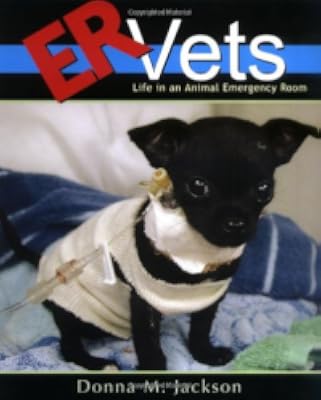
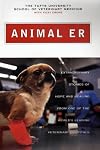
Beginning with the cover, the author’s selection of photographs pulls you in, in this case with a picture of an adorable, tiny dog wrapped in gauze and hooked up to an IV. The end pages show reproductions of letters written by the families of rescued pets to their veterinarians, which simultaneously warms the heart but also shows one of the rewards of the profession, which is important as the book is aimed at young people who are considering a career in veterinary medicine. Throughout the book there are several sidebars which act as on the spot glossaries to provide further information on the topic using discussed in nearby pages. These sidebars are supported at the end of the book with a comprehensive glossary full of all the complex medical and occupational terms used throughout the book. The book also includes both book and website suggestions for further reading as well as w detailed index of major topics and themes discussed.
My favorite feature outside of the photographs is the two-page spread on the essential items for a pet first aid kit. While it is probably unlikely that many readers will end up using such a kit, the message being put forth to the young reader is one of urgency, trust, and competency. By suggesting to the reader that they are ready to beginning their career in medicine by organizing themselves to at least help their own pets, the author is empowering the reader to begin to take steps into the adult world. One can easily imagine a thirteen-year-old gathering up all these supplies and keeping an extra sharp eye on her and her neighbor’s pets, perhaps becoming so engaged that they decide to volunteer at the local animal shelter.
But as mentioned above, the best feature of ER Vets is the photography. Photographs are present throughout the book, from the end pages to the index and glossary. While a handful may be stock photos of different types of animals, most are of animals whose emergencies are discussed in detail in the text. This provides a visual reference that shows the hard work, the emotion, and the suffering encountered in an animal hospital. From pictures of surgery to sedated animals and animals lying in ICUs surrounded by blankets and plush animals, the photographs are personal and informative at the same time. In particular, the photographs which tell the story of Shelley, a dog hit by a car, provide a detailed picture of every step of her process from injury to recovery. Starting with photos of the dog as a puppy, the author moves to pre-op photos to well captioned x-rays which explain the exact procedures the vets decided to use to help Shelley. The language provides an intimate look at the medical decisions being made without burdening the reader with too much veterinarian jargon. And then there is the photograph of a mother, her two daughters, and a counselor holding their cat, explaining that the best choice for the cat may be euthanasia. The picture tells so much; the earnest look in the counselors eyes, the mother looking intently into the counselors eyes while providing a comforting hand to her four year old daughter, who shows unabashed surprise at what is being discussed, while her older sister’s expression reflects a more mature, solemn understanding of what is about to happen. The author chose the photographs in this book with great care, and they are by far the star.
ER Vets give the young reader a look into the inner workings of emergency animal care. The book would be suitable for older elementary students as well as junior high and high school students who are getting closer to the time when they begin to first seriously consider a career path. show less
Beginning with the cover, the author’s selection of photographs pulls you in, in this case with a picture of an adorable, tiny dog wrapped in gauze and hooked up to an IV. The end pages show reproductions of letters written by the families of rescued pets to their veterinarians, which simultaneously warms the heart but also shows one of the rewards of the profession, which is important as the book is aimed at young people who are considering a career in veterinary medicine. Throughout the book there are several sidebars which act as on the spot glossaries to provide further information on the topic using discussed in nearby pages. These sidebars are supported at the end of the book with a comprehensive glossary full of all the complex medical and occupational terms used throughout the book. The book also includes both book and website suggestions for further reading as well as w detailed index of major topics and themes discussed.
My favorite feature outside of the photographs is the two-page spread on the essential items for a pet first aid kit. While it is probably unlikely that many readers will end up using such a kit, the message being put forth to the young reader is one of urgency, trust, and competency. By suggesting to the reader that they are ready to beginning their career in medicine by organizing themselves to at least help their own pets, the author is empowering the reader to begin to take steps into the adult world. One can easily imagine a thirteen-year-old gathering up all these supplies and keeping an extra sharp eye on her and her neighbor’s pets, perhaps becoming so engaged that they decide to volunteer at the local animal shelter.
But as mentioned above, the best feature of ER Vets is the photography. Photographs are present throughout the book, from the end pages to the index and glossary. While a handful may be stock photos of different types of animals, most are of animals whose emergencies are discussed in detail in the text. This provides a visual reference that shows the hard work, the emotion, and the suffering encountered in an animal hospital. From pictures of surgery to sedated animals and animals lying in ICUs surrounded by blankets and plush animals, the photographs are personal and informative at the same time. In particular, the photographs which tell the story of Shelley, a dog hit by a car, provide a detailed picture of every step of her process from injury to recovery. Starting with photos of the dog as a puppy, the author moves to pre-op photos to well captioned x-rays which explain the exact procedures the vets decided to use to help Shelley. The language provides an intimate look at the medical decisions being made without burdening the reader with too much veterinarian jargon. And then there is the photograph of a mother, her two daughters, and a counselor holding their cat, explaining that the best choice for the cat may be euthanasia. The picture tells so much; the earnest look in the counselors eyes, the mother looking intently into the counselors eyes while providing a comforting hand to her four year old daughter, who shows unabashed surprise at what is being discussed, while her older sister’s expression reflects a more mature, solemn understanding of what is about to happen. The author chose the photographs in this book with great care, and they are by far the star.
ER Vets give the young reader a look into the inner workings of emergency animal care. The book would be suitable for older elementary students as well as junior high and high school students who are getting closer to the time when they begin to first seriously consider a career path. show less
An effectively formatted book (though I disliked the page number font/typeface). A thorough, user-friendly read, ER Vets brings the reader directly into the daily operations of this facility; as someone who is not much an animal person, this was an excellent introduction to the various responsibilities associated with animal care and the significant changes which have been developed to assist animals. It also conveys the increasing appreciation and growing cultural value of animals in family life; even through death and burial, the respect and reverence dedicated to honoring family animals has grown – even when considered strictly from a commercial perspective. The “critical terms” - a compilation or glossary of terminology – show more was helpful and extensive, and the additional resources are a good starter for anyone needing more info on the subject. Organized effectively with respect to subject matter; each section humanized the process – clinical/technical but not cold -- by putting a face on many cases, including that of a very large snake, hardly a cuddly creature, but doing so, demonstrates the great amount of care the author took to create sympathy for pet owners - even those of cold-blooded creatures. show less
This book does a lot of things right. From the sad, almost pathetic, chihuahua on the cover to the illustrations and photographs throughout, young readers will be captivated by the life of a ER vet. There is just enough information provided to ignite a child's curiosity about the profession. It seems almost like a movie trailer instead of an in-depth investigation which will appeal to this age group. Every chapter begins with a teaser photo of the story to follow. Any child who just grazes through the photographs will probably learn something about animals or veterinary practices they did not know before. For the child that dreams of becoming a vet, this is a wonderful starter book.
I do feel like the content is a little disjointed. The show more stories seem to jump from one to the next without any flow or logical sequence. I also think the book is very shallow. As an introductory book into the profession it is probably adequate, but I'm sure even young readers will want more animal stories and pictures. show less
I do feel like the content is a little disjointed. The show more stories seem to jump from one to the next without any flow or logical sequence. I also think the book is very shallow. As an introductory book into the profession it is probably adequate, but I'm sure even young readers will want more animal stories and pictures. show less
The book that seems designed to help children and families deal with an experience that they will always have to deal with at some point. Donna M. Jackson's "ER Vets," uses a series of third person vignette stories to describe everyday occurrences in an animal hospital. The stories have no real structural ties, but they do have a strong thematic core. A series of stories discussing potential pet emergencies or the ability to judge whether or not an emergency is occurring leading into stories about dead pets and grief counselors for families shows clear thematic structure and purpose for the collection of stories. For what amounts to an anthology of disconnected stories with a unifying theme, that is the best thing you can hope for.
I, show more like any pet owner, have been here before. My dog tore her spine when I was 15 and I was told that we could not afford to fix her so she had to be put down. I watched them start the process and then immediately left the room to cry. So, emotionally, I understand what this book is aiming for. My problem is that I don't really feel the book has much to offer beyond gut punch emotional situations and the occasional notice for pet owners of things to watch out for to avoid emergencies. While its thematic focus is very clear, the lessons of the book are somewhat muddled by the disjointed anthology story structure and by the combination of more universal emotional themes with ultra specific veterinary situations. I liked the book fine, but I don't think this will leave much more of a lasting impression on me than those super depressing ASPCA adoption commercials. show less
I, show more like any pet owner, have been here before. My dog tore her spine when I was 15 and I was told that we could not afford to fix her so she had to be put down. I watched them start the process and then immediately left the room to cry. So, emotionally, I understand what this book is aiming for. My problem is that I don't really feel the book has much to offer beyond gut punch emotional situations and the occasional notice for pet owners of things to watch out for to avoid emergencies. While its thematic focus is very clear, the lessons of the book are somewhat muddled by the disjointed anthology story structure and by the combination of more universal emotional themes with ultra specific veterinary situations. I liked the book fine, but I don't think this will leave much more of a lasting impression on me than those super depressing ASPCA adoption commercials. show less
At first glance of the cover my heart strings are drawn, a small puppy hooked up to a tube wrapped in cloth to stay warm. The bold green "ER" in the title jumps out, telling me this book is written for young people. The endpages are thank you cards written from children and families sent to the veterinarians who saved their pets lives, this also peaked my interest for this book right away. Before the book begins, there are acknowledgements where Donna Jackson thanks everyone at the teaching hospital who helped her write the book. I thought it was interesting to add the Veterinarian's Oath page left of the table of contents, giving the reader more perspective of this line of work. The table of contents shows the book is organized show more topically, with inviting chapter titles. As Jackson writes about the lives of ER vets, their patients, and their families, there are photographs on every page to show the animals she is discussing. Each photograph has a description of the animal(s) and person/people captured. Jackson writes about the truths of working in the field, how exciting it is to teach a resident new techniques, the joys of saving an animal's life, and also the reality of their deaths. I learned some interesting facts such as, animals used to be put on trial! There is a lot of useful information for current or future pet owners as well, "toxic treats", signs your pet is sick, and how to build a pet first-aid kit.
There are field specific terms described throughout the book, helpful to everyone. In the back of the book there is a glossary of "critical terms" explaining the medical terminology, among other words unknown to some readers. Though the glossary is clear, this is still not a book I would suggest to an elementary student to read alone. There are challenging words throughout the book that are undefined, and may provide a challenge to early readers. In Jackson's source notes, she provides details for each chapter in the book. These notes show the dedication Jackson had to tell the compelling stories of ER Vets with accuracy. Following the source notes is a well outlined index with access only to the verbal text. I was curious how Jackson had chosen the Colorado State University Teaching Hospital, but inside the back cover it's documented Jackson has a degree from the University of Colorado. This is a well written book I would suggest to anyone in junior high and beyond. This book could be used with younger children with the help of an adult to explain difficult phrases and word choices. show less
There are field specific terms described throughout the book, helpful to everyone. In the back of the book there is a glossary of "critical terms" explaining the medical terminology, among other words unknown to some readers. Though the glossary is clear, this is still not a book I would suggest to an elementary student to read alone. There are challenging words throughout the book that are undefined, and may provide a challenge to early readers. In Jackson's source notes, she provides details for each chapter in the book. These notes show the dedication Jackson had to tell the compelling stories of ER Vets with accuracy. Following the source notes is a well outlined index with access only to the verbal text. I was curious how Jackson had chosen the Colorado State University Teaching Hospital, but inside the back cover it's documented Jackson has a degree from the University of Colorado. This is a well written book I would suggest to anyone in junior high and beyond. This book could be used with younger children with the help of an adult to explain difficult phrases and word choices. show less
Members
- Recently Added By
Author Information

16 Works 1,429 Members
Donna M. Jackson received a master's degree in journalism from the University of Colorado at Boulder. She is the author of nonfiction books for young readers including In Your Face, Extreme Scientists, Elephant Scientist, and Every Body's Talking: What We Say without Words. (Bowker Author Biography)
Awards and Honors
Awards
Common Knowledge
- People/Characters
- Tim Hackett; Vicki Campbell
- Important places
- James L. Voss Veterinary Teaching Hospital, Colorado State University
- Dedication
- To All who devote their lives to the well-being of animals
- First words
- A German shepherd...retreating to a corner...struggling to vomit...panting with pain.
- Last words
- (Click to show. Warning: May contain spoilers.)Adds Dr. Merriott, "He truly is a miracle."
- Publisher's editor
- Rider, Ann
Classifications
Statistics
- Members
- 154
- Popularity
- 212,162
- Reviews
- 24
- Rating
- (3.89)
- Languages
- English
- Media
- Paper, Ebook
- ISBNs
- 4
- UPCs
- 1
- ASINs
- 1