The Man-eating Leopard of Rudraprayag
by Jim Corbett
On This Page
Description
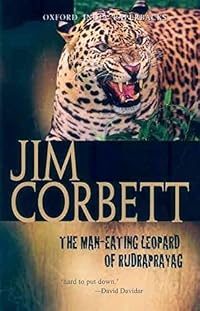
Most of Jim Corbett's books contain collections of stories that recount adventures tracking and shooting man-eaters in the Indian Himalaya. This volume, however, consists of a single story, often considered the most exciting of all Corbett's jungle tales. He gives a carefully-detailed account of a notorious leopard that terrorized life in the hills of the colonial United Provinces. This story represents Corbett's most sustained and unique effort.Tags
Recommendations

























Member Reviews
Както забелязах преди известно време, на Земята вече не останаха диви, неизследвани местности. В която и дълбока джунгла да отидеш, докато се усетиш ще почнеш да се препъваш в дървари, фотографи на Нешънъл Джиографик и „екоактивисти“ които протестират в защита на хабитата на червеногъзия мушитрънен бръмбар който живеел само там. Не е било толкова отдавна времето обаче, когато джунглите са криели show more значителни изненади и опасности – а Джим Корбет е бил специалист именно по тях.
Леопардът от Рудрапраяг е човекояден леопард, който в началото на 20-ти век убива и изяжда над 120 човека в местността Рудрапраяг в Индия и за период от 8 години тероризира местното население, живеещо доста нагъсто (все пак – Индия), но в малки селца из планините, в къщи направени от кал и дърво. Местните хора се ужасяват от него толкова, че вярват, че е зъл дух и дори не правят опити да го убият, въпреки че имат оръжие и са ловци.
По това време Индия е под властта на Британската империя и английският парламент се принуждава да се обърне към известния ловец Джим Корбет, който има опит с лов на хищници от семейство котки и по-специално тигри-човекоядци в други области на Индия и да му осигури средства и помощ за залавяне на леопарда.
Опитите за отравяне с различни отрови (стрихнин, цианид) се оказват неуспешни, както и заложените многобройни капани. Леопардът от Рудрапраяг е стар и изключително хитър – избягва капаните, не яде отровеното месо, а в същото време скача през прозорците на къщи, кърти вратите и дори прокопава глинените стени за да вземе поредната си жертва.
Все пак, Джим Корбет, с помощта на друг английски ловец и на местното население успява да надхитри човекоядеца и да го убие, рискувайки на много пъти собствения си живот – да вървиш нощем из джунглите или да чакаш в укритието и на сутринта по следите да разбереш, че докато напразно си чакал човекоядния леопард, той всъщност се е движил отзад и е дебнал теб, чакайки да отпуснеш само за момент вниманието си… show less
Леопардът от Рудрапраяг е човекояден леопард, който в началото на 20-ти век убива и изяжда над 120 човека в местността Рудрапраяг в Индия и за период от 8 години тероризира местното население, живеещо доста нагъсто (все пак – Индия), но в малки селца из планините, в къщи направени от кал и дърво. Местните хора се ужасяват от него толкова, че вярват, че е зъл дух и дори не правят опити да го убият, въпреки че имат оръжие и са ловци.
По това време Индия е под властта на Британската империя и английският парламент се принуждава да се обърне към известния ловец Джим Корбет, който има опит с лов на хищници от семейство котки и по-специално тигри-човекоядци в други области на Индия и да му осигури средства и помощ за залавяне на леопарда.
Опитите за отравяне с различни отрови (стрихнин, цианид) се оказват неуспешни, както и заложените многобройни капани. Леопардът от Рудрапраяг е стар и изключително хитър – избягва капаните, не яде отровеното месо, а в същото време скача през прозорците на къщи, кърти вратите и дори прокопава глинените стени за да вземе поредната си жертва.
Все пак, Джим Корбет, с помощта на друг английски ловец и на местното население успява да надхитри човекоядеца и да го убие, рискувайки на много пъти собствения си живот – да вървиш нощем из джунглите или да чакаш в укритието и на сутринта по следите да разбереш, че докато напразно си чакал човекоядния леопард, той всъщност се е движил отзад и е дебнал теб, чакайки да отпуснеш само за момент вниманието си… show less
A classic tale from the northern edge of India set in 1925 and told with poetic simplicity by a very brave, humane and observant man.
I first read this book as a teenager and have reread it many times aloud to Céili since; it never seems to pall and has a rare quality of balance and perfection in it's structure and form.The people and their beliefs,the environment and the wild and domesticated creatures,
the personal hardships and at times terrifying situations that Corbett encountered are related with a charmingly deft touch.
Do try and get the Raymond Sheppard illustrated version from the early '50s.
If you are not a hunter or ordinarily interested in hunting tales this is a book that transcends that category; it is a thriller, a show more suspenseful search, a naturalists dairy, a book about Hindu belief, a piece of history...
(by Bowery- Céili's piece) show less
I first read this book as a teenager and have reread it many times aloud to Céili since; it never seems to pall and has a rare quality of balance and perfection in it's structure and form.The people and their beliefs,the environment and the wild and domesticated creatures,
the personal hardships and at times terrifying situations that Corbett encountered are related with a charmingly deft touch.
Do try and get the Raymond Sheppard illustrated version from the early '50s.
If you are not a hunter or ordinarily interested in hunting tales this is a book that transcends that category; it is a thriller, a show more suspenseful search, a naturalists dairy, a book about Hindu belief, a piece of history...
(by Bowery- Céili's piece) show less
Once again Jim Corbett takes us on a thrilling adventure as he tracks and eventually kills an Indian Leopard which, up to its own death caused 125 recorded deaths, and possibly more. The book is dedicated to the victims of the man-eating leopard of Rudraprayag. The leopard roamed over a region of some 500 square miles in the north of India, encompassing the area where the two rivers - Mandakini and Alaknanda join to create the mighty Ganges. The leopard roamed and killed people between 1918 and 1926. Corbett takes us into the mind and motivation of a man-eating leopard. This skill he has allows us to see the respect he holds for the animals he must kill. Corbett himself admits he prefers photographing wilds animals and that the methods show more for stalking, observing and taking great photographs are almost identical to those needed for a successful hunter with a gun. Corbett obviously has a deep affection for the people of India and their lifestyle and safety. The victims in this situation include pilgrims who make the journey on foot - of course to various Hindu temples. Deaths of pilgrims can contribute to a fall of pilgrims and the tiny but essential "tourist income" various lepers, temples and sleeping huts earn. This book is an exciting insight into how a dangerous animal is killed to prevent more deaths of residents and pilgrims. show less
Jim Corbett's second book, following his classic Man Eaters of Kummaon. In the first book, each chapter is a self-contained unit, concerning 1 tiger and Corbett's story how he hunted and killed it. Here it is an entire book about 1 man-eating leopard which took 10 weeks to track and kill in the foothills of the Himalayas. It has its moments, but I was not as enthralled with adrenaline as in the first book - perhaps the initial aura of Corbett has worn off. The final kill lacked the drama such a long hunt deserved. But heh, this is real life, not a novel, in that sense it's still the stuff of legend. Corbett's humanitarianism, respect for life and humble simplicity make him a pleasure to read.
What a wonderful read! The details of the jungles and everything mysterious in it ,as vivid as a picture.What a great way to be teleported back to the forests i hold dear.
I'd been on the lookout for another Corbett book, because his one about the man-eating tigers in India was so interesting. This volume, about a notorious leopard he strove to track down, was rather dry in style but I kept going back to it regardless. Corbett relates how he was summoned to hunt down a man-eating leopard that terrorized villages near Rudraprayag, India. He surmises what makes a leopard habitually prey on man (old age, serious injury, or learning humans can be a food source when bodies are dumped over a cliff instead of properly buried during a disease epidemic). His account is one long list of failures- following every little rumor of a kill, sitting up for the leopard over a body, staking out goats in hopes the leopard show more would come to it (it still fed on cattle and goats when couldn't get a person), setting out poisoned bait and careful traps many times over.... He did kill two leopards that were in the vicinity but knew by the details of tracks and behavior patterns it wasn't the right leopard. It took eight years of tracking, stakeouts and numerous attempts before he had success. With several breaks to rest and avoid getting killed himself, when fatigue set in and he feared would let his guard down. Through the story are some details about life in rural India, the superstitions of the local people (many believed the leopard was an evil spirit, impossible to kill), their abject terror of the beast, their profuse gratitude when the leopard was finally done in. Also, very similar to the other book, some interesting notes on other wildlife in the area, and how Corbett's observation of their behavior helped him track the leopard.
from the Dogear Diary show less
from the Dogear Diary show less
কী দুর্দান্ত!! শিকার নিয়ে লেখা আমার পড়া প্রথম বই। পুরো অমনিবাস শেষ করে একটা রিভিউ লেখার ইচ্ছা আছে, তাই আপাতত পাঁচটি তারা দিয়ে রাখলাম শুধু।
Members
- Recently Added By
Author Information

30+ Works 1,548 Members
Jim Corbett (1875-1955), well-known hunter, naturalist, and conservationist, is the author of several acclaimed classics, including Man-Eaters of Kumaon (1944), The Man-Eating Leopard of Rudrapravag (1948), and My India (1952).
Series
Belongs to Publisher Series
Work Relationships
Is contained in
Common Knowledge
- Canonical title
- The Man-eating Leopard of Rudraprayag
- Original publication date
- 1948
Classifications
Statistics
- Members
- 205
- Popularity
- 158,871
- Reviews
- 8
- Rating
- (4.38)
- Languages
- 5 — English, Estonian, Finnish, Italian, Swedish
- Media
- Paper, Audiobook, Ebook
- ISBNs
- 7
- ASINs
- 14