
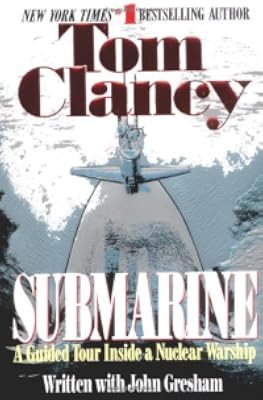
Submarine: A Guided Tour Inside a Nuclear Warship
by Tom Clancy, John Gresham (Contributor)
Guided Tour Series (1)
On This Page
Description
An inside look at life aboard a Los Angeles-class (SSN-688) nuclear submarine, from captain to crew, from training exercises to operations. Includes profiles of other submarines.Tags
Recommendations




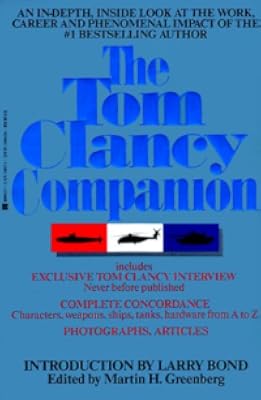




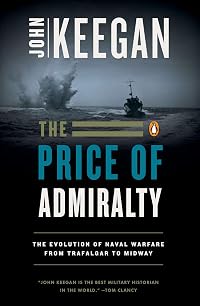


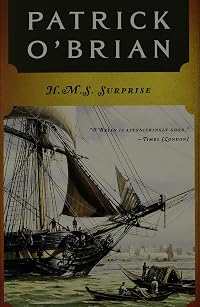

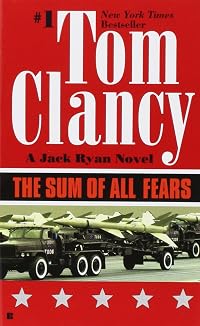


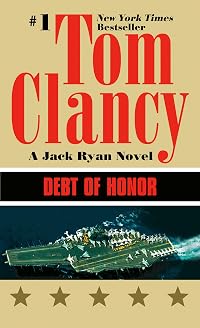












Member Recommendations
Member Reviews
One of the features I liked best about [book:The Hunt for Red October] was the detailed description of submarine technology. Now that Tom Clancy is famous and the darling of the military, he gets to tour all the ships and hardware that he wrote about and the military guys all have to suck up to him because he represents just one more method of increasing their public image. Anyway, Clancy published this non-fictional tour, if you will, of a modern nuclear-powered submarine).
Being somewhat enamored of technology myself I had to read it, and I must admit it's quite fascinating. We are good at creating awesome weapons of destruction -- shame we can't get high speed rail going with the same enthusiasm.
Contrary to the John Wayne crash show more dives in movies we were all raised on, a modern nuclear submarine requires 5-8 minutes of delicately balanced ballet to submerge, After all, a Los Angeles class submarine weighs about 7,000 tons, so maneuvering is "done with subtlety and a minimum of rapid action." Eliminating noise is the key. They must be as silent as possible to avoid making their presence known.
Underwater running is very smooth, just like walking on concrete. There is no sensation of movement. Of course, on the surface, especially during choppy weather, it's a whole new ball game; "it rolls rather drunkenly. " Living quarters are tight and the men must practice "hotbunking," the sharing of bunks, since there is not enough room for a separate bunk for each. The bunks themselves are identical in size to coffins, 6 x 3 x 2. The captain gets a huge space measuring about 8 X 10 feet. The crews are quite small, only about 130 men, but that still requires lots of food and water.
The distillation plant produces 10,000 gallons per day. Oxygen is produced by splitting water into oxygen and hydrogen. The hydrogen is vented to the outside and the oxygen used for breathing. Living on a nuclear sub is "a combination of living in an oversized motor home and summer camp. Not much room, very little noise [summer camp?], very little news from home, and no privacy."
Clancy delves into the weaponry also. One interesting sidelight. The Exocet missile that destroyed the Sheffield during the Falkland Islands spat actually failed to detonate. It was the unburned fuel of the rocket engine that started a fire that ultimately destroyed the ship. The Tomahawk cruise missile the subs carry which were used extensively during Bush's attempt at reelection was actually Nobel Peace Prize winner Kissinger's successful desire to thwart the treaty obligations of SALT 1. These cruise missiles were a nuclear loophole.
Achieving silence is the most classified technology of the submarine service. The power plant generates 35,000 shaft horse power, yet "the noise radiated by the Miami is probably something less than the energy given off by a 20-watt light bulb. Everything is mounted on rubber. and special sensors are used to detect unusual vibrations from equipment. This has the added benefit of warning of equipment failure, as bearings begin to sound differently as they wear out.
Clancy dedicates about half the book to an examination of British submarines and their rolein NATO, which -is quite interesting. I recommend this book to all non-Luddites. show less
Being somewhat enamored of technology myself I had to read it, and I must admit it's quite fascinating. We are good at creating awesome weapons of destruction -- shame we can't get high speed rail going with the same enthusiasm.
Contrary to the John Wayne crash show more dives in movies we were all raised on, a modern nuclear submarine requires 5-8 minutes of delicately balanced ballet to submerge, After all, a Los Angeles class submarine weighs about 7,000 tons, so maneuvering is "done with subtlety and a minimum of rapid action." Eliminating noise is the key. They must be as silent as possible to avoid making their presence known.
Underwater running is very smooth, just like walking on concrete. There is no sensation of movement. Of course, on the surface, especially during choppy weather, it's a whole new ball game; "it rolls rather drunkenly. " Living quarters are tight and the men must practice "hotbunking," the sharing of bunks, since there is not enough room for a separate bunk for each. The bunks themselves are identical in size to coffins, 6 x 3 x 2. The captain gets a huge space measuring about 8 X 10 feet. The crews are quite small, only about 130 men, but that still requires lots of food and water.
The distillation plant produces 10,000 gallons per day. Oxygen is produced by splitting water into oxygen and hydrogen. The hydrogen is vented to the outside and the oxygen used for breathing. Living on a nuclear sub is "a combination of living in an oversized motor home and summer camp. Not much room, very little noise [summer camp?], very little news from home, and no privacy."
Clancy delves into the weaponry also. One interesting sidelight. The Exocet missile that destroyed the Sheffield during the Falkland Islands spat actually failed to detonate. It was the unburned fuel of the rocket engine that started a fire that ultimately destroyed the ship. The Tomahawk cruise missile the subs carry which were used extensively during Bush's attempt at reelection was actually Nobel Peace Prize winner Kissinger's successful desire to thwart the treaty obligations of SALT 1. These cruise missiles were a nuclear loophole.
Achieving silence is the most classified technology of the submarine service. The power plant generates 35,000 shaft horse power, yet "the noise radiated by the Miami is probably something less than the energy given off by a 20-watt light bulb. Everything is mounted on rubber. and special sensors are used to detect unusual vibrations from equipment. This has the added benefit of warning of equipment failure, as bearings begin to sound differently as they wear out.
Clancy dedicates about half the book to an examination of British submarines and their rolein NATO, which -is quite interesting. I recommend this book to all non-Luddites. show less
i had high hopes for this book - loved patriot games and red october, and while the first sections were very interesting (about the history of the sub and then a tour of a yank ssn) it then went downhill quicker than uss thresher. this was nothing more than pro-american waffle - while he didnt come out and say it, there were hints that maybe the british boats were maybe better, byt then the author did everything he could to assure the reader that the us boats were on a par if not better without actually proving it. and while the two boats may be similar, the tour of the british boat was a mere byword compared to the in-depth analysis of the us boat, gee we even had a detailed tour of the washing machine!
other than that, it wasnt too bad show more on facts and figures - it is very out of date as other books have covered the 'gaps' in this one. at the time though, it must have benn some reading to those fascinated with the cold war.
i am soon to read aircraft carrier, but not with so much enthusiasm. show less
other than that, it wasnt too bad show more on facts and figures - it is very out of date as other books have covered the 'gaps' in this one. at the time though, it must have benn some reading to those fascinated with the cold war.
i am soon to read aircraft carrier, but not with so much enthusiasm. show less
Not very detailed survey of the history of submarines, and the way in which nuclear submarines are designed for the US and Royal Navies. Most of the material relates to the late eighties, although the revised edition has a chapter which brings it more up to date. Hints on the jacket that it is 'controversial' are just window dressing - it's not that at all. Useful as an introduction to submarines and some of the tactical issues that arise from their use, as background to books by Clancy himself and other authors like Patrick Robinson. But very non-technical - for instance it does not describe how a nuclear reactor works in any detail. Actually has more on weapons than the submarines, to some extent.
An interesting tour through a US Navy nuclear submarine brought to you by the man who made them famous.
A fascinating look at the silent service.
Kind of old (2003) but very good
Sep 16, 2017Italian
Members
- Recently Added By
Author Information

180+ Works 121,991 Members
Tom Clancy was born in Baltimore, Maryland on April 12, 1947. He graduated with a degree in English from Loyola College in 1969, became an insurance agent, and in 1973 became the owner of an insurance agency. It was not until 1980 that he started writing novels. His works include Red Storm Rising, The Cardinal of the Kremlin, The Sum of All Fears, show more Rainbow Six, Dead or Alive, and Threat Vector. His books The Hunt for Red October, Patriot Games, and Clear and Present Danger were adapted into major motion pictures. He also wrote nonfiction books including Into the Storm: A Study in Command, Submarine, Armored Cav, Fighter Wing, Airborne, and Reality Check: What's Going on Out There? He died on October 2, 2013 at the age of 66. His last book, Command Authority, co-authored with Mark Greaney, was published posthumously in December 2013 and made the New York Times bestseller list. (Bowker Author Biography) show less
Series

Belongs to Publisher Series
Common Knowledge
- Canonical title
- Submarine: A Guided Tour Inside a Nuclear Warship
- Original title
- Submarine: A Guided Tour Inside a Nuclear Warship
- Original publication date
- 1993
- Important places
- Atlantic Ocean
Classifications
- Genres
- Nonfiction, General Nonfiction, History
- DDC/MDS
- 623.82574 — Applied science & technology Engineering Military Vehicles: Land, Air, & Sea Naval architecture; Shipbuilding History of Naval Architecture Warships
- LCC
- V857.5 .C55 — Naval Science Naval science (General) War vessels: Construction, armament, etc.
- BISAC
Statistics
- Members
- 1,007
- Popularity
- 25,812
- Reviews
- 6
- Rating
- (3.24)
- Languages
- 6 — Czech, English, German, Italian, Japanese, Spanish
- Media
- Paper, Ebook
- ISBNs
- 19
- ASINs
- 11
