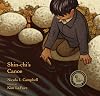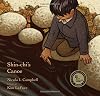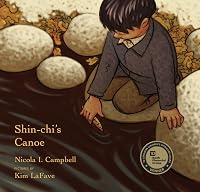
Shin-chi's Canoe
by Nicola I. Campbell
On This Page
Description
Winner of the TD Canadian Children's Literature Award and finalist for the Governor General's Award: Children's IllustrationThis moving sequel to the award-winning Shi-shi-etko tells the story of two children's experience at residential school. Shi-shi-etko is about to return for her second year, but this time her six-year-old brother, Shin-chi, is going, too.
As they begin their journey in the back of a cattle truck, Shi-shi-etko tells her brother all the things he must remember: the show more trees, the mountains, the rivers and the salmon. Shin-chi knows he won't see his family again until the sockeye salmon return in the summertime. When they arrive at school, Shi-shi-etko gives him a tiny cedar canoe, a gift from their father.
The children's time is filled with going to mass, school for half the day, and work the other half. The girls cook, clean and sew, while the boys work in the fields, in the woodshop and at the forge. Shin-chi is forever hungry and lonely, but, finally, the salmon swim up the river and the children return home for a joyful family reunion.
. show less
Tags
Recommendations






Member Reviews
In this follow-up to her earlier Shi-shi-etko, children's author Nicola I. Campbell, who is of Interior Salish and Metis descent, returns to the residential school experience of Canada's First Nations peoples - a heartbreaking process in which native children were forcibly removed from their homes and families, and placed in abusive church-run boarding schools. As Shi-Shi-etko prepares to return to school for her second year, her younger brother Shinchi must confront his own first year away, and his impending separation from his family. Riding to school in a dusty cattle truck, he is reminded by his elder sister of the things he "must always remember," and, once at school (where they are not permitted to speak to one another) given a show more little canoe to remind him of home, and of their people's traditions...
Unlike the previous title, which confined itself to Shi-shi-etko's experiences leading up to her removal from home, Shin-chi's Canoe actually follows the children to school itself, gently setting out some very un-gentle realities. The inhumane practices of such institutions - the fact that the children were punished for speaking their own language, were forbidden from communicating with their families at home, or even with family members also at school; the insufficient food they were given, while the adults in charge feasted on the produce of the farms run on the children's labor - is set out in the story. So too is the students' effort to hold onto what was good and comforting, in the face of what can only be called abuse.
Although it addresses some painful aspects of history - and, although set in Canada, it is a history that also has relevance here in the USA, where similar institutions flourished - Shinchi's Canoe is not unremittingly dark. True, it is a record of hardship and cruelty visited upon children, but it is also a story of surviving such experiences. I recommend it to anyone, teacher or parent, trying to introduce this difficult topic to younger readers. show less
Unlike the previous title, which confined itself to Shi-shi-etko's experiences leading up to her removal from home, Shin-chi's Canoe actually follows the children to school itself, gently setting out some very un-gentle realities. The inhumane practices of such institutions - the fact that the children were punished for speaking their own language, were forbidden from communicating with their families at home, or even with family members also at school; the insufficient food they were given, while the adults in charge feasted on the produce of the farms run on the children's labor - is set out in the story. So too is the students' effort to hold onto what was good and comforting, in the face of what can only be called abuse.
Although it addresses some painful aspects of history - and, although set in Canada, it is a history that also has relevance here in the USA, where similar institutions flourished - Shinchi's Canoe is not unremittingly dark. True, it is a record of hardship and cruelty visited upon children, but it is also a story of surviving such experiences. I recommend it to anyone, teacher or parent, trying to introduce this difficult topic to younger readers. show less
Shin-chi’s Canoe is the sequel to Shi-shi-etko and follows Shin-chi, the young brother of the girl from the first book, as he begins life at residential school. He is not allowed to speak to his sister or use his real name. The days are long, lonely, and he is often hungry. His sister gives him a small canoe to keep hidden, and he finds comfort and a sense of connection by the river while playing with it. The story shows how even small acts of love and memory can help children hold onto their culture and endure the hardships of residential school.
Shin-chi's Canoe by Nicola I. Campbell, illustrated by Kim La Fave and published by Groundwood Books is a beautiful sequel story to Shi-shi-etko.
This story follows the two siblings who are heading off to residential school, Shi-shi-etko for year two and Shin-chi for the first time. When the cattle truck arrives to which them away, Shi-shi-etko tells her brother of all the things he must remember and keep in his heart until he gets to return home again. He wants his father to build him his own canoe and as they get to school, Shi-shi-etko presents him with a miniature canoe made by their father. Their days are spent going to lessons, mass, cleaning, and work but once the salmon run, they will return to the bosom of their family to a show more joyful reunion and surprise.
Once again, Nicola Campbell weaves the tale of the hardships experienced by our First Nations people being forced to enter residential schools. She describes the pain and the perseverance of these people to remember their homes and themselves in the harshest of circumstances. I love Kim La Fave's bold illustrations! They make such an impactful statement in their uniformity and sameness in certain sections of the story.
This book is perfect to share with your children as early as preschool. The more we share these stories the more we will learn and grow to towards understanding and reconciliation. show less
This story follows the two siblings who are heading off to residential school, Shi-shi-etko for year two and Shin-chi for the first time. When the cattle truck arrives to which them away, Shi-shi-etko tells her brother of all the things he must remember and keep in his heart until he gets to return home again. He wants his father to build him his own canoe and as they get to school, Shi-shi-etko presents him with a miniature canoe made by their father. Their days are spent going to lessons, mass, cleaning, and work but once the salmon run, they will return to the bosom of their family to a show more joyful reunion and surprise.
Once again, Nicola Campbell weaves the tale of the hardships experienced by our First Nations people being forced to enter residential schools. She describes the pain and the perseverance of these people to remember their homes and themselves in the harshest of circumstances. I love Kim La Fave's bold illustrations! They make such an impactful statement in their uniformity and sameness in certain sections of the story.
This book is perfect to share with your children as early as preschool. The more we share these stories the more we will learn and grow to towards understanding and reconciliation. show less
Summary:
This book opens up with an Author’s Note about how Native children in Canada and the U.S. were forced into schools to learn European ways and severe ties with their traditional cultures. The book tells the story of a brother and sister who are forced to leave their family and attend an Indian Residential School during the academic year. It is the young boy’s first year away at school, and his sister tries her best to help him. The book ends with the children returning to their home for the summer.
Personal Response:
Because of the tough subject matter, this book made me feel somber. I wasn’t sure which genre to label this book, but it includes facts about the running of the schools along with the fictional story of the show more brother and sister. I was intrigued from the start, and I found the language of the text to be simple to follow yet powerful.
Curriculum Connections:
It is important for all children to develop an understanding of different cultures and ways of life. Although this story is very against the “colonization” of the Native people and sheds a very negative light on Indian Residential Schools, it also provides facts about this time in our history. This book would be appropriate for middle elementary grades. show less
This book opens up with an Author’s Note about how Native children in Canada and the U.S. were forced into schools to learn European ways and severe ties with their traditional cultures. The book tells the story of a brother and sister who are forced to leave their family and attend an Indian Residential School during the academic year. It is the young boy’s first year away at school, and his sister tries her best to help him. The book ends with the children returning to their home for the summer.
Personal Response:
Because of the tough subject matter, this book made me feel somber. I wasn’t sure which genre to label this book, but it includes facts about the running of the schools along with the fictional story of the show more brother and sister. I was intrigued from the start, and I found the language of the text to be simple to follow yet powerful.
Curriculum Connections:
It is important for all children to develop an understanding of different cultures and ways of life. Although this story is very against the “colonization” of the Native people and sheds a very negative light on Indian Residential Schools, it also provides facts about this time in our history. This book would be appropriate for middle elementary grades. show less
I really enjoyed reading this book. It is very educational for kids to learn about this very difficult time were there was forced assimilation for those of different cultures.
I thought “Shin - Chi’s Canoe” by Nicola I. Campbell was an excellent book. This is the first I have ever heard about Indian residential schools and I found the book very interesting. I liked the fact that the author used Shi - Shi’s perspective of Shin - Chi’s experience to emphasize just how horrible these schools were. When Shi - Shi describes early on that she had her grandmother remove her braids because the teachers had mocked her and removed them the year before it it made me feel disgusted. The illustrators use of earth tones seem to pair well with the young children who refuse to forget their native american heritage despite the best efforts of the instructors at the school. This book’s main idea is clearly the show more importance of culture and the ways that education was used to assimilate marginalized groups in the past. show less
This book uses two characters to tell the wider story of forced enrollment of Native Americans and First Peoples in church ran or residential schools in the 19th and 20th centuries. The effort was an attempt to civilize a population that was deemed uncivilized by the Europeans that moved to North America, by forcing them into schools where they were unable to speak their own language, practice any cultural traditions, or converse with each other. In this book, the author tells of the daily routine and hardships that the children go through during the many months that they are away from their family - and the joy that they feel in being reconnected once more.
Members
- Recently Added By
Lists

A Child's Book Tour of Canada
63 works; 2 members

Top 100 books by Indigenous Masters
134 works; 7 members

Children's Picture Books
188 works; 1 member
Author Information

7+ Works 895 Members
All Editions
Awards and Honors
Awards
Notable Lists
Work Relationships
Is a (non-series) sequel to
Common Knowledge
- Important places
- Canada
Classifications
Statistics
- Members
- 274
- Popularity
- 117,870
- Reviews
- 21
- Rating
- (4.30)
- Languages
- English, French
- Media
- Paper, Ebook
- ISBNs
- 7
- ASINs
- 1