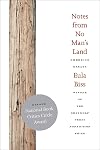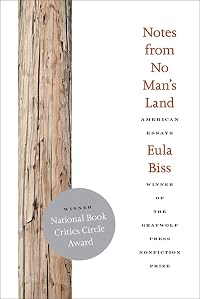
Notes from No Man's Land: American Essays
by Eula Biss
On This Page
Description
"Acclaimed for its frank and fascinating investigation of racial identity, and reissued on its ten-year anniversary, Notes from No Man's Land begins with a series of lynchings, ends with a list of apologies, and in an unsettling new coda revisits a litany of murders that no one seems capable of solving. Eula Biss explores race in America through the experiences chronicled in these essays--teaching in a Harlem school on the morning of 9/11, reporting from an African American newspaper in San show more Diego, watching the aftermath of Hurricane Katrina from a college town in Iowa, and rereading Laura Ingalls Wilder in the Rogers Park neighborhood of Chicago. What she reveals is how families, schools, communities, and our country participate in preserving white privilege. Notes from No Man's Land is an essential portrait of America that established Biss as one of the most distinctive and inventive essayists of our time."--Back cover. show lessTags
Recommendations









Member Recommendations

nsblumenfeld Two authors with very different backgrounds and styles, but they share an incredibly humanistic view of the world.

Member Reviews
Summary: A collection of American essays connected to four places the author lived, all exploring the realities of race in which we all are implicated.
Telephone poles. An essay on the introduction of (and resistance to) telephone poles on the landscape becomes an essay on lynching. It turns out that telephone poles were used to hang many black men. Biss writes of how she once thought the “arc and swoop” of phone lines a thing of beauty. Now she comments, “they do not look the same to me. Nothing is innocent, my sister reminds me. But nothing, I would like to think, remains unrepentant.”
This striking comment captures a theme running through this book. Wherever we go in America, if our eyes are open, we recognize that we are show more implicated in our nation’s racial history. Nothing is innocent. And yet what also comes through in these essays is that Biss is not resigned to this state of affairs–repentance, a turning, is yet possible.
In her essays we follow Biss from New York to San Diego (and trips into Mexico), Iowa City, and the Rogers Park neighborhood of north Chicago. She describes locking kids into a Harlem school where she is teaching on 9/11 and how New York depleted her. In an essay sharing the title of Joan Didion’s “Goodbye to All That” she speaks of how “New York took everything I had” and like Didion, she left, but unlike Didion, she has not returned, and questions how Didion tolerated so many myths about the city.
She moves to San Diego, working for an African-American newspaper. One of her most telling essays describes Eve Johnson’s struggle with Child Protective Services to gain custody of her own grandchildren, and the repeated barriers she encounters because she is “too black” and her persistence. She notes that she never saw such stories in the New York Times.
Her next move is to Iowa City. She writes about her research into the Black company town of Buxton, no longer in existence that seemed idyllic. There was a fabric of community organizations and a strong sense of identity and self-respect among the black residents. She dares to wonder about the kind of “integration” in which Blacks are a small minority in a sea of white, as was the case with dissatisfied Black students at the University of Iowa. Is such integration really a form of assimilation rather than an affirmation of identity? She also discusses the race blindness she encounters as people decry “looting” after Katrina, but downplay thefts by students after a tornado tore through their city.
The title essay, “No Man’s Land” is set in Rogers Park, a neighborhood on the north side of Chicago, bordering Evanston. It was originally called No Man’s Land because of its location. It is also highly integrated with no racial majority, yet she writes both of the racial fears that persist among whites like her in this diverse community and of her husband’s hope that “more white people don’t move here.”
Her concluding essay is titled “All Apologies” and explores the meaning of apologies both in personal life and in our racial history. Amid this is her telling observation: “Some apologies are unspeakable. Like the one we owe our parents.”
Biss dares to explore both our implicatedness in racism, and the ambiguities of living among one another with all that history. She recognizes the ambiguity in her own family, the mixed racial ancestry that gives her a cousin able to move between white and black communities, even while on the basis of appearance, she cannot. Her essays reveal a very different version of our national character from what many would have the textbook versions to be. She sees both the beauty and value of people and cultures, and the blindness, the hardness, and the obfuscations that sustain these disparate versions of America. In her spare, reflective prose she does not offer answers but invites us to sit with her and see. show less
Telephone poles. An essay on the introduction of (and resistance to) telephone poles on the landscape becomes an essay on lynching. It turns out that telephone poles were used to hang many black men. Biss writes of how she once thought the “arc and swoop” of phone lines a thing of beauty. Now she comments, “they do not look the same to me. Nothing is innocent, my sister reminds me. But nothing, I would like to think, remains unrepentant.”
This striking comment captures a theme running through this book. Wherever we go in America, if our eyes are open, we recognize that we are show more implicated in our nation’s racial history. Nothing is innocent. And yet what also comes through in these essays is that Biss is not resigned to this state of affairs–repentance, a turning, is yet possible.
In her essays we follow Biss from New York to San Diego (and trips into Mexico), Iowa City, and the Rogers Park neighborhood of north Chicago. She describes locking kids into a Harlem school where she is teaching on 9/11 and how New York depleted her. In an essay sharing the title of Joan Didion’s “Goodbye to All That” she speaks of how “New York took everything I had” and like Didion, she left, but unlike Didion, she has not returned, and questions how Didion tolerated so many myths about the city.
She moves to San Diego, working for an African-American newspaper. One of her most telling essays describes Eve Johnson’s struggle with Child Protective Services to gain custody of her own grandchildren, and the repeated barriers she encounters because she is “too black” and her persistence. She notes that she never saw such stories in the New York Times.
Her next move is to Iowa City. She writes about her research into the Black company town of Buxton, no longer in existence that seemed idyllic. There was a fabric of community organizations and a strong sense of identity and self-respect among the black residents. She dares to wonder about the kind of “integration” in which Blacks are a small minority in a sea of white, as was the case with dissatisfied Black students at the University of Iowa. Is such integration really a form of assimilation rather than an affirmation of identity? She also discusses the race blindness she encounters as people decry “looting” after Katrina, but downplay thefts by students after a tornado tore through their city.
The title essay, “No Man’s Land” is set in Rogers Park, a neighborhood on the north side of Chicago, bordering Evanston. It was originally called No Man’s Land because of its location. It is also highly integrated with no racial majority, yet she writes both of the racial fears that persist among whites like her in this diverse community and of her husband’s hope that “more white people don’t move here.”
Her concluding essay is titled “All Apologies” and explores the meaning of apologies both in personal life and in our racial history. Amid this is her telling observation: “Some apologies are unspeakable. Like the one we owe our parents.”
Biss dares to explore both our implicatedness in racism, and the ambiguities of living among one another with all that history. She recognizes the ambiguity in her own family, the mixed racial ancestry that gives her a cousin able to move between white and black communities, even while on the basis of appearance, she cannot. Her essays reveal a very different version of our national character from what many would have the textbook versions to be. She sees both the beauty and value of people and cultures, and the blindness, the hardness, and the obfuscations that sustain these disparate versions of America. In her spare, reflective prose she does not offer answers but invites us to sit with her and see. show less
These essays pack a punch, particularly the first one that starts as a straightforward essay about telephone poles - until you hit a list of black men who were lynched off of telephone poles. It’s like hitting a wall. I think it’s really hard for most white people to look at their own life through the lens of racism in America, and most, quite frankly, choose not to. To make it public like this - Ms. Biss is a brave woman and a wonderful writer.
I picked up this book because it was selected as the University of Kansas's inaugural "Common Book" read. I was also encouraged by the enthusiastic review from Sherman Alexie, whose writing I enjoy. This is definitely an insightful, thought-provoking, and well-crafted collection of essays, but also uneven. I believe this stems from Biss's use of two distinct essay styles: one, a more traditional narrative approach where the ideas are fleshed out and woven into a larger cohesive point, and another format which I call verbal montage. Here Biss simply presents small prose snippets, each creating a specific image, one after the other. It is up to the reader try to process this chain of images into a more cohesive narrative. While I admire show more her willingness to stretch beyond the traditional style, I unfortunately found the effect to be, at best, disjointed or unclear, and at worst, ham-handed. At times it was like the literary equivalent of watching someone's travel slides out of order with limited or no commentary. However, highlights like "Goodbye to All That", "Black News", and "Is this Kansas" more than make up for the one-offs. Overall, a worthwhile read. show less
Essays about whiteness, and the precarious ways in which white Americans play out their guilt and denial. Some great moments in here, although some of the essays are too short to work up a real head of steam. Also some real shockers, as when Biss talks about starting out to write an essay about telephone poles and then changing when so many of the newspaper stories she found using the words in the first few decades of the twentieth century were about lynchings.
I kinda seesawed on this one, largely depending on how fractured her storytelling was. The best essays cover race in a deeply personal yet informed way, but without a strong subject to animate an essay, she kinda lapses back into pointillist storytelling that tries to coax deeper meaning out of a mishmash of anecdotes. There's (rightly) a backlash against the myth of a singular MFA style, but goddamn, Biss doesn't help matters by going into classic University of Iowa lyrical-realist style at every opportunity she gets. Though her prose is almost always great, sometimes it just disguises meaningless nonsense. When she's good, she's GOOD—but that's not the case far too often.
Notes from No Man's Land is an elegant collection of essays. Biss has a sharp intellectual insight that she applies to her experiences intertwined with issues of race in America. The book is divided into parts by location and I found this construction to be helpful in following Biss through her own discoveries. Her use of form is particularly striking as all the threads in each piece cohere and support the idea of the essay, this is particularly striking in "Relations."
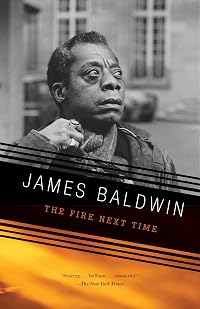
As beautiful as you can possibly imagine an essay collection about race, crime and our collective responsibility to one another as Americans can be. When you think Baldwin or Didion or Fadiman, now also think Biss. I will be giving copies of this magical book to everyone.
Members
- Recently Added By
Author Information

7+ Works 1,915 Members
Awards and Honors
Awards
Distinctions
Common Knowledge
- Important places
- New York, New York, USA; San Diego, California, USA; Iowa City, Iowa, USA; Buxton, Iowa, USA; Chicago, Illinois, USA; New Orleans, Louisiana, USA
- Important events
- Hurricane Katrina
- Dedication
- For my baby, who doesn't have a name yet.
- First words
- "Of what use is such an invention?" the New York World asked shortly after Alexander Graham Bell first demonstrated his telephone in 1976.
- Quotations
- This system was designed specifically for the education of freed slaves, and established public education in America as the method we use to manage large populations of our own people who frighten us. (p. 45)
- Last words
- (Click to show. Warning: May contain spoilers.)In this case, I can only hope that my life, which is my crime, might also serve as my apology.
- Blurbers
- Alexie, Sherman
Classifications
Statistics
- Members
- 426
- Popularity
- 72,592
- Reviews
- 9
- Rating
- (4.14)
- Languages
- English
- Media
- Paper, Audiobook, Ebook
- ISBNs
- 6
- ASINs
- 5