On This Page
Description
An explorer obsessed with reaching the North Pole undertakes a harrowing expedition in this classic novel of adventure and survival in the Arctic.Capt. John Hatteras will stop at nothing to reach the North Pole. After having a steamship built for the purpose, he embarks for terra incognita. But when he encounters a frozen sea, mutiny and shipwreck leave Hatteras and his remaining crew stranded on an island in the harsh Arctic winter. Even in the face of death by starvation or polar bear show more attack, Hatteras knows that the sea must eventually thaw, opening a path to incredible discovery.First published in 1864, The Adventures of Captain Hatteras was written in two parts: The English at the North Pole and The Desert of Ice. It was later included in Jules Verne's Extraordinary Voyages series, alongside Twenty Thousand Leagues Under the Sea, Around the World in Eighty Days, and many others. show lessTags
Recommendations































Member Reviews
This is the third novel I read in my personal journey through Verne's Voyages Extraordinaires. Among those three (the others are Five Weeks in a Balloon and Journey to the Center of the Earth), Captain Hatteras is the closest to a conventional adventure novel. And I say that in the best possible sense. This one doesn't have such a ground-breaking premise; it's just an old-fashioned naval exploration tale, but what a gripping one. It was published originally as two books: Les Anglais au pôle nord (The English at the North Pole) and Le Désert de glace (The Desert of Ice).
Synopsys: Set in 1861, describes the adventures of a British naval expedition led by Captain John Hatteras to the Arctic Ocean. Struggling against mutiny and the show more harshness of the polar winter, Hatteras refuses to give up in his ambition to reach the North Pole.
The Adventures of Captain Hatteras is long, as long as the previous two novels put together, but for my taste it has better pace. None of it was dull. From the moment it starts, with a bunch of sailors discussing a state-of-the-art ship that has just been built, and the mysterious captain who doesn't skimp on expense and only communicates with his crew through letters, it gets our attention, and doesn't let it go throughout the whole epic tale.
There is a speculative element here, although in this case it's purely geographic. At the time it was written, no one had been able to reach the northernmost regions of the Earth, and it was unknown what they would find there. There was a very popular theory at the time, called the Open Polar Sea, suggesting that in the summer there was an open sea around the North Pole. Many naval expeditions had failed to reach it, becoming stranded in a frozen sea, sometimes for several years. However, there were measurements suggesting that the "cold pole", the coldest areas of the northern hemisphere, were at lower latitudes than the North Pole, and there were some testimonies of captains who thought they had glimpsed an open sea in the summer, north to the point where they were themselves trapped in the ice fields. (As modern readers, we know the Open Polar Sea theory is not true, but in Verne's world that was still unknown and waiting to be determined.)
Captain Hatteras firmly believes in that theory. He is convinced that he will be able to reach that open sea and get to the pole with his ship. However, the tragic outcomes of his previous expeditions make it difficult for him to hire a crew. What follows is a truly epic and gritty fight of human spirit against the force of nature.
The cast of key characters here is larger than in the other two novels I have read. We have of course Captain Hatteras, who is that kind of visionary, strong-willed character that we find in many Verne novels. Like Professor Lidenbrock from Journey to the Center of the Earth, Hatteras is relentless in his quest. No matter how overwhelming the danger is, to himself and to his companions, he won't give up. In this case, this relentless character is the adventurer, not the scientist.
The role of the scientist then is played by the ship physician, Doctor Clawbonny. He is competent in his job, good-natured but also filled with a thirst for knowledge and adventure, even if he has a lot of the former and little experience of the latter. His knowledge and ingenious ideas (like making a bullet with frozen mercury from a thermometer when they are far from the ship, without ammunitions and stalked by a hungry beast) save the lives of his companions more than once.
We also have Shandon, the first mate of the ship, whose falling-out with Hatteras poisons the expedition. We have Duke, the captain's dog, with as much character and dedication as any member of the crew (in fact, in the beginning of the novel, before Hatteras shows up, there was a rumour among the crew that the dog was actually the captain). We have Captain Altamont, the American explorer, who is a bitter rival of Hatteras but may have to find a way to cooperate with him if they are all to survive. And several other important characters...
The book is narrated in third person, and the Verne-style infodumps come in the form of conversations of Doctor Clawbonny with other characters, where he talks about the state of Arctic exploration. I find the subject fascinating, so I was on board with that. You know, the story of Franklin's lost expedition and that kind of thing.
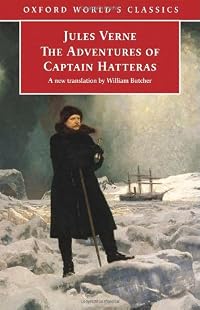
As always, if you read it in English and can afford to pay a bit more, look for a modern translation if there is one, in this case William Butcher's translation published by Oxford University Press.
Enjoyment factor: I hadn't read this one in my youth and liked it a lot. Even though it's long, and as always with Verne there are educative infodumps, the pace of this novel is good. The dangers were not occasional, but ever-present, and the difficulties seemingly overwhelming. It doesn't have as much sense of wonder as the previous two novels, but the thrill of getting to unexplored regions is there. I really enjoyed it, and if your edition doesn't have a map, don't hesitate to look for the Captain Hatteras map online, to follow the course of the journey as you read.
See all my Verne reviews here: https://www.sffworld.com/forum/threads/reading-vernes-voyages-extraordinaires.58... show less
Synopsys: Set in 1861, describes the adventures of a British naval expedition led by Captain John Hatteras to the Arctic Ocean. Struggling against mutiny and the show more harshness of the polar winter, Hatteras refuses to give up in his ambition to reach the North Pole.
The Adventures of Captain Hatteras is long, as long as the previous two novels put together, but for my taste it has better pace. None of it was dull. From the moment it starts, with a bunch of sailors discussing a state-of-the-art ship that has just been built, and the mysterious captain who doesn't skimp on expense and only communicates with his crew through letters, it gets our attention, and doesn't let it go throughout the whole epic tale.
There is a speculative element here, although in this case it's purely geographic. At the time it was written, no one had been able to reach the northernmost regions of the Earth, and it was unknown what they would find there. There was a very popular theory at the time, called the Open Polar Sea, suggesting that in the summer there was an open sea around the North Pole. Many naval expeditions had failed to reach it, becoming stranded in a frozen sea, sometimes for several years. However, there were measurements suggesting that the "cold pole", the coldest areas of the northern hemisphere, were at lower latitudes than the North Pole, and there were some testimonies of captains who thought they had glimpsed an open sea in the summer, north to the point where they were themselves trapped in the ice fields. (As modern readers, we know the Open Polar Sea theory is not true, but in Verne's world that was still unknown and waiting to be determined.)
Captain Hatteras firmly believes in that theory. He is convinced that he will be able to reach that open sea and get to the pole with his ship. However, the tragic outcomes of his previous expeditions make it difficult for him to hire a crew. What follows is a truly epic and gritty fight of human spirit against the force of nature.
The cast of key characters here is larger than in the other two novels I have read. We have of course Captain Hatteras, who is that kind of visionary, strong-willed character that we find in many Verne novels. Like Professor Lidenbrock from Journey to the Center of the Earth, Hatteras is relentless in his quest. No matter how overwhelming the danger is, to himself and to his companions, he won't give up. In this case, this relentless character is the adventurer, not the scientist.
The role of the scientist then is played by the ship physician, Doctor Clawbonny. He is competent in his job, good-natured but also filled with a thirst for knowledge and adventure, even if he has a lot of the former and little experience of the latter. His knowledge and ingenious ideas (like making a bullet with frozen mercury from a thermometer when they are far from the ship, without ammunitions and stalked by a hungry beast) save the lives of his companions more than once.
We also have Shandon, the first mate of the ship, whose falling-out with Hatteras poisons the expedition. We have Duke, the captain's dog, with as much character and dedication as any member of the crew (in fact, in the beginning of the novel, before Hatteras shows up, there was a rumour among the crew that the dog was actually the captain). We have Captain Altamont, the American explorer, who is a bitter rival of Hatteras but may have to find a way to cooperate with him if they are all to survive. And several other important characters...
The book is narrated in third person, and the Verne-style infodumps come in the form of conversations of Doctor Clawbonny with other characters, where he talks about the state of Arctic exploration. I find the subject fascinating, so I was on board with that. You know, the story of Franklin's lost expedition and that kind of thing.
As always, if you read it in English and can afford to pay a bit more, look for a modern translation if there is one, in this case William Butcher's translation published by Oxford University Press.
Enjoyment factor: I hadn't read this one in my youth and liked it a lot. Even though it's long, and as always with Verne there are educative infodumps, the pace of this novel is good. The dangers were not occasional, but ever-present, and the difficulties seemingly overwhelming. It doesn't have as much sense of wonder as the previous two novels, but the thrill of getting to unexplored regions is there. I really enjoyed it, and if your edition doesn't have a map, don't hesitate to look for the Captain Hatteras map online, to follow the course of the journey as you read.
See all my Verne reviews here: https://www.sffworld.com/forum/threads/reading-vernes-voyages-extraordinaires.58... show less
This was Jules Verne’s second novel and the first of his Extraordinary Journeys, a series that continued for 50 years and 63 more books.
It was popular in its day. Four English were done in the 1870s, but Butcher, as the back cover would have it, “the father of Verne Studies”, says none were subsequently done until his.
Real polar explorers found it one of the most accurate pictures ever written of life in the Arctic — or so a footnoted source says.
There’s no doubt Verne turned over a library for this book. He was a devotee of polar exploration though somewhat hampered by not reading English. However, many polar chronicles had been translated from English into French.
The plot of this two-decker novel has the ship the Forward show more departing Liverpool on April 6, 1860 with Richard Shandon, second-in-command, on board. The captain, whoever he is, will show up later. Shandon is known as a reliable and knowledgeable seaman with experience of Arctic waters. Dr. Clawbonny joins the ship later in the voyage. He’ll be an affable, steadfast character with an encyclopedic knowledge of polar exploration and the polar clime – though most of it is was learned through books. He’s looking for more actual experience.
The Captain does show up later. Actually, he’s been aboard already but in disguise. It is, of course, Hatteras. The crew is not happy about that. To them, he’s a bit of a cursed figure since he’s the sole survivor of a previous, failed expedition to the North Pole. And that’s where he wants to go again.
Eventually, even the reliable Shandon has had enough, and he leads a mutiny.
The first part of the novel ends with:
And yet the situation was terrible for these four people, in the company of a dying man. They were without resources, lost and alone at the eightieth degree, in the heart of the Arctic!
In the second half of the novel, in a scene similar to what happens when the castaways arrive on Verne’s The Mysterious Island, Clawbonny takes inventory of what they have to keep them alive.
Hatteras shows just how obsessive he is because he’s not giving up the idea of heading for the North Pole.
He’s also very hostile to Americans and wants the glory of reaching the Pole to be granted to England. That hostility only gets worse when the men meet Johnson, a remnant of an American expedition. The fact that Johnson and Hatteras’ are essential for each other’s survival doesn’t make Hatteras any more grateful or gracious.
Things get to the point where Hatteras and Johnson fight a duel on an ice floe. But, after again saving each other’s life, the two are finally reconciled and its forward to the Pole.
Hatteras gets there. There’s a volcano at the top of the world, and a warm sea, and even talk of a hollow earth (an idea explored further, of course, in Verne’s Journey to the Center of the Earth).
Hatteras’ gets his monument and credit, but he also goes completely mad, subsumed by the obsession that has marked his character from the beginning.
On returning to civilization, Clawbonny visits Hatteras at the mad house. The novel ends with Hatteras aligned like a compass needle to a pole he’s already reached:
For some time, Captain Hatteras had been walking several houses each day, followed by his faithful dog [and Duke the dog is quite faithful throughout the book], who gazed at him with soft, sad eyes; but it was invariably in a particular direction along a certain avenue at Sten Cottage. Once the captain reached the end of the avenue, he would retrace his route, walking backwards. If somebody stopped him, he would point to a fixed spot in the sky. If someone tried to make him turn round, he would flare up, and Duke, sharing his anger, would bark furiously.
The doctor attentively observed such a strange mania, and soon understood the reason for such a singular obstinacy; he guessed why the walk followed a fixed direction, under the influence, as it were, of a magnetic force.
Captain John Hatteras marched constantly north.
But, as engaging as Hatteras’ mad drive north is, equally interesting are the tales and bits of Arctic lore that he and Clawbonny share.
Butcher loads this edition with all sorts of extras including footnotes stating where Verne got all his information. Can you really start a fire using a piece of ice? Yes, you can! William Scoresby did!. Can you use your frozen hands to make ice? Yes!
Butcher also points out Verne’s occasional sexual puns and innuendos, his misspellings of names, surprisingly frequent confusion between “east” and “west”, and where he seems to have totally invented locations or mangled his sources.
Butcher completes his nice package of extras with a map showing Hatteras and company’s journey through the real and Vernian Arctic. There’s also a chronology of Arctic exploration through the time of Verne’s novel, contemporary advertisements and reviews of the novel, and a timeline of Verne’s life.
No, it’s probably not that interesting for those who aren’t interested in Verne or polar exploration. But this relatively obscure novel is worth a look if you are. show less
It was popular in its day. Four English were done in the 1870s, but Butcher, as the back cover would have it, “the father of Verne Studies”, says none were subsequently done until his.
Real polar explorers found it one of the most accurate pictures ever written of life in the Arctic — or so a footnoted source says.
There’s no doubt Verne turned over a library for this book. He was a devotee of polar exploration though somewhat hampered by not reading English. However, many polar chronicles had been translated from English into French.
The plot of this two-decker novel has the ship the Forward show more departing Liverpool on April 6, 1860 with Richard Shandon, second-in-command, on board. The captain, whoever he is, will show up later. Shandon is known as a reliable and knowledgeable seaman with experience of Arctic waters. Dr. Clawbonny joins the ship later in the voyage. He’ll be an affable, steadfast character with an encyclopedic knowledge of polar exploration and the polar clime – though most of it is was learned through books. He’s looking for more actual experience.
The Captain does show up later. Actually, he’s been aboard already but in disguise. It is, of course, Hatteras. The crew is not happy about that. To them, he’s a bit of a cursed figure since he’s the sole survivor of a previous, failed expedition to the North Pole. And that’s where he wants to go again.
Eventually, even the reliable Shandon has had enough, and he leads a mutiny.
The first part of the novel ends with:
And yet the situation was terrible for these four people, in the company of a dying man. They were without resources, lost and alone at the eightieth degree, in the heart of the Arctic!
In the second half of the novel, in a scene similar to what happens when the castaways arrive on Verne’s The Mysterious Island, Clawbonny takes inventory of what they have to keep them alive.
Hatteras shows just how obsessive he is because he’s not giving up the idea of heading for the North Pole.
He’s also very hostile to Americans and wants the glory of reaching the Pole to be granted to England. That hostility only gets worse when the men meet Johnson, a remnant of an American expedition. The fact that Johnson and Hatteras’ are essential for each other’s survival doesn’t make Hatteras any more grateful or gracious.
Things get to the point where Hatteras and Johnson fight a duel on an ice floe. But, after again saving each other’s life, the two are finally reconciled and its forward to the Pole.
Hatteras gets there. There’s a volcano at the top of the world, and a warm sea, and even talk of a hollow earth (an idea explored further, of course, in Verne’s Journey to the Center of the Earth).
Hatteras’ gets his monument and credit, but he also goes completely mad, subsumed by the obsession that has marked his character from the beginning.
On returning to civilization, Clawbonny visits Hatteras at the mad house. The novel ends with Hatteras aligned like a compass needle to a pole he’s already reached:
For some time, Captain Hatteras had been walking several houses each day, followed by his faithful dog [and Duke the dog is quite faithful throughout the book], who gazed at him with soft, sad eyes; but it was invariably in a particular direction along a certain avenue at Sten Cottage. Once the captain reached the end of the avenue, he would retrace his route, walking backwards. If somebody stopped him, he would point to a fixed spot in the sky. If someone tried to make him turn round, he would flare up, and Duke, sharing his anger, would bark furiously.
The doctor attentively observed such a strange mania, and soon understood the reason for such a singular obstinacy; he guessed why the walk followed a fixed direction, under the influence, as it were, of a magnetic force.
Captain John Hatteras marched constantly north.
But, as engaging as Hatteras’ mad drive north is, equally interesting are the tales and bits of Arctic lore that he and Clawbonny share.
Butcher loads this edition with all sorts of extras including footnotes stating where Verne got all his information. Can you really start a fire using a piece of ice? Yes, you can! William Scoresby did!. Can you use your frozen hands to make ice? Yes!
Butcher also points out Verne’s occasional sexual puns and innuendos, his misspellings of names, surprisingly frequent confusion between “east” and “west”, and where he seems to have totally invented locations or mangled his sources.
Butcher completes his nice package of extras with a map showing Hatteras and company’s journey through the real and Vernian Arctic. There’s also a chronology of Arctic exploration through the time of Verne’s novel, contemporary advertisements and reviews of the novel, and a timeline of Verne’s life.
No, it’s probably not that interesting for those who aren’t interested in Verne or polar exploration. But this relatively obscure novel is worth a look if you are. show less
A mysterious benefactor outfits a ship and crew for what seems a voyage in arctic seas but no one is sure of its ultimate goal.
So this starts off both as a mystery and more or less a comedy. Its quite light-hearted at the start. The mystery element seems a little forced but does make sense given the nature of the main character.
A very mixed bag of a novel. Some good high seas and arctic adventure elements. Some useful facts although a lot of its science is laughably out of date. The factual elements especially the history of polar navigational can be quite boring.
The most interesting factual elements for me were how one survives a winter in the arctic in the 19th century which is far more involved than i previously expected. My other show more hope for the story was that it was about the english but written by a frenchman, which always left the ultimate conclusion doubtful. And there were some nice twists along the way.
Overall, many an outdated element and the second half was much more uneven and pulpy than the first but overall not a terrible adventure story. show less
So this starts off both as a mystery and more or less a comedy. Its quite light-hearted at the start. The mystery element seems a little forced but does make sense given the nature of the main character.
A very mixed bag of a novel. Some good high seas and arctic adventure elements. Some useful facts although a lot of its science is laughably out of date. The factual elements especially the history of polar navigational can be quite boring.
The most interesting factual elements for me were how one survives a winter in the arctic in the 19th century which is far more involved than i previously expected. My other show more hope for the story was that it was about the english but written by a frenchman, which always left the ultimate conclusion doubtful. And there were some nice twists along the way.
Overall, many an outdated element and the second half was much more uneven and pulpy than the first but overall not a terrible adventure story. show less
This was a great adventure book by Jules Verne. You are taken along a mighty voyage of obsession towards a goal. Captain Hatteras is the embodiment of a tragic hero and his actions ultimately result in his own fate. A riveting adventure by Verne, this one surprised me with how entertaining it was.
3.75- definitely worth it.
3.75- definitely worth it.
Romaani tegevus algab 1861. aastal, mil kapten John Hatterase juhitud Briti ekspeditsioon suundub prikil Forward põhjapoolust avastama. Ülimalt raskete tingimuste, karmi talve ning Hatterase kinnisideede tõttu puhkeb mäss, mis päädib priki püssirohukambri plahvatuse ning laeva hävimisega. Hatteras koos paari kaaslasega jätkab teekonda pooluse suunas. Uus-Ameerika saare rannikult leiavad nad Ameerika Ühendriikide laeva vraki ning talvituvad sellel saarel. Karmides oludes ellujäämine õnnestub neil peamiselt tänu doktor Clawbonny geniaalsusele, kes suudab süüdata tuld jääst läätse abil, valmistada tahkeks külmunud elavhõbedast püssikuuli ning tõrjuda jääkarude rünnakud musta püssirohu kaugjuhitava plahvatusega.
«Il y a eu pour moi Poe, quand j'avais douze ans - Stendhal, quand j'en avais quinze - Wagner, quand j'en avais dix-huit - Breton, quand j'en avais vingt-deux. Mes seuls véritables intercesseurs et éveilleurs. Et auparavant, pinçant une à une toutes ces cordes du bec grêle de son épinette avant qu'elles ne résonnent sous le marteau du piano forte, il y a eu Jules Verne. Je le vénère, un peu filialement. Je supporte mal qu'on me dise du mal de lui. Ses défauts, son bâclage m'attendrissent. Je le vois toujours comme un bloc que le temps patine sans l'effriter. C'est mon primitif à moi. Et nul ne me donnera jamais honte de répéter que les Aventures du capitaine Hatteras sont un chef-d'œuvre.»
Julien Gracq, Lettrines, show more I.
(4ème de couverture) show less
Julien Gracq, Lettrines, show more I.
(4ème de couverture) show less
Jul 19, 2011 (Edited)French
Dieses Buch wurde anonym bearbeitet und mit neuem Ende versehen! Folglich kann man davor nur warnen. Nicht nur das (realistischere) traurige Ende des fragwürdigen Helden fehlt, sondern auch alle jene Passagen sind getilgt, die das zeittypische Kolorit ausmachen, natürlich auch alle Rassismen und sonstige Chauvinismen des Autors. Was bleibt ist ein belangloses Kinderbuch. Dabei ist das Original, einer der frühesten Romane Jules Vernes, durchaus lesenswert. Es ist die Geschichte eines Besessenen, der zur Erfüllung seiner selbsternannten Mission, den Nordpol als Erster zu besuchen, buchstäblich über Leichen geht. Da das Buch lange vor der Eroberung des Nordpols geschrieben wurde, kann man hier durchaus Science-Fiction-Elemente show more entdecken, auf jeden Fall aber spannendes Abenteuer. Zum Glück kann man vollständige Übersetzungen sowohl antiquarisch als auch elektronisch (etwa bei Gutenberg) erwerben - sie dürfen ruhig etwas älter sein. show less
Feb 9, 2021 (Edited)German
Members
- Recently Added By
Author Information

Jules Verne was born on February 8, 1828 in Nantes, France. He wrote for the theater and worked briefly as a stockbroker. He is considered by many to be the father of science fiction. His most popular novels included Journey to the Center of the Earth, Twenty Thousand Leagues Under the Sea, and Around the World in Eighty Days. Several of his works show more have been adapted into movies and TV mini-series. In 1892, he was made a Chevalier of the Legion of Honor in France. He died on March 24, 1905 at the age of 77. (Bowker Author Biography) Jules Verne (1828-1905) is the author of numerous adventure stories grounded in popularizations of science. (Publisher Provided) show less
Some Editions
Awards and Honors
Series

Belongs to Publisher Series
Work Relationships
Common Knowledge
- Canonical title
- The Adventures of Captain Hatteras
- Original title
- Voyages et aventures du capitaine Hatteras; Les Aventures du capitaine Hatteras
- Original publication date
- 1866; 1874 (English ∙ George Routledge and Sons) (English ∙ | George Routledge and Sons); 1876 (English ∙ James R. Osgood) (English ∙ | James R. Osgood)
- People/Characters
- Shandon; Captain John Hatteras
- Important places
- Antarctica; North Pole; Liverpool, England, UK
- Related movies
- The Conquest of the Pole (1912 | IMDb)
- First words
- "Demain, à la marée descendante, le brick le Forward, capitaine, K.Z., second, Richard Shandon, partira de New Princes Docks pour une destination inconnue."
- Last words
- (Click to show. Warning: May contain spoilers.)Le capitaine John Hatteras marchait invariablement vers le Nord.
- Original language
- French
Classifications
- Genres
- Fiction and Literature, General Fiction
- DDC/MDS
- 843.8 — Literature & rhetoric French & related literatures French fiction Later 19th century 1848–1900
- LCC
- PQ2469 .V8 .E5 — Language and Literature French, Italian, Spanish and Portuguese literatures French literature Modern literature 19th century
- BISAC
Statistics
- Members
- 446
- Popularity
- 68,231
- Reviews
- 12
- Rating
- (3.53)
- Languages
- 12 — Czech, English, Estonian, Finnish, French, German, Hungarian, Italian, Portuguese (Brazil), Russian, Spanish, Swedish
- Media
- Paper, Audiobook, Ebook
- ISBNs
- 73
- ASINs
- 26