Bendigo Shafter
by Louis L'Amour
On This Page
Description
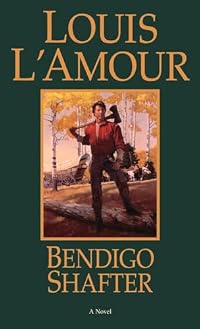
Fiction. Western. Thriller. Historical Fiction. At what point does a group of strangers become a community? When young Bendigo Shafter and a ragtag bunch of travelers settle in the rugged Wyoming mountains, they quickly come to depend on a toughness and wisdom many of them never knew they possessed. Led by the beautiful and resourceful widow Ruth Macken, the settlers battle harsh winters, renegade opportunists, and the destructive lure of gold. Through these brutally demanding experiences, show more young Bendigo is forged into a man. But when he travels to New York to reclaim the love of Ninon, his childhood sweetheart, Bendigo is faced with new challenges. Will hard-edged instincts, honed from years in the mountains, serve him in the big city? Does Ninon's heart belong to the lights and glamour of the theater? And if his destiny deems it so, will he be willing to leave the community he toiled so long and hard to build? show lessTags
Recommendations














Member Reviews
Because Perry says the MC carries Montaigne in his saddlebags....
... which turned out to be wrong. He read Montaigne, but not as thoroughly as many other books. He carried Blackstone for a while.
A good enough book for a teen boy who needs a role model. The philosophy is mainly good advice, and I liked how Shafter loves both the rough wild land and the ideals & learnings he gets from Plutarch, Locke, etc. He does respect everyone as people, even the Indians and the women, but he tends to feel a bit like an Ayn Rand character... he's a bit more compassionate than that, but not very respectful of anyone not as godlike as himself. (He does express humility, but it never rings as sincere.)
It's my first, and probably last, L'Amour. It reads show more to me like either a debut novel, or an author's swan song... interestingly, it's neither. Another interesting thing is that Shafter was advised to show more in his writing, but L'Amour did an awful lot of telling....
Samples of the kind of ideas you'll read again & again, should you pick this up:
"Much as I loved reading I was wary of it, for I soon saw that much that passed for thinking was simply a good memory, and many an educated man was merely repeating what he had learned, not what he had thought out for himself."
And about the Indians: "Whenever two cultures collide, the one with the most efficient way of living will survive." show less
... which turned out to be wrong. He read Montaigne, but not as thoroughly as many other books. He carried Blackstone for a while.
A good enough book for a teen boy who needs a role model. The philosophy is mainly good advice, and I liked how Shafter loves both the rough wild land and the ideals & learnings he gets from Plutarch, Locke, etc. He does respect everyone as people, even the Indians and the women, but he tends to feel a bit like an Ayn Rand character... he's a bit more compassionate than that, but not very respectful of anyone not as godlike as himself. (He does express humility, but it never rings as sincere.)
It's my first, and probably last, L'Amour. It reads show more to me like either a debut novel, or an author's swan song... interestingly, it's neither. Another interesting thing is that Shafter was advised to show more in his writing, but L'Amour did an awful lot of telling....
Samples of the kind of ideas you'll read again & again, should you pick this up:
"Much as I loved reading I was wary of it, for I soon saw that much that passed for thinking was simply a good memory, and many an educated man was merely repeating what he had learned, not what he had thought out for himself."
And about the Indians: "Whenever two cultures collide, the one with the most efficient way of living will survive." show less
This is the story of a young man coming of age in the wilds of Wyoming. He helps found a new town, finds love and wealth. Of course it isn't easy and he must fight for these things.
I do enjoy Louis L'Amour and this is one of his better books in my opinion. Granted part of that is that I have been down some of the trails and been to some of the locations from the book.
I do enjoy Louis L'Amour and this is one of his better books in my opinion. Granted part of that is that I have been down some of the trails and been to some of the locations from the book.
Not your typical good guy vs bad buy shoot 'em up western from L'Amour. This is a little more thoughtful & told in the first person, from our hero's POV. Bendigo journey's west with his older brother & his family. They set up a new town in the wilderness. L'Amour hits some of the high points of what that entails & makes you think a bit about how hard it was for them.Bendigo is a little to good to be true (typical hero) but it's a fun read. There's plenty of action, but not a lot of slap-leather, get-out-of-town-by-noon stuff. Hunting for lost people in the snow, hunting for food, keeping out some riff-raff & even a glimpse of NYC during that time.The only downside to the book is the philosophizing that Bendigo constantly shares with us. show more It actually wasn't bad reading as a teenager since it is idealistic & appealed to me at the time. Now, it's a little too trite & too much. Still, a very good book. show less
Travelers headed west with a wagon train stop and form a tiny settlement on the plains. A teenager, but a man grown, Bendigo Shafter recounts his experience in helping create a town with a solid foundation. From its roots to the end of the trail, weak and strong stand together against through blizzards, outlaw raids and invasions of hell-fire and brimstone spouting preachers.
One of my favorite L'Amour books, I always find something new to take away.
One of my favorite L'Amour books, I always find something new to take away.
One of L'Amour's more sprawling epics. The founding of a town, the development of a man, the fruition of dreams (or the dieing thereof), the growing of "men to match my mountains." Larger cast of characters than usual, well developed.
One of the best of his works, Bendigo Shafter not only has a great storyline (that of a boy growing to manhood, shouldering responsibility, and becoming a well-respected member of his community), but also is extremely informative. This novel contains enough information to teach any reasonably intelligent individual to survive in the wild with little more than a knife and ax. Even includes techniques for cold-weather survival, house building, and tree harvesting.
Members
- Recently Added By
Published Reviews
ThingScore 75
[A]s I re-read Bendigo Shafter the other night, I realized just how formative Louis L’Amour has been to my world view. Not in the throw-away plots and impossible characters, but in the landscapes (L’Amour was a careful researcher) and in the sense of justice, and in the love of reading and learning that nearly all his protagonists share.
added by Shortride
Author Information

870+ Works 99,419 Members
Born in Jamestown, North Dakota on March 22, 1908, Louis L'Amour's adventurous life could have been the subject of one of his novels. Striking out on his own in 1923, at age 15, L'Amour began a peripatetic existence, taking whatever jobs were available, from skinning dead cattle to being a sailor. L'Amour knew early in life that he wanted to be a show more writer, and the experiences of those years serve as background for some of his later fiction. During the 1930s he published short stories and poetry; his career was interrupted by army service in World War II. After the war, L'Amour began writing for western pulp magazines and wrote several books in the Hopalong Cassidy series using the pseudonym Tex Burns. His first novel, Westward the Tide (1950), serves as an example of L'Amour's frontier fiction, for it is an action-packed adventure story containing the themes and motifs that he uses throughout his career. His fascination with history and his belief in the inevitability of manifest destiny are clear. Also present and typical of L'Amour's work are the strong, capable, beautiful heroine who is immediately attracted to the equally capable hero; a clear moral split between good and evil; reflections on the Native Americans, whose land and ways of life are being disrupted; and a happy ending. Although his work is somewhat less violent than that of other western writers, L'Amour's novels all contain their fair share of action, usually in the form of gunfights or fistfights. L'Amour's major contribution to the western genre is his attempt to create, in 40 or more books, the stories of three families whose histories intertwine as the generations advance across the American frontier. The novels of the Irish Chantry, English Sackett, and French Talon families are L'Amour's most ambitious project, and sadly were left unfinished at his death. Although L'Amour did not complete all of the novels, enough of the series exists to demonstrate his vision. L'Amour's strongest attribute is his ability to tell a compelling story; readers do not mind if the story is similar to one they have read before, for in the telling, L'Amour adds enough small twists of plot and detail to make it worth the reader's while. L'Amour fans also enjoy the bits of information he includes about everything from wilderness survival skills to finding the right person to marry. These lessons give readers the sense that they are getting their money's worth, that there is more to a L'Amour novel than sheer escapism. With over 200 million copies of his books in print worldwide, L'Amour must be counted as one of the most influential writers of westerns in this century. He died from lung cancer on June 10, 1988. (Bowker Author Biography) Louis L'Amour, truly America's favorite storyteller, was the first fiction writer ever to receive the Congressional Gold Medal from the United States Congress in honor of his life's work, & was also awarded the Medal of Freedom. There are over 260 million copies of his books in print worldwide. (Publisher Provided) show less
Awards and Honors
Awards
Common Knowledge
- Original publication date
- 1979
- People/Characters
- Bendigo Shafter; Cain Shafter; Ruth Macken; Ethan Sackett; John Sampson; Lorna Shafter (show all 20); Drake Morrell; Ninon Vauvert; Stacy Follett; Uruwishi; Neely Stuart; Evan Webb; Tom Croft; Bud Macken; Porter Rockwell; Truman Trask; Moses FinnerlyJ; Joseph Pappin; Ollie Trotter; Short Bull
- Important places
- The Medecine wheel, Big Horn Mountains, Wyoming, USA; The Town, South Pass, Wind River Range, Wyoming Territory, USA; Oregon Trail, USA; New York, New York, USA
- Epigraph
- [None]
- Dedication
- To the hard-shelled men who built with nerve and hand that which the soft-bellied latecomers call the "western myth."
- First words
- Where the wagons stopped we built our homes, making the cabins tight against the winter's coming.
- Quotations
- A mind, like a home, is furnished by its owner, so if one’s life is cold and bare he can blame none but himself. You have a chance to select from some pretty elegant furnishings.
I had been given certain flesh and certain brains susceptible of shaping, and the shaping was mine to do. Of course, I would be influenced by heredity, by the world in which I lived, and by the contacts, abrasive or otherwis... (show all)e, but still and all, the shaping was in my hands.
What kind of man was I to be? What sort of thing must I do to become that man?
…that strangeness of returning, for the secret is what Shakespeare said, that no traveler returns. He is always a little changed, a little different, and wistful and longing for what has been lost. - Last words
- (Click to show. Warning: May contain spoilers.)Tonight he would ride the Milky Way, which the Cree call the Chief's Road, and I would go back to our town and after a while back to Ninon and the life that lay before me.
Classifications
Statistics
- Members
- 911
- Popularity
- 29,276
- Reviews
- 15
- Rating
- (4.13)
- Languages
- 5 — Danish, English, Norwegian (Bokmål), Norwegian, Swedish
- Media
- Paper, Audiobook, Ebook
- ISBNs
- 22
- ASINs
- 10