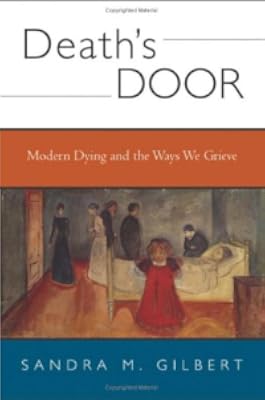
Death's Door: Modern Dying and the Ways We Grieve: A Cultural Study
by Sandra M. Gilbert
On This Page
Description
Critic, poet, and memoirist Sandra M. Gilbert explores our relationship to death through literature, history, poetry and societal practices. Seneca wrote, "Anyone can stop a man's life but no one his death; a thousand doors open on to it." This inevitability has left varying marks on all human cultures. Exploring expressions of faith, burial customs, photographs, poems, and memoirs, Sandra M. Gilbert examines both the changelessness of grief and the changing customs that mark contemporary show more mourning. show lessTags
Recommendations





















Member Reviews
http://www.newsreview.com/sacramento/Content?oid=oid%3A55892
My interview with Sandra M. Gilbert on publication of DEATH'S DOOR: MODERN DYING AND THE WAYS WE GRIEVE:
Retired UC Davis professor Sandra M. Gilbert doesn’t look like a woman who spends a lot of time contemplating death. She’s lively and quick with a joke, and her home at the bottom of one of Berkeley’s wooded hills is full of light--as well as the brightly colored plastic clutter of a visiting grandchild. During a recent lunch there, Gilbert, a renowned feminist literary critic and poet, was bright and welcoming, without a hint of funereal gloom.
In spite of her light demeanor, death--and the way Western tradition and American culture deal with it--has occupied a great show more deal of Gilbert’s thinking for more than a decade. In 1991, her husband, also a professor of English at UC Davis, died as the result of a medical error following surgery in Sacramento. The loss of her husband was devastating for Gilbert, and it was followed by the difficulty of a malpractice lawsuit. She wrote Wrongful Death: A Memoir about the experience, as well as a prize-winning collection of poems, Ghost Volcano.
Gilbert’s newest book, Death’s Door: Modern Dying and the Ways We Grieve, is a wide-ranging volume best described as genre-busting. It brings together elements of memoir, personal meditation, literary criticism and cultural commentary in an accessible, meticulously researched text. Though it might sound like the ultimate interdisciplinary work--and it is--it’s also fascinating reading for the non-specialist.
“It was a question in my mind whether it was going to work,” Gilbert said with a laugh. “This book was, for me, a really major innovation, a major change in my way of writing.” She normally circulates her work among friends before publishing, and in this case, she spent more time doing so, “because I really needed to see if it was going to work.”
In undertaking Death’s Door, Gilbert set out to write a study of the elegy but wasn’t satisfied with the result. “I had to write something more directly personal,” she said. “I had to bear witness, in the way that people do when they bear witness to their grief.” Although she’d had a great deal of success as a literary critic--her collaboration with Susan Gubar, The Madwoman in the Attic: The Woman Writer and the Nineteenth-Century Literary Imagination, has become a foundation text for feminist literary studies--Gilbert found it impossible to write in a strictly academic style. “I found that I was so changed, so utterly transformed by my husband’s death, that after doing all the work I did in writing about it, in eulogizing him and describing what we went through in order to find out what had happened to him, I could not go back to doing literary criticism the way that I once did.”
Death’s Door is very personal; Gilbert returns again and again to her own loss as she surveys Western attitudes toward death. But her examination--including the institutionalization of the dying and the medical and technological attention given to a passage that once took place in the home--always returns to poetry. “We’re always struggling to control death,” she said. “Poetry reminds us that we can’t.”
Grief is persistent, she pointed out. “There’s this deceptiveness of the whole American idea of closure,” she said. But where death is concerned, “that door doesn’t close. ... It never gets better.” She referred to Joan Didion’s recent memoir, The Year of Magical Thinking, as an example of how difficult it is to accept that a dead loved one will not return: “One of the points of Didion’s book was that her mind couldn’t wrap around the idea that he wasn’t coming back.”
It’s a sentiment Gilbert is quite familiar with herself. “I certainly felt something like what Didion talked about. I no longer believe, except perhaps in the most fantastic part of my consciousness, that Elliott will come back. But I did have times when I thought that.”
She’s been involved in a new relationship for a number of years now. “It’s a different person, a different way of being, and it’s good. But there’s no closure.”
Gilbert attributed the American obsession with “moving on” as part of the desire to control death. “We think death is inappropriate,” she said. “We think we can control our fate by controlling our diet, our exercise, by having a cheerful outlook on the world.” She pointed out that when people die, “unless they’re 95 years old,” others want to know what they did to bring about their deaths. She listed some of the questions: “Were you drinking? Or using drugs? Were you crossing the street at the wrong time? Were you taking Ambien and driving in your sleep?”
And while it’s sad, it’s also funny. “Death is a personal character flaw,” Gilbert pronounced. “If you die before you’re ancient, it’s because you didn’t eat right, you didn’t exercise enough, your social behavior was in some way inappropriate, and you are rewarded with the most inappropriate of fates, namely death.”
Gilbert noted that, when she was touring to promote the memoir about her husband’s death, “there were doctors who would say, ‘Mistakes are inevitable. It’s no one’s fault.’” But more troubling were the people--and it happened with surprising frequency--who would want to know what she had done wrong. “They would ask, ‘How is it that two sophisticated, middle-class intellectuals like you didn’t know how to choose the right doctors and the right medical facility?’”
Gilbert still registers surprise at the thought. “We gathered a lot of information and made what we thought was a very good decision,” she said. “But the way most of us react to death is to think, ‘I must have done something wrong. I must have made the wrong decision in order for death to occur.’”
According to Gilbert, we’re doing the best we can with death. “What we can’t bear is randomness. As human beings in Western civilization, we’re programmed to believe in reason and causality, so when something happens out of the blue, we assume that there’s a reason.” It’s a way to adapt ourselves to the reality of death, but this belief that we can control death leads us to think we can control grief. “We can’t accept it. We don’t know what to do with it. So we create all these things like ‘moving on’ and ‘closure.’”
Gilbert is intrigued by the way the term “closure” has gained such weight in discussions of grief. Originally a business term, “closure” was, as she understands it, first applied to grief and loss in the 1980s. “It goes back, I think, to Elisabeth Kübler-Ross and the stages she attributed to people who are coming to terms with their own death,” Gilbert said, “and those stages are not as neat as they seem.” She pointed out that, for the dying person, the final stage of acceptance is followed by death. “It’s over for the person who died. But for the person who’s left grieving, there is no end. You just go on being the survivor.”
People are unwilling to acknowledge that they will, to one degree or another, move back and forth through the various stages of grief for the rest of their lives. “We just don’t want to think about that dark thing.” Gilbert called the concept of closure “the mistaken idea that you’ll get through it. We just pretend that grief has an end.”
The place where she finds this desire for closure most intense--and perhaps most misguided--is in the insistence on the survivors of murder victims that the execution of the killer will bring about some sort of end to their suffering. “It’s grotesque,” she said. “What kind of closure did the survivors of the victims of the Oklahoma City bombing get when they watched Timothy McVeigh executed? They got to see a man executed, but they don’t get to see their loved ones come back. The first day after someone’s death is the first day of forever.”
Gilbert believes the study of literature is necessary to understand death “because poets and writers are the ones who refuse to believe that there’s any kind of control over death, and they are not embarrassed by that lack of control.”
She pointed out that, for the modernists, “sex was the thing that was not to be discussed. It was embarrassing and somehow dirty, and it had to be repressed.” That is, she said, the way we now treat death. But the great modernist poets--D.H. Lawrence, James Joyce, T.S. Eliot--“refused to repress sex.”
“Death is the new sex,” Gilbert confidently proclaimed. “It’s what poets and writers refuse to repress. We need them to help us loosen up.” show less
My interview with Sandra M. Gilbert on publication of DEATH'S DOOR: MODERN DYING AND THE WAYS WE GRIEVE:
Retired UC Davis professor Sandra M. Gilbert doesn’t look like a woman who spends a lot of time contemplating death. She’s lively and quick with a joke, and her home at the bottom of one of Berkeley’s wooded hills is full of light--as well as the brightly colored plastic clutter of a visiting grandchild. During a recent lunch there, Gilbert, a renowned feminist literary critic and poet, was bright and welcoming, without a hint of funereal gloom.
In spite of her light demeanor, death--and the way Western tradition and American culture deal with it--has occupied a great show more deal of Gilbert’s thinking for more than a decade. In 1991, her husband, also a professor of English at UC Davis, died as the result of a medical error following surgery in Sacramento. The loss of her husband was devastating for Gilbert, and it was followed by the difficulty of a malpractice lawsuit. She wrote Wrongful Death: A Memoir about the experience, as well as a prize-winning collection of poems, Ghost Volcano.
Gilbert’s newest book, Death’s Door: Modern Dying and the Ways We Grieve, is a wide-ranging volume best described as genre-busting. It brings together elements of memoir, personal meditation, literary criticism and cultural commentary in an accessible, meticulously researched text. Though it might sound like the ultimate interdisciplinary work--and it is--it’s also fascinating reading for the non-specialist.
“It was a question in my mind whether it was going to work,” Gilbert said with a laugh. “This book was, for me, a really major innovation, a major change in my way of writing.” She normally circulates her work among friends before publishing, and in this case, she spent more time doing so, “because I really needed to see if it was going to work.”
In undertaking Death’s Door, Gilbert set out to write a study of the elegy but wasn’t satisfied with the result. “I had to write something more directly personal,” she said. “I had to bear witness, in the way that people do when they bear witness to their grief.” Although she’d had a great deal of success as a literary critic--her collaboration with Susan Gubar, The Madwoman in the Attic: The Woman Writer and the Nineteenth-Century Literary Imagination, has become a foundation text for feminist literary studies--Gilbert found it impossible to write in a strictly academic style. “I found that I was so changed, so utterly transformed by my husband’s death, that after doing all the work I did in writing about it, in eulogizing him and describing what we went through in order to find out what had happened to him, I could not go back to doing literary criticism the way that I once did.”
Death’s Door is very personal; Gilbert returns again and again to her own loss as she surveys Western attitudes toward death. But her examination--including the institutionalization of the dying and the medical and technological attention given to a passage that once took place in the home--always returns to poetry. “We’re always struggling to control death,” she said. “Poetry reminds us that we can’t.”
Grief is persistent, she pointed out. “There’s this deceptiveness of the whole American idea of closure,” she said. But where death is concerned, “that door doesn’t close. ... It never gets better.” She referred to Joan Didion’s recent memoir, The Year of Magical Thinking, as an example of how difficult it is to accept that a dead loved one will not return: “One of the points of Didion’s book was that her mind couldn’t wrap around the idea that he wasn’t coming back.”
It’s a sentiment Gilbert is quite familiar with herself. “I certainly felt something like what Didion talked about. I no longer believe, except perhaps in the most fantastic part of my consciousness, that Elliott will come back. But I did have times when I thought that.”
She’s been involved in a new relationship for a number of years now. “It’s a different person, a different way of being, and it’s good. But there’s no closure.”
Gilbert attributed the American obsession with “moving on” as part of the desire to control death. “We think death is inappropriate,” she said. “We think we can control our fate by controlling our diet, our exercise, by having a cheerful outlook on the world.” She pointed out that when people die, “unless they’re 95 years old,” others want to know what they did to bring about their deaths. She listed some of the questions: “Were you drinking? Or using drugs? Were you crossing the street at the wrong time? Were you taking Ambien and driving in your sleep?”
And while it’s sad, it’s also funny. “Death is a personal character flaw,” Gilbert pronounced. “If you die before you’re ancient, it’s because you didn’t eat right, you didn’t exercise enough, your social behavior was in some way inappropriate, and you are rewarded with the most inappropriate of fates, namely death.”
Gilbert noted that, when she was touring to promote the memoir about her husband’s death, “there were doctors who would say, ‘Mistakes are inevitable. It’s no one’s fault.’” But more troubling were the people--and it happened with surprising frequency--who would want to know what she had done wrong. “They would ask, ‘How is it that two sophisticated, middle-class intellectuals like you didn’t know how to choose the right doctors and the right medical facility?’”
Gilbert still registers surprise at the thought. “We gathered a lot of information and made what we thought was a very good decision,” she said. “But the way most of us react to death is to think, ‘I must have done something wrong. I must have made the wrong decision in order for death to occur.’”
According to Gilbert, we’re doing the best we can with death. “What we can’t bear is randomness. As human beings in Western civilization, we’re programmed to believe in reason and causality, so when something happens out of the blue, we assume that there’s a reason.” It’s a way to adapt ourselves to the reality of death, but this belief that we can control death leads us to think we can control grief. “We can’t accept it. We don’t know what to do with it. So we create all these things like ‘moving on’ and ‘closure.’”
Gilbert is intrigued by the way the term “closure” has gained such weight in discussions of grief. Originally a business term, “closure” was, as she understands it, first applied to grief and loss in the 1980s. “It goes back, I think, to Elisabeth Kübler-Ross and the stages she attributed to people who are coming to terms with their own death,” Gilbert said, “and those stages are not as neat as they seem.” She pointed out that, for the dying person, the final stage of acceptance is followed by death. “It’s over for the person who died. But for the person who’s left grieving, there is no end. You just go on being the survivor.”
People are unwilling to acknowledge that they will, to one degree or another, move back and forth through the various stages of grief for the rest of their lives. “We just don’t want to think about that dark thing.” Gilbert called the concept of closure “the mistaken idea that you’ll get through it. We just pretend that grief has an end.”
The place where she finds this desire for closure most intense--and perhaps most misguided--is in the insistence on the survivors of murder victims that the execution of the killer will bring about some sort of end to their suffering. “It’s grotesque,” she said. “What kind of closure did the survivors of the victims of the Oklahoma City bombing get when they watched Timothy McVeigh executed? They got to see a man executed, but they don’t get to see their loved ones come back. The first day after someone’s death is the first day of forever.”
Gilbert believes the study of literature is necessary to understand death “because poets and writers are the ones who refuse to believe that there’s any kind of control over death, and they are not embarrassed by that lack of control.”
She pointed out that, for the modernists, “sex was the thing that was not to be discussed. It was embarrassing and somehow dirty, and it had to be repressed.” That is, she said, the way we now treat death. But the great modernist poets--D.H. Lawrence, James Joyce, T.S. Eliot--“refused to repress sex.”
“Death is the new sex,” Gilbert confidently proclaimed. “It’s what poets and writers refuse to repress. We need them to help us loosen up.” show less
"The most comprehensive multidisciplinary contemplation of mortality we are likely to get." -Thomas Lynch, New York Times Book Review Prominent critic, poet, and memoirist Sandra M. Gilbert explores our relationship to death though literature, history, poetry, and societal practices. Does death change;and if it does, how has it changed in the last century? And how have our experiences and expressions of grief changed? Did the traumas of Hiroshima and the Holocaust transform our thinking about mortality? More recently, did the catastrophe of 9/11 alter our modes of mourning? And are there at the same time aspects of grief that barely change from age to age? Seneca wrote, "Anyone can stop a man's life but no one his death; a thousand show more doors open on to it." This inevitability has left varying marks on all human cultures. Exploring expressions of faith, burial customs, photographs, poems, and memoirs, acclaimed author Sandra M. Gilbert brings to the topic of death the critical skill that won her fame for The Madwoman in the Attic and other books, as she examines both the changelessness of grief and the changing customs that mark contemporary mourning. 25 illustrations show less
Ratings
Members
- Recently Added By
Lists

Deathreads
78 works; 2 members
Author Information

45+ Works 3,491 Members
A poet, feminist critic, and professor of English at the University of California at Davis, Gilbert received her Ph.D. from Columbia University in 1968. Her early work addressed canonical male figures, but in the 1970s she began to focus on women writers from a feminist perspective, teaming up with Susan Gubar in what has proven to be a very show more influential collaboration. In 1979 they published their first joint efforts, a collection of feminist essays on women poets, Shakespeare's Sisters, and The Madwoman in the Attic, an exploration of major nineteenth-century women writers, which has had a major role in defining feminist scholarship. This massive volume takes its title from Jane Eyre's "mad" and monstrous double, Bertha, hidden away in the attic by Jane's would-be lover, Rochester; Gilbert and Gubar see figures like Bertha as resisting patriarchy, subversive surrogates for the docile heroines who populate nineteenth-century fiction by women. Although Gilbert and Gubar's ideas have been very influential, many critics, particularly poststructuralists, have taken issue with them. For Gilbert and Gubar, a woman writer is by definition angry, and her text will express that anger, albeit in disguised or distorted form. Reading hinges on knowing the sex of the author, rather than on a careful analysis of the text itself and the multivalency of its language. Gilbert and Gubar's work is part of a debate about essentialist and antiessentialist feminist theories, which has addressed issues like "the signature" (the significance of knowledge about the author and authorial intentions) and gendered expression in general. (Bowker Author Biography) Sandra M. Gilbert's most recent poetry collection is "Blood Pressure". She teaches at the University of California, Davis. (Bowker Author Biography) show less
Classifications
- Genres
- Nonfiction, Literature Studies and Criticism, History
- DDC/MDS
- 155.9 — Philosophy & psychology Psychology Differential and developmental psychology Environmental psychology
- LCC
- HQ1073 .G54 — Social sciences The family. Marriage, Women and Sexuality The Family. Marriage. Women Thanatology. Death. Dying
- BISAC
Statistics
- Members
- 120
- Popularity
- 272,660
- Reviews
- 2
- Rating
- (3.50)
- Languages
- English
- Media
- Paper
- ISBNs
- 3