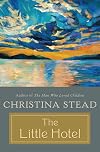
The Little Hotel
by Christina Stead
On This Page
Description
A German-American, in South Africa, fighting the British, in an Irish commando, in the Boer army Some years ago Donal McCracken was working on a book of Ireland and the Anglo-Boer War (1899-1902) when, in the British Ministry of Defence Library, the old War Office Library, off Whitehall, he came upon a slim volume. It was a war diary written by a young German from Halbertstad named Ernest Luther. As a child, Luther went with his mother to New York. From there, in a short period, he fought as show more a volunteer in three wars: the Graeco-Turkish War, the United States-Spanish War and the Anglo-Boer War show lessTags
Recommendations


















Member Reviews
Text Publishing's catalogue includes some Australian classics that have been hard to obtain for decades. I read The Man Who Loved Children many years ago, but had never come across any of Stead's other books until now. The Little Hotel was first published in 1973, but it is set just after World War II.
The Little Hotel is a cheap tourist hotel in Lausanne, on Lake Geneva. It is the off-season, so most of the residents are staying for many months at cheap rates. Some have spent the years after the war drifting around the world, speculating in currency. Some are in hiding. Others are ill and have come to recuperate or to die. Apart from one sympathetic character, this is a group of selfish people, caught up in pettiness and show more vindictiveness.
This is a witty, satirical book. I found it very funny, but was glad it was no longer because I didn't want to spend any more time with such dreadful people. After this reintroduction to Stead's wonderful writing, I'm going to read more. show less
The Little Hotel is a cheap tourist hotel in Lausanne, on Lake Geneva. It is the off-season, so most of the residents are staying for many months at cheap rates. Some have spent the years after the war drifting around the world, speculating in currency. Some are in hiding. Others are ill and have come to recuperate or to die. Apart from one sympathetic character, this is a group of selfish people, caught up in pettiness and show more vindictiveness.
This is a witty, satirical book. I found it very funny, but was glad it was no longer because I didn't want to spend any more time with such dreadful people. After this reintroduction to Stead's wonderful writing, I'm going to read more. show less
Enjoyable and structurally interesting, though ultimately slight. Stead let this one sit for some time before finishing it off and getting it published, and it shows. The book was initially called 'Mrs Trollope and Madame Blaise,' which is far more accurate and representative of the last two thirds than 'The Little Hotel,' which is a great title for the first part of the book. As this suggests, there's a pretty big technical problem: Stead spends a long time enjoying herself with the various guests of the eponymous hotel, and then gets on to the focus of her story, Mrs Trollope and post-war currency export restrictions. No, I am not joking.
So the first part is a bit of allegory, as poor guests of various nationalities do idiotic show more things; it is great fun and wonderfully written from the perspective of the hotel keeper. The rest is told more neutrally, and reminds me of Compton-Burnett or Elizabeth Jolley (much as I hate to compare it only to other women, I just haven't read men who do this style so well): kind of abstracted, but quite detailed at the same time. And it's allegorical, too, but more involved in money questions. Christina Stead is awesome; in other hands, this would have been a mess. Instead, it's fun and interesting. show less
So the first part is a bit of allegory, as poor guests of various nationalities do idiotic show more things; it is great fun and wonderfully written from the perspective of the hotel keeper. The rest is told more neutrally, and reminds me of Compton-Burnett or Elizabeth Jolley (much as I hate to compare it only to other women, I just haven't read men who do this style so well): kind of abstracted, but quite detailed at the same time. And it's allegorical, too, but more involved in money questions. Christina Stead is awesome; in other hands, this would have been a mess. Instead, it's fun and interesting. show less
Christina Stead was an Australian novelist and short-story writer acclaimed for her satirical wit and penetrating psychological characterizations. She was born in Sydney, Australia, and died in Sydney. However in between she spent the vast majority of her life outside Australia in Europe and, briefly, in America. Having left her homeland in 1928, she subsequently lived in London, Paris, Brussels, New York and Hollywood before returning to her country of origin in 1969. She experienced a nomadic lifestyle, moving restlessly from country to country. Never completely at home in London, her relationship with Australia was decidedly ambivalent. Prior to 1965, none of her novels were published in Australia and she was denied the Britannica show more Australia Award for Literature in 1967 on the grounds that her years abroad called into question her Australian citizenship. Only later in her career did she receive critical acclaim in her homeland.
Though championed by Saul Bellow, this is a minor novel among the oeuvre of Christina Stead. It is minor in the sense that it is only a third the size of her typical books - and simply because Stead usually excels at what appears to be a Rabelaisian approach to her narrative canvas. A tale that starts and ends was not one of her enduring interests, and here we have a few amusing vignettes, and a few less amusing ones, all set in the "Swiss-Touring Hotel", a nondescript, probably a touch shabby, little hotel a few years after the end of WWII.
Most of the occupants are elderly Europeans (the English commonly crop up) who are various shades of desperate or insane (in the humorous sense). The book is narrated by the 26 year-old woman who runs the hotel, and Stead proves to have a terrific ability to reproduce the voice of such a person; she finds a sort of Swiss-German English that's a little halting, a little too precise, and works like a charm. Stead's ability to juggle a number of story-lines at one time (there are dozens of characters in a novel running under 200 pages) is on full display here - as long as things are filtered through the young owner's perception. Past the halfway point in the book she (Stead) makes the strange decision to change to an omniscient narrator, smooth out the language, and to concentrate on one of the hotel's aging English guests and her relationship with a man who refuses to marry her and who may be simply out to procure her large fortune, along with periphery friends and associates of this character. The novel probably could not have been sustained through the original narrator's voice, simply recounting all the amusing incidents, and the choice to eventually bring a few characters up front and center is right; but Stead's way of doing it is jarring and the book never recovers either its momentum or interest. It shows the impact of probably having been two separate books that were put together to make one small novel.
Like Christina Stead's pre-war novels set in Europe, this one suggests the disintegration of European culture. It is a microcosm of Europe in ruins, with its pitiful characters on a lifeboat and not a spot of land or ship around. In a letter Stead once complained that she couldn't write "positive" characters. It was not her talent. Aside from the hotel owner few of the characters appear very pleasant, and even she is less a saint than a practical businesswomen. However, there are memorable characters like the "Mayor of B", a Belgian whose personal idiosyncrasies provide fodder for several scenes as when he gently harangues the staff. And a proper British woman, Mrs Trollope (even the name is quaintly literary) is also the focus of many episodes including a nostalgic moment:
"I invited Mrs Trollope to the movies. The film was Goodbye, Mr Chips and I was longing to see it. Mrs Trollope wanted to see it again. She said:
'It gives you such a feeling of the dear old world still being with us in the new; though the young seem so old nowadays.'" (p 54) Moments like this one make her perhaps the most sympathetic of the hotel's residents.
Stead had a special gift for both proper and reprehensible characters, sick, neurotic, or insane, . The joy of The Little Hotel lies in her little portraits.
"The Princess said: 'Well, South America is good, there are so many skin diseases. But I met a doctor in New York, a very rich man, a friend of mine, who said nine-tenths of the babies in South America should be gassed; he said the bomb wouldn't do them the least harm; they should be exterminated. He toured South America and he was shocked. American science could do nothing for them. He is a splendid husband and father and he has seven children and knows what he is talking about.'
Lilia said: 'I think that is cruel.'
The Princess said: 'Oh, science is cruel; and this is a cruel age.'" show less
Though championed by Saul Bellow, this is a minor novel among the oeuvre of Christina Stead. It is minor in the sense that it is only a third the size of her typical books - and simply because Stead usually excels at what appears to be a Rabelaisian approach to her narrative canvas. A tale that starts and ends was not one of her enduring interests, and here we have a few amusing vignettes, and a few less amusing ones, all set in the "Swiss-Touring Hotel", a nondescript, probably a touch shabby, little hotel a few years after the end of WWII.
Most of the occupants are elderly Europeans (the English commonly crop up) who are various shades of desperate or insane (in the humorous sense). The book is narrated by the 26 year-old woman who runs the hotel, and Stead proves to have a terrific ability to reproduce the voice of such a person; she finds a sort of Swiss-German English that's a little halting, a little too precise, and works like a charm. Stead's ability to juggle a number of story-lines at one time (there are dozens of characters in a novel running under 200 pages) is on full display here - as long as things are filtered through the young owner's perception. Past the halfway point in the book she (Stead) makes the strange decision to change to an omniscient narrator, smooth out the language, and to concentrate on one of the hotel's aging English guests and her relationship with a man who refuses to marry her and who may be simply out to procure her large fortune, along with periphery friends and associates of this character. The novel probably could not have been sustained through the original narrator's voice, simply recounting all the amusing incidents, and the choice to eventually bring a few characters up front and center is right; but Stead's way of doing it is jarring and the book never recovers either its momentum or interest. It shows the impact of probably having been two separate books that were put together to make one small novel.
Like Christina Stead's pre-war novels set in Europe, this one suggests the disintegration of European culture. It is a microcosm of Europe in ruins, with its pitiful characters on a lifeboat and not a spot of land or ship around. In a letter Stead once complained that she couldn't write "positive" characters. It was not her talent. Aside from the hotel owner few of the characters appear very pleasant, and even she is less a saint than a practical businesswomen. However, there are memorable characters like the "Mayor of B", a Belgian whose personal idiosyncrasies provide fodder for several scenes as when he gently harangues the staff. And a proper British woman, Mrs Trollope (even the name is quaintly literary) is also the focus of many episodes including a nostalgic moment:
"I invited Mrs Trollope to the movies. The film was Goodbye, Mr Chips and I was longing to see it. Mrs Trollope wanted to see it again. She said:
'It gives you such a feeling of the dear old world still being with us in the new; though the young seem so old nowadays.'" (p 54) Moments like this one make her perhaps the most sympathetic of the hotel's residents.
Stead had a special gift for both proper and reprehensible characters, sick, neurotic, or insane, . The joy of The Little Hotel lies in her little portraits.
"The Princess said: 'Well, South America is good, there are so many skin diseases. But I met a doctor in New York, a very rich man, a friend of mine, who said nine-tenths of the babies in South America should be gassed; he said the bomb wouldn't do them the least harm; they should be exterminated. He toured South America and he was shocked. American science could do nothing for them. He is a splendid husband and father and he has seven children and knows what he is talking about.'
Lilia said: 'I think that is cruel.'
The Princess said: 'Oh, science is cruel; and this is a cruel age.'" show less
The little hotel by Stead_ Christina
Story follows many who have stayed at the little hotel-in Switerzerland.
Seems to me they gossiped a lot about the guests among the owner and the maids.
Like they don't have enough to do with their work. Stories of women taken advantage of because of all the money they have.
I received this book from National Library Service for my BARD (Braille Audio Reading Device).
Story follows many who have stayed at the little hotel-in Switerzerland.
Seems to me they gossiped a lot about the guests among the owner and the maids.
Like they don't have enough to do with their work. Stories of women taken advantage of because of all the money they have.
I received this book from National Library Service for my BARD (Braille Audio Reading Device).
This is a most interesting book by a renowned Australian author. Written in 1973, it captures the pretenstions and preoccupations of guests in a small Swiss hotel with satirical wit. To read more, see http://anzlitlovers.wordpress.com/2009/05/09/the-little-hotel-by-christina-stead...
strange book but good
Ratings
Members
- Recently Added By
Lists

Boarding House and Hotel Fiction
73 works; 25 members

500 Great Books by Women
507 works; 60 members

Kirkus Starred Fiction Reviews of Books Published in 2017
412 works; 7 members
Author Information

24+ Works 3,517 Members
Author Christina Stead was born in Rockdale, New South Wales, Australia on July 17, 1902. She left Australia in 1928 and spent time in Europe, England, and the United States before permanently returning in 1974. She wrote fifteen novels and numerous volumes of short stories. She is best known for her novel, The Man Who Loved Children, which was show more based on her childhood. Her novels were unpublished in Australia until 1965 and she was denied the Britannica-Australia award in 1967 on the grounds that she was no longer considered an Australian. In 1974, she won the Patrick White award. While living in the United States during the 1940s, she worked as a Hollywood scriptwriter and contributed to Madame Curie and They Were Expendable. She died on March 31, 1983. (Bowker Author Biography) show less
Awards and Honors
Notable Lists
Series
Belongs to Publisher Series
Common Knowledge
- Canonical title
- The Little Hotel
- Original publication date
- 1973
- Dedication
- For Gunnvor and Oliver Stallybrass
- First words
- If you knew what happens in the hotel every day!
- Last words
- (Click to show. Warning: May contain spoilers.)I do not know if hey ever saw each other again.
Classifications
Statistics
- Members
- 134
- Popularity
- 242,050
- Reviews
- 6
- Rating
- (3.53)
- Languages
- English, Italian, Turkish
- Media
- Paper, Ebook
- ISBNs
- 12
- ASINs
- 2