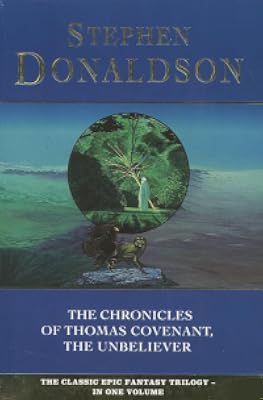
The Chronicles Of Thomas Covenant The Unbeliever
by Stephen Donaldson
The First Chronicles of Thomas Covenant, The Unbeliever (Collections and Selections — Omnibus 1-3), The Complete Chronicles of Thomas Covenant (Collections and Selections — 01-03)
On This Page
Description
The acclaimed fantasy epic, together in one volume.Tags
Recommendations



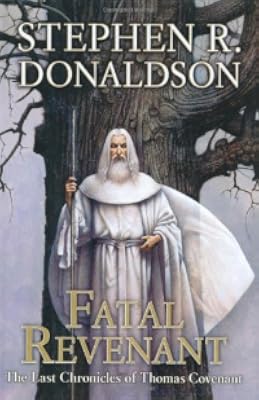


Member Reviews
I'm well over half done and the thought of picking this up again is filling me with dread. Maybe I'll try again when winter has settled in. But now I need something with some life in it. Something that won't leave me rolling my eyes at the characters and wishing that they'd get on with it. I'm starting to understand why Kevin just said "Fuck it. I'm just gonna burn it all down. These asshats just won't STFU."
How did my judgement fail me so horribly when I was a teenager/young adult?
Oh wait.
I was a moody, hormonal teenager/young adult. That might be it right there.
I'm leaving an extra star because there are a lot of moody, hormonal people out there who might like this as much as I did back in the day.
How did my judgement fail me so horribly when I was a teenager/young adult?
Oh wait.
I was a moody, hormonal teenager/young adult. That might be it right there.
I'm leaving an extra star because there are a lot of moody, hormonal people out there who might like this as much as I did back in the day.
I gave the first book of this series grief for being a slow burn. I stand by that assessment, but this volume illustrates why you might spend an entire book building a world — so you can burn it to the ground in the most horrifying way possible.
“The Illearth War” picks up a few weeks after the events of the first book. Thomas Covenant has barely had time to readjust to life in our world as a despised leper when he's drawn back to the Land, thrust into his unwanted destiny to save or destroy it — assuming it’s not the product of a broken mind.
One strength of this book is that it doesn’t shy away from the consequences of Covenant’s first visit to the Land. As in Narnia, time works differently here; and in the interval since show more his first visit, the ripples of his crime have wrought both great evil and great good.
With that in mind, if the first book grapples with the question of whether or not redemption is possible for unredeemable people, this second book attacks the question of whether or not evil itself can have redemptive purpose. Donaldson’s answer seems, again, to be yes.
This is perhaps best illustrated by Warmark Hile Troy, who quickly became one of my favorite literary characters. His arc from disability to command is magnificent, especially his evolution as a leader of men in a frantic forced march against Lord Foul the Despiser’s terrifying horde.
After countless cycles of war with Lord Foul, Troy’s strategy is the first that breaks with the hidebound defense offered by the Lords of Revelstone, the first that offers a chance of real victory. But without Covenant’s original sin, Troy wouldn’t be positioned to bring his unique vision to the war.
This theme of evil birthing good surfaces in other ways, such as in the speculation of some in the Land that Kevin Landwaster’s ancient, despairing enactment of the Ritual of Desecration may have been a deliberate self-sacrifice; and that only through a terrible rending can good triumph over evil.
If you sense in this a shadow of Christ’s cross, I don’t think you’re imagining things. As in “Lord Foul’s Bane,” I believe Donaldson’s Presbyterian upbringing is one tributary of his thought. Certainly he grew up steeped in the core ideal of Christianity; namely, that death has been defeated through death.
Of course, Donaldson no longer accepts the faith of his fathers, and so blurs this hopeful theme in the person of Thomas Covenant, Unbeliever. Covenant remains the question mark at the center of the story: a man at once resistant to the promise of the Land and unable to resist its imperatives.
Even as Covenant struggles to escape the urgency of the Land, he is pulled deeper into a life offensive both to his reason and his paranoia. His unbelief motivates him to see further into Lord Foul’s plans, and the unpredictability of the Wild Magic he carries forces caution on the Despiser.
And so, even the sin of Covenant’s unbelief serves to affirm, strengthen, and preserve the very Land whose reality he doubts. Is this a happy accident, or the wise purpose of the Land’s Creator, a Creator whose existence is questioned even by residents of the Land?
Either way, Donaldson seems to say, the righteous indignations on which we mount are too small for the vistas of our moral universe. Good can, and perhaps sometimes must, come from evil; we’re simply too small to see the end from the beginning. Perhaps glory exists only at the end of dark paths. Perhaps Friday’s death is only the turn of a key that throws open the door to Sunday’s resurrection. show less
“The Illearth War” picks up a few weeks after the events of the first book. Thomas Covenant has barely had time to readjust to life in our world as a despised leper when he's drawn back to the Land, thrust into his unwanted destiny to save or destroy it — assuming it’s not the product of a broken mind.
One strength of this book is that it doesn’t shy away from the consequences of Covenant’s first visit to the Land. As in Narnia, time works differently here; and in the interval since show more his first visit, the ripples of his crime have wrought both great evil and great good.
With that in mind, if the first book grapples with the question of whether or not redemption is possible for unredeemable people, this second book attacks the question of whether or not evil itself can have redemptive purpose. Donaldson’s answer seems, again, to be yes.
This is perhaps best illustrated by Warmark Hile Troy, who quickly became one of my favorite literary characters. His arc from disability to command is magnificent, especially his evolution as a leader of men in a frantic forced march against Lord Foul the Despiser’s terrifying horde.
After countless cycles of war with Lord Foul, Troy’s strategy is the first that breaks with the hidebound defense offered by the Lords of Revelstone, the first that offers a chance of real victory. But without Covenant’s original sin, Troy wouldn’t be positioned to bring his unique vision to the war.
This theme of evil birthing good surfaces in other ways, such as in the speculation of some in the Land that Kevin Landwaster’s ancient, despairing enactment of the Ritual of Desecration may have been a deliberate self-sacrifice; and that only through a terrible rending can good triumph over evil.
If you sense in this a shadow of Christ’s cross, I don’t think you’re imagining things. As in “Lord Foul’s Bane,” I believe Donaldson’s Presbyterian upbringing is one tributary of his thought. Certainly he grew up steeped in the core ideal of Christianity; namely, that death has been defeated through death.
Of course, Donaldson no longer accepts the faith of his fathers, and so blurs this hopeful theme in the person of Thomas Covenant, Unbeliever. Covenant remains the question mark at the center of the story: a man at once resistant to the promise of the Land and unable to resist its imperatives.
Even as Covenant struggles to escape the urgency of the Land, he is pulled deeper into a life offensive both to his reason and his paranoia. His unbelief motivates him to see further into Lord Foul’s plans, and the unpredictability of the Wild Magic he carries forces caution on the Despiser.
And so, even the sin of Covenant’s unbelief serves to affirm, strengthen, and preserve the very Land whose reality he doubts. Is this a happy accident, or the wise purpose of the Land’s Creator, a Creator whose existence is questioned even by residents of the Land?
Either way, Donaldson seems to say, the righteous indignations on which we mount are too small for the vistas of our moral universe. Good can, and perhaps sometimes must, come from evil; we’re simply too small to see the end from the beginning. Perhaps glory exists only at the end of dark paths. Perhaps Friday’s death is only the turn of a key that throws open the door to Sunday’s resurrection. show less
My my, how readers hate these books! Yes, Thomas is a cruel, foolish man who does an--at least one--unforgivable act.
That's the *point.* He is never forgiven, and in later books, the evil fallout of his actions are... disturbing.
This is one of those books that actually taught me one of the foundational author's lessons: you do not have to like your main character. But by God, you must understand them. And this character is very real (albeit, at times insufferably so!)
That's the *point.* He is never forgiven, and in later books, the evil fallout of his actions are... disturbing.
This is one of those books that actually taught me one of the foundational author's lessons: you do not have to like your main character. But by God, you must understand them. And this character is very real (albeit, at times insufferably so!)
After a car knocks him unconscious, leper outcast unclean anti-hero Thomas Covenant finds himself transported to The Land, an imaginative world with such tangible beauty and life that one can't help but care about it as passionately as the characters themselves. Covenant's nerve-ends awaken; his leprosy is fading. In stark contrast to his years as an outcast in his home-town, he is now hailed as a reincarnation of the legendary Berek Halfhand, a saviour of the land. But is it illusion or reality? Should Covenant attempt to save The Land from the deadly Despiser as its legends prophesise, or retain his detached leper mentality to survive should it prove to be the former? This is a tale of sanity, survival and discipline, of struggle and show more purpose, of love, of redemption, of conquering despair and despite, where the external and internal run parallel with the line between them frequently blurred, and fundamental ethical questions are forced like hot knives into the mind of reader and character alike. "The Chronicles..." are as savage as they are beautiful, with a controversial rape scene forcing many to stop reading after only a few chapters, but ultimately this is a wonderfully liberating, entrancing tale - among the best epic fantasy has ever produced, and probably ever will produce. 5 stars. show less
I haven't read much fantasy literature but I'm glad I read this trilogy. The entire Chronicles by Donaldson is one of my all-time favorites. The main character is almost an anti-hero and the story, while it slows briefly, never let me down. Other than Tolkien, Donaldson is the best writer I've come across in (my limited reading of) the genre.
When Vamplit Publishing offered to take on my book they likened my style to Stephen Donaldson Author of the Thomas Covenant Chronicles and others. Now I have never heard of Stephen Donaldson so that meant little to me. I have now however acquainted myself with the author’s work and stand perplexed. Does my publisher really think that I right like the creator of Thomas Covenant?
Some people do not like The Thomas Covenant Chronicles because of the self-pitying angry anti-hero. I for one do. The writing is so fluid and descriptive in ways that many authors could only envy. If the questers are following a river the prose keeps pace with the flowing waters. You feel the bite of the stinging rain and cloying grasp of the living darkness. show more There’s a spring in the earth that you can feel in every breath that the land takes. The land that is truly living and beautifully rendered as indeed are its varying indigenous peoples.
I was never bored reading this book, of which I have now completed the first part of the trilogy. I’ll tell you nothing of the story whatsoever. To tell you anything of the plot will tarnish it in your mind. Read it and let it polish that dulled, tarnished metal that has encased so many reader’s minds over innumerate years as you have been fed endless trite as excuses for fantasy. This is classic fantasy. Not the fuzzy teddies on a picnic but a visceral festival of extravagant prose that demands a reader’s attention. This is not the likes of Harry Potter, Twilight or any of the modern urban brigand. This is the work of a skilled raconteur, a teller of high tales and bard of lost lore and legends well remembered.
Before I knew where I was I had strayed 80 pages into the sequel just for mild curiosity. If you like your fantasy high and classic like that of Tolkien then you will enjoy this. But as for whether I write like the author or not I never dare to mount such a lofty pedestal.
So, Thomas Covenant has returned to his own world only to become even more hated just for being alive and having an illness that will eventually kill him if the residents don’t first.
With his mind reeling at the intrusion of his ‘dream’ Covenant begins to unravel. Not surprising. He spends three weeks battling with reality and the growing rejection of his own world until an accident renders him unconscious and he wakes up once again in The Land. This time however the stakes are much higher, so to defend himself Thomas Covenant builds his barriers even deeper to keep the unreality from seeping in. The Land is thrust into the titular Illearth War from which, somehow, Covenant must escape intact.
He quickly surmises that either he or the one who summoned must die in order for him to escape back to his own world. Therein lies the greatest emotional turmoil that the cowardly Covenant has to face. I’ll not give any spoilers no review ever should, but his choice is would not be easy for anyone to make.
The Ravers are ravaging the land. War is everywhere. A second person has been summoned to The Land from Covenant’s world but he is only too willing to take up his place and fight for the good of The Land. War is everywhere, death surrounds all but still a demand is placed on Thomas Covenant that he cannot resist – ah Unbeliever what is the truth of your heart? That is the deepest question the Thomas Covenant must answer if, indeed, he can.
Yet again Stephen Donaldson has produced an outstanding work that flows straight on from the first. The rich tapestry that makes up The Land is continually woven with ever increasing majesty. Though at times I found myself reaching for a dictionary and then wishing that simpler, more down to earth words had been used. Not once was my enjoyment spoiled by my limited vocabulary, the story is too strong for that.
Battles ebb and flow like a ceaseless tide across the pages that must at times be read thoroughly so as not to miss the slightest passion of the writer. Take your time when reading the world of Mr Donaldson, his are not the comfort books of Harry Potter or Percy Jackson, his are works of art there to be admired and beheld.
Another book deserving of full marks.
The Power that Preserves is the third part of the Thomas Covenant series and the end of the first trilogy. Simply put: a great book. The Unbeliever comes of age at last and accepts that he has a purpose in life other than to survive. He confesses his love for the Land into the face of lord Foul the Despiser and then simply tells him that it does not exist. Thus he unlocks the paradox to the wild magic.
War is everywhere in Land but everywhere that Thomas Covenant goes he is faced with the memory of those that he, in his own eyes, has slain. Those that he loved, cherished, and abused to meet his own need and denial of the Land. And it would seem that the Land itself believes in Thomas Covenant to the point where it ensures that he fulfils his declaration to destroy Lord Foul. At some point or other every place that means anything is assaulted and destroyed by Foul’s Ravers until only Covenant remains standing amid the protection of his unbelief. When Covenant and Foul finally stand toe to toe and duel for the very existence of the Land we are treated to one of the most spectacular magic battles ever written. The power in the passages that depict the final confrontation make Lord Voldermort pale into insignificance. Here is magic running wild, pure evil battling the paradox between love and denial with a conclusion so satisfying that I doubt anyone will better it.
There is movie called Avatar that borrows heavily upon the themes in the series, so much so that I find it impossible to believe that it was not the foundational influence for that tale. In the Land people ‘see’ one another; they see the heart, the wholeness, the power, and the deep truths. They are all one with the Land, a land that is sentient. There is the One Tree, the one forest and the great spirit – the Creator. Too many things that work in the same way to be coincidental. But Stephen Donaldson tells it with much more detail and passion. It’s as though he walks the land and ‘sees’ its people. He is a writer that lives his stories and thus brings them to life.
In summation, the trilogy is a triumph of storytelling: epic in its truest sense.
A thoroughly deserved 10 out of 10 show less
Some people do not like The Thomas Covenant Chronicles because of the self-pitying angry anti-hero. I for one do. The writing is so fluid and descriptive in ways that many authors could only envy. If the questers are following a river the prose keeps pace with the flowing waters. You feel the bite of the stinging rain and cloying grasp of the living darkness. show more There’s a spring in the earth that you can feel in every breath that the land takes. The land that is truly living and beautifully rendered as indeed are its varying indigenous peoples.
I was never bored reading this book, of which I have now completed the first part of the trilogy. I’ll tell you nothing of the story whatsoever. To tell you anything of the plot will tarnish it in your mind. Read it and let it polish that dulled, tarnished metal that has encased so many reader’s minds over innumerate years as you have been fed endless trite as excuses for fantasy. This is classic fantasy. Not the fuzzy teddies on a picnic but a visceral festival of extravagant prose that demands a reader’s attention. This is not the likes of Harry Potter, Twilight or any of the modern urban brigand. This is the work of a skilled raconteur, a teller of high tales and bard of lost lore and legends well remembered.
Before I knew where I was I had strayed 80 pages into the sequel just for mild curiosity. If you like your fantasy high and classic like that of Tolkien then you will enjoy this. But as for whether I write like the author or not I never dare to mount such a lofty pedestal.
So, Thomas Covenant has returned to his own world only to become even more hated just for being alive and having an illness that will eventually kill him if the residents don’t first.
With his mind reeling at the intrusion of his ‘dream’ Covenant begins to unravel. Not surprising. He spends three weeks battling with reality and the growing rejection of his own world until an accident renders him unconscious and he wakes up once again in The Land. This time however the stakes are much higher, so to defend himself Thomas Covenant builds his barriers even deeper to keep the unreality from seeping in. The Land is thrust into the titular Illearth War from which, somehow, Covenant must escape intact.
He quickly surmises that either he or the one who summoned must die in order for him to escape back to his own world. Therein lies the greatest emotional turmoil that the cowardly Covenant has to face. I’ll not give any spoilers no review ever should, but his choice is would not be easy for anyone to make.
The Ravers are ravaging the land. War is everywhere. A second person has been summoned to The Land from Covenant’s world but he is only too willing to take up his place and fight for the good of The Land. War is everywhere, death surrounds all but still a demand is placed on Thomas Covenant that he cannot resist – ah Unbeliever what is the truth of your heart? That is the deepest question the Thomas Covenant must answer if, indeed, he can.
Yet again Stephen Donaldson has produced an outstanding work that flows straight on from the first. The rich tapestry that makes up The Land is continually woven with ever increasing majesty. Though at times I found myself reaching for a dictionary and then wishing that simpler, more down to earth words had been used. Not once was my enjoyment spoiled by my limited vocabulary, the story is too strong for that.
Battles ebb and flow like a ceaseless tide across the pages that must at times be read thoroughly so as not to miss the slightest passion of the writer. Take your time when reading the world of Mr Donaldson, his are not the comfort books of Harry Potter or Percy Jackson, his are works of art there to be admired and beheld.
Another book deserving of full marks.
The Power that Preserves is the third part of the Thomas Covenant series and the end of the first trilogy. Simply put: a great book. The Unbeliever comes of age at last and accepts that he has a purpose in life other than to survive. He confesses his love for the Land into the face of lord Foul the Despiser and then simply tells him that it does not exist. Thus he unlocks the paradox to the wild magic.
War is everywhere in Land but everywhere that Thomas Covenant goes he is faced with the memory of those that he, in his own eyes, has slain. Those that he loved, cherished, and abused to meet his own need and denial of the Land. And it would seem that the Land itself believes in Thomas Covenant to the point where it ensures that he fulfils his declaration to destroy Lord Foul. At some point or other every place that means anything is assaulted and destroyed by Foul’s Ravers until only Covenant remains standing amid the protection of his unbelief. When Covenant and Foul finally stand toe to toe and duel for the very existence of the Land we are treated to one of the most spectacular magic battles ever written. The power in the passages that depict the final confrontation make Lord Voldermort pale into insignificance. Here is magic running wild, pure evil battling the paradox between love and denial with a conclusion so satisfying that I doubt anyone will better it.
There is movie called Avatar that borrows heavily upon the themes in the series, so much so that I find it impossible to believe that it was not the foundational influence for that tale. In the Land people ‘see’ one another; they see the heart, the wholeness, the power, and the deep truths. They are all one with the Land, a land that is sentient. There is the One Tree, the one forest and the great spirit – the Creator. Too many things that work in the same way to be coincidental. But Stephen Donaldson tells it with much more detail and passion. It’s as though he walks the land and ‘sees’ its people. He is a writer that lives his stories and thus brings them to life.
In summation, the trilogy is a triumph of storytelling: epic in its truest sense.
A thoroughly deserved 10 out of 10 show less
This is the three books in this series in one volume (Lord Foul's Bane; The Illearth War; The Power that Preserves). It is a spare copy passed on to me by a friend, as I have the three volumes in hardback my own personal collection.
Thomas Covenant is a leper, shunned by our world, and transported to another land where his nerves regenerate and the white gold wedding band he wears is a powerful weapon. To the people of The Land, Covenant is Berek Halfhand reborn - a hero whose wild magic is the only possible answer to the evils of Drool Rockworm and Lord Foul the Despiser. But Covenant cannot and will not believe in The Land. He cannot accept the responsibility the Land demands of him. To do so would be to ignore the discipline and show more vigilance he must maintain as a safeguard against the constant reality of his leprosy.
There is, however, a puzzle at the heart of the novel which is never adequately explained. If the Land is a dream, whatever Covenant does cannot affect him in the real world. So he may as well help the Land and fight its foes taking whatever risks to himself are necessary. On the other hand, if the Land is real, Covenant is not a leper there and need not exercise such caution. Whenever he is confronted with this logic, Covenant can only mutter, "It isn't that easy." At times, Thomas is not an especially likeable protagonist and I often wanted to give him a good shake!
A lot of people have compared it to Lord of the Rings - some positively; some negatively. To me, while both are by definition fantasy tales, that is where the similarities stop. Some people complain that "The Land" is not as thoroughly developed as "Middle Earth." But the situations are totally different. Set foot into Middle Earth and that's where you stay; in this tale, Thomas makes regular excursions to the real, modern world.
This is a series you either love or you hate - and I loved it. show less
Thomas Covenant is a leper, shunned by our world, and transported to another land where his nerves regenerate and the white gold wedding band he wears is a powerful weapon. To the people of The Land, Covenant is Berek Halfhand reborn - a hero whose wild magic is the only possible answer to the evils of Drool Rockworm and Lord Foul the Despiser. But Covenant cannot and will not believe in The Land. He cannot accept the responsibility the Land demands of him. To do so would be to ignore the discipline and show more vigilance he must maintain as a safeguard against the constant reality of his leprosy.
There is, however, a puzzle at the heart of the novel which is never adequately explained. If the Land is a dream, whatever Covenant does cannot affect him in the real world. So he may as well help the Land and fight its foes taking whatever risks to himself are necessary. On the other hand, if the Land is real, Covenant is not a leper there and need not exercise such caution. Whenever he is confronted with this logic, Covenant can only mutter, "It isn't that easy." At times, Thomas is not an especially likeable protagonist and I often wanted to give him a good shake!
A lot of people have compared it to Lord of the Rings - some positively; some negatively. To me, while both are by definition fantasy tales, that is where the similarities stop. Some people complain that "The Land" is not as thoroughly developed as "Middle Earth." But the situations are totally different. Set foot into Middle Earth and that's where you stay; in this tale, Thomas makes regular excursions to the real, modern world.
This is a series you either love or you hate - and I loved it. show less
Members
- Recently Added By
Lists

David Pringle's Modern Fantasy: The 100 Best Novels
100 works; 5 members

Favorite Series
238 works; 94 members

Stories of Good Versus Evil
22 works; 7 members

Stephen King's 'Danse Macabre' reading list
111 works; 25 members

Biggest Disappointments
606 works; 163 members

Survey of Fantasy Classics
111 works; 23 members
Best Fantasy Novels
821 works; 357 members
Author Information

Awards and Honors
Awards
Distinctions
Series


Work Relationships
Is contained in
Common Knowledge
- Canonical title
- The Chronicles Of Thomas Covenant The Unbeliever
- Original publication date
- 2004
- Important places
- Arch of Time
Classifications
Statistics
- Members
- 1,170
- Popularity
- 21,528
- Reviews
- 20
- Rating
- (3.76)
- Languages
- English, French, German, Norwegian (Bokmål)
- Media
- Paper, Audiobook, Ebook
- ISBNs
- 14
- UPCs
- 1
- ASINs
- 16