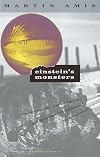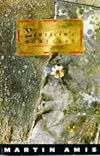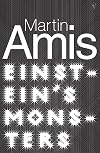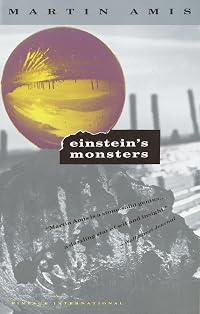
Einstein's Monsters
by Martin Amis
On This Page
Description
This collection of five short stories about nuclear war includes a story of escalating paranoia as seen by a twelve-year-old.Tags
Recommendations



















Member Reviews
Martin Amis has written a collection of five stories about lving with the threat of, or after, a nuclear war.
In two of the stories, the existence of nuclear weapons is a backdrop for the anxieties and behaviour of characters. These were my favourites, with a strength of language and imagery that literally made me pause and reflect mid-paragraph at times.
The other three stories could more easily fit the science-fiction genre since they take place after nuclear war has destroyed the world as we know it. Even in these, Mr. Amis's focus is on people: these aren't stories about war and technology, but about what they do to humanity.
In two of the stories, the existence of nuclear weapons is a backdrop for the anxieties and behaviour of characters. These were my favourites, with a strength of language and imagery that literally made me pause and reflect mid-paragraph at times.
The other three stories could more easily fit the science-fiction genre since they take place after nuclear war has destroyed the world as we know it. Even in these, Mr. Amis's focus is on people: these aren't stories about war and technology, but about what they do to humanity.
I know a rating of two stars is not enough to make you want to run out and grab the nearest copy of [b:Einstein's Monsters|10155044|Einstein's Monsters|Martin Amis|http://ecx.images-amazon.com/images/I/41iB3nJLHzL._SL75_.jpg|2502955]. It's not exactly an enthusiastic recommendation for sure. I only hope that if you happen upon it in your local library you'll feel an irrational need to pick it up and read the introduction....because it is amazing.
The author's opening essay "Thinkability" is all about nuclear weapons and the absurdity of nuclear deterrence. It turned out to be both the best and the worst possible way to open this book. It sets the reader in the right frame of mind. It plants the seed that grows into unwieldy thoughts of show more nuclear winters and bleak postwar futures. Unfortunately, the stories that follow pale in comparison. I really only enjoyed reading the last two: "The Little Puppy That Could" and "The Immortals." Everything else was eh. show less
The author's opening essay "Thinkability" is all about nuclear weapons and the absurdity of nuclear deterrence. It turned out to be both the best and the worst possible way to open this book. It sets the reader in the right frame of mind. It plants the seed that grows into unwieldy thoughts of show more nuclear winters and bleak postwar futures. Unfortunately, the stories that follow pale in comparison. I really only enjoyed reading the last two: "The Little Puppy That Could" and "The Immortals." Everything else was eh. show less
A collection of post-nuclear stories. The writing is radioactive. My most favorite story here is "The Little Puppy That Could" (a masterful welding of horror story and fairy tale), followed by "The Immortals" (comic and inventive).
A slightly hit-and-miss collection of stories - and an excellent opening essay - on the nuclear reality of the 1980s.
This was not a good book. The introduction which consisted of about a third of the whole book was interesting but got to be repetitive about half-way through. The stories were a slog with the last two being somewhat tolerable however the second to last, the Little Puppy that Could, had points that bogged it down and had a confusing ending. The only stories that had much to do with a nuclear Apocalypse aside from just using it as a background that contributed nothing to the story were the last two. It was a quick read but I cannot recommend this book, it sucked.
too "clever" and too much bad allegory
El ex hombre-fuerte de un circo, veterano de Varsovia en 1939, y artista de Notting Hill, encuentra su propio y personal holocausto en "Bujak y la fuerza poderosa o Los dados de Dios". Aburrimiento máximo y amor mínimo son aconsejados en "La enfermedad del tiempo". Una esquizofrénica virulenta abruma al joven hijo del "padre de la era nuclear" en "Lucidez en Flama Lake". La evolución ha tomado un camino repugnante en la kafkiana historia de amor "El cachorrito que pudo", y la historia de la tierra es discutida con franqueza por alguien que lo ha visto todo en "Los inmortales." Encuadernación: Tapa dura con sobrecubierta.
Jun 24, 2022Spanish
Members
- Recently Added By
Published Reviews
ThingScore 100
The stories swirl with fallout and the stress of thinking you might be blown up any minute. People's social lives are like missile crises or else the mushroom-cloud is already in their heads — they have personal apocalypses, they are permanently fixed in The Day After.
added by andersocheva
Author Information

58+ Works 29,728 Members
Martin Amis, son of the novelist Kingsley Amis, was born August 25, 1949. His childhood was spent traveling with his famous father. From 1969 to 1971 he attended Exeter College at Oxford University. After graduating, he worked for the Times Literary Supplement and later as special writer for the Observer. Amis published his first novel, The Rachel show more Papers, in 1973, which received the prestigious Somerset Maugham Award in 1974. Other titles include Dead Babies (1976), Other People: A Mystery Story (1981); London Fields (1989), The Information (1995), and Night Train (1997). Martin Amis has been called the voice of his generation. His novels are controversial, often satiric and dark, concentrating on urban low life. His style has been compared to that of Graham Greene, Philip Larkin and Saul Bellow, among others. He is currently Professor of Creative Writing at the Centre for New Writing at the University of Manchester. In 2008, The Times named him one of the 50 greatest British writers since 1945. (Bowker Author Biography) show less
Some Editions
Series
Belongs to Publisher Series
Common Knowledge
- Original title
- Einstein's Monsters
- Original publication date
- 1987
- Dedication
- To
Louis and Jacob - Original language
- English
Classifications
Statistics
- Members
- 664
- Popularity
- 43,403
- Reviews
- 7
- Rating
- (3.24)
- Languages
- 7 — Dutch, English, French, German, Italian, Spanish, Swedish
- Media
- Paper, Ebook
- ISBNs
- 15
- ASINs
- 5