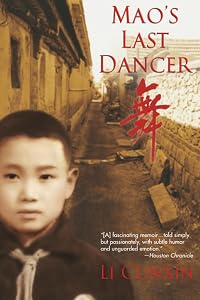
Mao's Last Dancer
by Cunxin Li
On This Page
Description
This is the true story of how, by the thinnest thread of a chance, one moment in time changed the course of a small boy's life in ways that are beyond imagination. One day he would dance with some of the greatest ballet companies of the world. One day he would be a friend to a President and First Lady, movie stars and the most influential people in America. One day he would become a star: Mao's last dancer, and the darling of the West. Here is Li Cunxin's own story, a beautiful, rich account show more of an inspirational life, told with honesty, dignity and pride. show lessTags
Recommendations










Member Recommendations
Member Reviews
From beginning to end, this is an engrossing read. The pace is gentle and pleasing in the opening chapters, where Cunxin relates the story of his childhood, when everything was in short supply except siblings, cousins, and familial love. Like any good nonfiction thriller, even though the outcome is already known, the suspense propels the reader rapidly from one page to the next during the telling of his detention in the Chinese Embassy in Houston. It's always a bit intriguing to peep into the life of someone who has hob-nobbed with the rich and famous, but Cunxin has much more than that to offer. Rich descriptions of Chairman Mao's China, both in the poorest sections of the remote countryside and in the relatively more affluent cities, show more put forth a glimpse into the lives of the people who lived inside a system that has long been a mystery to Western readers. Cunxin builds a bridge between the idealists who embraced the communism that was touted as the cure for hunger, injustice, and inequality and the people on the other side of the world who viewed the great experiment as a one-dimensional threat to democracy. He has successfully revealed the humanity on both sides. show less
This is a tremendous book for anyone who wants to understand life in the dying days of Mao's regime in China. Li Cunxin's story is one of hardship and poverty which, through sheer effort of will and a few lucky breaks, becomes one of freedom and fame. It's told with engaging honesty as Cunxin comes to realise that everything he has been taught to believe in by the Mao regime is based on a lie. Through it, he questions the essence of Marxism and the future of his country. But though the political context is critical to his story, it never dominates because first and foremost this is a story about one man and his ambition to rise to the top of his chosen profession. At times it's a painful story as Cunxin endures physical and mental show more anquish but its balanced by the strength of affection and love given first by his parents in China and then by his second family in the ballet world.
Highly recommended. show less
Highly recommended. show less
I enjoyed this story of the life of a young boy who becomes a world-famous dancer. This isn't great writing, but it's not bad and the story is gripping. At age 11, Li Cunxin is chosen to attend Madam Mao's dance school. He becomes an excellent dancer and defects to the US as a young man.
I wonder how typical his story is. He is able to send money to his family and return to visit them several times. His parents are even allowed to visit him in the U.S. I think his high international profile afforded him and his family some privileges that other defectors and their families would not have access to.
Worth reading. And find clips of Li dancing on line -- he really is amazing.
I wonder how typical his story is. He is able to send money to his family and return to visit them several times. His parents are even allowed to visit him in the U.S. I think his high international profile afforded him and his family some privileges that other defectors and their families would not have access to.
Worth reading. And find clips of Li dancing on line -- he really is amazing.
This book is so good, so inspiring.
The story follows Li Cunxin's journey from desperately poor peasant boy to the darling of the west as he is chosen from among hundreds of children to join Madame Mao's dance school and learn the artform of ballet.
Despite the subject matter, I loved this story. Cunxin is a natural born story teller. It goes along at it's own pace but it's never boring or repetitive. There wasn't anything I really disliked about this book except the sadness the circumstances evoked. Some of the stories Cunxin told are absoloutely hilarious (it'll take me a while before I can see a muffin as food!)
Anyone who is in the depths of despair should read this book. You'll feel instantly better (& you'll never look at a sweet show more potato the same way again) show less
The story follows Li Cunxin's journey from desperately poor peasant boy to the darling of the west as he is chosen from among hundreds of children to join Madame Mao's dance school and learn the artform of ballet.
Despite the subject matter, I loved this story. Cunxin is a natural born story teller. It goes along at it's own pace but it's never boring or repetitive. There wasn't anything I really disliked about this book except the sadness the circumstances evoked. Some of the stories Cunxin told are absoloutely hilarious (it'll take me a while before I can see a muffin as food!)
Anyone who is in the depths of despair should read this book. You'll feel instantly better (& you'll never look at a sweet show more potato the same way again) show less
An honest look at life growing up in Mao's China. Li Cunxin was born in 1961 and grew up believing the propaganda he was taught. At the age of 11 he was chosen to attend Madame Mao's dance academy, this eventually leads him to America and a realisation of the falsehood of what he has been taught.
This was a fascinating insight into a way of life that is completely alien to me. From the old traditions of China; the everyday life of a poor rural community; the hardship of becoming a ballet dancer; to the growth of Li Cunxin as an individual - all combine to present an image of an admirable man. It is obvious that this was written by a someone whose first language is not English but this is not a failing. I did find the sections set in show more China more enjoyable than his later life but this is still a book well worth reading. show less
This was a fascinating insight into a way of life that is completely alien to me. From the old traditions of China; the everyday life of a poor rural community; the hardship of becoming a ballet dancer; to the growth of Li Cunxin as an individual - all combine to present an image of an admirable man. It is obvious that this was written by a someone whose first language is not English but this is not a failing. I did find the sections set in show more China more enjoyable than his later life but this is still a book well worth reading. show less
Li Cunxin was born into desperate poverty, the sixth of seven sons in a Chinese peasant family in Mao's China in the 1960s. At age 11 he was selected to attend Madame Mao's dance academy in Beijing. This autobiography describes the circumstances of his growing up in Qingdao, the harsh training at the dance academy, his eventual international recognition achieved through his determination and growing love of ballet, and his escape to America in the early 1980s. Li's life story is an amazing one, highlighted by both luck and tremendous hard work. The pacing of the book is a little slow at times but the almost-unbelievable twists and turns of fate combined with Li's naivete, humility, good humour, and great love for his family and teachers show more make it well worth reading. show less
I really enjoyed this memoir. Li Cunxin was the sixth son born to a very poor Chinese peasant family. Then one day his luck changed. People from Madame Mao's Beijing Ballet School came to his village looking for likely candidates for their school. They almost left without selecting Cunxin but his teacher said to them "What about that one?" He passed their initial flexibility tests and was chosen to learn ballet. Far away from home and hating the lessons Cunxin nevertheless realized that he was lucky because the food was plentiful. After the first year he applied himself and became a very good dancer. So good he was chosen by a choreographer from the Houston Ballet to come for special classes in Houston.
Although Cunxin had been a loyal show more Maoist when he got to the USA he realized he had been told many lies about capitolism. After the summer school he was able to return for a year's residency. Only 19 years old he fell in love with a fellow dancer and they got married. Cunxin then defected to the US. For many years he was not allowed to return to China but his parents were given visas to visit him. In a very moving passage they enter the theatre where Cunxin is waiting to perform.
I learned a lot about life in China under Mao and I also realized there was a profound shift when Deng Xio Peng took over. According to the author there is much more freedom now and his family has quite a good life. I was disappointed that he didn't say anything about Tianamen Square but perhaps he felt he would endanger his family who still live in China. show less
Although Cunxin had been a loyal show more Maoist when he got to the USA he realized he had been told many lies about capitolism. After the summer school he was able to return for a year's residency. Only 19 years old he fell in love with a fellow dancer and they got married. Cunxin then defected to the US. For many years he was not allowed to return to China but his parents were given visas to visit him. In a very moving passage they enter the theatre where Cunxin is waiting to perform.
I learned a lot about life in China under Mao and I also realized there was a profound shift when Deng Xio Peng took over. According to the author there is much more freedom now and his family has quite a good life. I was disappointed that he didn't say anything about Tianamen Square but perhaps he felt he would endanger his family who still live in China. show less
Members
- Recently Added By
Lists


Author Information

8+ Works 2,230 Members
Awards and Honors
Awards
Notable Lists
Common Knowledge
- Canonical title
- Mao's Last Dancer
- Original title
- Mao's Last Dancer
- Original publication date
- 2003
- People/Characters
- Li Cunxin; Jiang Qing ( Madame Mao); Jiang Qing; Mao Zedong; Teacher Zhang Shu; Teacher Xiao
- Important places
- Beijing, China; China; Houston, Texas, USA
- Related movies
- Mao's Last Dancer (2009 | IMDb)
- Dedication
- To the two special women in my life - - my mother and my wife
- First words
- On the day of her marriage, a young girl sits alone in her village home.
- Last words
- (Click to show. Warning: May contain spoilers.)I thought of my journey towards the most precious thing I had, my freedom, and of what had always propelled me forwards - my dia's pride and dignity, and my niang's extraordinary courage and unlimited love.
- Original language
- English
Classifications
- Genres
- Biography & Memoir, Nonfiction
- DDC/MDS
- 792.8092 — Arts & recreation Recreation, sports, and performing arts Stage presentations Ballet and modern dance modified standard subdivisions History, geographic treatment, biography; Description, critical appraisal of specific theatres and companies Biography
- LCC
- GV1785 .L475 .A3 — Geography, Anthropology and Recreation Recreation. Leisure Recreation. Leisure Dancing
- BISAC
Statistics
- Members
- 1,776
- Popularity
- 12,331
- Reviews
- 44
- Rating
- (3.98)
- Languages
- 7 — Chinese, English, French, German, Italian, Portuguese, Swedish
- Media
- Paper, Audiobook, Ebook
- ISBNs
- 50
- ASINs
- 10