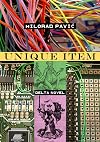
Unique Item
by Milorad Pavić
On This Page
Description
A detective thriller and love story, this novel diverges into 100 branches and offers the reader 100 different endings so that each reader can obtain his own personal version of the novel, and his own ending to the tale. Un “thriller” detectivesco y una historia de amor, esta novela se diverge en 100 caminos y le ofrece al lector 100 finales diferentes, de manera que cada lector puede obtener su propia versión de la novela, y su propia conclusión a la historia.Tags
Recommendations
















Member Reviews
WARNING:
Just as smoking is bad for your health,
so is the reading of a hundred endings
of the same book.
It is almost like gaining one hundred
deaths instead of one.
This book is described as a delta novel, with the story having a hundred possible endings. The endings were originally published in a separate book, but this English translation has everything in one volume.
An odd book, but odd in a good way, as I did enjoy it, but I was weak and read all the possible endings before choosing the one I liked best. My favourite editing error was 'rubble' for 'rabble'. I'm fairly sure that Pushkin's characters were attacked by an angry mob rather than having a building fall on them!
My favourite ending was number 26, which left Chief Inspector show more Stross with his suspicions about the suspects' degrees of guilt and innocence but no proof.
Erlangen is less guilty than could be concluded from the sentence he received. Distelli is more guilty than he seems, and than can be proven. Lempytzka had to have somebody else behind her as well, but we don't know whom. Klozewitz is the most suspicious of them all, but there is almost no tangible argument against him. show less
Just as smoking is bad for your health,
so is the reading of a hundred endings
of the same book.
It is almost like gaining one hundred
deaths instead of one.
This book is described as a delta novel, with the story having a hundred possible endings. The endings were originally published in a separate book, but this English translation has everything in one volume.
An odd book, but odd in a good way, as I did enjoy it, but I was weak and read all the possible endings before choosing the one I liked best. My favourite editing error was 'rubble' for 'rabble'. I'm fairly sure that Pushkin's characters were attacked by an angry mob rather than having a building fall on them!
My favourite ending was number 26, which left Chief Inspector show more Stross with his suspicions about the suspects' degrees of guilt and innocence but no proof.
Erlangen is less guilty than could be concluded from the sentence he received. Distelli is more guilty than he seems, and than can be proven. Lempytzka had to have somebody else behind her as well, but we don't know whom. Klozewitz is the most suspicious of them all, but there is almost no tangible argument against him. show less
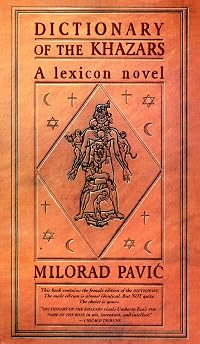
Another attempt by Pavić (more known for The Dictionary of the Khazars - book 44 on my list) to redefine, to extend, to twist around, to have a different take, to go against the notion of what is a novel, this time a mystery with 100 possible endings --- the end is up to you. An intriguing and playful story revolving around an androgyne who is a dreamcatcher and possessing an incredible power of smell. Several murders occur in different occasions, an opera singer who last performed as Pushkin (this detail we discover later is crucial) dies, some shady characters pop in and out, through it all the androgyne appears to be the link -- she has caught dreams for those people who, by dreaming dreams from their past life and dreams from after show more their death, forfeit their own present lives.
I found this book more interesting than i expected -- Pavić cleverly interweaves historical detail (the Pushkin part) with myth and fantasy. I was reminded of Bulgakov's The Master and Margarita where the Devil came in disguise to wreak havoc on the characters' lives -- there are similarities in this book. I wouldn't be surprised if the idea was Bulgakov-inspired. show less
I found this book more interesting than i expected -- Pavić cleverly interweaves historical detail (the Pushkin part) with myth and fantasy. I was reminded of Bulgakov's The Master and Margarita where the Devil came in disguise to wreak havoc on the characters' lives -- there are similarities in this book. I wouldn't be surprised if the idea was Bulgakov-inspired. show less
Ratings
Members
- Recently Added By
Lists

Gimmicks
56 works; 12 members
Author Information

71+ Works 3,575 Members
Milorad Pavic was born in Belgrade on October 15, 1929. After receiving a doctorate from the University of Zagreb, he taught philosophy at the University of Novi Sad followed by the University of Belgrade. During his lifetime, he wrote several novels including Dictionary of the Khazars, Landscape Painted with Tea, The Inner Side of the Wind, and show more Last Love in Constantinople. He also wrote short stories, nonfiction and poetry. He died due to complications of a heart attack on November 30, 2009 at the age of 80. (Bowker Author Biography) show less
Common Knowledge
- Original title
- Unikat
- Original publication date
- 2004
- Original language
- Serbian
Classifications
- Genres
- Fiction and Literature, Mystery
- DDC/MDS
- 808 — Literature & rhetoric Literature, rhetoric & criticism Rhetoric and collections of literary texts from more than two literatures
- LCC
- PG1419.26 .A78 .U5513 — Language and Literature Slavic languages and literatures. Baltic languages. Albanian language Slavic. Baltic. Albanian Serbo-Croatian
- BISAC
Statistics
- Members
- 35
- Popularity
- 819,597
- Reviews
- 2
- Rating
- (3.75)
- Languages
- English, Spanish
- Media
- Paper, Ebook
- ISBNs
- 5
- ASINs
- 1