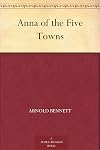
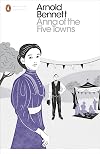
On This Page
Description
What would you do if your money-grubbing father decided to marry you off to someone you loathed, against your express wishes? That's precisely the dilemma facing virtuous Anna Tellwright in Arnold Bennett's juicy potboiler Anna of the Five Towns. Will Anna muster up the courage to defy her father's wishes and make her own way in the world?.
Tags
Recommendations


























Member Recommendations

Member Reviews
A plot summary would make this short, but perfectly formed novel sound parochial, unoriginal and maybe dull. It is not. Bennett is a wonderful observer and writer of the small-scale aspects that make life real and characters spring to life. He's also pretty good at writing female characters. In fact, by far the weakest character is male: the faultless Henry Mynors.
In many ways, my life is utterly different from Anna's, but in some key ways, I can identify with her more than I might wish to.
This book is rather like a factory Anna visits: "No stage of the manufacture was incredible by itself, but the result was incredible."
This isn't one of his lightly humorous books (The Grand Babylon Hotel and The Card).
Instead, it features a show more profoundly nasty man, who never lays a finger on anyone or commits any crime.
Setting and Plot
It's as simple as it says on the back of the book: it's set in the English potteries district, in the early 20th century. Anna Tellwright is about to come of age, and lives with her wealthy, miserly, twice-widowed father (Ephraim) and young half sister (Agnes) in a Methodist-dominated town. Ephraim "existed within himself, unrevealed" even to Anna.
Anna is dutiful, naive, lonely: "the peculiarity of her position... awe and pity were equally mingled" and unfamiliarity with social situations mean she is not "a facile talker".
She inherits money, is taken under the wing of the Suttons, is courted by up-and-coming Henry Mynors, still cares about the fate of the less fortunate (Titus Price and his adult son, Willie), and is very unsure of herself. When invited to a sewing party, she is baffled by the etiquette: "Should she arrive early, in which case she would have to talk more, or late, in which case there would be the ordeal of entering a crowded room?" Who of us has not felt a similar dilemma, even with more experience?
However, she is not mistress of her own destiny, and that is where the tension springs from.
What is love?
Anna's stirrings of love, her excitement and uncertainty ring very true: "the man whose arm she could have touched... She had felt happy and perturbed in being so near him... already she knew his face by heart."
She is afraid and excited, and everything looks different, "She saw how miserably narrow, tepid and trickling the stream of her life had been.. Now it gushed forth warm, impetuous and full." She is even tempted to neglect her duty to her family (only in trivial ways).
Henry calms many of her fears: he's wonderful with Agnes, and even with her father - teasing the former, and braving the latter (even daring to ask for more beef).
However, just when she should be happiest, she feels "no ineffable rapture, not ecstatic bliss." Despite her yearnings, Anna lacks passion, whether for a man or for God (see the Revival section, below). She tries to live as if she has it for both, hoping it will become true.
I also questioned Henry's love for Anna: he seems too perfect and, given his strong religious faith, oddly unperturbed by her lack of conviction (though her dedication is admirable).
Anna's love of her sister is unquestioned and unquestioning, but her feelings about her manipulative father are more complex: "The worst tyrannies of her father never dulled the sense of her duty to him."
Money
Ephraim Tellwright is a former Methodist preacher, but he's a very un-Christian emotional bully. The love of money is perhaps the root of his evil. He is a canny investor, a harsh landlord, and spends almost nothing, so his wealth has accumulated, and he's very proud of how well he's managed Anna's inheritance before she came of age.
He is shrewd and crafty. He simultaneously minimises his donation to the Sunday school and entraps his indebted tenant by promising to match the tenant's donation. He will also "promise repairs [only] in change for payment of arrears which he knew would never be paid". When he hands Anna's inheritance over, he really does no such thing. He makes her pay cheques in, forces her to write letters against her will, and ensures she daren't ask for a penny for herself. When she wants her cheque book, so she can buy a few clothes to go on holiday with the Suttons, he refuses.
Anna's own attitude to money is very different: she makes all her own clothes, has no servant or carriage, and uses nothing on her hair. "The arrival of money out of space, unearned, unasked, was a disturbing experience." "She wanted to test the actuality of this apparent dream by handling a coin and causing it to vanish over counters." The trouble is, she's now too rich to ask her father for any of his money, but she can't use her own, as he's tied her into a business agreement with someone. On holiday with the Suttons, she is startled by their "amazing habit of always buying the best of everything."
Ephraim
It's not only money that makes him mean. Anna and Agnes live in fear of his temper. His "terrible displeasure permeated the whole room like an ether, invisible but carrying vibrations to the heart." The mindset behing his bullying misogyny are chillingly exposed: "The women of the household were the natural victims of their master" who had "certain rights over the self-respect, the happiness, the peace of the defenceless souls set under him." When she is engaged, he claims her suitor is only after her money.
Revival
Anna has been raised a Methodist and teaches in Sunday School, but feels like an outsider as she's never had a conversion experience. Guilt is not just a prerogative of Roman Catholics.
There is excitement at the prospect of a campaign, featuring a famous preacher with an "ineffably wicked" past: "the faint rumour of that dead wickedness clung to his name like a piquant odour".
In preparation, Anna visits the families of Sunday School children and "found joy in the uncongenial and ill-performed task", both as a penance and because Henry asked her to do it.
In the service, he "had two audiences: God and the congregation". The mesmerising techniques, Biblical exhortations, emotional pressure, guilt, and concern are carefully described: I didn't quite believe (in) him, but wasn't certain that he was a charlatan either: "he had an extraordinary histrionic gift and he used it with imagination".
Poor Anna "was in despair at her own predicament and the sense of sin was not more strong than the sense of being confused and publicly shamed... She heaped up all the wickedness of a lifetime... and found horrid pleasure in the exaggeration... She had never doubted... Jesus died on the cross to save her soul... What then was lacking?" She is tormented by whether to go forward as a penitent, and more, by the knowledge she can't.
When she most needs faith, it fails her. She can't turn to Henry, because he is too pure
I have been Anna. I know all those services, techniques and
feelings. I am now free (despite a painful glimpse back, via this book), and I wanted her to be too.
Consequences
The key part of the plot is a factory, now owned by Anna, that is rented by Titus Price, a feckless man, deep in debt, with a sweet but ineffectual son, Willie.
Ephraim is keen for Anna to keep squeezing them for the rent arrears - a task Anna is not comfortable with. Worse still,Ephraim adds further pressure and threats behind her back. When Titus commits suicide, Anna blames her father and herself - even though the inquest finds other factors, such as embezzling church money. From this, everything in Anna's life is jeopardised.
Ending
Gasp! I didn't expect or want a clichéd happy ending or a shockingly tragic one, but I wasn't expecting this, and I'm not sure how I'd describe it (a bit of both?), so I won't!
Anna believes "A woman's life is always a renunciation" (not necessarily of what the reader expects). I don't think Arnold Bennett believes it should be, though. He was a man ahead of his time.
Period Surprises
The men (some shirtless) working alongside women in the pottery works was a surprise. More surprising still, was good Christians deliberately providing opportunity for a couple (not even engaged) to spend time alone together. Mind you, she did wear a "skirt which showed three inches of ankle"!
Maybe my history is at fault, though; this was published in 1902, so it just sneaks into the Edwardian, rather than Victorian category.
Quotes - Scenery and Atmosphere
Most of Bennett's books are set in the area he knew well. He portrays small town politics, industry, rivalries, and even makes factories seem beautiful.
"Burning ironstone glowed with all the strange colours of decadence... unique pyrotechnics of labour atoning for its grime... enchanted air... a romantic scene"!
The towns are "forbidding of aspect - sombre, hard-featured, uncouth; and the vaporous poison of their ovens and chimneys had soiled and shrivelled the surrounding country" to a "gaunt and ludicrous travesty of rural charms". This then segues into something rather different: "embrace the whole smoke-girt amphitheatre... this disfigurement is merely an episode in the unending warfare of man and nature and calls for no contrition... Nature is repaid for some of her notorious cruelties."
Factories can be cruel, though. The women paintresses, a few "die of lead poisoning - a fact which adds pathos to their frivolous charm. One paints nothing but circles, the "summit of monotony... stupendous phenomenon of absolute sameness."
Of those visiting a new park, "people going up to criticize and enjoy this latest outcome of municipal enterprise... housewives whose pale faces, as of prisoners free only for a while, showed a naive and timorous pleasure in this unusual diversion; young women made glorious by richly coloured stuffs and carrying themselves with the defiant independence of good wages... a small well-dressed group whose studious repudiation of the crowd betrayed a conscious eminence of rank."
Other Quotes
* Leaving Sunday School, the teachers "gradually dropping the pedagogic pose, and happy in the virtual sensation of a duty accomplished."
* An ageing and charitable woman's "bodily frame long ago proved inadequate to the ceaseless demands of a spirit of indefatigably altruistic, and her continuance in activity was notable illustration of the dominion of mind over matter."
* A young woman of 20 "had the lenient curves of absolute maturity."
* A man of 30 had "the elasticity of youth with the firm wisdom of age."
* A spinster "was lovable, but had never been loved... found compensation for the rigour of destiny in gossip, as innocent as indiscreet."
* "It seemed a face for the cloister... resigned and spiritual melancholy peculiar to women who through the error of destiny have been born into a wrong environment."
* "unconsciously-acquired arrogance of one who had always been accustomed to deference."
* "the quiet enchantment of reverie. Her mind... ranged voluptuously free."
* An old dresser: "Seventy years of continuous polishing by a dynasty of priestesses of cleanliness" looked "as though it had never been new."
* "The double happiness of present and anticipated pleasure."
* Bad news spreads: "All knew of the calamity, and had received from it a new interest in life."
Old fashioned spellings:
connexion
manikin
to-day show less
In many ways, my life is utterly different from Anna's, but in some key ways, I can identify with her more than I might wish to.
This book is rather like a factory Anna visits: "No stage of the manufacture was incredible by itself, but the result was incredible."
This isn't one of his lightly humorous books (The Grand Babylon Hotel and The Card).
Instead, it features a show more profoundly nasty man, who never lays a finger on anyone or commits any crime.
Setting and Plot
It's as simple as it says on the back of the book: it's set in the English potteries district, in the early 20th century. Anna Tellwright is about to come of age, and lives with her wealthy, miserly, twice-widowed father (Ephraim) and young half sister (Agnes) in a Methodist-dominated town. Ephraim "existed within himself, unrevealed" even to Anna.
Anna is dutiful, naive, lonely: "the peculiarity of her position... awe and pity were equally mingled" and unfamiliarity with social situations mean she is not "a facile talker".
She inherits money, is taken under the wing of the Suttons, is courted by up-and-coming Henry Mynors, still cares about the fate of the less fortunate (Titus Price and his adult son, Willie), and is very unsure of herself. When invited to a sewing party, she is baffled by the etiquette: "Should she arrive early, in which case she would have to talk more, or late, in which case there would be the ordeal of entering a crowded room?" Who of us has not felt a similar dilemma, even with more experience?
However, she is not mistress of her own destiny, and that is where the tension springs from.
What is love?
Anna's stirrings of love, her excitement and uncertainty ring very true: "the man whose arm she could have touched... She had felt happy and perturbed in being so near him... already she knew his face by heart."
She is afraid and excited, and everything looks different, "She saw how miserably narrow, tepid and trickling the stream of her life had been.. Now it gushed forth warm, impetuous and full." She is even tempted to neglect her duty to her family (only in trivial ways).
Henry calms many of her fears: he's wonderful with Agnes, and even with her father - teasing the former, and braving the latter (even daring to ask for more beef).
However, just when she should be happiest, she feels "no ineffable rapture, not ecstatic bliss." Despite her yearnings, Anna lacks passion, whether for a man or for God (see the Revival section, below). She tries to live as if she has it for both, hoping it will become true.
I also questioned Henry's love for Anna: he seems too perfect and, given his strong religious faith, oddly unperturbed by her lack of conviction (though her dedication is admirable).
Anna's love of her sister is unquestioned and unquestioning, but her feelings about her manipulative father are more complex: "The worst tyrannies of her father never dulled the sense of her duty to him."
Money
Ephraim Tellwright is a former Methodist preacher, but he's a very un-Christian emotional bully. The love of money is perhaps the root of his evil. He is a canny investor, a harsh landlord, and spends almost nothing, so his wealth has accumulated, and he's very proud of how well he's managed Anna's inheritance before she came of age.
He is shrewd and crafty. He simultaneously minimises his donation to the Sunday school and entraps his indebted tenant by promising to match the tenant's donation. He will also "promise repairs [only] in change for payment of arrears which he knew would never be paid". When he hands Anna's inheritance over, he really does no such thing. He makes her pay cheques in, forces her to write letters against her will, and ensures she daren't ask for a penny for herself. When she wants her cheque book, so she can buy a few clothes to go on holiday with the Suttons, he refuses.
Anna's own attitude to money is very different: she makes all her own clothes, has no servant or carriage, and uses nothing on her hair. "The arrival of money out of space, unearned, unasked, was a disturbing experience." "She wanted to test the actuality of this apparent dream by handling a coin and causing it to vanish over counters." The trouble is, she's now too rich to ask her father for any of his money, but she can't use her own, as he's tied her into a business agreement with someone. On holiday with the Suttons, she is startled by their "amazing habit of always buying the best of everything."
Ephraim
It's not only money that makes him mean. Anna and Agnes live in fear of his temper. His "terrible displeasure permeated the whole room like an ether, invisible but carrying vibrations to the heart." The mindset behing his bullying misogyny are chillingly exposed: "The women of the household were the natural victims of their master" who had "certain rights over the self-respect, the happiness, the peace of the defenceless souls set under him." When she is engaged, he claims her suitor is only after her money.
Revival
Anna has been raised a Methodist and teaches in Sunday School, but feels like an outsider as she's never had a conversion experience. Guilt is not just a prerogative of Roman Catholics.
There is excitement at the prospect of a campaign, featuring a famous preacher with an "ineffably wicked" past: "the faint rumour of that dead wickedness clung to his name like a piquant odour".
In preparation, Anna visits the families of Sunday School children and "found joy in the uncongenial and ill-performed task", both as a penance and because Henry asked her to do it.
In the service, he "had two audiences: God and the congregation". The mesmerising techniques, Biblical exhortations, emotional pressure, guilt, and concern are carefully described: I didn't quite believe (in) him, but wasn't certain that he was a charlatan either: "he had an extraordinary histrionic gift and he used it with imagination".
Poor Anna "was in despair at her own predicament and the sense of sin was not more strong than the sense of being confused and publicly shamed... She heaped up all the wickedness of a lifetime... and found horrid pleasure in the exaggeration... She had never doubted... Jesus died on the cross to save her soul... What then was lacking?" She is tormented by whether to go forward as a penitent, and more, by the knowledge she can't.
When she most needs faith, it fails her. She can't turn to Henry, because he is too pure
I have been Anna. I know all those services, techniques and
feelings. I am now free (despite a painful glimpse back, via this book), and I wanted her to be too.
Consequences
The key part of the plot is a factory, now owned by Anna, that is rented by Titus Price, a feckless man, deep in debt, with a sweet but ineffectual son, Willie.
Ephraim is keen for Anna to keep squeezing them for the rent arrears - a task Anna is not comfortable with. Worse still,
Ending
Gasp! I didn't expect or want a clichéd happy ending or a shockingly tragic one, but I wasn't expecting this, and I'm not sure how I'd describe it (a bit of both?), so I won't!
Anna believes "A woman's life is always a renunciation" (not necessarily of what the reader expects). I don't think Arnold Bennett believes it should be, though. He was a man ahead of his time.
Period Surprises
The men (some shirtless) working alongside women in the pottery works was a surprise. More surprising still, was good Christians deliberately providing opportunity for a couple (not even engaged) to spend time alone together. Mind you, she did wear a "skirt which showed three inches of ankle"!
Maybe my history is at fault, though; this was published in 1902, so it just sneaks into the Edwardian, rather than Victorian category.
Quotes - Scenery and Atmosphere
Most of Bennett's books are set in the area he knew well. He portrays small town politics, industry, rivalries, and even makes factories seem beautiful.
"Burning ironstone glowed with all the strange colours of decadence... unique pyrotechnics of labour atoning for its grime... enchanted air... a romantic scene"!
The towns are "forbidding of aspect - sombre, hard-featured, uncouth; and the vaporous poison of their ovens and chimneys had soiled and shrivelled the surrounding country" to a "gaunt and ludicrous travesty of rural charms". This then segues into something rather different: "embrace the whole smoke-girt amphitheatre... this disfigurement is merely an episode in the unending warfare of man and nature and calls for no contrition... Nature is repaid for some of her notorious cruelties."
Factories can be cruel, though. The women paintresses, a few "die of lead poisoning - a fact which adds pathos to their frivolous charm. One paints nothing but circles, the "summit of monotony... stupendous phenomenon of absolute sameness."
Of those visiting a new park, "people going up to criticize and enjoy this latest outcome of municipal enterprise... housewives whose pale faces, as of prisoners free only for a while, showed a naive and timorous pleasure in this unusual diversion; young women made glorious by richly coloured stuffs and carrying themselves with the defiant independence of good wages... a small well-dressed group whose studious repudiation of the crowd betrayed a conscious eminence of rank."
Other Quotes
* Leaving Sunday School, the teachers "gradually dropping the pedagogic pose, and happy in the virtual sensation of a duty accomplished."
* An ageing and charitable woman's "bodily frame long ago proved inadequate to the ceaseless demands of a spirit of indefatigably altruistic, and her continuance in activity was notable illustration of the dominion of mind over matter."
* A young woman of 20 "had the lenient curves of absolute maturity."
* A man of 30 had "the elasticity of youth with the firm wisdom of age."
* A spinster "was lovable, but had never been loved... found compensation for the rigour of destiny in gossip, as innocent as indiscreet."
* "It seemed a face for the cloister... resigned and spiritual melancholy peculiar to women who through the error of destiny have been born into a wrong environment."
* "unconsciously-acquired arrogance of one who had always been accustomed to deference."
* "the quiet enchantment of reverie. Her mind... ranged voluptuously free."
* An old dresser: "Seventy years of continuous polishing by a dynasty of priestesses of cleanliness" looked "as though it had never been new."
* "The double happiness of present and anticipated pleasure."
* Bad news spreads: "All knew of the calamity, and had received from it a new interest in life."
Old fashioned spellings:
connexion
manikin
to-day show less
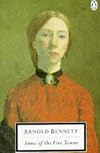
On this occasion, judging a book by its cover worked out very well for me. My eye was initially caught by the title – I still have a childish fondness for characters with my name. Then the arresting self-portrait by Gwen John on the cover convinced me to buy it for 50p from a charity shop. I’d maybe half-heard of the title ‘Anna of the Five Towns’, without having any specific preconceptions. In form and content it reminded me of [b:The Rector's Daughter|1220032|The Rector's Daughter|F.M. Mayor|https://images.gr-assets.com/books/1477226543s/1220032.jpg|1208509] and [b:The Post-Office Girl|2376087|The Post-Office Girl|Stefan Zweig|https://images.gr-assets.com/books/1347760549s/2376087.jpg|2382997], both sensitive and beautifully show more written portraits of young women constrained by circumstance. The titular Anna acts as housekeeper for her wealthy miser of a father and her younger sister. Like [b:The Rector's Daughter|1220032|The Rector's Daughter|F.M. Mayor|https://images.gr-assets.com/books/1477226543s/1220032.jpg|1208509], ‘Anna of Five Towns’ has a relatively sparse plot, as it concentrates on Anna’s inner life. I found her a sympathetic and involving protagonist as she deals with her domineering father, her faith, and a suitor. Her calm, caution, and competence are admirable.
Bennett is clearly a writer of skill and the rural Victorian (possibly early Edwardian?) setting is shown in exquisite detail. There’s an extended scene in which Anna tours a pottery works and sees the step by step process of clay becoming a new dinner plate which especially stood out. It may not sound particularly compelling, but I was rather beguiled by the whole thing. The book feels like a window into a previous age, not sparing its darker sides. Indeed, the treatment of indebtedness was very powerful and reminded me of Zola. Although ‘Anna of the Five Towns’ is much gentler than [b:Germinal|28407|Germinal (Les Rougon-Macquart, #13)|Émile Zola|https://images.gr-assets.com/books/1388208755s/28407.jpg|941651], one of least gentle books I’ve ever read, it throws rural poverty into stark relief. Anna herself is in a paradoxical situation: her family are landlords and very well-off, while she personally has no access to any of this wealth. Thanks to her father, she has no servants, shabby home-made clothes, and a strict housekeeping budget. This position allows her to feel considerable empathy with tenants unable to pay their rent, although she isn’t an unrealistic paragon. On this theme:
As well as such commentary, the writing also imbues the settings with a wonderful level of texture. My favourite example was the page-long description of a sideboard, of which this is only a part:
I loved ‘Anna of the Five Towns’ and would certainly read something else by Bennett. It was also pleasant to read an older novel for the first time in a little while; I think my fiction choices have been too modern recently. Anna is a protagonist who will linger in my mind long after this brief insight into her life, along with Mary Joyceln and Christine Hoflehner. show less
Bennett is clearly a writer of skill and the rural Victorian (possibly early Edwardian?) setting is shown in exquisite detail. There’s an extended scene in which Anna tours a pottery works and sees the step by step process of clay becoming a new dinner plate which especially stood out. It may not sound particularly compelling, but I was rather beguiled by the whole thing. The book feels like a window into a previous age, not sparing its darker sides. Indeed, the treatment of indebtedness was very powerful and reminded me of Zola. Although ‘Anna of the Five Towns’ is much gentler than [b:Germinal|28407|Germinal (Les Rougon-Macquart, #13)|Émile Zola|https://images.gr-assets.com/books/1388208755s/28407.jpg|941651], one of least gentle books I’ve ever read, it throws rural poverty into stark relief. Anna herself is in a paradoxical situation: her family are landlords and very well-off, while she personally has no access to any of this wealth. Thanks to her father, she has no servants, shabby home-made clothes, and a strict housekeeping budget. This position allows her to feel considerable empathy with tenants unable to pay their rent, although she isn’t an unrealistic paragon. On this theme:
The elaborate mechanism by which capital yields interest without suffering diminution from its original bulk is one of the commonest phenomena of modern life, and one of the least understood. Many capitalists never grasp it, nor experience the slightest curiosity about it until the mechanism through some defect ceases to revolve. Tellwright [Anna’s father] was of these, […] But to Anna, who had some imagination, and whose imagination was stirred by recent events, the arrival of moneys out of space, unearned, unasked, was a disturbing experience, affecting her as a conjuring trick affects a child, whose sensations hesitate between pleasure and apprehension. Practically, Anna could not believe that she was rich; and in fact she was not rich – she was merely a fixed point through which moneys that she was unable to arrest passed with the rapidity of trains.
As well as such commentary, the writing also imbues the settings with a wonderful level of texture. My favourite example was the page-long description of a sideboard, of which this is only a part:
In it was reflected the conscientious labour of generations. It had a soft and assuaged appearance, as though it had never been new and could never have been new. All its corners and edges had long lost the asperities of manufacture, and its smooth surfaces were marked by slight hollows similar in spirit to those worn by the naked feet of pilgrims into the marble steps of a shrine.
I loved ‘Anna of the Five Towns’ and would certainly read something else by Bennett. It was also pleasant to read an older novel for the first time in a little while; I think my fiction choices have been too modern recently. Anna is a protagonist who will linger in my mind long after this brief insight into her life, along with Mary Joyceln and Christine Hoflehner. show less
I'm a sucker for stories about women's daily lives - from other: time periods, parts of the world, and/or facets of society. I'm kicking myself for not marking passages but Bennett has a way of describing a room, an object, a view, an interaction while actually telling you what he thinks about humans and the world we inhabit and have largely created. For what it's worth, I believe she chose the right man (even though she didn't actually consider her other option) - Anna spared her sister further from her father, the miser (delightful title).
"She had sucked in with her mother's milk the profound truth that a woman's life is always a renunciation, greater or less."
Amazon describes this as a book about a young woman's struggle to free herself from her domineering father. Anna Tellwright lives in the Staffordshire pottery towns and keeps house for her wealthy, miserly, and cruel father Ephraim, and her younger sister Agnes. When she turns 21, she is surprised to learn that she has inherited a tidy sum from her mother's estate. However, her life does not change much, as her father controls all of her funds. Sometimes, though, her father sends her out to badger those who owe her estate rent or other debts, a task she both despises and is not good at. There is also a good deal show more about Methodism, as Anna's social life revolves entirely around her church, which she attends nearly every day.
Henry Minor, an eligible bachelor, begins to court Anna, and she is flattered. She soon learns that he is interested in her as a potential source of funds for the new pottery factory he is starting. Nevertheless, she agrees to marry him, though she fears the wrath of her father.
The book conveys a strong sense of place. It is a bit thin on plot, with none of the meanderings and subplots of those great big Victorian novels. It raises some important themes--the plight of women, always under the thumb of men; evangelical religions; the plight of factory workers; and more--yet it never explores any of these issues very deeply. I enjoyed reading this book, but I wouldn't describe it as an important book. And in terms of reading pleasure, I enjoyed Bennett's The Old Wive's Tale much more.
3 stars show less
Amazon describes this as a book about a young woman's struggle to free herself from her domineering father. Anna Tellwright lives in the Staffordshire pottery towns and keeps house for her wealthy, miserly, and cruel father Ephraim, and her younger sister Agnes. When she turns 21, she is surprised to learn that she has inherited a tidy sum from her mother's estate. However, her life does not change much, as her father controls all of her funds. Sometimes, though, her father sends her out to badger those who owe her estate rent or other debts, a task she both despises and is not good at. There is also a good deal show more about Methodism, as Anna's social life revolves entirely around her church, which she attends nearly every day.
Henry Minor, an eligible bachelor, begins to court Anna, and she is flattered. She soon learns that he is interested in her as a potential source of funds for the new pottery factory he is starting. Nevertheless, she agrees to marry him, though she fears the wrath of her father.
The book conveys a strong sense of place. It is a bit thin on plot, with none of the meanderings and subplots of those great big Victorian novels. It raises some important themes--the plight of women, always under the thumb of men; evangelical religions; the plight of factory workers; and more--yet it never explores any of these issues very deeply. I enjoyed reading this book, but I wouldn't describe it as an important book. And in terms of reading pleasure, I enjoyed Bennett's The Old Wive's Tale much more.
3 stars show less
I loved this novel because, as I heard somewhere, it raised the ordinary to extraordinary.
And that's exactly what makes this a thrilling novel. Nothing exceptional goes on, just what life for a young woman in an industrial village at the end of the XIX century might have been like. Unadorned and real.
Anna is an ordinary girl, who leads a simple existence with her tyrannical father and her younger half sister. She performs her duties without complaint, without any fuss or expectations. She is humble and austere and shy and not sure of what religion or love means, even though society imposes them on her.
When she turns 21, her oppressive father announces that she 's come into a great inheritance left to her from her deceased mother which show more makes her a wealthy and eligible woman. But that doesn't change anything, she is still depending on her miserly father.
Although Anna consents into everything imposed to her, she kind of starts making her own decisions to thread her future. While receiving constant attention from Henry Mynors, a young promising businessman, who wants to marry her, she can't help thinking of poor and humble Willie Prince, one of her tenants who is in deep debt. Her first own decision might change life as she had known it.
The end of the story left me breathless, so many emotions in such a few lines, without great passion, only with open sincerity, only with the pouring hearts of two people who are destined not to be together, and their cold acceptance to take life as it is. Hard, unfair and sad.
Great first experience of Bennett's writing. I'll read more by him definitely! show less
And that's exactly what makes this a thrilling novel. Nothing exceptional goes on, just what life for a young woman in an industrial village at the end of the XIX century might have been like. Unadorned and real.
Anna is an ordinary girl, who leads a simple existence with her tyrannical father and her younger half sister. She performs her duties without complaint, without any fuss or expectations. She is humble and austere and shy and not sure of what religion or love means, even though society imposes them on her.
When she turns 21, her oppressive father announces that she 's come into a great inheritance left to her from her deceased mother which show more makes her a wealthy and eligible woman. But that doesn't change anything, she is still depending on her miserly father.
Although Anna consents into everything imposed to her, she kind of starts making her own decisions to thread her future. While receiving constant attention from Henry Mynors, a young promising businessman, who wants to marry her, she can't help thinking of poor and humble Willie Prince, one of her tenants who is in deep debt. Her first own decision might change life as she had known it.
The end of the story left me breathless, so many emotions in such a few lines, without great passion, only with open sincerity, only with the pouring hearts of two people who are destined not to be together, and their cold acceptance to take life as it is. Hard, unfair and sad.
Great first experience of Bennett's writing. I'll read more by him definitely! show less
Bennett is more famous thannks to An Old Wives' Tale. But I was more impressed by this compelling story and charming grace of the main characters. Anna of the Five Towns is a 1902 novel, an intriguing coming-of-age story of a stifled young woman. Her navigation from nothingness to being a woman of means was very satisfying to follow up. It focuses on the morals and customs of that period . Anna is an intelligent young woman who does a fine job keeping house for her father and raising her younger sister, she also teaches Sunday school for the Methodist church, a position of great responsibility and gravity at the time. On her 21st birthday her father informs Anna that she has inherited 50,000 pounds and so she is instantly flung into the show more world of business management and a much higher social circle. The story becomes complicated and compelling as Anna is torn between the demands of good money management and the demands of her natural Christian kindness. She is also torn between a charming and appropriate suitor and a natural and unconditional love. Wonderful book relies on character development . Excellent story. show less
I loved this book. It had everything, men, moods and money (and maybe murder), very melodramatic. What more do you want in a Victorian potboiler? It would make a wonderful Hollywood-style movie. Plenty of opportunity for some thin, big-eyed, dark-haired beauty to lean out of a window and emote, panting fetchingly as her bosom heaves up and down and her eyes fill with glycerine tears. It wouldn't be able to be true to life because if there any two English accents I find difficult to understand, its the Black Country first and Potteries second, and this is the Potteries. I'm British myself, so Lord knows what an international audience would make of them.
Members
- Recently Added By
Lists

Favourite 19th century fiction
257 works; 62 members
Books I've Read More Than Once
602 works; 49 members

Fiction with Women's Names in the Title
378 works; 15 members
Author Information

193+ Works 6,838 Members
Arnold Bennett was born on May 27, 1867 in Hanley, Staffordshire, England. He began his working career as a law clerk and later he left the legal field and became an editor for the magazine Woman. His first novel was "A Man from the North." He wrote several novels set in Hanley, the town where he was born. These are known as the Five Town novels. show more Other titles include "The Babylon Hotel," "The Truth about an Author," and "How to Live on 24 Hours a Day." Bennett won the 1923 James Tait Black Memorial Prize for his novel "Riceyman Steps." "The Journal of Arnold Bennett" was published posthumously in three volumes. Bennett was also the author of "Hugo" which was made into a major motion picture in 2011 starring Jude law and Ben Kingsley, directed by Martin Scorsese. During WWI, Bennett was Director of Propaganda for France at the Ministry of Information. (At that time "propaganda" did not have the negative connotations it would have later in the twentieth century.) This appointment was based on the recommendation of Lord Beaverbrook, who also recommended him as Deputy Minister of that department at the end of the war. Bennett refused a knighthood in 1918. He died in London of typhoid fever on March 27, 1931. (Bowker Author Biography) show less
Series

Belongs to Publisher Series
Common Knowledge
- Canonical title
- Anna of the Five Towns
- Original title
- Anna of the Five Towns
- Original publication date
- 1902
- People/Characters
- Anna; Henry Mynors; Mrs. Sutton; Alderman Sutton; Willie Price
- Important places
- Staffordshire, England, UK; England, UK
- Dedication
- I dedicate this book
with affection and admiration
to
Herbert Sharpe
an artist
whose individuality and
achievement
have continually
inspired me - First words
- The yard was all silent and empty under the burning afternoon heat, which had made its asphalt springy like turf, when suddenly the children threw themselves out of the great doors at either end of the Sunday school - boys fr... (show all)om the right, girls from the left - in two howling, imperious streams, that widened, eddied, intermingled, and formed backwaters until the whole quadrangle was full of clamour and movement.
- Last words
- (Click to show. Warning: May contain spoilers.)And so---the Bank of England is the richer by a hundred pounds unclaimed, and the world the poorer by a simple and meek soul stung to revolt only in its last hour.
- Original language
- English
Classifications
Statistics
- Members
- 653
- Popularity
- 44,435
- Reviews
- 9
- Rating
- (3.61)
- Languages
- 5 — English, French, Italian, Spanish, Swedish
- Media
- Paper, Audiobook, Ebook
- ISBNs
- 66
- ASINs
- 23