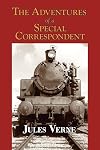
Claudius Bombarnac: The Adventures of a Special Correspondent
by Jules Verne
The Extraordinary Voyages (38)
On This Page
Description
Claudius Bombarnac is reporter who is assigned to travel on the Grand Transasiatic Railway and write about his travels. The train runs through Uzun Ada, Turkestan and Peking, China. Claudius befriends the eclectic band of travelers aboard the train, hoping to find a hero to make his story interesting. When a heavily-guarded carriage is added to the train, Claudius thinks his prayers might just have been answered..
Tags
Recommendations






























Member Reviews
(38) Claudius Bombarnac (Claudius Bombarnac, aka The Adventures of a Special Correspondent, 1892) (1 volume) 70K words
The 38th Extraordinary Voyage takes us back to Asia, crossing the whole length of it like we had done in "Michael Strogoff: The Courier of the Czar", although that was more to the north through Siberia, and also in "Cesar Cascabel", which took place even further north near the arctic circle. This time we go through the Russian Turkestan and China. The complete trip is done by train, which is a first, although that means of transportation had been used extensively in "Around the World in Eighty Days".
First read or reread?: First read for me.
What is it about?: Claudius Bombarnac, a reporter, is assigned by a French show more newspaper to cover the travels of the recently inaugurated Grand Transasiatic Railway which runs between Uzun Ada, by the coast of the Caspian Sea, to Peking, China, by the coast of the Pacific Ocean. Accompanying him on this journey is an interesting collection of characters, including one who is trying to beat the round the world record and another who is a stowaway hidden within the luggage. Claudius hopes one of them will become the hero of his piece, so his story won't be just a boring travelogue. He is not disappointed when a special car guarded by troops is added to the train, said to be carrying the remains of a great Mandarin. Before the journey is over, Claudius will find his hero.
So this is another travel story. As always with Verne's books, I enjoy following the characters' progress on the map provided.
During Verne's live, the world was getting smaller. The unexplored regions were shrinking and public transportation was improving. This was reflected in "Around the World in Eighty Days", where a trip that until then would have been much longer and difficult is done using public transportation, placing it within the reach of tourists rather than explorers or adventurers. From that book, progress continued, and here Verne's characters travel using a newly inaugurated railroad line that had not existed at the time of Phileas Fogg's travel around the world. In fact, in real life, several travelers inspired by Verne's story had comfortably bested the eighty days deadline. Here, one of Claudius Bombarnac's travel mates is a caricature of Phileas Fogg, a bad-tempered German baron who is attempting to break the record for a trip around the world.
The trouble with having the whole journey done by train is that this fits better a travelogue than an adventure story. And in fact, between the first half and the first two thirds of the novel feel like a travelogue. The story is told in the first person by the titular character, a reporter. He addresses the reader in a very colloquial manner, reminding me in that sense of "The Flight to France". We are given the character's impressions about his travel mates and the incidents of the trip, along with descriptions of the landscape and the cities where they make stops. The saving grace here is that the first person narrative is quite readable and Claudius' travel mates are a colorful bunch, but some readers will be bored by these descriptions.
Since this is still a Verne novel, things do speed up eventually and, by the time the trip finishes, the characters have gone through an adventure and Claudius Bombarnac has found the hero for his story.
The novel will work better for readers who appreciate a travelogue and who are entertained by the social satire and the contrasting characters of the travelers. I was amused by how Verne's national prejudices are reflected in the way the characters are depicted. Verne liked the Russians, and Major Noltitz, an experienced Russian army doctor, is an agreeable companion. The same can't be said of Sir Francis Trevellyan, one of the British representatives, who is a superscilious snob who barely deigns to exchange a word with his companions. Or about Baron Weissschnitzerdörfer, the irascible German whose list of travels is longer than his name and who is used as the comic relief of the story. We have Fulk Ephrinell, the American sales broker who has a rather unromantic romance with Mrs. Horacia Bluett, a British businesswoman with a similarly practical way of thinking; Kinko, the young Romanian stowaway who travels hidden within a luggage box because he has no money but hopes to reunite with his girlfriend who works as a milliner in Peking; Adolphe and Caroline Caterna, a happily married couple of French actors who reminded me of Mr. and Mrs. Cascabel from "Cesar Cascabel"; Pan-Chao, the young and fun-loving Chinese student who is returning home accompanied by his sedate and elderly chaperone; Popof, the Russian train conductor who is the only member of the staff who will make the whole trip with the travelers; Faruskiar, a proud and enigmatic Mongol lord...
Enjoyment factor: I enjoyed it, but I found the first part a bit uneventful, particularly when it came to describing the cities where they stop. Because of that, it's not the Verne book I would recommend to someone who is not already a fan of the writer. However, Verne can be relied on to include a good adventure story, even when it takes it a while to get moving. Even during the slow part, I just like the way he tells a story, and the idiosyncratic characters worked for me. It was interesting traveling through this part of the world, seeing it from the eyes of a 19th century writer.
Next up: Foundling Mick
See all my Verne reviews here: https://www.sffworld.com/forum/threads/reading-vernes-voyages-extraordinaires.58... show less
The 38th Extraordinary Voyage takes us back to Asia, crossing the whole length of it like we had done in "Michael Strogoff: The Courier of the Czar", although that was more to the north through Siberia, and also in "Cesar Cascabel", which took place even further north near the arctic circle. This time we go through the Russian Turkestan and China. The complete trip is done by train, which is a first, although that means of transportation had been used extensively in "Around the World in Eighty Days".
First read or reread?: First read for me.
What is it about?: Claudius Bombarnac, a reporter, is assigned by a French show more newspaper to cover the travels of the recently inaugurated Grand Transasiatic Railway which runs between Uzun Ada, by the coast of the Caspian Sea, to Peking, China, by the coast of the Pacific Ocean. Accompanying him on this journey is an interesting collection of characters, including one who is trying to beat the round the world record and another who is a stowaway hidden within the luggage. Claudius hopes one of them will become the hero of his piece, so his story won't be just a boring travelogue. He is not disappointed when a special car guarded by troops is added to the train, said to be carrying the remains of a great Mandarin. Before the journey is over, Claudius will find his hero.
So this is another travel story. As always with Verne's books, I enjoy following the characters' progress on the map provided.
During Verne's live, the world was getting smaller. The unexplored regions were shrinking and public transportation was improving. This was reflected in "Around the World in Eighty Days", where a trip that until then would have been much longer and difficult is done using public transportation, placing it within the reach of tourists rather than explorers or adventurers. From that book, progress continued, and here Verne's characters travel using a newly inaugurated railroad line that had not existed at the time of Phileas Fogg's travel around the world. In fact, in real life, several travelers inspired by Verne's story had comfortably bested the eighty days deadline. Here, one of Claudius Bombarnac's travel mates is a caricature of Phileas Fogg, a bad-tempered German baron who is attempting to break the record for a trip around the world.
The trouble with having the whole journey done by train is that this fits better a travelogue than an adventure story. And in fact, between the first half and the first two thirds of the novel feel like a travelogue. The story is told in the first person by the titular character, a reporter. He addresses the reader in a very colloquial manner, reminding me in that sense of "The Flight to France". We are given the character's impressions about his travel mates and the incidents of the trip, along with descriptions of the landscape and the cities where they make stops. The saving grace here is that the first person narrative is quite readable and Claudius' travel mates are a colorful bunch, but some readers will be bored by these descriptions.
Since this is still a Verne novel, things do speed up eventually and, by the time the trip finishes, the characters have gone through an adventure and Claudius Bombarnac has found the hero for his story.
The novel will work better for readers who appreciate a travelogue and who are entertained by the social satire and the contrasting characters of the travelers. I was amused by how Verne's national prejudices are reflected in the way the characters are depicted. Verne liked the Russians, and Major Noltitz, an experienced Russian army doctor, is an agreeable companion. The same can't be said of Sir Francis Trevellyan, one of the British representatives, who is a superscilious snob who barely deigns to exchange a word with his companions. Or about Baron Weissschnitzerdörfer, the irascible German whose list of travels is longer than his name and who is used as the comic relief of the story. We have Fulk Ephrinell, the American sales broker who has a rather unromantic romance with Mrs. Horacia Bluett, a British businesswoman with a similarly practical way of thinking; Kinko, the young Romanian stowaway who travels hidden within a luggage box because he has no money but hopes to reunite with his girlfriend who works as a milliner in Peking; Adolphe and Caroline Caterna, a happily married couple of French actors who reminded me of Mr. and Mrs. Cascabel from "Cesar Cascabel"; Pan-Chao, the young and fun-loving Chinese student who is returning home accompanied by his sedate and elderly chaperone; Popof, the Russian train conductor who is the only member of the staff who will make the whole trip with the travelers; Faruskiar, a proud and enigmatic Mongol lord...
Enjoyment factor: I enjoyed it, but I found the first part a bit uneventful, particularly when it came to describing the cities where they stop. Because of that, it's not the Verne book I would recommend to someone who is not already a fan of the writer. However, Verne can be relied on to include a good adventure story, even when it takes it a while to get moving. Even during the slow part, I just like the way he tells a story, and the idiosyncratic characters worked for me. It was interesting traveling through this part of the world, seeing it from the eyes of a 19th century writer.
Next up: Foundling Mick
See all my Verne reviews here: https://www.sffworld.com/forum/threads/reading-vernes-voyages-extraordinaires.58... show less
This was a good return to form for Verne in his oeuvres. I quite liked the story, the characters, and everything the plot had to offer. Overall, it's a train story with adventure gripping it every bit of the way. Well presented, well-written, and worth the time. Don't skip this if you're interested in Verne or adventure.
4 stars.
4 stars.
Jules Verne, French author, was born at Nantes, France, in 1828, and died in 1905. In 1850 he wrote a comedy in verse, but he eventually confined himself to the writing of scientific and geographical romances, achieving a great reputation. He visited the United States in 1867, sailing for New York on the Great Eastern, and his book, A Floating City, was the result of this voyage. His best-known books are: A Captain at Fifteen, A Two Years’ Vacation, A Voyage to the Center of the Earth (1864), From the Earth to the Moon (1865), 20,000 Leagues Under the Sea (1870), A Tour of the World in Eighty Days (1873), Michael Strogoff (1876), Mrs. Branica (1891), Clovis Dordentor (1896), The Brothers Kip (1902).
Esta historia escrita por Julio Verne en 1892 se tituló originalmente Claudius Bombarnac, y vió la luz por entregas en Le Soleil entre el 10 de octubre y el 7 de diciembre de 1892. Un año después se publicaría la novela en un solo volumen con ilustraciones de León Benett. Claudio Bombarnac, su protagonista, es un reportero francés que, enviado por su periódico, ?El siglo XX?, recorre la estepa asiática con destino a Pekín tratando de descubrir cuál de sus compañeros de viaje (un grupo de personajes variopintos, misteriosos, extravagantes, malvados encubiertos o seductores), merece ser el héroe de su reportaje. A lo largo de este ajetreado viaje en el Gran Transasiático, quizás inspirado en el mítico Orient-Express, el show more lector asistirá al descubrimiento de paisajes lejanos, ciudades con nombres impronunciables, amigos leales, malvados con códigos de honor, sorpresas inesperadas, historias de amor, y un tren imaginado por uno de los más grandes escritores de viajes de la Historia de la Literatura, presentado en esta novela como el medio de transporte literariamente perfecto para que en él se desarrollen el enigma y la aventura. show less
Nov 2, 2022Spanish
Příběh reportéra časopisu Dvacáté století Claudia Bombarnaka, který během služební cesty do Gruzi e dostane příkaz zúčastnit se dvoutýdenní cesty vlakem po transasijské dráze do Pekingu a z této cesty pořídit reportáž. Ve vlaku se seznámí s celou řadou zajímavých lidí, například ruským majorem, arogantním anglickým lordem či německým baronem, který plánuje cestu kolem světa za 39 dnů. Claudius dokonce v bedně objeví černého pasažéra...
Dec 18, 2023Czech
Ratings
Members
- Recently Added By
Lists

French Fiction of the 18th and 19th Centuries in English Translation
169 works; 3 members
Author Information

Jules Verne was born on February 8, 1828 in Nantes, France. He wrote for the theater and worked briefly as a stockbroker. He is considered by many to be the father of science fiction. His most popular novels included Journey to the Center of the Earth, Twenty Thousand Leagues Under the Sea, and Around the World in Eighty Days. Several of his works show more have been adapted into movies and TV mini-series. In 1892, he was made a Chevalier of the Legion of Honor in France. He died on March 24, 1905 at the age of 77. (Bowker Author Biography) Jules Verne (1828-1905) is the author of numerous adventure stories grounded in popularizations of science. (Publisher Provided) show less
Some Editions
Series

Belongs to Publisher Series
Work Relationships
Is contained in
Common Knowledge
- Canonical title
- Claudius Bombarnac: The Adventures of a Special Correspondent
- Original title
- Claudius Bombarnac
- Alternate titles
- The Special Correspondent; The Adventures of a Special Correspondent in Central Asia; Claudius Bombarnac: Special Correspondent
- Original publication date
- 1892
- People/Characters
- Claudius Bombarnac
- Original language
- French
- Disambiguation notice
- Also published as: "Adventures of a Special Correspondent among the various races and countries of Central Asia" / "Adventures of a Special Correspondent in Central Asia" / "The Special Correspondent"
Classifications
Statistics
- Members
- 180
- Popularity
- 182,601
- Reviews
- 6
- Rating
- (3.50)
- Languages
- 12 — Czech, English, Finnish, French, German, Greek, Hungarian, Italian, Polish, Portuguese, Spanish, Turkish
- Media
- Paper, Ebook
- ISBNs
- 65
- ASINs
- 17