
The Fortune of the Rougons
by Émile Zola
Les Rougon-Macquart (publication order) (1), Les Rougon-Macquart (Zola's recommended reading order) (1)
On This Page
Description
The book's stirring opening happens on the eve of the coup d'état, involving an idealistic young village couple joining up with the republican militia in the middle of the night. Zola then spends the next few chapters flashing back in time to pre-Revolutionary Provence. We are then introduced to the eccentric heroine Adelaide Fouque, later known as "Tante Dide," who becomes the common ancestor for both the Rougon and Macquart families. Her legitimate son, from her short marriage to her late show more husband, is forced to grow up alongside two illegitimate children, from Dide's later romance with the smuggler, poacher, and alcoholic Macquart. show lessTags
Recommendations

























Member Reviews
This was a re-read of the first novel in Zola's 20 novel Rougon-Macquart cycle about the lives of two related families in the Second Empire period of Napoleon III between 1851-70. When I first read this almost exactly ten years ago, I wasn't too impressed and found it dull and slow moving. I have a more positive opinion now, and quite enjoyed most of the interplay between the generations of the two branches of the family, especially the opportunism and desire for fame and fortune of Pierre Rougon, dominated by his wife Felicite, the tragic backstory of his mother "Aunt" Dide, and the youthful romanticism, both political and emotional, of Silvere and Miette. While some of the manoeuvrings around the fictional town of Plassans dragged a show more bit, for the most part I enjoyed the story and feel an appetite now to tackle the following books in the series, which I did not feel ten years ago. At one point, the families are described colourfully as "a pack of unbridled, insatiate appetites amidst a blaze of gold and blood". Once the Coup d'Etat has brought the Emperor to power and buried the second French Republic, it is the Rougons' time to prosper: "Their appetites, sharpened by thirty years of restrained desire, now fell to with wolfish teeth. These fierce, insatiate wild beasts, scarcely entering upon indulgence, exulted at the birth of the Empire — the dawn of the Rush for the Spoils. The Coup d’Etat, which retrieved the fortune of the Bonapartes, also laid the foundation for that of the Rougons." show less
The Fortune of the Rougonsis the first book in Emile Zola's chronicle of the Rougon and Macquart families. While Zola planned at the outset to write more than one book, "several episodes", he probably didn't anticipate that he would write twenty of them over the next twenty-two years. His aim was ... to explain how a family, a small group of human beings, behaves in a given society... He wanted to solve "the dual problem of temperament and environment". In his preface to this first volume, he says that he had already been working for three years on the background material for his books.
Zola wanted to tie together two of the great studies of the nineteenth century: that of heredity as a determinant of character, and that of the rise show more through the class system, "... the essentially modern impulse that sets the lower classes marching through the social system." As if these two huge areas of interest weren't enough, he also wanted what he called "the dramas of their individual lives" to be a social, military and economic history of the Second Empire.
Zola tells us at the outset
Who then were these people? They were the descendants of Adélaide Fouque, a respectable enough girl, the last in a line of prosperous market gardeners. However, Adélaide's father died insane and when she began to exhibit odd behaviour, the neighbours started to talk. When she married the hired peasant Rougon, the neighbours were shocked. Zola spends a lot of time writing about the small minds of many, the craving for gossip, the inevitable exaggerations and misrepresentations of any situation.
Deprived of an excuse for gossip when more than a year went by before the Rougons' son Pierre was born, the neighbours were ecstatic when Rougon died suddenly and Adélaide took as a lover "that beggar Macquart". The two never married, but had two children, Ursule and Antoine, whom Macquart acknowledged and gave his name.
It is the story of these three children and some of their offspring that constitutes the first novel. Necessarily, a lot of time is spent building up their individual backgrounds, for they will be the foundation of the books and characters to come. At times this exercise of outlining three generations of the family makes it difficult to realize that most of the actual action of this particular novel takes place in one month, December 1851. This action is the republican struggle against Louis-Napoleon Bonaparte, who had dissolved the National Assembly on the second of the month in as effort to restore the Empire with himself as Emperor, a feat he would accomplish the next year.
We see the townspeople of Plassans (Aix), terrified of choosing the wrong side in this struggle, of losing their possessions and livelihoods, and what status they have. There are lies and double crosses, bribery and manipulation, as the town is forced to choose a course. Zola's depictions of veniality and self preservation are superb. His science seems dated today, but his descriptions still hold. Pierre's son Pascal, a physician with no interest in politics whatsoever, spent a few evenings in his parents' sitting room, observing those who were plotting for gain, financial and social:
There were idealists in Plassans too. Even here though, Zola sets them under his microscope. The young apprentice Silvère, Pierre's nephew, who was caught up in the peasant resistance to Bonaparte's forces, is portrayed as having a nervous disturbance, "Hysteria or excitement, shameful madness or sublime madness. Always those terrible nerves", when he became inspired by Rousseau's writings and dreamt of a Republic. Silvère and his girlfriend Miette are innocents and their love story is sympathetically detailed, but their naiveté is in itself a shameful taint.
It may have taken some time to get going, but by the end of this first volume, Zola has given us a solid ground for the novels to come, drawn us in with a love story, and left us wondering what the next move will be. A skilled writer indeed. show less
Zola wanted to tie together two of the great studies of the nineteenth century: that of heredity as a determinant of character, and that of the rise show more through the class system, "... the essentially modern impulse that sets the lower classes marching through the social system." As if these two huge areas of interest weren't enough, he also wanted what he called "the dramas of their individual lives" to be a social, military and economic history of the Second Empire.
Zola tells us at the outset
The great characteristic of the Rougon - Macquarts, the group or family I propose to study, is their ravenous appetites, the great upsurge of our age as it rushes to satisfy those appetites.
Who then were these people? They were the descendants of Adélaide Fouque, a respectable enough girl, the last in a line of prosperous market gardeners. However, Adélaide's father died insane and when she began to exhibit odd behaviour, the neighbours started to talk. When she married the hired peasant Rougon, the neighbours were shocked. Zola spends a lot of time writing about the small minds of many, the craving for gossip, the inevitable exaggerations and misrepresentations of any situation.
Deprived of an excuse for gossip when more than a year went by before the Rougons' son Pierre was born, the neighbours were ecstatic when Rougon died suddenly and Adélaide took as a lover "that beggar Macquart". The two never married, but had two children, Ursule and Antoine, whom Macquart acknowledged and gave his name.
It is the story of these three children and some of their offspring that constitutes the first novel. Necessarily, a lot of time is spent building up their individual backgrounds, for they will be the foundation of the books and characters to come. At times this exercise of outlining three generations of the family makes it difficult to realize that most of the actual action of this particular novel takes place in one month, December 1851. This action is the republican struggle against Louis-Napoleon Bonaparte, who had dissolved the National Assembly on the second of the month in as effort to restore the Empire with himself as Emperor, a feat he would accomplish the next year.
We see the townspeople of Plassans (Aix), terrified of choosing the wrong side in this struggle, of losing their possessions and livelihoods, and what status they have. There are lies and double crosses, bribery and manipulation, as the town is forced to choose a course. Zola's depictions of veniality and self preservation are superb. His science seems dated today, but his descriptions still hold. Pierre's son Pascal, a physician with no interest in politics whatsoever, spent a few evenings in his parents' sitting room, observing those who were plotting for gain, financial and social:
On his first visit he was stupefied at the degree of imbecility to which sane men can sink.... He looked, with the fascination of a naturalist, at their grimacing faces, in which he discerned traces of their occupations and appetites; and he listened to their inane chatter as he might have tried to divine the meaning of a cat's miaow or a dog's bark. At his time he was greatly preoccupied with comparative natural history... He noted the similarities between the grotesque creatures he saw and the animals he knew.
There were idealists in Plassans too. Even here though, Zola sets them under his microscope. The young apprentice Silvère, Pierre's nephew, who was caught up in the peasant resistance to Bonaparte's forces, is portrayed as having a nervous disturbance, "Hysteria or excitement, shameful madness or sublime madness. Always those terrible nerves", when he became inspired by Rousseau's writings and dreamt of a Republic. Silvère and his girlfriend Miette are innocents and their love story is sympathetically detailed, but their naiveté is in itself a shameful taint.
It may have taken some time to get going, but by the end of this first volume, Zola has given us a solid ground for the novels to come, drawn us in with a love story, and left us wondering what the next move will be. A skilled writer indeed. show less
The Rougon-Macquart cycle was partly inspired by Balzac's vast Comédie humaine, but it was conceived as a much more tightly-planned and focussed study, following the career of one particular family through the period of the Second Empire (1851-1871). Zola wants to show us how every aspect of French society was infected by the corruption, greed, and cynical self-interest coming down from the top, and over the course of the 20 volumes (originally he wanted to do it in 10...) and more than 20 years of work, that's pretty much what he did.
In this first volume Zola introduces us to the many members of the family, the lucky possessors of genetic material from Adélaïde Fouque (epileptic and mentally-disturbed) and her husband Rougon (vile show more peasant) or her lover Macquart (criminal). By the logic of 19th-century genetic science, we know that nothing could possibly go right with this mix, and it doesn't. The family is as corrupt as the government it lives under.
Because there are so many characters to introduce for future use and so much back-story to establish, this doesn't feel like a particularly well-balanced book, but from Zola's point of view we need all this information if we are to make sense of what follows, so you'd better be taking notes. Or have one of those editions that has Zola's famous crib-sheet in the endpapers.
The foreground story takes place over a few days in December 1851 as the sleepy provincial town of Plassans (Aix-en-Provence) reacts to the news of Louis Napoléon's coup-d'état. The idealistic teenager Silvère and his 13-year-old playmate/budding girlfriend Miette join the peasant army that is setting off to no-one-knows-where to defend the Republic against the evil Bonapartists, whilst Silvère's uncle Pierre schemes to ally himself to whichever side looks like giving him a worthwhile civic appointment when the dust settles. Normally in a historical novel it's a problem for the author that we already know who is going to win, but Zola cunningly exploits our hindsight to supply the tragic irony behind the story of the young revolutionaries and the black comedy of coup, counter-coup, and counter-counter-coup that plays out between the entrenched, the suppressed, and the upwardly-mobile in Plassans, in what we are obviously meant to take as a small-scale parody of the even more unseemly political events in Paris.
This book doesn't have the same kind of detailed excavation of the life of a particular aspect of society that we find in the later books in the cycle - it's obviously mostly based on Zola's own childhood memories of small-town life at the time of the coup, and so we don't get quite as much interesting detail as I would like, and we do get rather more than I would like of the sentimental adolescent friendship/love-affair of Silvére and Miette. But still definitely worth reading! show less
In this first volume Zola introduces us to the many members of the family, the lucky possessors of genetic material from Adélaïde Fouque (epileptic and mentally-disturbed) and her husband Rougon (vile show more peasant) or her lover Macquart (criminal). By the logic of 19th-century genetic science, we know that nothing could possibly go right with this mix, and it doesn't. The family is as corrupt as the government it lives under.
Because there are so many characters to introduce for future use and so much back-story to establish, this doesn't feel like a particularly well-balanced book, but from Zola's point of view we need all this information if we are to make sense of what follows, so you'd better be taking notes. Or have one of those editions that has Zola's famous crib-sheet in the endpapers.
The foreground story takes place over a few days in December 1851 as the sleepy provincial town of Plassans (Aix-en-Provence) reacts to the news of Louis Napoléon's coup-d'état. The idealistic teenager Silvère and his 13-year-old playmate/budding girlfriend Miette join the peasant army that is setting off to no-one-knows-where to defend the Republic against the evil Bonapartists, whilst Silvère's uncle Pierre schemes to ally himself to whichever side looks like giving him a worthwhile civic appointment when the dust settles. Normally in a historical novel it's a problem for the author that we already know who is going to win, but Zola cunningly exploits our hindsight to supply the tragic irony behind the story of the young revolutionaries and the black comedy of coup, counter-coup, and counter-counter-coup that plays out between the entrenched, the suppressed, and the upwardly-mobile in Plassans, in what we are obviously meant to take as a small-scale parody of the even more unseemly political events in Paris.
This book doesn't have the same kind of detailed excavation of the life of a particular aspect of society that we find in the later books in the cycle - it's obviously mostly based on Zola's own childhood memories of small-town life at the time of the coup, and so we don't get quite as much interesting detail as I would like, and we do get rather more than I would like of the sentimental adolescent friendship/love-affair of Silvére and Miette. But still definitely worth reading! show less
The first installment in Zola's family epic roman-fleuve, Les Rougon-Macquart, La Fortune des Rougons was, as others have warned, a difficult place to begin even if a natural one. I ended up getting bogged down for a while which may be why it took me the longest it's taken for a while to finish a novel in French but at the end of it all, even if it's quite a scrappy and exposition-heavy origin story, I have to admire Zola's achievement with this book. Contained in this novel is a full accounting of the roots of an entire family*, their dreams, ambitions, personalities, feuds and schemes; the fall of the Second Republic and the birth of the Second Empire in its wake, buttressed by the most grasping social climbers of the French middle show more classes; and two plots both of which intertwine and contrast to give a full portrait of an era of revolutionary change.
If it's not a great novel as such it's still an enjoyable one, especially if you understand the politics and society of France at the time - the Rougon-Macquarts are already demonstrating themselves to be quite a brood of vipers by the end of this first chapter in their story, and there's enough betrayals and plots to keep the intrigue in this novel even if the number of sympathetic characters so far is low (how easily political allegiances shift and transform according to outside circumstance and convenience alone is an enjoyably cynical part of Zola's perspective on the petit-boureoisie milieu of the tale).
* I ended up having to keep an improvised family tree by my bedside to keep track of things and will probably continue to update and expand it as I work through these novels - recommended if you're crazy enough to try and do this project too. show less
If it's not a great novel as such it's still an enjoyable one, especially if you understand the politics and society of France at the time - the Rougon-Macquarts are already demonstrating themselves to be quite a brood of vipers by the end of this first chapter in their story, and there's enough betrayals and plots to keep the intrigue in this novel even if the number of sympathetic characters so far is low (how easily political allegiances shift and transform according to outside circumstance and convenience alone is an enjoyably cynical part of Zola's perspective on the petit-boureoisie milieu of the tale).
* I ended up having to keep an improvised family tree by my bedside to keep track of things and will probably continue to update and expand it as I work through these novels - recommended if you're crazy enough to try and do this project too. show less
This is the first book in Zola's Rougon-Macquart cycle of novels. The cycle is a sort of series in which Zola appears to work through ideas about heredity and whether individuals inherit character traits the predispose them to paths of virtue or vice. Or at least that is how I took the task at a simple level. And this was reinforced a bit by starting my reading with later books in this novel cycle, like the more well known Germinal and L'Assommoir, which focus on the hard scrabble lives of descendents from the Macquart line.
This first book, however, makes it clear to me that Zola's concern is not just with human nature, although that is a big driver. One can easily see that there are tendencies toward sloth and violence among the show more Macquarts. But in some ways, the tendencies appearing in the Rougons are presented as equally sociopathic -- many of the Rougons are presented as greedy, callous, and opportunistic (except Pascal, who I hope has his own book in this series). However, fortune favors some (I quite like this doubled meaning of fortune in the title) and the Rougons happened to be shrewd enough to pick the winning side in the 1851 coup d'état, where their greed and opportunity seeking paid off by seeming to be political savvy and valor. And this is the point that I was missing in the later novels, which is that it's not just human characteristics that matter but also the social structure that favors one side whose values become entrenched and reified and turned into virtues. Acquiring wealth is not a vice; it's a virtue. It's not greed; it's personal success. Likewise, opportunism is not a vice because seen in the right social light it is pro-activeness and ambition. It's a kind of institutional bias that I could see people being worried about in a time of domestic upheaval, as in the Second Empire.
Not the most scintillating read, but still interesting and full of the kind of naturalistic, realistic writing that Zola is known for. show less
This first book, however, makes it clear to me that Zola's concern is not just with human nature, although that is a big driver. One can easily see that there are tendencies toward sloth and violence among the show more Macquarts. But in some ways, the tendencies appearing in the Rougons are presented as equally sociopathic -- many of the Rougons are presented as greedy, callous, and opportunistic (except Pascal, who I hope has his own book in this series). However, fortune favors some (I quite like this doubled meaning of fortune in the title) and the Rougons happened to be shrewd enough to pick the winning side in the 1851 coup d'état, where their greed and opportunity seeking paid off by seeming to be political savvy and valor. And this is the point that I was missing in the later novels, which is that it's not just human characteristics that matter but also the social structure that favors one side whose values become entrenched and reified and turned into virtues. Acquiring wealth is not a vice; it's a virtue. It's not greed; it's personal success. Likewise, opportunism is not a vice because seen in the right social light it is pro-activeness and ambition. It's a kind of institutional bias that I could see people being worried about in a time of domestic upheaval, as in the Second Empire.
Not the most scintillating read, but still interesting and full of the kind of naturalistic, realistic writing that Zola is known for. show less
I am embarking on reading the whole Rougon-Macquart cycle written by Emile Zola. I have absolutely loved several of the books that occur later in the cycle, and I decided to join in on a group read to read them in order.
[The Fortunes of the Rougons] is the first book in the cycle, and it sets up the family origins that will be explored throughout the subsequent novels. Adelaide is the matriarch and she has children with two different husbands. These children and their children will form the basis of exploration. It was really interesting to read about this, already having a little glimpse into future characters through my Zola reading. Also in this book, Zola sets up the politics of the Second Empire and has his characters either show more supporting Louis-Phillipe's regime or as Republicans hoping for a more democratic France. I had to do a refresher on French politics of the time period and I'm still not sure I have it really sorted out, but I think it will continue to clarify as I read more.
Also in this story is the love story of the very young Silvere and Miette. Their story was the most engaging part of the book for me, but it was odd to have years of their relationship encapsulated within the short days of the revolution in their hometown of Plassans. At first I was confused about what was happening with the timeline.
This book is not Zola's best, but it's important as set up for what will happen later on. And, still present is his striking imagery. I loved the description of the enormous cloaks the women would wear as the walked with their lovers, enveloping both. And no one does a death scene like Zola. :-)
If you want a taste of Zola, don't start here, but if you already love his writing, you'll enjoy this. show less
[The Fortunes of the Rougons] is the first book in the cycle, and it sets up the family origins that will be explored throughout the subsequent novels. Adelaide is the matriarch and she has children with two different husbands. These children and their children will form the basis of exploration. It was really interesting to read about this, already having a little glimpse into future characters through my Zola reading. Also in this book, Zola sets up the politics of the Second Empire and has his characters either show more supporting Louis-Phillipe's regime or as Republicans hoping for a more democratic France. I had to do a refresher on French politics of the time period and I'm still not sure I have it really sorted out, but I think it will continue to clarify as I read more.
Also in this story is the love story of the very young Silvere and Miette. Their story was the most engaging part of the book for me, but it was odd to have years of their relationship encapsulated within the short days of the revolution in their hometown of Plassans. At first I was confused about what was happening with the timeline.
This book is not Zola's best, but it's important as set up for what will happen later on. And, still present is his striking imagery. I loved the description of the enormous cloaks the women would wear as the walked with their lovers, enveloping both. And no one does a death scene like Zola. :-)
If you want a taste of Zola, don't start here, but if you already love his writing, you'll enjoy this. show less
Les Rougon-Macquart cycle of twenty novels by Émile Zola is a portrayal of the Second Empire and a study in heredity through the lens of a single family. In this, the first book in the cycle, Zola lays out the origins of the family and its branches, with the main action taking place during the coup d'état in which Napoléon III overthrows the Second Republic.
The Revolution of 1848 found all the Rougons on the lookout, frustrated by their bad luck, and ready to use any means necessary to advance their cause. The were a family of bandits lying in wait, read to plunder and steal.
Pierre Rougon is the legitimate son of Adélaïde Fouque and the progenitor of one side of the family. A greedy schemer, Pierre and his equally avaricious wife show more plot to win wealth and a better position in life, by taking advantage of the confusion in the provinces after the coup. Pierre's illegitimate half-brother, Antoine Macquart, is a lazy do-nothing who sides with the doomed Republicans because he believes they will take from the rich and allow the poor like him to live a life of un-worked-for luxury. Silvère Macquart, son of Antoine's sister, is a young idealistic boy of seventeen, in love with an even younger local girl, Miette. Silvère and Miette are innocents, caught up in their dreams of a Republican Utopia and a life together.
The first part of the book contains the origin story of the Rougon-Macquart family, with all the key players sketched, and I found this part of the book quite interesting, more so than the story of Silvère and Miette, which takes up the middle portion. Most of the action takes place in the last third of the book, when Pierre and Félicité are scheming during the coup. Because so much of this book is the setup for what is to follow, it's hard to comment on the themes of heredity and social history. What is striking is Zola's detailed descriptions of nature, doing for a field what Balzac did with a teapot. This focus on nature is both descriptive and a foil for the social commentary that Zola wishes to convey.
The sleeping countryside awoke with a start, quivering like a beaten drum; it resounded in its very depths, repeating with each echo the stirring notes of the national anthem. Then the singing seemed to come from everywhere. From the horizon, from the distant rocks, the ploughed land, the fields, the copses, the smallest bits of brushwood, human voices seemed to be rising up. The great amphitheatre, stretching up from the river to Plassans, the gigantic torrent over which the bluish moonlight flowed, seemed filled with a huge, invisible crowd cheering on the insurgents; and in the depths of the Viorne, along the water streaked with mysterious metallic reflections, every dark spot seemed to conceal people taking up the refrain with increasing passion. The air and earth seemed alive; it was as if the whole countryside was crying out for vengeance and liberty. As the little army descended the slope, the roar rolled on in sonorous waves broken only by sudden outbursts which shook the very stones in their path.
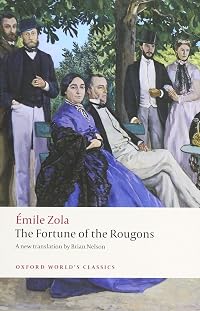
Note that I read the Brian Wilson translation, the first new translation in over 100 years. It read smoothly and is reputed to be a much truer translation that the bowdlerized version by H. Vizetelly. The introduction in the Oxford World's Classic edition was extremely helpful in laying out the history of the time period, Zola's influences and themes, and a family tree. show less
The Revolution of 1848 found all the Rougons on the lookout, frustrated by their bad luck, and ready to use any means necessary to advance their cause. The were a family of bandits lying in wait, read to plunder and steal.
Pierre Rougon is the legitimate son of Adélaïde Fouque and the progenitor of one side of the family. A greedy schemer, Pierre and his equally avaricious wife show more plot to win wealth and a better position in life, by taking advantage of the confusion in the provinces after the coup. Pierre's illegitimate half-brother, Antoine Macquart, is a lazy do-nothing who sides with the doomed Republicans because he believes they will take from the rich and allow the poor like him to live a life of un-worked-for luxury. Silvère Macquart, son of Antoine's sister, is a young idealistic boy of seventeen, in love with an even younger local girl, Miette. Silvère and Miette are innocents, caught up in their dreams of a Republican Utopia and a life together.
The first part of the book contains the origin story of the Rougon-Macquart family, with all the key players sketched, and I found this part of the book quite interesting, more so than the story of Silvère and Miette, which takes up the middle portion. Most of the action takes place in the last third of the book, when Pierre and Félicité are scheming during the coup. Because so much of this book is the setup for what is to follow, it's hard to comment on the themes of heredity and social history. What is striking is Zola's detailed descriptions of nature, doing for a field what Balzac did with a teapot. This focus on nature is both descriptive and a foil for the social commentary that Zola wishes to convey.
The sleeping countryside awoke with a start, quivering like a beaten drum; it resounded in its very depths, repeating with each echo the stirring notes of the national anthem. Then the singing seemed to come from everywhere. From the horizon, from the distant rocks, the ploughed land, the fields, the copses, the smallest bits of brushwood, human voices seemed to be rising up. The great amphitheatre, stretching up from the river to Plassans, the gigantic torrent over which the bluish moonlight flowed, seemed filled with a huge, invisible crowd cheering on the insurgents; and in the depths of the Viorne, along the water streaked with mysterious metallic reflections, every dark spot seemed to conceal people taking up the refrain with increasing passion. The air and earth seemed alive; it was as if the whole countryside was crying out for vengeance and liberty. As the little army descended the slope, the roar rolled on in sonorous waves broken only by sudden outbursts which shook the very stones in their path.
Note that I read the Brian Wilson translation, the first new translation in over 100 years. It read smoothly and is reputed to be a much truer translation that the bowdlerized version by H. Vizetelly. The introduction in the Oxford World's Classic edition was extremely helpful in laying out the history of the time period, Zola's influences and themes, and a family tree. show less
Members
- Recently Added By
Lists

Top Five Books of 2013
1,562 works; 721 members

Books Read in 2022
5,166 works; 114 members
Talk Discussions
Past Discussions
September 2024 The Fortune of the Rougons Preface/Translation Notes/Chapters I/II in Emile Zola Group Read (September 2024)
The Fortune of the Rougons by Zola in Author Theme Reads (January 2013)
Author Information

676+ Works 35,725 Members
Zola was the spokesperson for the naturalist novel in France and the leader of a school that championed the infusion of literature with new scientific theories of human development drawn from Charles Darwin (see Vol. 5) and various social philosophers. The theoretical claims for such an approach, which are considered simplistic today, were show more outlined by Zola in his Le Roman Experimental (The Experimental Novel, 1880). He was the author of the series of 20 novels called The Rougon-Macquart, in which he attempted to trace scientifically the effects of heredity through five generations of the Rougon and Macquart families. Three of the outstanding volumes are L'Assommoir (1877), a study of alcoholism and the working class; Nana (1880), a story of a prostitute who is a femme fatale; and Germinal (1885), a study of a strike at a coal mine. All gave scope to Zola's gift for portraying crowds in turmoil. Today Zola's novels have been appreciated by critics for their epic scope and their visionary and mythical qualities. He continues to be immensely popular with French readers. His newspaper article "J'Accuse," written in defense of Alfred Dreyfus, launched Zola into the public limelight and made him the political conscience of his country. (Bowker Author Biography) show less
Some Editions
Awards and Honors
Series

Les Rougon-Macquart (publication order)
21 works (1)

Les Rougon-Macquart (Zola's recommended reading order)
20 works (1)
Belongs to Publisher Series
Goldmanns gelbe Taschenbücher (732/733)
Work Relationships
Common Knowledge
- Canonical title
- The Fortune of the Rougons
- Original title
- La Fortune des Rougon
- Alternate titles*
- Hoe de Rougons fortuin maakten
- Original publication date
- 1871
- People/Characters*
- Pierre Rougon; Félicité Rougon; Eugène Rougon; Pascal Rougon; Aristide Rougon; Sylvère (show all 11); Miette; Antoine Macquart; Adelaïde Fouque; Gervaise Macquart; Ursule Macquart
- Important places
- Plassans, Provence-Alpes-Côte d'Azur, France (fictional)
- Important events
- Coup d'Etat of Bonaparte 18 Brumaire
- First words
- When you leave Plassans by the Porte de Rome, on the southern side of the town, you will find, on the right-hand side of the Nice road, a little way past the first houses in the Faubourg, a patch of waste ground known locally... (show all) as the Aire Saint-Mittre.
- Last words
- (Click to show. Warning: May contain spoilers.)And far away, in the depths of the Aire Saint-Mittre, a pool of blood was congealing on a tombstone.
- Original language
- French
*Some information comes from Common Knowledge in other languages. Click "Edit" for more information.
Classifications
Statistics
- Members
- 1,044
- Popularity
- 24,639
- Reviews
- 33
- Rating
- (3.89)
- Languages
- 8 — Dutch, English, French, German, Hungarian, Italian, Spanish, Swedish
- Media
- Paper, Audiobook, Ebook
- ISBNs
- 126
- ASINs
- 43