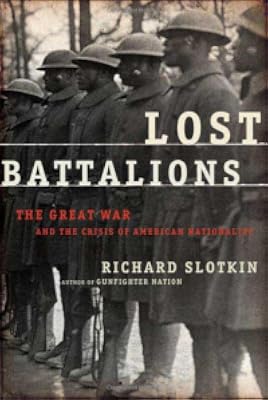
Lost Battalions: The Great War and the Crisis of American Nationality
by Richard Slotkin
100 Members (2.50)
On This Page
Description
"A work of stunning density and penetrating analysis . . . Lost Battalions deploys a narrative symmetry of gratifying complexity."--David Levering Lewis,The NationDuring the bloodiest days of World War I, no soldiers served more valiantly than the African American troops of the 369th Infantry--the fabled Harlem Hellfighters--and the legendary 77th "lost battalion" composed of New York City immigrants. Though these men had lived up to their side of the bargain as loyal American soldiers, the show more country to which they returned solidified laws and patterns of social behavior that had stigmatized them as second-class citizens.Richard Slotkin takes the pulse of a nation struggling with social inequality during a decisive historical moment, juxtaposing social commentary with battle scenes that display the bravery and solidarity of these men. Enduring grueling maneuvers, and the loss of so many of their brethren, the soldiers in the lost battalions were forever bound by their wartime experience.Both a riveting combat narrative and a brilliant social history, Lost Battalions delivers a richly detailed account of the fierce fight for equality in the shadow of a foreign war. show lessTags
Recommendations




Member Reviews
Members
- Recently Added By
Lists

Works Cited in The History of White People by Nell Irvin Painter
321 works; 2 members
Author Information

13+ Works 1,504 Members
Richar Slotkin is the Olin Professor of American Studies at Wesleyan University. He is the author of Gunfighter Nation and Regeneration Through Violence, both National Book Award Finalists, and The Crater. (Bowker Author Biography)
Some Editions
Common Knowledge
- Original publication date
- 2005
- People/Characters
- Julius Ochs Adler; Robert Alexander; Newton Baker; Herman Bergasse; Crawford Blagden; Belvedere Brooks ("Bel") (show all 129); Clifford Brown; William Butler; Leon Cadore ("Josh"); Abraham Cahan; Phil Cepaglia ("Zip"); Henry Cheatham; John Holley Clark, Jr; Frederick Cobb; Irvin Cobb; Charles E. Coughlin; William Cullen; George Armstrong Custer; Eugene V. Debs; Sergeant Del Duca; Robert Dodd; W. E. B. Du Bois; Francis Duffy; Leonidas C. Dyer; Max Eastman; Arthur Guy Empey; James Reese Europe; Lincoln Eyre; Charles W. Fillmore; Hamilton Fish, Jr.; Ferdinand Foch; Samuel Gompers; Henri Gourand; Edward L. Grant ("Eddie"); Madison Grant; Warren G. Harding; Lieutenant Harrington; Hubert Harrison; William Hayward; William R. Hearst; Jack Hershowitz; Morris Hillquit; Adolf Hitler; Nelson Holderman; Lowell Hollingshead; Herbert Hoover; Eugene Houghton; Major Hünicken; John Jamieson; Ralph John; Albert Johnson; Edna Jackson Johnson (wife of Henry, mother of Herman); Evan M. Johnson; Henry Johnson (husband of Edna, father of Herman); Herman Johnson (son of Henry & Edna); Thomas M. Johnson; Harold Kaplan; Ben Kaufman; Kee Sing; Paul Knight; Stanislaw Kozikowski; Abe Krotoshinski; Fiorello La Guardia; Harry Laughlin (Harry H. Laughlin); William Layton; Lieutenant Leak; Sergeant Leumann; Lieutenant Lewis; Charles A. Lindbergh; Arthur Little; Henry Cabot Lodge; Meyer London; Erich Ludendorff; Arthur McKeogh; George McMurtry, Jr. (George G. McMurtry); Napoleon Bonaparte Marshall; L. Wardlaw Miles; Philip Mills; John Monson ("Jack"); James A. Moss; Henry Fairfield Osborn; Lee Slater Overman (Lee S. Overman); Lieutenant Peabody; John J. Pershing ("Black Jack"); Horace Pippin; Elie Pocket; Thomas Pool; Austin Prescott; Leutenant Prinz; John Bayard Pruyn; Ernie Pyle; W. Kerr Rainsford (Walter Kerr Rainsford); A. Philip Randolph; Omer Richards; Needham Roberts; Franklin Delano Roosevelt; James A. Roosevelt [Army Officer, 308th Infantry Regiment, WWI]; Theodore Roosevelt; Theodore Roosevelt, Jr.; Damon Runyon; Siegfried Sassoon; Gordon Schenck; Emmett Scott; Alan Seeger; George Simons; Noble Sissle; Al Smith (Alfred E. Smith); Lieutenant-Colonel Smith; Lorillard Spencer; Joel Springarn; Cromwell Stacy; Lothrop Stoddard (T. L. Stoddard); Lieutenant Teichmoller; Lewis Terman; Frank Tiebout; Ben Tillman (Benjamin Tillman, Pitchfork Ben); Booker T. Washington; Lieutenant Whiting; Charles Whitman; Charles Whittlesey (Charles W. Whittlesey); Melzar Whittlesey; Woodrow Wilson; Stephen Wise (Stephen Samuel Wise); Simon Wolf; Leonard Wood; Robert M. Yerkes; Robert Yoder; Alvin York ("Sergeant York," Alvin C. York); Charles Young
- Important places
- Europe; United States of America
- Important events
- World War I (1914 | 1918)
- Epigraph
- War is the health of the state.
-- Randolph Bourne
Yeah, fighting a war to fix something works about as good as going to a whorehouse to get rid of a clap.
-- Norman Mailer, The Naked and the Dead
You can't break eggs without making an omelette
-- That's what they tell the eggs.
-- Randall Jarrell, "A War" - Dedication
- Dedicated to my father,
Herman Slotkin --
different war, same fight - First words
- On Monday, April 2, 1917, President Woodrow Wilson summoned Congress into joint session to hear his call for a declaration of war against the German empire.
- Last words
- (Click to show. Warning: May contain spoilers.)To win their hearts and minds, their acceptance of the ultimate sacrifice, the nation had only to offer safety, a measure of dignity, a chance for material betterment, a credible promise of justice down the road, and a plausible claim the the war was just and necessary.
No more than that, and nothing less. - Publisher's editor
- Macrae, Jack
- Blurbers
- Mosier, John; D'Este, Carlo
Classifications
Statistics
- Members
- 100
- Popularity
- 323,636
- Rating
- (2.50)
- Languages
- English
- Media
- Paper, Ebook
- ISBNs
- 3
- ASINs
- 2