On This Page
Description
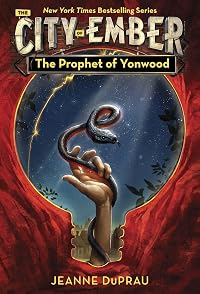
While visiting the small town of Yonwood, North Carolina, eleven-year-old Nickie makes some decisions about how to identify both good and evil when she witnesses the townspeople's reactions to the apocalyptic visions of one of their neighbors.Tags
Recommendations

Member Reviews
I actively disliked this book, which was surprising to me because I loved the first two Ember books. It's important to note, though, that while this is called the Third Book of Ember, it's actually a prequel with very little connection to Ember. I was a bit disappointed when I first realized that, but I still had high expectations for this book.
Boy, was I wrong. I found a large part of the book almost unbearable, because I couldn't stand the main character. Like the other Ember books, DuPrau has a message to get across here, but unlike the other ones, it doesn't make for a good story. Nickie wants to do something good for the world, so she's quick to accept the word of a stranger that it's necessary to root out sinners. This basically show more results in her becoming a big tattle-tale, despite herself doing things that she must realize she shouldn't, like secretly keeping a dog in her house. She's quick to accuse other people for very little reason, causing a lot of harm, and I really didn't enjoy reading about it.
Then there's the fact that all the different threads in the story don't really resolve into a satisfactory whole; it was more like one random disappointment after another. I can't resist including some SPOILERS here: the supposed terrorist in the woods turns out to be an albino bear (what?), the coded message that Nickie's father is sending from the top-secret mission that he's on turns out just to say what state he's in (what's the point?), and the mysterious flashes in the sky are really a way to see into parallel universes, which led to the discovery of extraterrestrial life and so intrigued the important people in Washington that they put off going to war with the terrorists (WTF?).
Rather than being left with a sense of satisfaction when everything was explained in the end, I was deeply disappointed. I felt that this story was much less than the sum of its parts. show less
Boy, was I wrong. I found a large part of the book almost unbearable, because I couldn't stand the main character. Like the other Ember books, DuPrau has a message to get across here, but unlike the other ones, it doesn't make for a good story. Nickie wants to do something good for the world, so she's quick to accept the word of a stranger that it's necessary to root out sinners. This basically show more results in her becoming a big tattle-tale, despite herself doing things that she must realize she shouldn't, like secretly keeping a dog in her house. She's quick to accuse other people for very little reason, causing a lot of harm, and I really didn't enjoy reading about it.
Then there's the fact that all the different threads in the story don't really resolve into a satisfactory whole; it was more like one random disappointment after another. I can't resist including some SPOILERS here: the supposed terrorist in the woods turns out to be an albino bear (what?), the coded message that Nickie's father is sending from the top-secret mission that he's on turns out just to say what state he's in (what's the point?), and the mysterious flashes in the sky are really a way to see into parallel universes, which led to the discovery of extraterrestrial life and so intrigued the important people in Washington that they put off going to war with the terrorists (WTF?).
Rather than being left with a sense of satisfaction when everything was explained in the end, I was deeply disappointed. I felt that this story was much less than the sum of its parts. show less
Following "The City of Ember" and "The People of Sparks," Yonwood is actually a prequel to the adventures of Lina and Doon, recounted in Ember and Sparks.
In my opinion, DuPrau has maintained the quality and qualities of Ember throughout the series, while bringing freshness to each installment. And while the stories may be dealing with ethical and philosophical questions, especially about society and governance, the plots are fun and compelling reads.
In fact, I'd make the claim that DuPrau is one of the best writers of science fiction (real science fiction--not fantasy--in that this series is set in the future and deals with challenges of technology and society) for teens today. The actual, underlying challenges that her characters face show more are classic dilemmas from science fiction literature.
Ember deals with a society dependent upon technology it doesn't understand, compounded by a corrupt government. Sparks considers the challenges when two wholly diverse societies must suddenly learn to live together, focusing on the nature of courage. And Yonwood explores the affects of fear on individuals and society, as well as the question of doing right when you don't know what right is--or who to believe.
The books are timely, philosophical, and compelling--but never preachy. Excellent reads. show less
In my opinion, DuPrau has maintained the quality and qualities of Ember throughout the series, while bringing freshness to each installment. And while the stories may be dealing with ethical and philosophical questions, especially about society and governance, the plots are fun and compelling reads.
In fact, I'd make the claim that DuPrau is one of the best writers of science fiction (real science fiction--not fantasy--in that this series is set in the future and deals with challenges of technology and society) for teens today. The actual, underlying challenges that her characters face show more are classic dilemmas from science fiction literature.
Ember deals with a society dependent upon technology it doesn't understand, compounded by a corrupt government. Sparks considers the challenges when two wholly diverse societies must suddenly learn to live together, focusing on the nature of courage. And Yonwood explores the affects of fear on individuals and society, as well as the question of doing right when you don't know what right is--or who to believe.
The books are timely, philosophical, and compelling--but never preachy. Excellent reads. show less
This is a prequel to DuPrau's City of Ember kids' series, although it stands on its own very nicely, without any need to have read the other books in the series. The story features a girl who, in a country facing the looming threat of a possibly apocalyptic war, comes to a small town to help her aunt prepare her recently deceased great-grandfather's house to sell. She soon learns that something interesting is going on there: a local woman experienced a powerful vision of a devastated future and now lies semi-conscious, muttering cryptic words that most of the town believes hold the key to averting disaster, if only they have enough dedication and faith.
This was published in 2006, and is clearly influenced by the political climate of the show more time, being very much a commentary on war, religion, and the dangers of blind belief in a way that feels like it should be painfully heavy-handed, but somehow manages to work surprisingly well, anyway. The world-building is very lightly sketched, and aspects of the ending are a little too pat, but overall I was surprised by how much I liked this. show less
This was published in 2006, and is clearly influenced by the political climate of the show more time, being very much a commentary on war, religion, and the dangers of blind belief in a way that feels like it should be painfully heavy-handed, but somehow manages to work surprisingly well, anyway. The world-building is very lightly sketched, and aspects of the ending are a little too pat, but overall I was surprised by how much I liked this. show less
The Prophet of Yonwood is one of those infuriating books that is pretty good until the end, and then it all falls to pieces.
Nickie goes with her aunt in a vague near-future America to the small town of Yonwood, North Carolina, where they plan to pack up and sell a mansion that has been left to them after the old relative's death. Nickie's father is away on a secret government project; and the nation is on the brink of war against an enemy alliance. In Yonwood, there is a frail woman who the townspeople believe to be a prophet of God, her vague mumblings interpreted by the deeply self righteous Mrs. Beeson. Nickie decided she wants to do what is right and follows Mrs. Beeson's directions. Also in town are Grover, a boy who likes snakes, show more and Hoyt McCall, a local eccentric.
The tale kept me wrapped up and interested... but in the end, none of it mean anything. Grover and his snakes? Irrelevant. Hoyt McCall and his astronomical experiments? Irrelevant. The Prophet and Mrs. Beeson? Irrelevant. The dog? Other people in town? The mysterious objects she finds in the old house? All irrelevant! Nothing that happens in the entire book has a point. Every aspect of the story is either abandoned completely, or winds up with an abysmally anticlimactic conclusion. Apart from a mention in the superfluous epilogue, there isn't anything whatsoever in this book that has to do with the City of Ember. It's not really a prequel, just a pointless book by the same author.
Tip: Even if you're reading the series and like the others, don't waste your time on this book. show less
Nickie goes with her aunt in a vague near-future America to the small town of Yonwood, North Carolina, where they plan to pack up and sell a mansion that has been left to them after the old relative's death. Nickie's father is away on a secret government project; and the nation is on the brink of war against an enemy alliance. In Yonwood, there is a frail woman who the townspeople believe to be a prophet of God, her vague mumblings interpreted by the deeply self righteous Mrs. Beeson. Nickie decided she wants to do what is right and follows Mrs. Beeson's directions. Also in town are Grover, a boy who likes snakes, show more and Hoyt McCall, a local eccentric.
The tale kept me wrapped up and interested... but in the end, none of it mean anything. Grover and his snakes? Irrelevant. Hoyt McCall and his astronomical experiments? Irrelevant. The Prophet and Mrs. Beeson? Irrelevant. The dog? Other people in town? The mysterious objects she finds in the old house? All irrelevant! Nothing that happens in the entire book has a point. Every aspect of the story is either abandoned completely, or winds up with an abysmally anticlimactic conclusion. Apart from a mention in the superfluous epilogue, there isn't anything whatsoever in this book that has to do with the City of Ember. It's not really a prequel, just a pointless book by the same author.
Tip: Even if you're reading the series and like the others, don't waste your time on this book. show less
I don’t really see a lot of point to this book. It’s a prequel to the first two books in the city, but it’s barely connected. And even the elements within this book were fairly disconnected from each other. There’s the main character, Nickie, and her aunt, who are visitors to Yonwood, and their disagreement about selling the house they’re there to clean out and possibly sell. The actual Prophet storyline, which barely comes across as the main storyline. Grover and his plight to make it to camp in Arizona. The kooky man who is interested in the heavens and is the only who who successfully defies the Prophet’s lackeys. There is just too much going on, and even by the halfway point, I had no idea what the purpose of the book show more really was.
As the Prophet’s main interpreter begins to get more and more ridiculous with her rules, I quickly began to realize that this is just another attempt on the author’s part to teach readers something she feels is important. But unlike a more universally accepted truth in the 2nd book (“War is bad”), this one is a lot more controversial. The book turns into basically an indictment on religion, seeming to imply that religions are largely fabricated by their followers. It actually reminds me most of the Pharisees who, by Jesus’ time, had imposed so many of their own rules, they had lost the core message. On top of all of that, the author attempts a tug at the heartstrings that is likely far more successful for dog lovers. I’m more of a dog tolerater (I know that’s not a word). I can acknowledge that what happens is ridiculous (stupid, really), but definitely didn’t get as emotionally invested as others might. In the end, I really wish DuPrau had kept this series more in line with the first book. The second wasn’t bad, but the first and fourth were my favorite, and I really just wish for more like them. If you are considering reading this series, I recommend it, but feel free to skip this third book. show less
As the Prophet’s main interpreter begins to get more and more ridiculous with her rules, I quickly began to realize that this is just another attempt on the author’s part to teach readers something she feels is important. But unlike a more universally accepted truth in the 2nd book (“War is bad”), this one is a lot more controversial. The book turns into basically an indictment on religion, seeming to imply that religions are largely fabricated by their followers. It actually reminds me most of the Pharisees who, by Jesus’ time, had imposed so many of their own rules, they had lost the core message. On top of all of that, the author attempts a tug at the heartstrings that is likely far more successful for dog lovers. I’m more of a dog tolerater (I know that’s not a word). I can acknowledge that what happens is ridiculous (stupid, really), but definitely didn’t get as emotionally invested as others might. In the end, I really wish DuPrau had kept this series more in line with the first book. The second wasn’t bad, but the first and fourth were my favorite, and I really just wish for more like them. If you are considering reading this series, I recommend it, but feel free to skip this third book. show less
Nickie goes to Yonwood to clean out her great-grandfather's home. Little does she know that Yonwood wants to be the safest place in America.
Although published two years ago, this book resonates as particularly topical now. We all want to protect ourselves and our way of life, but we are not all in agreement as to how to do that. This book looks at what happens when an entire village lets its desperation overshadow reason. It has echoes in 1930s Germany and the rhetoric that comes from the extreme right wing demonstrators that make the evening news today. It also considers just how easy it is to be taken in because the first steps always seem so reasonable and logical. The book really makes the reader think critically about why a society show more chooses its rules.
This is the best of DuPrau's trilogy, and it should really be included in Middle School and Public Library collections. show less
Although published two years ago, this book resonates as particularly topical now. We all want to protect ourselves and our way of life, but we are not all in agreement as to how to do that. This book looks at what happens when an entire village lets its desperation overshadow reason. It has echoes in 1930s Germany and the rhetoric that comes from the extreme right wing demonstrators that make the evening news today. It also considers just how easy it is to be taken in because the first steps always seem so reasonable and logical. The book really makes the reader think critically about why a society show more chooses its rules.
This is the best of DuPrau's trilogy, and it should really be included in Middle School and Public Library collections. show less
The 3rd/4th book in the City of Ember series*. This is a prequel, set before the Disaster, so it won't satisfy your itch if you want more stories of Lina and Doon.
The book is the tale of Nickie, who is basically a good kid who wants to be helpful and do the Right Thing. Sadly, the people in charge of Yonwood are crazy fundamentalists who have become slightly unhinged through living in the shadow of the oncoming war. Nickie starts by doing as she's told, spying on her neighbours and reporting anything suspicious, but as she sees the consequences of her actions, and the demands of the religion become even more extreme (no dogs! ) she is faced with the question of how can you actually know what is Right and what God wants?
It's still a book show more pitched at late primary school aged children, so the worldbuilding and the philosophy are a little simplistic at times,(I thought it was quite weak how the whole book twangs with 'the Disaster is about to happen, and then right at the end pulls its punches and says 'no, it didn't happen, not here and now in this slice of time when you've really warmed to these people, not for years until they've all had good and happy lives) but like the other Ember books it has a very warm heart and interesting characters.
* In publication order, this is the third book of four. But many of the published series think you should read the three books set at the same time with Doon and Lina as 1, 2 and 3, and then read this as a follow-on. show less
The book is the tale of Nickie, who is basically a good kid who wants to be helpful and do the Right Thing. Sadly, the people in charge of Yonwood are crazy fundamentalists who have become slightly unhinged through living in the shadow of the oncoming war. Nickie starts by doing as she's told, spying on her neighbours and reporting anything suspicious, but as she sees the consequences of her actions, and the demands of the religion become even more extreme (
It's still a book show more pitched at late primary school aged children, so the worldbuilding and the philosophy are a little simplistic at times,
* In publication order, this is the third book of four. But many of the published series think you should read the three books set at the same time with Doon and Lina as 1, 2 and 3, and then read this as a follow-on. show less
Members
- Recently Added By
Lists

Novels that you shouldn't waste your time on
94 works; 50 members

An End of the World Reading List
63 works; 4 members

Books Read in 2009
464 works; 11 members
Author Information

20+ Works 26,199 Members
Some Editions
Series

Belongs to Publisher Series
Work Relationships
Is contained in
Common Knowledge
- Canonical title
- The Prophet of Yonwood
- Original title
- The Prophet of Yonwood
- Original publication date
- 2006-04-01
- Important places
- Yonwood, North Carolina, USA
- Epigraph
- The universe is not only stranger than we imagine,it is stranger than we imagine. ____J.B.S. Haldane
- First words
- On a warm July afternoon in the town of Yonwood, North Carolina, a woman named Althea Tower went out to her backyard to fill the bird feeder.
- Last words
- (Click to show. Warning: May contain spoilers.)It will be a sort of letter to the future.
Classifications
Statistics
- Members
- 3,644
- Popularity
- 4,468
- Reviews
- 73
- Rating
- (3.16)
- Languages
- Dutch, English, French, Italian
- Media
- Paper, Audiobook, Ebook
- ISBNs
- 20
- ASINs
- 14