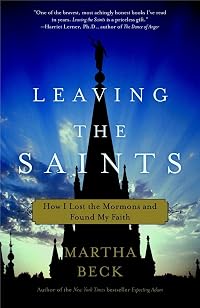
Leaving the Saints: How I Lost the Mormons and Found My Faith
by Martha Beck
On This Page
Description
A memoir of one woman's spiritual quest and journey toward faith. As "Mormon royalty," Beck was raised in a home frequented by the Church's high elders, and her existence was framed by their strict code of conduct. However, soon after Martha began teaching at Brigham Young University, she began to see firsthand the Church's ruthlessness as it silenced dissidents and masked truths that contradicted its published beliefs. Most troubling of all, she was forced to face her history of sexual show more abuse by one of the Church's most prominent authorities. This book chronicles her difficult decision to sever her relationship with the faith that had cradled her for so long, and to confront and forgive the person who betrayed her so deeply.--Publisher. show lessTags
Recommendations






Member Reviews
“Your religion is crazy!”
Growing up the daughter of an infamous Mormon apologist can’t be easy; doubly so when you’re raised in a cloistered, uber-evangelical conservative Mormon community in Provo, Utah. Just ask Martha Nibley Beck, whose now-deceased father Hugh Nibley made a career out of twisting (and sometimes even fudging) the facts for the Mormon church.
In LEAVING THE SAINTS, Beck remembers her child- and young adulthood. One of eight children, Beck and her siblings lived in near-poverty. Though her father was well-respected in Mormon circles, an academic job at Brigham Young University (BYU) is considered “God’s work” – and thus is its own reward, with an appropriately paltry salary. Beck married her husband show more John at a young age (twenty-one – that’s old maid in Mormon years!), and the two left Provo so that Beck could attend Harvard, where she eventually earned a PhD in sociology. The two returned to Provo after the birth of their second child, Adam, who has Down Syndrome; Beck felt that her choice to have Adam would be met with greater support in Provo. While living in Provo, Beck finished her thesis at Harvard, gave birth to her third child, and took a part-time teaching job at BYU. Within three years, Beck experienced repressed memories of childhood sexual abuse; soldiered through academic repression and intellectual purges at BYU; and, along with her husband, resigned from BYU, left the Mormon church, and fled from Provo. (Though it’s not revealed in LEAVING THE SAINTS, both Mr. and Mrs. Beck later divorced and “came out” as homosexuals.)
Beck’s most contentious claim is that her father sexually abused her from the ages of five to eight. The feminist in me tends to believe women when they say they were sexually assaulted, abused or raped: the rate of false reports of sexual assault are no higher than that of other crimes; the rates of report, investigation, prosecution and conviction in sexual assault cases are notoriously low, i.e., victims are unlikely to report such crimes and, when they do, the likelihood that they’ll find justice is nil; and, finally, such cases are rife with victim-blaming, such that women who report sexual assault are put on trial themselves. Given these circumstances, I find it highly improbable that most women would simply “make up” stories of sexual assault, for whatever reason.
However, I also find recovered memories suspect, particularly if they’re recovered during psychotherapy. Elsewhere, Beck says that, while she did undergo psychotherapy, this was only after her repressed memories began to resurface. Additionally, physical evidence (including extensive vaginal scarring) does point to past trauma. Beck also claims to have elicited a confession of sorts from her mother when she initially told her of the abuse. Unlike the childhood memories of sexual abuse, it’s unlikely that Beck’s mind manufactured this memory; so either she’s lying or she isn’t. Though her mother later recanted, this might be easily explained both by Mormon culture and the fact that Mrs. Nibley is wholly dependent on her husband for support.
Whether you believe Beck’s recovered memories to be real or not, LEAVING THE SAINTS is nevertheless a fascinating look at the Mormon religion and culture. Unlike older religions like Christianity and Islam, Mormonism is so young that it’s been documented – extensively - in modern history. Contemporary news reports reveal founder Joseph Smith as a con artist and fraud, and his own accounts of church teachings and personal revelations show that he was also an egotist and philanderer. For this reason, I find Mormonism (and similar “young” “religions” like Scientology) remarkably interesting. (Full disclosure: I’m a heathen vegan feminist.)
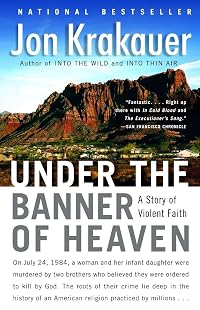
Most of the exposes I’ve read previously have focused on fundamentalist, breakaway Mormon sects which still practice plural marriages (see, for example, Jon Krakauer’s UNDER THE BANNER OF HEAVEN). In contrast, LEAVING THE SAINTS looks at mainstream Mormonism – and reveals it to be just as wacky, dysfunctional and misogynist as the excommunicated cults. For example, Beck’s account of a women’s forum held at BYU, which she moderated shortly before leaving the church, is jaw-dropping – and actually has one Mormon scholar blaming children for their own sexual abuse!
Beck recounts her journey – leaving the saints and finding her faith – in a series of flashbacks, interspersed with a conversation/confrontation she had with her elderly father in a hotel room shortly before writing LEAVING THE SAINTS. Beck is a master story teller, and though the reader can posit a guess early on as to the source of Beck’s trauma, the details are no less surprising once Beck’s repressed memories come flooding back with ferocity. As an atheist, I had some trouble relating to Beck’s spiritual journey, but these sections are written beautifully, and non-practicing religious/New Age readers will no doubt enjoy Beck’s quest for a more intrinsic, less prescribed sort of faith.
http://www.easyvegan.info/2009/04/20/leaving-the-saints-by-martha-beck/ show less
Growing up the daughter of an infamous Mormon apologist can’t be easy; doubly so when you’re raised in a cloistered, uber-evangelical conservative Mormon community in Provo, Utah. Just ask Martha Nibley Beck, whose now-deceased father Hugh Nibley made a career out of twisting (and sometimes even fudging) the facts for the Mormon church.
In LEAVING THE SAINTS, Beck remembers her child- and young adulthood. One of eight children, Beck and her siblings lived in near-poverty. Though her father was well-respected in Mormon circles, an academic job at Brigham Young University (BYU) is considered “God’s work” – and thus is its own reward, with an appropriately paltry salary. Beck married her husband show more John at a young age (twenty-one – that’s old maid in Mormon years!), and the two left Provo so that Beck could attend Harvard, where she eventually earned a PhD in sociology. The two returned to Provo after the birth of their second child, Adam, who has Down Syndrome; Beck felt that her choice to have Adam would be met with greater support in Provo. While living in Provo, Beck finished her thesis at Harvard, gave birth to her third child, and took a part-time teaching job at BYU. Within three years, Beck experienced repressed memories of childhood sexual abuse; soldiered through academic repression and intellectual purges at BYU; and, along with her husband, resigned from BYU, left the Mormon church, and fled from Provo. (Though it’s not revealed in LEAVING THE SAINTS, both Mr. and Mrs. Beck later divorced and “came out” as homosexuals.)
Beck’s most contentious claim is that her father sexually abused her from the ages of five to eight. The feminist in me tends to believe women when they say they were sexually assaulted, abused or raped: the rate of false reports of sexual assault are no higher than that of other crimes; the rates of report, investigation, prosecution and conviction in sexual assault cases are notoriously low, i.e., victims are unlikely to report such crimes and, when they do, the likelihood that they’ll find justice is nil; and, finally, such cases are rife with victim-blaming, such that women who report sexual assault are put on trial themselves. Given these circumstances, I find it highly improbable that most women would simply “make up” stories of sexual assault, for whatever reason.
However, I also find recovered memories suspect, particularly if they’re recovered during psychotherapy. Elsewhere, Beck says that, while she did undergo psychotherapy, this was only after her repressed memories began to resurface. Additionally, physical evidence (including extensive vaginal scarring) does point to past trauma. Beck also claims to have elicited a confession of sorts from her mother when she initially told her of the abuse. Unlike the childhood memories of sexual abuse, it’s unlikely that Beck’s mind manufactured this memory; so either she’s lying or she isn’t. Though her mother later recanted, this might be easily explained both by Mormon culture and the fact that Mrs. Nibley is wholly dependent on her husband for support.
Whether you believe Beck’s recovered memories to be real or not, LEAVING THE SAINTS is nevertheless a fascinating look at the Mormon religion and culture. Unlike older religions like Christianity and Islam, Mormonism is so young that it’s been documented – extensively - in modern history. Contemporary news reports reveal founder Joseph Smith as a con artist and fraud, and his own accounts of church teachings and personal revelations show that he was also an egotist and philanderer. For this reason, I find Mormonism (and similar “young” “religions” like Scientology) remarkably interesting. (Full disclosure: I’m a heathen vegan feminist.)
Most of the exposes I’ve read previously have focused on fundamentalist, breakaway Mormon sects which still practice plural marriages (see, for example, Jon Krakauer’s UNDER THE BANNER OF HEAVEN). In contrast, LEAVING THE SAINTS looks at mainstream Mormonism – and reveals it to be just as wacky, dysfunctional and misogynist as the excommunicated cults. For example, Beck’s account of a women’s forum held at BYU, which she moderated shortly before leaving the church, is jaw-dropping – and actually has one Mormon scholar blaming children for their own sexual abuse!
Beck recounts her journey – leaving the saints and finding her faith – in a series of flashbacks, interspersed with a conversation/confrontation she had with her elderly father in a hotel room shortly before writing LEAVING THE SAINTS. Beck is a master story teller, and though the reader can posit a guess early on as to the source of Beck’s trauma, the details are no less surprising once Beck’s repressed memories come flooding back with ferocity. As an atheist, I had some trouble relating to Beck’s spiritual journey, but these sections are written beautifully, and non-practicing religious/New Age readers will no doubt enjoy Beck’s quest for a more intrinsic, less prescribed sort of faith.
http://www.easyvegan.info/2009/04/20/leaving-the-saints-by-martha-beck/ show less
As one fascinated by all things Mormon, I found this memoir about growing up the daughter of a famous LDS apologist to be a captivating look at life in a culture that's pretty foreign to my own experience. Beck writes with great humor and insight about a difficult childhood and recovering memories of being sexually abused by her father, and she succeeds in putting it all in perspective within the Church's culture and overall influence.
Full review at The Book Lady's Blog .
Full review at The Book Lady's Blog .
Martha Beck was an atheist-inclined grad student when miraculous happenings during her second pregnancy reawakened her interest in spirituality. After moving back to her hometown of Provo, she embraced her childhood religion in effort to deepen this newfound faith. She writes with lucidity and humor about how she instead discovered the dark side of the Mormon church, including fundamental beliefs that contradict known fact, a culture that stifled intellectual exploration, and a suspected relationship between the inferior position of women in the church and incidents of sexual abuse.
A large part of Beck’s journey involves confronting her own history of sexual abuse, and the book sometimes feels disjointed as it shifts back and forth show more between the narrative and a scene in which she confronted her abuser. That issue aside, Beck’s attempt to free herself from the bonds of this unhealthy religion while still keeping her seed of faith alive serves as a fascinating example of how important it is to continually ask critical questions in all matters of faith. show less
A large part of Beck’s journey involves confronting her own history of sexual abuse, and the book sometimes feels disjointed as it shifts back and forth show more between the narrative and a scene in which she confronted her abuser. That issue aside, Beck’s attempt to free herself from the bonds of this unhealthy religion while still keeping her seed of faith alive serves as a fascinating example of how important it is to continually ask critical questions in all matters of faith. show less
Hmmm, well, this book was certainly interesting. I'm not Mormon, nor are there a lot of Mormons in my area. Funnily enough, though, I live not too far from where Joseph Smith started out, here in upstate New York. Religions of all kinds have always fascinated me, but I'll admit that I didn't know that much about the Church of Latter Day Saints before I started reading this. Beck is a fine writer, and she's at her best when describing the small moments of everyday life: her interaction with her family members and community. The descriptions of the community, especially, illustrate why this religion appeals to so many. The people described are warm, moral, friendly. That makes it all the more shocking when they turn against the author. show more Beck describes a lot of Mormon theology that, to an outsider like myself, does sound rather off the wall. And then, when she gets into the most painful part of the memoir, describing her recollections of childhood abuse at the hands of her father, a well-known Mormon scholar. However (and I hate to say this, because every fiber of my feminist being tells me not to doubt a woman who comes forward against abuse) she doesn't remember these incidents until she undergoes hypnotic regression. I'm unconvinced of the validity of this method, and that makes me unsure whether or not her story is true.
When I finished this book, I went on Amazon.com, and I was shocked to read how controversial it is. I expected there to be some controversy, as with any book attacking an established religion. But I was surprised to find how much many Mormons hated the book, or ex-Mormons and outsiders loved it. Those who disliked the book attacked Beck's description of Latter Day Saints theology and rituals, as well as her personal character and the truth of her accusations against her father. In the end, I didn't know what to think or believe. Beck obviously has some bias against the religion, whether her memories/accusations are true or not. Although it's not a lifestyle or religion that I could ever see myself embracing, I would like to read some books from the other side, what those who are still involved in the Latter Day Saints community say about their theology, etc.
I think what matters about my experience with the book is this: it was told well (Beck can certainly write) and it made me think, whether it's one hundred percent true or not. Recently, the James Frey scandal has called into question the veracity of many memoirs, and it's up to the reader to choose whether to swallow everything that is told to you as factual truth, or to just appreciate the book as a work of literature. show less
When I finished this book, I went on Amazon.com, and I was shocked to read how controversial it is. I expected there to be some controversy, as with any book attacking an established religion. But I was surprised to find how much many Mormons hated the book, or ex-Mormons and outsiders loved it. Those who disliked the book attacked Beck's description of Latter Day Saints theology and rituals, as well as her personal character and the truth of her accusations against her father. In the end, I didn't know what to think or believe. Beck obviously has some bias against the religion, whether her memories/accusations are true or not. Although it's not a lifestyle or religion that I could ever see myself embracing, I would like to read some books from the other side, what those who are still involved in the Latter Day Saints community say about their theology, etc.
I think what matters about my experience with the book is this: it was told well (Beck can certainly write) and it made me think, whether it's one hundred percent true or not. Recently, the James Frey scandal has called into question the veracity of many memoirs, and it's up to the reader to choose whether to swallow everything that is told to you as factual truth, or to just appreciate the book as a work of literature. show less
I first heard of this book around the time it was published. I wanted to read it to learn more about Mormonism, so when it (finally) turned up at my library, I checked it out. I thought the emphasis would be on Mormonism, and why and how the author left. To a certain extent it was, and I did learn a bit about the more arcane practices of the church, but I think the book was primarily about the sexual abuse the author suffered at the hands of her father starting when she was about 5 years old. Her father was a prominent leader (and apologist) for the church, and the author's accusations have been violently condemned by the church and most members of her family. That said, I tend to believe her about the sexual abuse allegations, although show more there are several other factors that have led me to question certain aspects of this book.
First, there's a lot of "new agey" "woo-woo" stuff in the book. She's had and she describes lots of magical-seeming epiphanies she has experienced over the years, seeing the light, hearing voices etc. These things didn't convince me of much, and in fact raised suspicions. I was really impatient with this aspect of the book.
Also, although the book seems mostly truthful, looking into it further, there seems to be a lot she withheld. For example, around the time the book was published she and her husband divorced, yet in the book he is presented as her soulmate for life, fully supportive of her. He has in fact published a review of the book discounting some of the events described (although he himself left the Mormon church before she did). In the book, there is no hint of conflict. There must have been some on-going conflict with her husband during the time period covered by this book since a divorce immediately ensued, yet there is nothing in the book to indicate a marriage in trouble.
I also didn't particularly like her style of writing. She writes of serious matters frequently with a humor embued with sarcasm that I sometimes found a bit coy and grating. I believe that she has gone on to become a "life coach" (somehow "endorsed" by Oprah), and maybe that's a tone that appears in her other writings. An example, "My mother kept grinding away at the one occupation recommended for Mormon females: breeding well in captivity."
All in all, I'm not sorry I read this, but I'm wondering if there is a better book out there on the topic.
2 1/2 stars show less
First, there's a lot of "new agey" "woo-woo" stuff in the book. She's had and she describes lots of magical-seeming epiphanies she has experienced over the years, seeing the light, hearing voices etc. These things didn't convince me of much, and in fact raised suspicions. I was really impatient with this aspect of the book.
Also, although the book seems mostly truthful, looking into it further, there seems to be a lot she withheld. For example, around the time the book was published she and her husband divorced, yet in the book he is presented as her soulmate for life, fully supportive of her. He has in fact published a review of the book discounting some of the events described (although he himself left the Mormon church before she did). In the book, there is no hint of conflict. There must have been some on-going conflict with her husband during the time period covered by this book since a divorce immediately ensued, yet there is nothing in the book to indicate a marriage in trouble.
I also didn't particularly like her style of writing. She writes of serious matters frequently with a humor embued with sarcasm that I sometimes found a bit coy and grating. I believe that she has gone on to become a "life coach" (somehow "endorsed" by Oprah), and maybe that's a tone that appears in her other writings. An example, "My mother kept grinding away at the one occupation recommended for Mormon females: breeding well in captivity."
All in all, I'm not sorry I read this, but I'm wondering if there is a better book out there on the topic.
2 1/2 stars show less
I really admire Martha Beck for publishing this story, even though she knew ahead of time that still faithful Mormons would do anything to deny it, spread gossip, and try to discredit her, which is what happened. She overcame abuse and ostracism, and is now helping many people on their Spiritual (not religious) quest.
I read this book, because I am curious about the spiritual paths of other women, especially when it is different from what they are raised with. Since these people need to think deeply about their own spiritual philosophy, they have to dig deeper than those who stay in what they have been raised with.
That is a spiritual journey in itself. A journey which a human being needs to go independently. No one has the exact same way show more of thinking and believing as someone else. show less
I read this book, because I am curious about the spiritual paths of other women, especially when it is different from what they are raised with. Since these people need to think deeply about their own spiritual philosophy, they have to dig deeper than those who stay in what they have been raised with.
That is a spiritual journey in itself. A journey which a human being needs to go independently. No one has the exact same way show more of thinking and believing as someone else. show less
I found her writing to be funny, honest and witty.
Martha Beck, daughter of a high ranking Mormon family left Utah to go to Harvard. When she returns home, a place she feels will be an easier and more welcoming environment that Cambridge to raise her son with Downs Syndrome, she "discovers" that her father has brutally abused her as a child.
I have read so much about her case, and many rebuttal's by family members, that I have a hard time believing everything that was written. That said, it was a good read.
Martha Beck, daughter of a high ranking Mormon family left Utah to go to Harvard. When she returns home, a place she feels will be an easier and more welcoming environment that Cambridge to raise her son with Downs Syndrome, she "discovers" that her father has brutally abused her as a child.
I have read so much about her case, and many rebuttal's by family members, that I have a hard time believing everything that was written. That said, it was a good read.
Members
- Recently Added By
Author Information

15+ Works 3,502 Members
Classifications
- Genres
- Religion & Spirituality, Nonfiction, Biography & Memoir, General Nonfiction
- DDC/MDS
- 200 — Religion Religion Religion
- LCC
- BX8678 .B43 .A3 — Philosophy, Psychology and Religion Christian Denominations Christian Denominations Protestantism Other Protestant denominations Mormons. Church of Jesus Christ of Latter-Day Saints
- BISAC
Statistics
- Members
- 458
- Popularity
- 66,793
- Reviews
- 14
- Rating
- (3.69)
- Languages
- English
- Media
- Paper, Audiobook, Ebook
- ISBNs
- 12
- ASINs
- 4