On This Page
Description
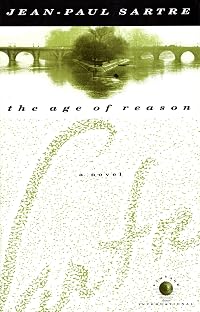
The middle-aged protagonist of Sartre's philosophical novel, set in 1938, refuses to give up his ideas of freedom, despite the approach of the war.Tags
Recommendations

















Member Reviews
A dark brooding, philosophical film noir of a novel; a knife stabbed through the hand in a Parisian cabaret night club as a proof of metaphysical freedom. Sure, some might say it is melodramatic navel gazing for the most of it, but this is to miss the mood, the existentialist experience, the atmosphere of self-examination, of moral questioning. This is no novel to be read for the plot, it is an illustration of a few of the minor philosophical reflections that Sartre makes in his Being and Nothingness, of the relation to the Other, the action of the human gaze, bad faith, and the giddying vertigo that the sense of freedom induces (and why we avoid it). Few of the characters are really likeable, but who can speculate if they would be show more representative of our friends if we knew them as well as we know ourselves. That is Sartre talking, and we know he did not particularly like himself. show less
I was surprised how good this novel was as an attention gripping and well constructed story. Such close attention to the outer and inner dialogues of the major characters allows the reader to fully engage with its tortuous progress.
The Parisian atmosphere of grubby apartments, loud nightclubs, café and the feverish self-absorption of the characters creates a captivating story line.
And we all know that the catastrophe of the downfall of France is but one year away from the sordid little deceptions that accompany this sad drama.
An important book on any book list - and a wonderful translation too.
The Parisian atmosphere of grubby apartments, loud nightclubs, café and the feverish self-absorption of the characters creates a captivating story line.
And we all know that the catastrophe of the downfall of France is but one year away from the sordid little deceptions that accompany this sad drama.
An important book on any book list - and a wonderful translation too.
Soap opera with brains. Yes, I can agree with this. Caring about other people while watching their little lives and dramas is so much more fulfilling when they prove themselves to have complex despair behind their everyday actions. It never ends, really. The constant proving to oneself that this life is worthwhile, that the hopes of the past and the dreams of the future won't go to waste. Mathieu keeps to his belief of freedom, to be capable of anything, no matter what constraints have been laid across his living by emotional bonds and societal dictations and past history. In the end he achieves this freedom, and finds that he no longer believes in it. He has reached the age of reason, when he sees that the ideas that once characterized show more him can no longer be applied to him, unless he wishes to be a hypocrite. In achieving his freedom, he sacrificed for nothing, a nothing that provides a clean a break from everything that had been forcing him into a situation that was no longer; and for what? He may have found a small satisfaction in not being free, now that he had realized that he was waiting for a moment of a lifetime that would never come. Everyone around him either spins out delusions of the future or chases desires that had died long ago, joining him in his everlasting goal of not sinking into regret and despair. A satisfyingly realistic portrayal of the tightrope walk that daily life really is. show less
There's a bit where Sartre describes Mathieu's sister-in-law: she's pretty, but "Mathieu had on countless occasions tried to unify these fluid features, but they escaped him; as a face, Odette's always seemed to be dissolving, and thus retained its elusive bourgeois mystery." (p. 127) And that's a little how I feel about this book, halfway through; it's certainly very good, and pretty to look at, but it's weirdly slippery. I can't quite get a handle on it.
That may be my fault. Tough to say what you bring to a book, and what the book brings to you.
And there's a sense of foreboding hanging over the thing that makes me feel like this won't always be the story; like something might happen soon to throw everyone into sharper relief. Maybe show more the whole thing is like the Gauguin self-portrait that Mathieu takes Ivich to see: so far we're just drawing the shadowy figures behind him, and soon enough we'll show the figure in front.
Sorry, I got a little flowery there.
---------------------------------------------------
And it ended like and unlike how I expected. I don't want to say too much, 'cause, y'know, spoilers and all that. It was beautiful, and I feel like getting screamingly plastered now. show less
That may be my fault. Tough to say what you bring to a book, and what the book brings to you.
And there's a sense of foreboding hanging over the thing that makes me feel like this won't always be the story; like something might happen soon to throw everyone into sharper relief. Maybe show more the whole thing is like the Gauguin self-portrait that Mathieu takes Ivich to see: so far we're just drawing the shadowy figures behind him, and soon enough we'll show the figure in front.
Sorry, I got a little flowery there.
---------------------------------------------------
And it ended like and unlike how I expected. I don't want to say too much, 'cause, y'know, spoilers and all that. It was beautiful, and I feel like getting screamingly plastered now. show less
I read this book many years ago in my youth and it has been a revelation to re-read this work. I had forgotten how unpleasant the characters are but also how you so gripped by what is going on. The writing is masterful and some of the scenes just linger with you as they are quite brutal. By that I mean the lengths an individual will go to in an attempt to get their own way.
An achingly analysed view of human's potential to be "free", whatever that means, Sartre shows the way in which morality is important in his view due to the complex web of human relations. Whatever choice a person makes, they are accountable to whoever those choices affect. A person's freedom, according to Sartre, is dependent on their agency in deciding between the myriad paths in life.
I have to say I tend to lean more towards a Foucauldian view than those held by Sartre, it was an interesting read though, and I found it an easy introduction to his work.
I have to say I tend to lean more towards a Foucauldian view than those held by Sartre, it was an interesting read though, and I found it an easy introduction to his work.
This was a novel that was great in how it was written, the ideas and formulated concepts that were developed throughout its duration. While the content itself is not the strongest point, what it is meant to represent is much stronger and carries the story from its inception to its conclusion. Overall, a fine book.
4 stars.
4 stars.
Members
- Recently Added By
Lists

Favorite Coming of Age Novels.
164 works; 51 members

Philosophical Fiction
97 works; 27 members

Books That Changed Me
158 works; 46 members
Existentialism
90 works; 11 members

Paris, City of Lights
103 works; 17 members

Books translated from Romance Languages into English
102 works; 7 members

Filosofía - Clásicos
217 works; 1 member

THE WAR ROOM
813 works; 24 members

Books We Love to Reread
695 works; 299 members

Favorite French Fiction
226 works; 109 members
Author Information

Sartre is the dominant figure in post-war French intellectual life. A graduate of the prestigious Ecole Normale Superieure with an agregation in philosophy, Sartre has been a major figure on the literary and philosophical scenes since the late 1930s. Widely known as an atheistic proponent of existentialism, he emphasized the priority of existence show more over preconceived essences and the importance of human freedom. In his first and best novel, Nausea (1938), Sartre contrasted the fluidity of human consciousness with the apparent solidity of external reality and satirized the hypocrisies and pretensions of bourgeois idealism. Sartre's theater is also highly ideological, emphasizing the importance of personal freedom and the commitment of the individual to social and political goals. His first play, The Flies (1943), was produced during the German occupation, despite its underlying message of defiance. One of his most popular plays is the one-act No Exit (1944), in which the traditional theological concept of hell is redefined in existentialist terms. In Red Gloves (Les Mains Sales) (1948), Sartre examines the pragmatic implications of the individual involved in political action through the mechanism of the Communist party and a changing historical situation. His highly readable autobiography, The Words (1964), tells of his childhood in an idealistic bourgeois Protestant family and of his subsequent rejection of his upbringing. Sartre has also made significant contributions to literary criticism in his 10-volume Situations (1947--72) and in works on Baudelaire, Genet, and Flaubert. In 1964 he was awarded the Nobel Prize in Literature and refused it, saying that he always declined official honors. (Bowker Author Biography) show less
Some Editions
Awards and Honors
Distinctions
Series

Belongs to Publisher Series
Work Relationships
Is contained in
Has as a commentary on the text
Common Knowledge
- Canonical title
- The Age of Reason
- Original title
- Les Chemins de la Liberté I. L'âge de raison
- Original publication date
- 1945
- People/Characters
- Mathieu Delarue; Marcelle Duffet; Madame Duffet; Ivich Serguine; Boris Serguine; Lola (show all 12); Sarah Gomez; Brunet; Weymüller; Jacques Delarue; Daniel Sereno; Gomez
- Important places
- Paris, France
- Important events
- World War II (1939 | 1945); Guernica
- First words
- Half-way down the Rue Vercingétorix, a tall man seized Matthieu by the arm; a policeman was patrolling the opposite pavement.
- Last words
- (Click to show. Warning: May contain spoilers.)He yawned again as he repeated to himselfy: “It’s true, it’s really true: I have attained the age of reason.”
- Blurbers
- Kerr, Philip
- Original language*
- Frans
*Some information comes from Common Knowledge in other languages. Click "Edit" for more information.
Classifications
Statistics
- Members
- 3,821
- Popularity
- 4,173
- Reviews
- 30
- Rating
- (3.80)
- Languages
- 17 — Czech, Danish, Dutch, English, French, German, Italian, Japanese, Lithuanian, Norwegian (Bokmål), Norwegian, Russian, Slovenian, Spanish, Swedish, Turkish, Portuguese (Portugal)
- Media
- Paper, Ebook
- ISBNs
- 52
- ASINs
- 67