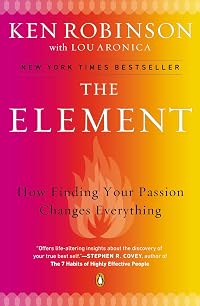
The Element: How Finding Your Passion Changes Everything
by Ken Robinson
On This Page
Description
The Element is the point at which natural talent meets personal passion. When people arrive at the Element, they feel most themselves, most inspired, and achieve at their highest levels. The Element draws on the stories of a wide range of people: Paul McCartney, The Simpsons creator Matt Groening, Meg Ryan, Gillian Lynne, who choreographed the Broadway productions of Cats and The Phantom of the Opera, journalist Arianna Huffington, renowned physicist Richard Feynman, and many others, show more including business leaders and athletes. It explores the components of this new paradigm: the diversity of intelligence, the power of imagination and creativity, and the importance of commitment to our own capabilities.With a wry sense of humor, Ken Robinson looks at the conditions that enable us to find ourselves in the Element and those that stifle that possibility. He shows that age and occupation are no barrier and that once we have found our path, we can help others do so as well. The Element shows the vital need to enhance creativity and innovation by thinking differently about human resources and imagination. It is an essential strategy for transforming education, business, and communities to meet the challenges of living and succeeding in the twenty-first century.
. show less
Tags
Recommendations

Member Reviews
Without a doubt Robinson is an exemplary communicator. In The Element he formulates the argument that if we find that thing which ignites both passion and talent (aka the element), we feel most ourselves, most inspired, learn how to "flow," and achieve our highest level of success. And he argues that if we can empower others to find their element, we will be access true human potential and empower humanity to overcome the difficulties ahead of us.
Throughout he floods the reader with countless stories of smash hit successes in a diversity of fields. Sometimes we cannot engage our element in our full time jobs but find in through serious hobbies/recreation, becoming amateurs, in the truest sense of the word.
Overall, it was a good book, show more and I plan on reading the follow-up book, Finding Your Element. In a sense, he is describing what feels like a similar idea as that in The Alchemist, who refers repeatedly to one's "Personal Legend." The author of The Alchemist (Paulo Coelho) is one of many examples of someone who found their element and Robinson references him. Coelho was forced into a mental hospital by his parent actually for wanting to be a writer, instead of a lawyer as they preferred.
My only pushback on the overall argument is that the many many examples he gave were of people who seemed extraordinary, and incredibly talented in their respective fields. I feel like this might build unrealistic expectations on some level. The vast majority of us cannot be extraordinary. We shouldn't even desire it, but learn contentment, joy, and diligence in where we find ourselves in life. Can someone love something profoundly and be just mediocre? Of course. Does everyone have the capacity to excel at any one thing? I don't know. What if someone is just barely above average at a few things, but they love them? Enjoying what you do seems more important to me than talent and wild success. To conclude, your element may or may not be extraordinary. But it will make life rich. I'm not sure if I have "one element" or a handful of things I love to do... I'll let you know after I finish the next one. show less
Throughout he floods the reader with countless stories of smash hit successes in a diversity of fields. Sometimes we cannot engage our element in our full time jobs but find in through serious hobbies/recreation, becoming amateurs, in the truest sense of the word.
Overall, it was a good book, show more and I plan on reading the follow-up book, Finding Your Element. In a sense, he is describing what feels like a similar idea as that in The Alchemist, who refers repeatedly to one's "Personal Legend." The author of The Alchemist (Paulo Coelho) is one of many examples of someone who found their element and Robinson references him. Coelho was forced into a mental hospital by his parent actually for wanting to be a writer, instead of a lawyer as they preferred.
My only pushback on the overall argument is that the many many examples he gave were of people who seemed extraordinary, and incredibly talented in their respective fields. I feel like this might build unrealistic expectations on some level. The vast majority of us cannot be extraordinary. We shouldn't even desire it, but learn contentment, joy, and diligence in where we find ourselves in life. Can someone love something profoundly and be just mediocre? Of course. Does everyone have the capacity to excel at any one thing? I don't know. What if someone is just barely above average at a few things, but they love them? Enjoying what you do seems more important to me than talent and wild success. To conclude, your element may or may not be extraordinary. But it will make life rich. I'm not sure if I have "one element" or a handful of things I love to do... I'll let you know after I finish the next one. show less
Your element has two important features: aptitude and passion.
People talk about “being in their element” when referring to a sense of fulfillment and connection with their true identity and purpose. It sounds great, but how can you find that place for yourself?......You could have an aptitude for anything from software development to poetry to playing the violin. Maybe you have a voice perfectly suited for opera, or for radio–that’s aptitude.....But aptitude isn’t enough. You also need passion.
I’m actually reading only the Blinkist version of the book so my review should be considered in this light. It’s easy to be unfair to the original if you have only reqad somebody else’s summary of it.
I’ve actually heard Ken show more Robinson speak on this subject: in person at an IDP (Education) Conference in Melbourne and somewhat later on TV somewhere. And it was pretty much the same message both times.....so at least he is consistent. But I’ve got to hand it to him. He is a magnificent speaker...funny, great delivery...and great stage presence given that he clearly has difficulty walking. But even that is part of his charm. His basic message is that intelligence is probably an over-rated measure and people can find fulfilling roles for themselves in many different ways. I recall, one of his case studies became a very successful ballet dancer (And you probably don’t need A level mathematics for this).......it’s about “finding your element.
Finding your element requires the right attitude and appropriate opportunities.
You’ll have a difficult time ever finding your element, if you’re not driven by the proper attitude......John Wilson is a good example. At the age of twelve, he was blinded during a mishap in chemistry class. But the experience didn’t defeat him....He excelled at a college for the blind and later at Oxford, where he studied law alongside sighted students.....he went on to play a role in the formation of Sight Savers International,......doing incredible work.
That’s the power of attitude. I read somewhere that Ken, himself, following a bout of polio was sent to a school for the disabled and his future looked bleak....until he was picked out of the crowd as being “bright” and sent off to some other school where he had the chance to excel, to attend University and become the success he was.
Of equal importance is opportunity. To understand why, just imagine being the most talented pearl diver in the world, yet you happen to live in the Sahara Desert..... . I read somewhere that Ken, himself, following a bout of polio was sent to a school for the disabled and his future looked bleak....until he was picked out of the crowd as being “bright” and sent off to some other school where he had the chance to excel, to attend University and become the success he was.....he was given the opportunity.
Intelligence is diverse, dynamic and distinctive.
Most people have a relatively limited perception of intelligence. They think of it as a score on a test, a grade in school or a knack for words and numbers. But, actually, a totally different perspective is required.....Intelligence needn’t be limited by standard definitions. It’s a dynamic force. Like the human brain, it never settles into a single fixed state, and it can be developed by forming connections in a variety of ways....That means there are no two people who use their intelligence in precisely the same way.
Finding the people you naturally gravitate toward will help you discover your element.
Finding your element is much easier if you first find your tribe....So your tribe can help you find your element, but keep in mind that, once you do find your element, it might fully absorb you......You can’t expect to be entirely absorbed in what you’re doing every second of your life. Sometimes the situation just isn’t right or you find your mood isn’t appropriate. You’re bound to get distracted from time to time and it’s important to accept that fact.
Personal and social barriers are par for the course on your way to your element.
Whether you suffer from a physical disability or not, a strong will is essential. Remember, even a perfectly healthy person won’t be able to complete a marathon without a good attitude.
What would you do if your closest friends, or your family, disdained the life path you chose?
Brazilian author Paulo Coelho had that problem. He had a difficult life growing up and his parents were desperate for him to become a lawyer. As a result, when Paulo pushed ahead with his art, they had him put into a psychiatric asylum, not just once–but three times!
“... it is difficult to feel accomplished when you’re not accomplishing something that matters to you.”
It’s rarely too late to find your element: you don’t need to be a professional to do it
The successful author Harriet Doerr......was 72 when her first novel, Stones for Ibarra, finally came out.
To find and enjoy your element, it’s completely unnecessary to be a professional. After all, your element isn’t about getting rich or famous; it’s about living according to your talent and your passion......The academic Gabriel Trop is a good example. When he had to make a choice between music and literature, he chose the latter as his profession. Both pursuits put him in his element, but a career in literature would let him pursue the cello without financial stress.
The key message in this book: Every person can find her element–that place where she feels totally absorbed and fulfilled. Age, career status and personal barriers will be no match for you if you can find the confluence of your talent and passion and commit yourself to sticking with it.
OK after reading the book (or, more accurately, the summary) I’m asking myself, “What is my element” Not sure that I ever found it though I’ve enjoyed the career I’ve h...and, perhaps even had modest success if a few fields. But I certainly never found one element that captured me day and night for years on end. Not even sure that I would want this. So maybe “the element” combined with passion is ok for artists, musicians, dancers.....but is it the same for a public servant in the War Graves Commission? Hmm....I don’t think the book actually envisages that there are people around that don’t have, nor ever will have “their element” Still an interesting book, I give it four stars. show less
People talk about “being in their element” when referring to a sense of fulfillment and connection with their true identity and purpose. It sounds great, but how can you find that place for yourself?......You could have an aptitude for anything from software development to poetry to playing the violin. Maybe you have a voice perfectly suited for opera, or for radio–that’s aptitude.....But aptitude isn’t enough. You also need passion.
I’m actually reading only the Blinkist version of the book so my review should be considered in this light. It’s easy to be unfair to the original if you have only reqad somebody else’s summary of it.
I’ve actually heard Ken show more Robinson speak on this subject: in person at an IDP (Education) Conference in Melbourne and somewhat later on TV somewhere. And it was pretty much the same message both times.....so at least he is consistent. But I’ve got to hand it to him. He is a magnificent speaker...funny, great delivery...and great stage presence given that he clearly has difficulty walking. But even that is part of his charm. His basic message is that intelligence is probably an over-rated measure and people can find fulfilling roles for themselves in many different ways. I recall, one of his case studies became a very successful ballet dancer (And you probably don’t need A level mathematics for this).......it’s about “finding your element.
Finding your element requires the right attitude and appropriate opportunities.
You’ll have a difficult time ever finding your element, if you’re not driven by the proper attitude......John Wilson is a good example. At the age of twelve, he was blinded during a mishap in chemistry class. But the experience didn’t defeat him....He excelled at a college for the blind and later at Oxford, where he studied law alongside sighted students.....he went on to play a role in the formation of Sight Savers International,......doing incredible work.
That’s the power of attitude. I read somewhere that Ken, himself, following a bout of polio was sent to a school for the disabled and his future looked bleak....until he was picked out of the crowd as being “bright” and sent off to some other school where he had the chance to excel, to attend University and become the success he was.
Of equal importance is opportunity. To understand why, just imagine being the most talented pearl diver in the world, yet you happen to live in the Sahara Desert..... . I read somewhere that Ken, himself, following a bout of polio was sent to a school for the disabled and his future looked bleak....until he was picked out of the crowd as being “bright” and sent off to some other school where he had the chance to excel, to attend University and become the success he was.....he was given the opportunity.
Intelligence is diverse, dynamic and distinctive.
Most people have a relatively limited perception of intelligence. They think of it as a score on a test, a grade in school or a knack for words and numbers. But, actually, a totally different perspective is required.....Intelligence needn’t be limited by standard definitions. It’s a dynamic force. Like the human brain, it never settles into a single fixed state, and it can be developed by forming connections in a variety of ways....That means there are no two people who use their intelligence in precisely the same way.
Finding the people you naturally gravitate toward will help you discover your element.
Finding your element is much easier if you first find your tribe....So your tribe can help you find your element, but keep in mind that, once you do find your element, it might fully absorb you......You can’t expect to be entirely absorbed in what you’re doing every second of your life. Sometimes the situation just isn’t right or you find your mood isn’t appropriate. You’re bound to get distracted from time to time and it’s important to accept that fact.
Personal and social barriers are par for the course on your way to your element.
Whether you suffer from a physical disability or not, a strong will is essential. Remember, even a perfectly healthy person won’t be able to complete a marathon without a good attitude.
What would you do if your closest friends, or your family, disdained the life path you chose?
Brazilian author Paulo Coelho had that problem. He had a difficult life growing up and his parents were desperate for him to become a lawyer. As a result, when Paulo pushed ahead with his art, they had him put into a psychiatric asylum, not just once–but three times!
“... it is difficult to feel accomplished when you’re not accomplishing something that matters to you.”
It’s rarely too late to find your element: you don’t need to be a professional to do it
The successful author Harriet Doerr......was 72 when her first novel, Stones for Ibarra, finally came out.
To find and enjoy your element, it’s completely unnecessary to be a professional. After all, your element isn’t about getting rich or famous; it’s about living according to your talent and your passion......The academic Gabriel Trop is a good example. When he had to make a choice between music and literature, he chose the latter as his profession. Both pursuits put him in his element, but a career in literature would let him pursue the cello without financial stress.
The key message in this book: Every person can find her element–that place where she feels totally absorbed and fulfilled. Age, career status and personal barriers will be no match for you if you can find the confluence of your talent and passion and commit yourself to sticking with it.
OK after reading the book (or, more accurately, the summary) I’m asking myself, “What is my element” Not sure that I ever found it though I’ve enjoyed the career I’ve h...and, perhaps even had modest success if a few fields. But I certainly never found one element that captured me day and night for years on end. Not even sure that I would want this. So maybe “the element” combined with passion is ok for artists, musicians, dancers.....but is it the same for a public servant in the War Graves Commission? Hmm....I don’t think the book actually envisages that there are people around that don’t have, nor ever will have “their element” Still an interesting book, I give it four stars. show less
Overall, this was a good read but not a must read. If you watched Ken Robinson's TED talks, and it left you wanting more of the same, then you'll enjoy the book. If those talks were sufficient for you, this doesn't offer much new, just more depth.
In the book, the author describes the importance of finding your passion. He doesn't describe -- and doesn't try to describe -- how to find your own passion. Rather, he describes what it feels like and looks like to live a life activated by passion. He does this with a mix of personal stories, stories of others, and reference to psychological research.
To me, the primary value of this book was the way it conveyed the energy of living a life around your passion. Such a life is not just one where show more you feel happy -- at times, pursuing your passion may force you to make decisions that can make you deeply unhappy for a time -- but it is a life where you feel driven to do what you do.
At a wider level, the value brought by a vision like that in The Element is that everyone's element is different. It's not music in general; it may be a particular type of music or an instrument. It's not just programming, but perhaps it's handling complex interactions or giving users a delightful experience. Because of the varieties of talent we have, the author believes that schools need reform. Schools define intelligence narrowly and demand conformity. He spends the last chapter of the book discussing this.
Although the book did not focus on how to find your element, it is possible to extract some tips. Although I used the terms "passion" and "element" interchangeably above, your element is really where your passion and your talents intersect. So looking for those things that both energize you and which you are good at is a part of finding your element.
Another key part to building your element is finding your tribe -- the group of people who share your passion. Your tribe can help you develop your skills, provide inspiration, provide role models, and more.
Taking advantage of opportunities that arise is also key. Often times, these opportunities will require adding more work to an already busy life, but the energy you get from doing the thing you really love can help you push through that and shape your life to hit the right balance.
Sometimes, what you need is not a new idea, but an old idea described well. That is what The Element gives us. show less
In the book, the author describes the importance of finding your passion. He doesn't describe -- and doesn't try to describe -- how to find your own passion. Rather, he describes what it feels like and looks like to live a life activated by passion. He does this with a mix of personal stories, stories of others, and reference to psychological research.
To me, the primary value of this book was the way it conveyed the energy of living a life around your passion. Such a life is not just one where show more you feel happy -- at times, pursuing your passion may force you to make decisions that can make you deeply unhappy for a time -- but it is a life where you feel driven to do what you do.
At a wider level, the value brought by a vision like that in The Element is that everyone's element is different. It's not music in general; it may be a particular type of music or an instrument. It's not just programming, but perhaps it's handling complex interactions or giving users a delightful experience. Because of the varieties of talent we have, the author believes that schools need reform. Schools define intelligence narrowly and demand conformity. He spends the last chapter of the book discussing this.
Although the book did not focus on how to find your element, it is possible to extract some tips. Although I used the terms "passion" and "element" interchangeably above, your element is really where your passion and your talents intersect. So looking for those things that both energize you and which you are good at is a part of finding your element.
Another key part to building your element is finding your tribe -- the group of people who share your passion. Your tribe can help you develop your skills, provide inspiration, provide role models, and more.
Taking advantage of opportunities that arise is also key. Often times, these opportunities will require adding more work to an already busy life, but the energy you get from doing the thing you really love can help you push through that and shape your life to hit the right balance.
Sometimes, what you need is not a new idea, but an old idea described well. That is what The Element gives us. show less
I read this book for three reasons. First, I’ve been a fan of Sir Ken Robinson since I watched his first TED Talk, “Schools Kill Creativity” along with his subsequent talks on TED.com. Second, I’m an English teacher and I agree wholeheartedly with Robinson that our educational systems need to be redesigned beyond the current industrialism model. Third, I assigned this book to my current English 302 class and wanted to read it along with them.
I was not disappointed. It’s easy to read, full of examples for every point Robinson makes, and dotted with humorous references in every chapter. My students mostly liked it too (most gave it 4-5/5 stars. My only criticism is that most of the book is filled with anecdotal examples, and it show more isn’t until the last chapter that Robinson actually offers some very doable suggestions for making changes.
The book is filled with some very relatable sentences that make sense and offer good advice or bring the reader to an epiphany. For example, Robinson says, “Creative insights often come in nonlinear ways, through seeing connections and similarities between things that we hadn’t noticed before. Creative thinking depends greatly on what’s sometimes called divergent or lateral thinking, and especially on thinking in metaphors or seeing analogies.”
A few pages later he writes, “We don’t just see the world as it is; we interpret it through the particular ideas and beliefs that have shaped our own cultures and our personal outlook.”
My favorite chapter is the last one, “Making the Grade.” It makes reading the anecdotes worthwhile as Robinson describes ways in which we can transform our current educational system into one that encourages creativity and happiness. I highly recommend this book for all educators, from teachers to administrators, and to policy makers, parents, and students. As Robinson says regarding life and education, “we can always try to think differently.” show less
I was not disappointed. It’s easy to read, full of examples for every point Robinson makes, and dotted with humorous references in every chapter. My students mostly liked it too (most gave it 4-5/5 stars. My only criticism is that most of the book is filled with anecdotal examples, and it show more isn’t until the last chapter that Robinson actually offers some very doable suggestions for making changes.
The book is filled with some very relatable sentences that make sense and offer good advice or bring the reader to an epiphany. For example, Robinson says, “Creative insights often come in nonlinear ways, through seeing connections and similarities between things that we hadn’t noticed before. Creative thinking depends greatly on what’s sometimes called divergent or lateral thinking, and especially on thinking in metaphors or seeing analogies.”
A few pages later he writes, “We don’t just see the world as it is; we interpret it through the particular ideas and beliefs that have shaped our own cultures and our personal outlook.”
My favorite chapter is the last one, “Making the Grade.” It makes reading the anecdotes worthwhile as Robinson describes ways in which we can transform our current educational system into one that encourages creativity and happiness. I highly recommend this book for all educators, from teachers to administrators, and to policy makers, parents, and students. As Robinson says regarding life and education, “we can always try to think differently.” show less
This book made my reading list because it was on a list of books recommended to change your life, or a similar promise. Perhaps this would be true if I were reading it at age 19, but I suspect that most people of my age have encountered Robinson's themes previously. I recall as a teenager having Dr. Norman Vincent Peale's The Power of Positive Thinking thrust upon me by my parents, who apparently thought I was mired in teen negativity. Imagine that! In the intervening years, I've had exposure to finding my "zone", the "artist's way", and myriad programs of workplace creativity-inspiring. And yet, I still can't definitively label my particular element. There are numerous activities I enjoy, and a few I even do well, but nothing I could show more accurately describe as an overriding passion.
Most of Robinson's success stories involve people who found their element seemingly by chance. I'm left to wonder what happens to the would-be dancer who is never taken to the ballet studio and thus never discovers this latent gift? Robinson doesn't address that, although he does give examples of people who find a passion later in life, or in a unorthodox context.
I spent most of the book also wondering who would drive the garbage trucks if everyone is out looking for their creative element. Surely some tasks are necessary but unlikely to elicit much passion. Zen Buddhists tackle this reality by urging mindfulness and reverence when performing every task, no matter how mundane. But Robinson doesn't seem to be coming from the "be here now" school of thought. However, he does indirectly address the question in a section titled "for love or money," noting that some people pursue their passion as a hobby while working a job to pay the bills.
Robinson's stories are engaging and inspirational, and every now and then even those of us in our middle years can benefit by renewed attention to this question of, "what are my dreams and am I pursuing them?" show less
Most of Robinson's success stories involve people who found their element seemingly by chance. I'm left to wonder what happens to the would-be dancer who is never taken to the ballet studio and thus never discovers this latent gift? Robinson doesn't address that, although he does give examples of people who find a passion later in life, or in a unorthodox context.
I spent most of the book also wondering who would drive the garbage trucks if everyone is out looking for their creative element. Surely some tasks are necessary but unlikely to elicit much passion. Zen Buddhists tackle this reality by urging mindfulness and reverence when performing every task, no matter how mundane. But Robinson doesn't seem to be coming from the "be here now" school of thought. However, he does indirectly address the question in a section titled "for love or money," noting that some people pursue their passion as a hobby while working a job to pay the bills.
Robinson's stories are engaging and inspirational, and every now and then even those of us in our middle years can benefit by renewed attention to this question of, "what are my dreams and am I pursuing them?" show less
ShelfNotes Review
Dear Reader,
The Element made for an interesting listen, since I audio-booked this. The Audio version had many pros and cons. I'm not a huge fan of self-help books but when I do read one, I prefer to listen to the audio book. This particular book had an excellent narrator and was really easy to follow along (without getting lost if you miss a sentence or two).
Robinson starts off the book using bullet points of everything he was planning on getting to (which I found slightly college term paper-esque). Each section has vignettes of personal experiences (many from famous/successful people). Each chapter ends with questions and exercises to help you work out your Element. This was what didn't really work for me since I show more listen to my audio books in the car. I tried to participate in my mind while driving home from work but I found myself needing the physical pen and paper to complete the exercises successfully. When I got home, I had every intention of picking up the pen and paper but it never really happened. Not sure if this is a failure on my part or the inconvenience of having the subject brought up to me during an inopportune time.
Even though I didn't complete the work the way the book was intended, I still felt I started recognizing my strengths. I've always known I'm a bookaholic, and I know that I would be extremely happy to have a job surrounding books. Now that I recognize my element... I'm suppose to work towards utilizing it. Many of the successful stories happened because of luck, money and accessibility... which is all well and good for someone who comes across this but not everyone has this chance. My circumstances have me up against the wall when it comes to education and as far as money goes, fat chance. I'm left with pure luck and hard work and I only control one of those aspects. I believe what he tells us in the book is very helpful to most people, I just might not be one of them. I respect all that Robinson shows us through The Element but haven't been convinced that it'll save your life.
Happy Reading,
AmberBug show less
Dear Reader,
The Element made for an interesting listen, since I audio-booked this. The Audio version had many pros and cons. I'm not a huge fan of self-help books but when I do read one, I prefer to listen to the audio book. This particular book had an excellent narrator and was really easy to follow along (without getting lost if you miss a sentence or two).
Robinson starts off the book using bullet points of everything he was planning on getting to (which I found slightly college term paper-esque). Each section has vignettes of personal experiences (many from famous/successful people). Each chapter ends with questions and exercises to help you work out your Element. This was what didn't really work for me since I show more listen to my audio books in the car. I tried to participate in my mind while driving home from work but I found myself needing the physical pen and paper to complete the exercises successfully. When I got home, I had every intention of picking up the pen and paper but it never really happened. Not sure if this is a failure on my part or the inconvenience of having the subject brought up to me during an inopportune time.
Even though I didn't complete the work the way the book was intended, I still felt I started recognizing my strengths. I've always known I'm a bookaholic, and I know that I would be extremely happy to have a job surrounding books. Now that I recognize my element... I'm suppose to work towards utilizing it. Many of the successful stories happened because of luck, money and accessibility... which is all well and good for someone who comes across this but not everyone has this chance. My circumstances have me up against the wall when it comes to education and as far as money goes, fat chance. I'm left with pure luck and hard work and I only control one of those aspects. I believe what he tells us in the book is very helpful to most people, I just might not be one of them. I respect all that Robinson shows us through The Element but haven't been convinced that it'll save your life.
Happy Reading,
AmberBug show less
This book is really just his opinions on this topic for he only uses anecdotes to support his points. While it was uplifting at points it also felt long and drawn out. It was interesting hearing about the famous people who were having a hard time in school only to find their calling later in life. (He does a lot of school bashing) While this is not a self help book he does explore what is involved in finding your element and valuing the pursuit of it in others. There are better books on this topic.
Members
- Recently Added By
Lists

Independent Reading Suggestions
69 works; 3 members

Books recommended by Calgary Public Library staff
1,588 works; 4 members
Author Information

14 Works 3,036 Members
All Editions
Awards and Honors
Distinctions
Common Knowledge
- Alternate titles
- 讓天賦自由. English.; 讓天賦自由; 肯・羅賓森.
- Original publication date
- 2009
- First words
- A few years ago, I heard a wonderful story, which I'm very fond of telling.
- Last words
- (Click to show. Warning: May contain spoilers.)To do that each of us individually and all of us together need to discover the Element.
- Blurbers
- Covey, Stephen R.; Robbins, Tony; Bennis, Warren; Lynne, Gillian; Toffler, Alvin; Jeffers, Susan, Ph.D.
Classifications
Statistics
- Members
- 1,518
- Popularity
- 15,173
- Reviews
- 38
- Rating
- (3.80)
- Languages
- 9 — Chinese, Czech, Dutch, English, French, German, Hungarian, Portuguese, Spanish
- Media
- Paper, Audiobook, Ebook
- ISBNs
- 36
- ASINs
- 16