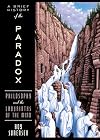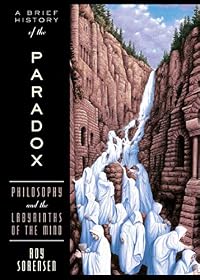
A Brief History of the Paradox: Philosophy and the Labyrinths of the Mind
by Roy Sorensen
On This Page
Description
Covers the entire history of philosophy, from the Greeks, through the Middle Ages, the Enlightenment, and the twentieth century, showing how individual philosophers have each grappled with a particular paradoxTags
Recommendations















Member Reviews
Philosophy advances, on the whole, by asking simple questions that have unexpectedly difficult answers. When it turns out that a plausible argument leads from apparently sensible premises to an absurd or contradictory result, philosophers descend on it in droves, and sometimes spend multiple millennia trying to work out what has gone wrong. This is — as Terry Pratchett liked to point out — bad news for tortoises and for the reputation of Cretans, but at least it creates work for Athenian shipwrights...
Of course, the result is that in writing a "history of the paradox" directed at general readers, Roy Sorensen has ended up simply putting a slightly new spin on the traditional Anaximander-to-Wittgenstein narrative of western show more philosophy. It's different enough in its approach that you won't be bored if you've already worked your way through one or two similar histories (I read Anthony Kenny's book a few years ago), but it doesn't cover very much really unfamiliar ground. Sorensen is quite brisk and lively, covering the ground in under 400 pages, and he sticks to the point without going off into the usual digressions into the private lives of the philosophers. (We do get the G H Hardy taxi anecdote, but there seems to be a strict rule that that has to be included in all popular philosophy and pure-maths texts...) show less
Of course, the result is that in writing a "history of the paradox" directed at general readers, Roy Sorensen has ended up simply putting a slightly new spin on the traditional Anaximander-to-Wittgenstein narrative of western show more philosophy. It's different enough in its approach that you won't be bored if you've already worked your way through one or two similar histories (I read Anthony Kenny's book a few years ago), but it doesn't cover very much really unfamiliar ground. Sorensen is quite brisk and lively, covering the ground in under 400 pages, and he sticks to the point without going off into the usual digressions into the private lives of the philosophers. (We do get the G H Hardy taxi anecdote, but there seems to be a strict rule that that has to be included in all popular philosophy and pure-maths texts...) show less
As you would expect, this book is difficult reading, especially if you really try to comprehend each side of every paradox. It is also difficult to follow thousands of years of history as the concept of paradox evolved. However, Sorensen makes the adventure more interesting and enjoyable by sprinkling in historical anecdotes such as the suspicions that Kant was suffering from a prefrontal lobe tumor because his Critique of Pure Reason was incomprehensible to some. Sorenson’s writing is clear and expressive. One passage I found humorously ironic was, “Severely retarded sufferers of “chatterbox syndrome” have normal, even overdeveloped, linguistic faculties that enable them to pass as hypersophisticated conversationalists. They show more use big words.” show less
I was disappointed in this book. I thought it would be an in depth discussion on paradoxes, but rather it was about the history of them. Paradoxically, if I had studied the title carefully, I probably would have realized what I was getting into. Ha.
Ratings
Members
- Recently Added By
Author Information
9+ Works 533 Members
Roy Sorensen is Professor of Philosophy at Dartmouth College.
Common Knowledge
- Original title
- A Brief History of the Paradox. Philosophy and the Laberynths of the Mind
- Original publication date
- 2003
- Epigraph
- There are two famous labyrinths where our reason very often goes astray: one concerns the great question of the Free and the Necessary, above all in the production and the origin of Evil; the other consists in the discussion ... (show all)of continuity and of the indivisibles which appear to be the elements thereof, and where the consideration of the infinite must enter in. The first perplexes almost all the human race, the other exercises philosophers only. -- Gottfried Liebniz, Theodicy
Here and elsewhere we shall not obtain the best insight into things until we actually see them growing from the beginning ... -- Aristotle, Politics - Dedication
- To those who never have a book dedicated to them.
- First words
- "...5, 1, 4, 1, 3—Done!" exclaims a haggard old man.
- Last words
- (Click to show. Warning: May contain spoilers.)As he reads this final sentence, I remind him that he stands at a new horizon, inaccessible to the author of this book.
Classifications
Statistics
- Members
- 325
- Popularity
- 97,176
- Reviews
- 3
- Rating
- (3.70)
- Languages
- English, Spanish
- Media
- Paper, Ebook
- ISBNs
- 6
- ASINs
- 3