On This Page
Description
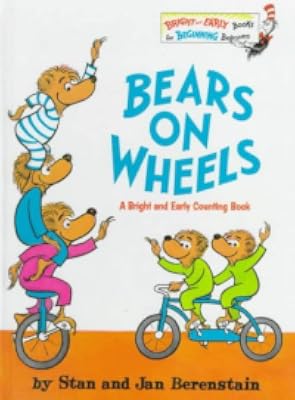
An acrobatic act begins with one bear on a unicycle and ends with twenty-one bears and sixteen wheels flying through the air.Tags
Recommendations





Member Recommendations

Member Reviews
I like this book because it is really good for helping young students get an initial understanding of numbers and conservation. Although this book is a Berenstain Bear book and the characters in the book are all bears, this book does not contain the Bear family characters that we know from the main series. This book was one of the authors’ earlier books when they published under Dr. Seuss. This book really reminded me of one of Dr. Seuss’ books “Red Fish, Blue Fish.” The style was very, as was the writing style. Even the art was similar to that of Dr. Seuss’ with the primary colors and outrageous situations. The art is pretty simple, but is effective in helping the reader visualize what is being described through the text. show more Other than the fact that this book is about bears, I would have mistaken this book as one of Dr. Seuss’s books. The book is quite easy to follow being about a bear who meets various figures on his journey on a road. I really enjoy that the story starts with “One bear on one wheel,” and ends with “One on one again.” The book does its job well with introducing math concepts through literature. Lastly, I really love how this whole book is written almost like a tongue twister. If you tried to read it really fast, it would be really hard to do so. show less
I like this book but I don't love it. The Berenstain Bears is a classic series of fun children's books. However, that is all they are - fun. As an adult reading these books, I see that they are fun but I don't think they offer any real important messages to adults or children. This particular book was about counting which is good but it was not very educational. I do like that these stories are written about bears and not people. The personification of animals is always appealing to a young soul. I do not think there are real "big messages" in this book. The only one I would really observe is counting - adding/subtraction. Other than that, I can't see any important messages.
This is one of the earlier Berenstain Bear books, and it shows. As you can see by the cover, the bears on the *inside* of this book are less stylized and cutesy than the bears in the newer books, and the story is an early reader instead of a longer read-aloud.
It's a cute little story about a cub and his misadventures with his bike. The illustrations make it perfect, as he's constantly getting jumped on, or falling off, or colliding with other bears.
There are only a few words per page, with a basic vocabulary, so this one is perfect both for early readers and for little-little ones learning to talk. However, don't expect it to help your child learn to count, it's not really a good book for that. It mentions numbers, but it doesn't really show more mention counting, or go through the numbers consecutively. show less
It's a cute little story about a cub and his misadventures with his bike. The illustrations make it perfect, as he's constantly getting jumped on, or falling off, or colliding with other bears.
There are only a few words per page, with a basic vocabulary, so this one is perfect both for early readers and for little-little ones learning to talk. However, don't expect it to help your child learn to count, it's not really a good book for that. It mentions numbers, but it doesn't really show more mention counting, or go through the numbers consecutively. show less
Genre: Informational
Summary: These bears are riding bikes. Some bikes have a lot of wheels. A lot of bears could be on a small bike. There could be a many wheeled bike filled with many bycicling bears. The illustrations convey the unrealistic numbers as well. Such as "Five on One" shows the tower of bears starting to tip over, and the pedaling bear looking frantic.
Personal Reaction: Using bears and wheels Stan and Jan Berenstain help the reader count. Simple and colorful illustrations show the bears on their bikes. I find it clever to use an acrobatic type visual to entice young children to count while they read. This helps with cognative skills and young childhood development. It also shows numbers in groups.
Classroom Lesson: I would show more give each student five numbers. They would then have to write it in word form and draw a group of objects that conveys the amount of that number. Then create a scentence summarizing the illuistration. show less
Summary: These bears are riding bikes. Some bikes have a lot of wheels. A lot of bears could be on a small bike. There could be a many wheeled bike filled with many bycicling bears. The illustrations convey the unrealistic numbers as well. Such as "Five on One" shows the tower of bears starting to tip over, and the pedaling bear looking frantic.
Personal Reaction: Using bears and wheels Stan and Jan Berenstain help the reader count. Simple and colorful illustrations show the bears on their bikes. I find it clever to use an acrobatic type visual to entice young children to count while they read. This helps with cognative skills and young childhood development. It also shows numbers in groups.
Classroom Lesson: I would show more give each student five numbers. They would then have to write it in word form and draw a group of objects that conveys the amount of that number. Then create a scentence summarizing the illuistration. show less
It seems as if the Berensteins can do no wrong, that is if their goal is to write a bunch of books with no plot whatsoever, yet are still entertaining, and in some ways amusing. Yes, I know, this is a kid's book, but shouldn't kid's books actually have a plot. Well, I guess it depends on the purpose of the kid's book. I guess the genius of these books is that they have no plot, but they teach children to read and they do it in a most entertaining way. I know that it is entertaining because I can remember as a kid I was really entertained by the books. In fact I loved the Dr Suess books (and really did not think all that much of the Little Golden books).
This story is about a bear on a monocycle and as he travels on his monocycle other show more bears jump onto him and then off of him, and as such it is simply a process of counting all the way through the book. By reading this books we are able to identify the words and the numbers that these words represent. I guess that is the essence of language, being able to understand the meaning of the words in a way that other people also understand them. I am sure we can easily make up our own languages (as Amy Ferra Fowler does in the Big Bang Theory – and I believe Sheldon Cooper has done it as well) but what is the point of constructing a language that nobody knows (unless that language is a computer language, and as long as a computer understands the language it is pointless whether anybody else understands it because that language is simply a way for you to communicate with a computer).
Some dude named Wittgenstein wrote a lot about language and sees it in a most unusual light. As far as Wittgenstein is concerned language is actually meaningless and the only reason language has meaning is because we attach meaning to it. Language developed as a means for us to communicate with each other, and as we seek to distinguish more things from other things, our languages grow ever more complex, but also as complexity develops, people are also lazy and end up simplifying it. As such we have new forms of language, such as the language used when sending text messages (though that has changed with smartphones where the phone can predict the word you want to use).
It was funny how many people got really upset at the use of text symbols replacing the English Language, but we must remember that this symbolic language is an organic development that allowed quick and easy communication with other people in a way that they can understand. With the awkwardness of writing a message on a mobile phone, a means of being able to do it quicker and simpler had to develop, and this, as I suggested, developed organically.
Gee, it looks like I have spiral off from a commentary on a children's book into a post-modernist view of language. show less
This story is about a bear on a monocycle and as he travels on his monocycle other show more bears jump onto him and then off of him, and as such it is simply a process of counting all the way through the book. By reading this books we are able to identify the words and the numbers that these words represent. I guess that is the essence of language, being able to understand the meaning of the words in a way that other people also understand them. I am sure we can easily make up our own languages (as Amy Ferra Fowler does in the Big Bang Theory – and I believe Sheldon Cooper has done it as well) but what is the point of constructing a language that nobody knows (unless that language is a computer language, and as long as a computer understands the language it is pointless whether anybody else understands it because that language is simply a way for you to communicate with a computer).
Some dude named Wittgenstein wrote a lot about language and sees it in a most unusual light. As far as Wittgenstein is concerned language is actually meaningless and the only reason language has meaning is because we attach meaning to it. Language developed as a means for us to communicate with each other, and as we seek to distinguish more things from other things, our languages grow ever more complex, but also as complexity develops, people are also lazy and end up simplifying it. As such we have new forms of language, such as the language used when sending text messages (though that has changed with smartphones where the phone can predict the word you want to use).
It was funny how many people got really upset at the use of text symbols replacing the English Language, but we must remember that this symbolic language is an organic development that allowed quick and easy communication with other people in a way that they can understand. With the awkwardness of writing a message on a mobile phone, a means of being able to do it quicker and simpler had to develop, and this, as I suggested, developed organically.
Gee, it looks like I have spiral off from a commentary on a children's book into a post-modernist view of language. show less
This is a great book for begging readers. It's very simple, but there is a lot of action packed into the story. It's funny too and adults will think it's funny.
21 months - not one of my favorites but for $1 I'm not going to complain. For a simple beginning reading counting book I think Ten Apples Up On Top is more successful but it's always nice to have a bit of variety.
Members
- Recently Added By
Lists

Favorite Childhood Books
1,651 works; 519 members

Bicycles on cover -- children's/young adult fiction
110 works; 4 members
Author Information

547+ Works 176,834 Members
Stan Berenstain was born in 1923 in Philadelphia, the same year and place as his future wife, Jan. They met as students at the Philadelphia College of Art. World War II delayed their career plans: Stan joined the army as a medical assistant while Jan supported the war effort by working in an airplane factory. They married in 1946 and together show more began drawing cartoons for the McCall's/Good Housekeeping It's All in the Family series. They worked on this feature from 1956 through 1990. The Big Honey Hunt, published in 1962, was their first book for children. This book about a family of bears, written for Dr. Seuss's Beginner Books series, was so popular that Dr. Seuss himself, Theodore Geisel, encouraged them to write more stories. Geisel's advice launched the Berenstains on life-career writing and illustrating the very successful Berenstain Bears books. The Berenstain Bears' New Baby, published in 1974, was the beginning of the First Time Books series. The Children's Choice Award was given to The Berenstain Bears' New Neighbors in 1995. The Berenstains were also honored for their work in children's literature when they received the Ludington Award in 1989. There have been television shows based on the Berenstain Bears books, as well as CD-ROMs and videos. Stan Berenstain passed away on November 26th, 2005, after a lengthy battle with lymphoma. He was 82. (Bowker Author Biography) show less

566+ Works 194,953 Members
Jan Berenstain was born Jan Grant on July 26, 1923 in Philadelphia, Pennsylvania. She met Stan Berenstain on their first day of classes in 1941 at the Philadelphia Museum School of Industrial Art. During World War II, Stan served as a medical illustrator in an Army hospital and Jan worked as a draftswoman in the Army Corps of Engineers and as an show more aircraft riveter. They married in 1946 and together began drawing cartoons for the McCall's/Good Housekeeping All in the Family series. They worked on this feature from 1956 through 1990. They also published artwork in magazines like Colliers and the Saturday Evening Post. The Big Honey Hunt, published in 1962, was their first book for children. This book, which was written for Dr. Seuss's Beginner Books series, was so popular that Dr. Seuss himself, Theodore Geisel, encouraged them to write more stories. His advice launched them on a life-career writing and illustrating the Berenstain Bears books. The Berenstain Bears' New Baby, published in 1974, was the beginning of the First Time Books series. She wrote more than 300 books during her lifetime. The couple received numerous awards including the Children's Choice Award for The Berenstain Bears' New Neighbors in 1995 and the Ludington Award in 1989 for their work in children's literature. There have been television shows based on the Berenstain Bears books, as well as CD-ROMs and videos. She died after a stroke on February 24, 2012 at the age of 88. (Bowker Author Biography) show less
Series

Belongs to Publisher Series
Bright and Early Books (BE-6)
Step Into Reading (Step 1)
Work Relationships
Is contained in
Common Knowledge
- Canonical title
- Bears on Wheels
- Original publication date
- 1969
- People/Characters
- One bear on one wheel; Three bears in blue; One bear on two wheels; Three bears on three wheels; Four bears in ranger hats; Five bears in red jumpsuits (show all 8); One bear on five wheels; Ten bears on ten wheels
- Important places
- Bear Country
- First words
- One bear. One wheel.
- Last words
- (Click to show. Warning: May contain spoilers.)One on one again.
Classifications
Statistics
- Members
- 4,147
- Popularity
- 3,727
- Reviews
- 28
- Rating
- (3.99)
- Languages
- English
- Media
- Paper, Audiobook, Ebook
- ISBNs
- 18
- UPCs
- 1
- ASINs
- 16