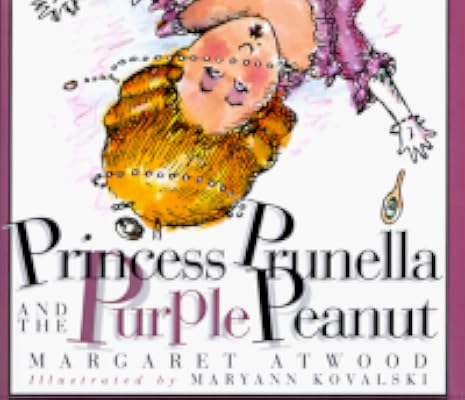
Princess Prunella and the Purple Peanut
by Margaret Atwood
On This Page
Description
Prunella, a proud, prissy, princess, plans to marry a pinheaded prince who will pamper her--until a wise old woman's spell puts a purple peanut on the princess's pretty nose.Tags
Recommendations












Member Reviews
Prunella is a vain and self-centered young princess who has no concern for other people's problems. One day a wise woman puts a magic spell on her, causing a purple peanut to continually grow on Prunella's nose until she performs three good deeds. Over time, Prunella begins looking out for other people instead of worrying about her appearance and lo and behold, the purple peanut disappears without her even noticing.
In the past, I've read and really enjoyed some of Atwood's adult novels so when I saw she had written some children's books also, I knew I had to check them out. Perhaps my expectations were just to high, but I found this book a bit odd. Atwood was clearly experimenting with writing an highly alliterative story, as the book show more relies a great deal on the use of words that begin with "p." Sometimes this is more effective than others. (The purple peanut is in fact not a peanut, so that's an example of a less effective use of the repetitive "p.") The repeated use of words starting with "p" makes this a bit of a tongue-twister to read aloud, but it also seems to pull children in a little bit more. (My kindergarteners said they liked the story, so that's something.) If they stop to ask questions or use a dictionary, children will undoubtedly walk away with some new vocabulary words learned as a result of all the "p" words Atwood had to use.
The story itself is pretty typical of fairy tales, with the conceited princess being taken down a notch or two and realizing that she needs to be concerned with people beyond herself. However, the good deeds that she performs are not necessarily the most earth-shattering. In a way, that can be a good lesson though, showing kids that being kind doesn't always mean having to go through a great sacrifice. The magic spell that can only be broken by performing good deeds is a bit of an overhanded moralistic device, but Atwood's clever use of language here with the constant alliteration saves the book from being overly didactic.
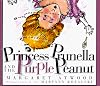
The illustrations are fun, mainly drawing from the French court of Versailles in the look of the characters (i.e., high pompadours, large-hipped ball gowns, etc.). There are some random details that I guess were meant to be funny but succeed more at just being odd. For instance, in one illustration of the wise woman, she is pictured on her bottom surrounded by newspapers and books with unusual headlines/titles like "98 yr old woman weds 22 yr old man" and Chairman Mao's The Amazing Rice Diet despite there being absolutely no mention of any of this in the text. show less
In the past, I've read and really enjoyed some of Atwood's adult novels so when I saw she had written some children's books also, I knew I had to check them out. Perhaps my expectations were just to high, but I found this book a bit odd. Atwood was clearly experimenting with writing an highly alliterative story, as the book show more relies a great deal on the use of words that begin with "p." Sometimes this is more effective than others. (The purple peanut is in fact not a peanut, so that's an example of a less effective use of the repetitive "p.") The repeated use of words starting with "p" makes this a bit of a tongue-twister to read aloud, but it also seems to pull children in a little bit more. (My kindergarteners said they liked the story, so that's something.) If they stop to ask questions or use a dictionary, children will undoubtedly walk away with some new vocabulary words learned as a result of all the "p" words Atwood had to use.
The story itself is pretty typical of fairy tales, with the conceited princess being taken down a notch or two and realizing that she needs to be concerned with people beyond herself. However, the good deeds that she performs are not necessarily the most earth-shattering. In a way, that can be a good lesson though, showing kids that being kind doesn't always mean having to go through a great sacrifice. The magic spell that can only be broken by performing good deeds is a bit of an overhanded moralistic device, but Atwood's clever use of language here with the constant alliteration saves the book from being overly didactic.
The illustrations are fun, mainly drawing from the French court of Versailles in the look of the characters (i.e., high pompadours, large-hipped ball gowns, etc.). There are some random details that I guess were meant to be funny but succeed more at just being odd. For instance, in one illustration of the wise woman, she is pictured on her bottom surrounded by newspapers and books with unusual headlines/titles like "98 yr old woman weds 22 yr old man" and Chairman Mao's The Amazing Rice Diet despite there being absolutely no mention of any of this in the text. show less
This children's picture book is about a spoiled, vain princess named Prunella. To teach her a lesson, an old lady casts a spell on her that can only be undone if she does three good deeds for others. At first she doesn't think much of it but soon her nose sprouts a purple peanut that keeps growing and growing until she is miserable and over time she starts to notice those around her and begins helping them. After a few good deeds the peanut starts to shrink but she is not concerned with their own self anymore and doesn't take notice when it finally is gone because she now thinks of others first and not herself. The main themes in this book are selfishness and helping others. It can be interpreted that doing good deeds makes us better show more people and that being selfish doesn't make us look very nice. It's almost reminiscent of the story of Pinocchio, where his nose grows longer when he lies, but in this story it is reversed and her nose shrinks when she does good. The illustrations are done with pen and watercolor and use mainly soft pastel colors and cross hatching for shading. The story is set in Victorian times so there are many small details that give a reader a lot to look at. The author uses alliteration that gives the book a fun whimsical feel to it and can be good for young readers learning the "p" sound. Teachers can use this book to teach students about helping one another and what selfishness looks like. They can have their students set a goal to do one good deed a day for a week and then write a reflective journal on the experience. MENTOR TEXT show less
This book was quite possibly my absolute favorite as a child. The entire story is one giant alliteration using the letter P, and therefore turned a story that I may or may not have read into a pleasure to read. Using that alliteration as a gimmick, Atwood tuned me in to a beautiful and very simple story about a very vain princess who learns to care about others via a purple peanut that grows larger on the tip of her nose every time she is vain or self-absorbed, and only recedes as she learns to do good for others. By letting me giggle through the whole book, Atwood taught a lesson that many childrens' authors try to tell, but with varying amounts of success. Princess Prunella has stuck with me, and really taught me alot.
It is about a young princess who is silly and loves her pussycats and pug dog. It is a good book to teach children all the various things that can start with the letter P and how there are animals, people and various things that all start with P. The illustrations are vivid and exciting visuals to represent this silly princess's character.
Prunella is a spoiled brat who learns a lesson about the importance of being kind and generous. She learns to treat the people in her life better, and to enjoy life.
Ratings
Members
- Recently Added By
Author Information

291+ Works 199,871 Members
Margaret Atwood was born on November 18, 1939 in Ottawa, Canada. She received a B.A. from Victoria College, University of Toronto in 1961 and an M.A. from Radcliff College in 1962. Her first book of verse, Double Persephone, was published in 1961 and was awarded the E. J. Pratt Medal. She has published numerous books of poetry, novels, story show more collections, critical work, juvenile work, and radio and teleplays. Her works include The Journals of Susanna Moodie, Power Politics, Cat's Eye, The Robber Bride, Morning in the Buried House, the MaddAdam trilogy, and The Heart Goes Last. She has won numerous awards including the Prince of Asturias Award for Literature, the Booker Prize in 2000 for The Blind Assassin, the Giller Prize and the Premio Mondello for Alias Grace, and the Governor General's Award in 1966 for The Circle Game and in 1986 for The Handmaid's Tale, which also won the very first Arthur C. Clarke Award in 1987. She won the PEN Pinter prize in 2016 for her political activism. She was awarded the 2016 PEN Pinter Prize for the outstanding literary merit of her body of work. (Bowker Author Biography) show less
All Editions
Common Knowledge
- Canonical title*
- La principessa Prunella
- Original title
- Princess Prunella and the Purple Peanut
- People/Characters
- Princess Prunella
*Some information comes from Common Knowledge in other languages. Click "Edit" for more information.
Classifications
Statistics
- Members
- 275
- Popularity
- 117,881
- Reviews
- 5
- Rating
- (3.58)
- Languages
- English, French, German, Italian
- Media
- Paper
- ISBNs
- 7
- UPCs
- 2
- ASINs
- 4